The Blackcraig

9.8 miles  5h 44m   900m ascent

Blackcraig-Blacklorg-Meikledodd-Alwhat-Cannock Hill-Craigbraneoch

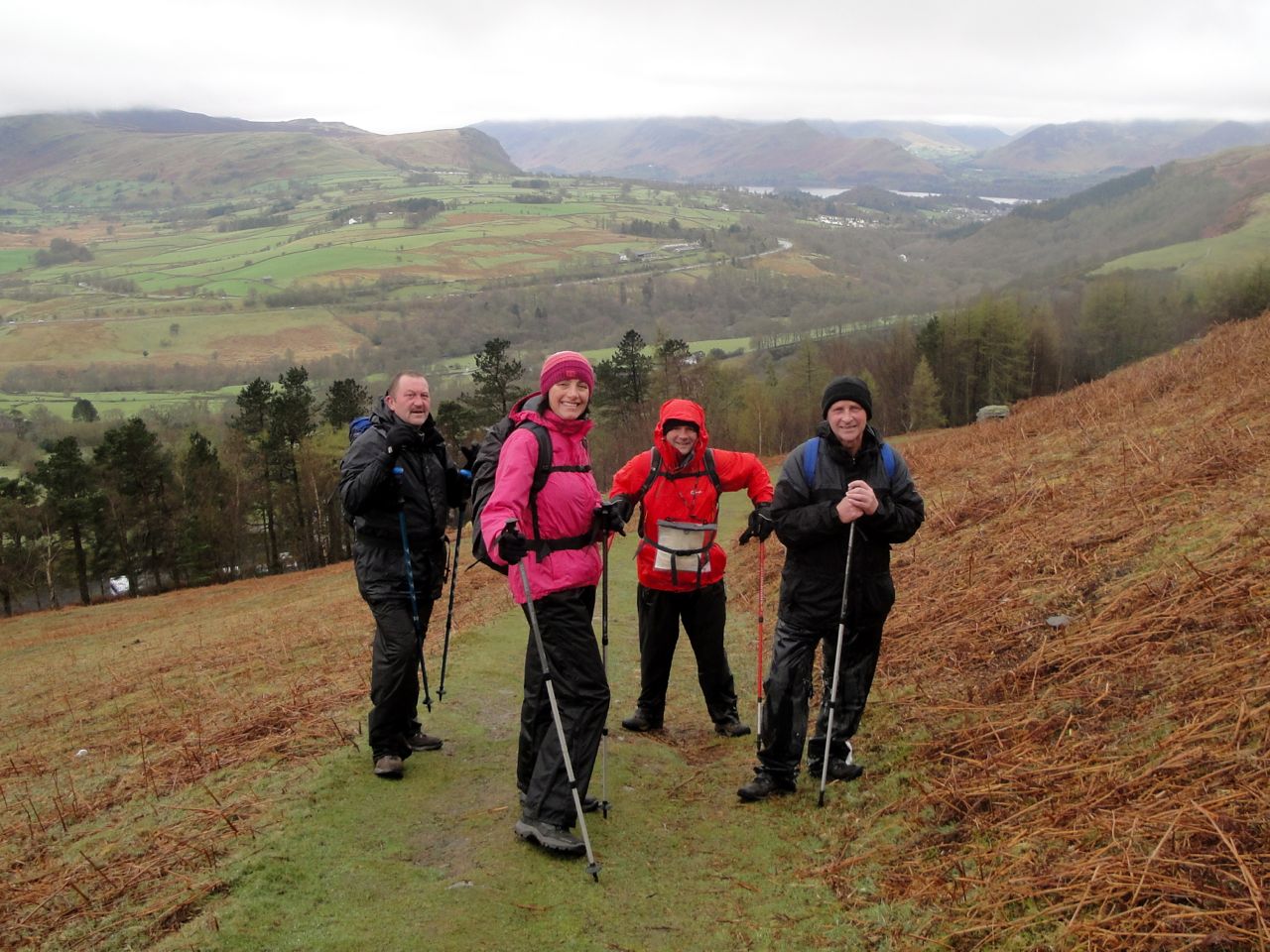
A beautiful day so I set off for the Afton hills. I parked the car on the Afton road before Craigdarroch Farm and got kitted out under the watchful eyes of some rather shaggy looking calves.

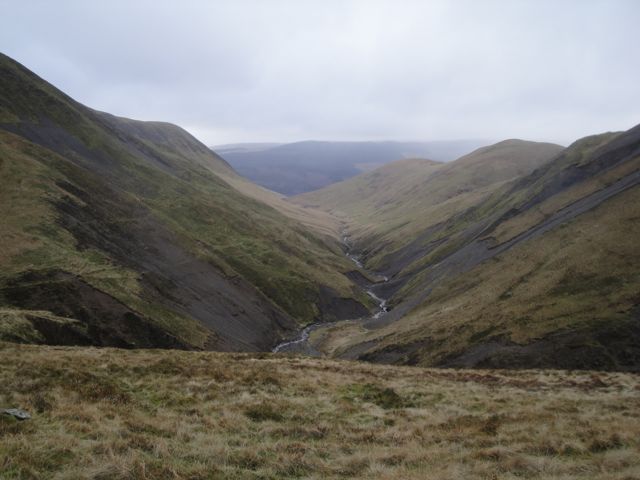
Blackcraig was to be my first port of call and I had pondered whether to head up via Quintin Knowe (more track, gentler gradient, longer) or along Craig Glen and up by the Pollachie Burn on to the col (less track, steeper, shorter, possibly wetter). As it turned out I ascended, unplanned by the Black Craigs (no track, too steep, impossible).
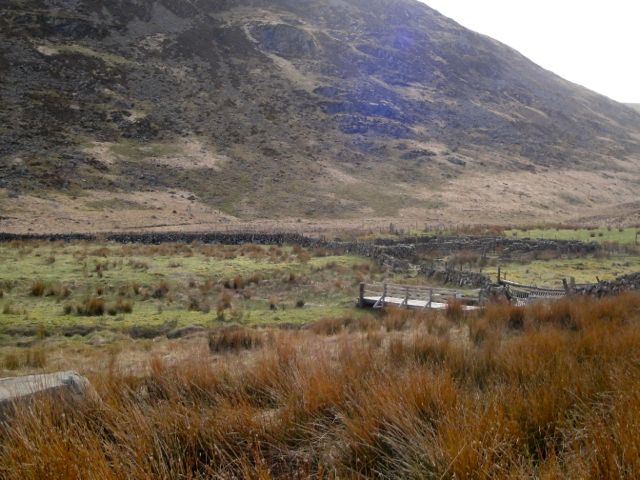
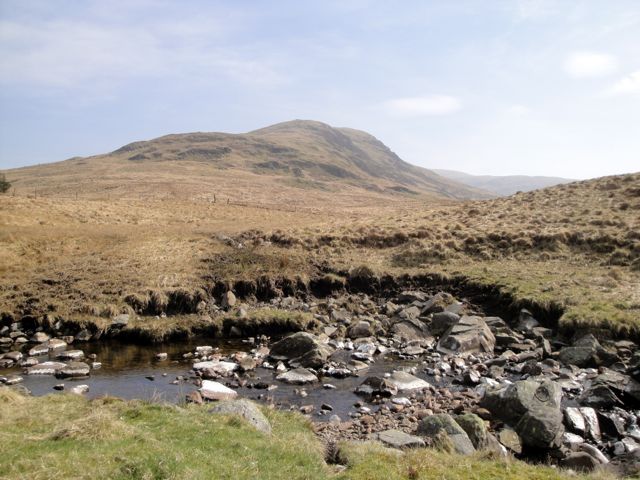
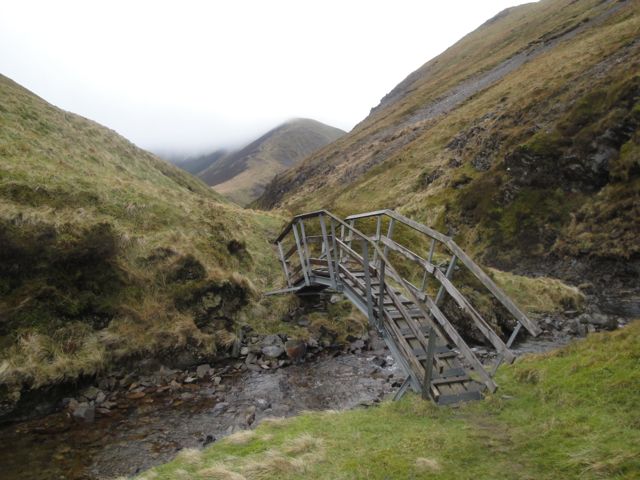
Footbridge below Blackcraig

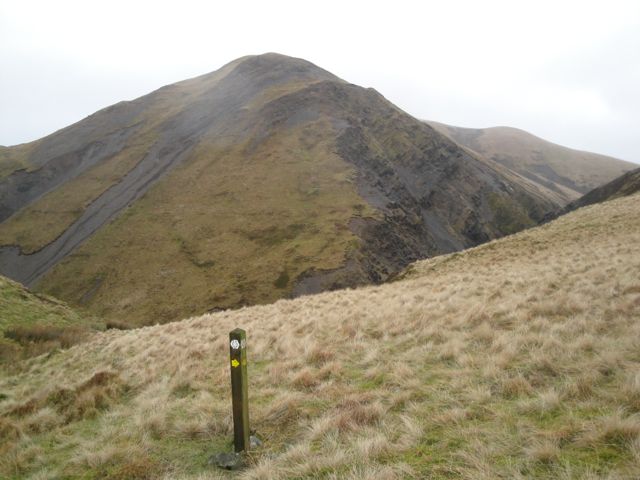
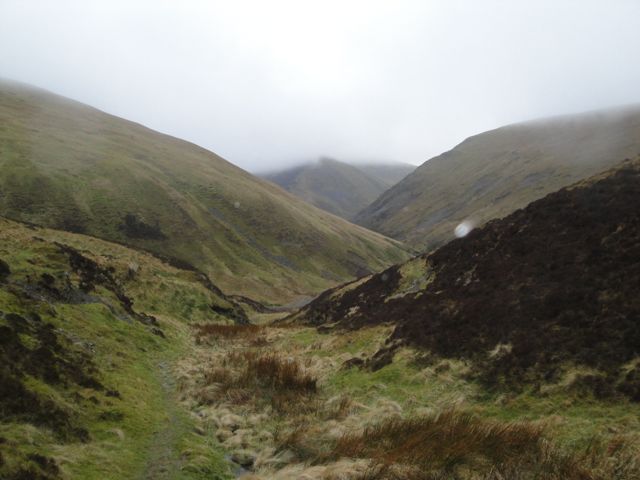
The original plan was to follow the farm track up the valley then head up on to the col. The first problem was that the track was not on the valley floor. It gradually climbed up the Craigbraneoch side of the glen and I didn’t fancy unnecessary ascent and descent (I am  homozygous for the laziness gene). Better to cross Craig burn and walk along its eastern side heading for the col. And there before me was a footbridge. What’s more a little way past the bridge was a sign with a walker and an arrow pointing the way I was going.
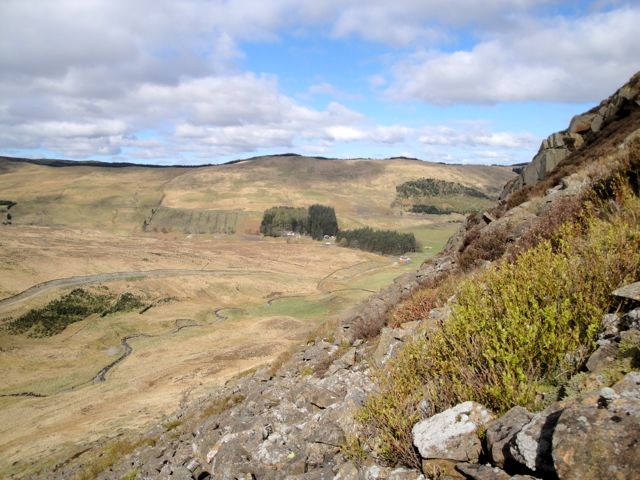
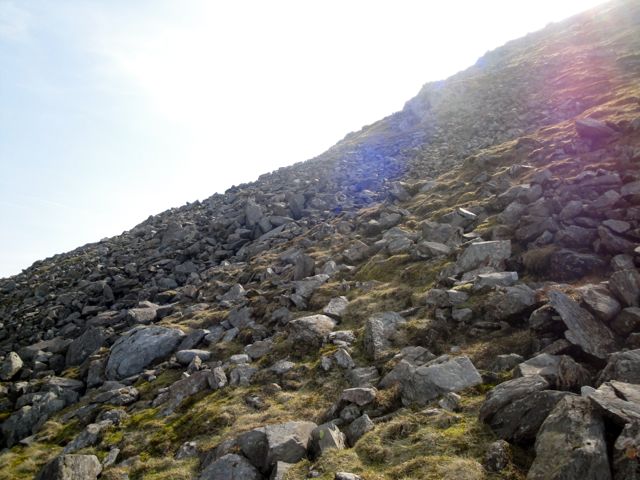
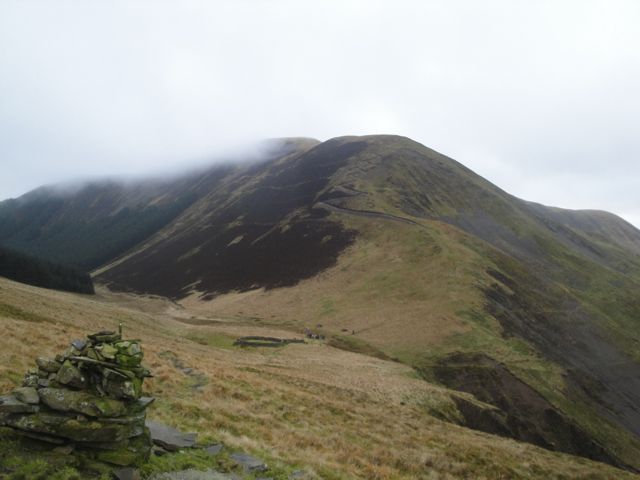
Ascending Blackcraig

Here I committed an error of judgement, but with the best intentions. Why walk along the burn then start climbing after half a mile? I decided to begin a slow gentle climb as I went. Whenever my path was obstructed, by a rock for example, I would climb rather than descend. This had me gaining height more quickly than I had intended. A jutting outcrop had me climb even further, rather than drop below it. Before I knew it I was up amongst rocks and the best routes were up rather than across. So I climbed a good 500m short of the Pollachie Burn.

As the gradient eased, a chubby fox ran away from me but too quickly for the camera. I’ve never seen a chubby fox before. Those more rural than I have been pointed out that it was probably pregnant rather than fat.
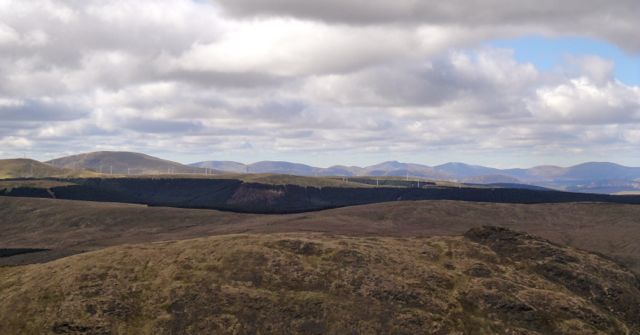
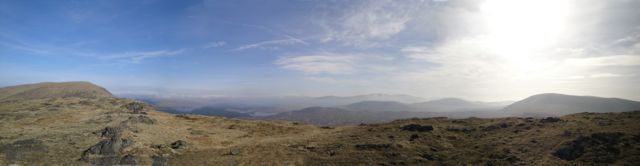
Galloway Hills from Blackcraig

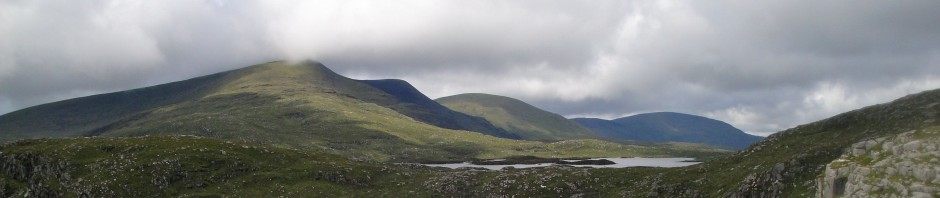
The summit of Blackcraigs has several substantial cairns and a small shelter to rest from the wind. The visibility and views were great. I could see the Galloway Hills, Arran, Kintyre (I think), Ailsa Craig, Screel, Criffel, the Lowthers, Tinto, Skiddaw, and distant snow covered peaks to the north. Closer were the craggy slopes of Craigbraneoch and the Carsphairn hills.

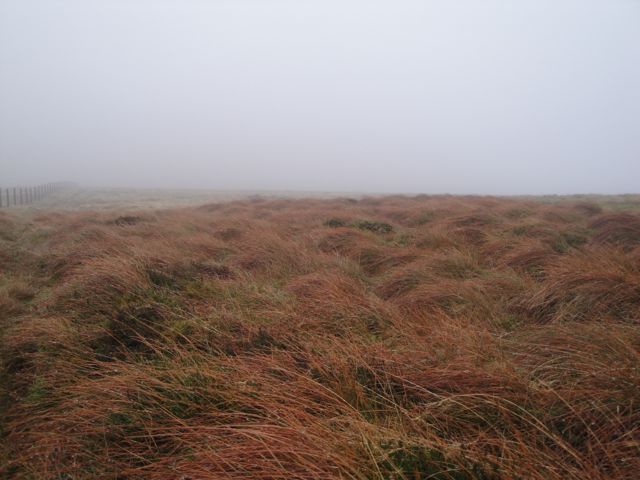
There is a faint track heading off along the fence towards Blacklorg, and another sign with a walker and arrow. It’s a straightforward walk, by the fence, across to Blacklorg. The terrain was easy going except in the col, where there was an expanse of waterlogged sphagnum moss, which tested the waterproofing of my boots. The right boot failed the test despite recent re-proofing.
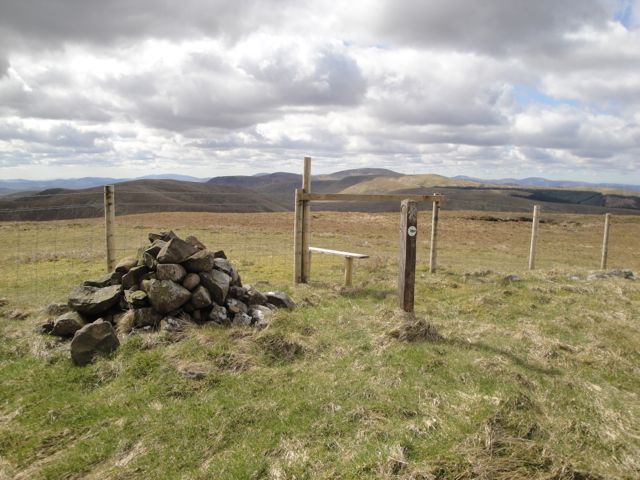
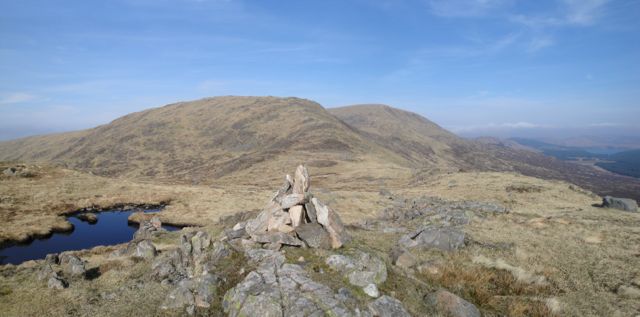
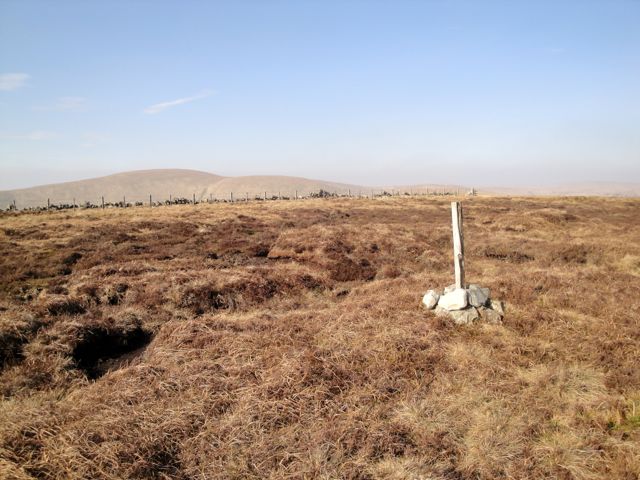
“Pile of stones” Blacklorg summit

At Blacklorg another sign points across to Cannock Hill. Here I stopped for refuelling and considered my options. Follow the arrows over to Cannock? Continue on to Meikledodd and Alwhat? Both? Since the weather was so good I headed on towards Meikledodd, following the fence. The col here also had some watery moss. This section took me over Littledodd Hill which is really just a false summit of Meikledodd. Once at the unmarked summit, the Water of Ken could just be seen to the south.
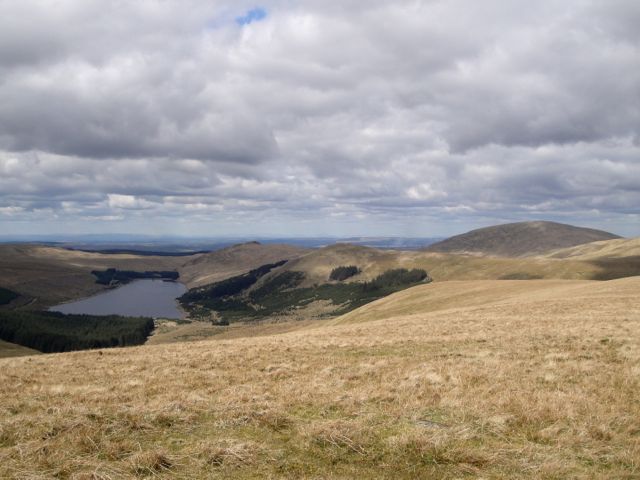
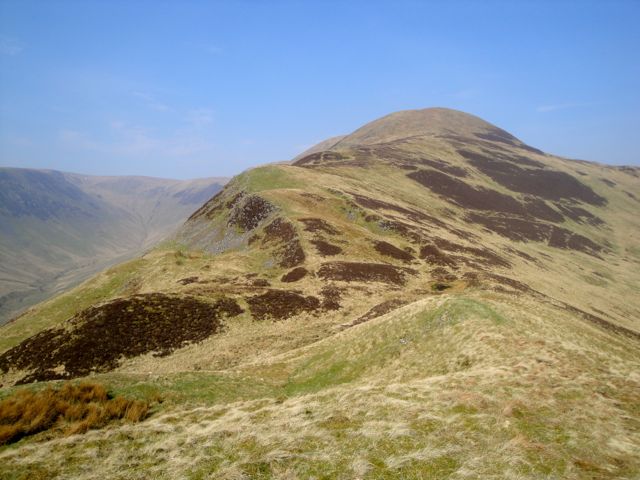
Afton Hills from Alwhat

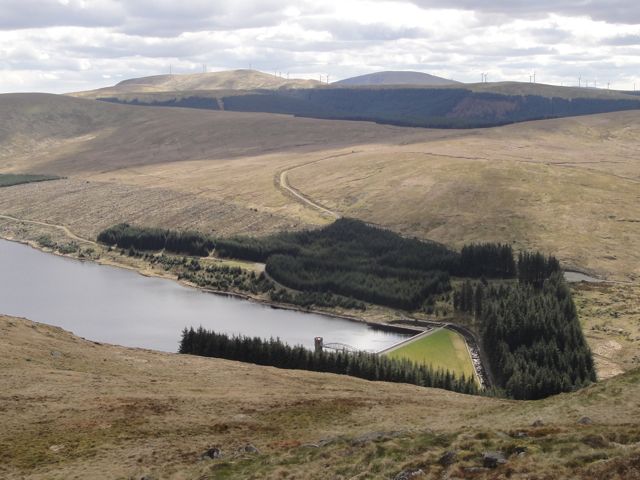
Next was Alwhat, again following the fence over the col. As I walked towards the summit, the Afton reservoir at last could be seen in its entirety and  I was beginning to flag. I decided that I had used up all my metres of ascent, and from there it would have to be downhill.

Alwhat’s summit is of the minimalist type. No trig, no cairn, but some fence posts to lean on. While leaning, rehydrating, musing, and gazing at the views, I found my inner strength gradually returning. The options at this point were to head down to the reservoir (no more ascent) and back on the road, or over to Cannock Hill and Craigbraneoch.

I had decided earlier that if I arrived at Alwhat within four hours I would go for the extra hills. It was 3h 36m. My dislike of descent-reascent had led me to to consider contouring back round by Meikledodd. This now looked quite a long way and I suspected the terrain would be less easy on the lower slopes. The slopes up to the col between Blacklorg and Cannock hill didn’t look especially steep so I decided to take a direct approach.
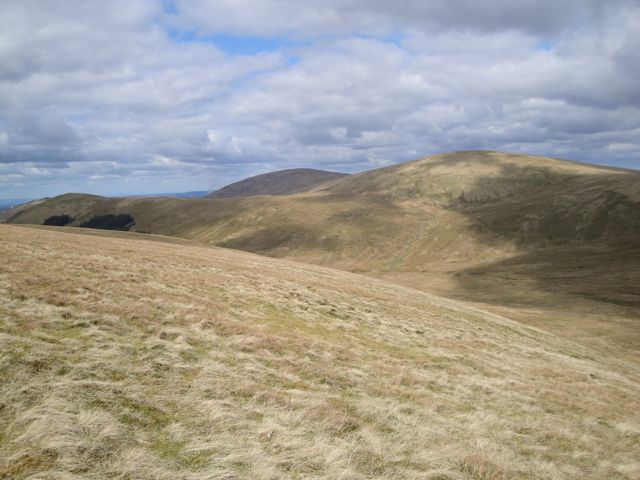
The way from Alwhat to Cannock

I headed down into the Montraw glen heading for the end of the Blacklorg burn, and from there climbed just a little west of north to rejoin the fence on the col. The valley actually has a number of drainage ditches, so the ground wasn’t as wet as I had expected and the climb was easy going. Here I met another post indicating the way.

Cannock Hill is the first and largest of three prominences on a spur arising from Blacklorg, the other two making up Craigbraneoch. Cannock has a small cairn and great views. Another post nestles in the col between Cannock and Craigbraneoch and points towards the dam. Presumably there is a way down that way.

I continued on to the rocky summit of Craigbraneoch for a final sit down and to finish my coffee while enjoying the views.
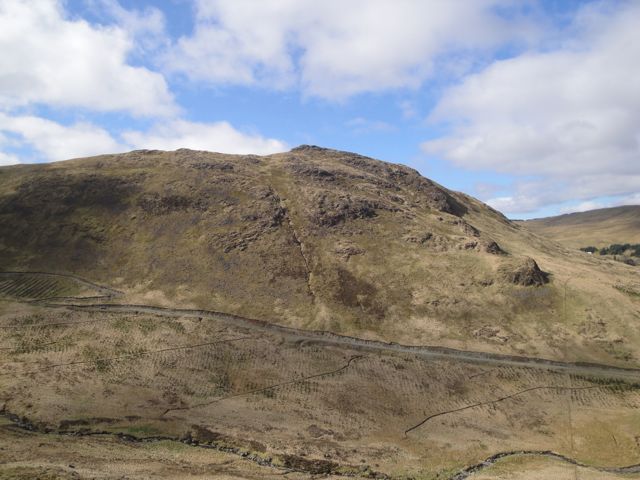
Craigbraneoch and the path below it

Rather than head directly off the rocky north face of Craigbraneoch I decided to head back to the col and down from there. I had been able to see from Blackcraig that the path up the valley has been extended much further than that shown on google earth and I intended to get on to that.

I began heading down a little short of the col, certainly to the north of Horse Craig, which had me negotiating some stony sections but soon got me to the path. Unfortunately there was a deer fence to climb to get to it. From there it was as easy as following the path, then track,  back to the farm.

I felt obliged to pause briefly at Afton Water which was indeed flowing gently. My final decision was how to cross it. There is a ford, a vehicle bridge and a footbridge. I chose the latter.

This was a pleasant walk, in beautiful weather, with excellent views. The hills themselves are a little monotonous, though the walk can be spiced up by using some of the rocky sections as I had done. If a shorter walk is needed it looks as though there is a way marked route taking in Blackcraig, Blacklorg, Cannock Hill, and Craigbraneoch.

.
Posted in Ayrshire, Dumfries & Galloway | Tagged , , | Comments Off on The Blackcraig

Cailleach’s Wrath

7.5 miles  3h 52min  835m ascent

Blencathra via Blease Fell

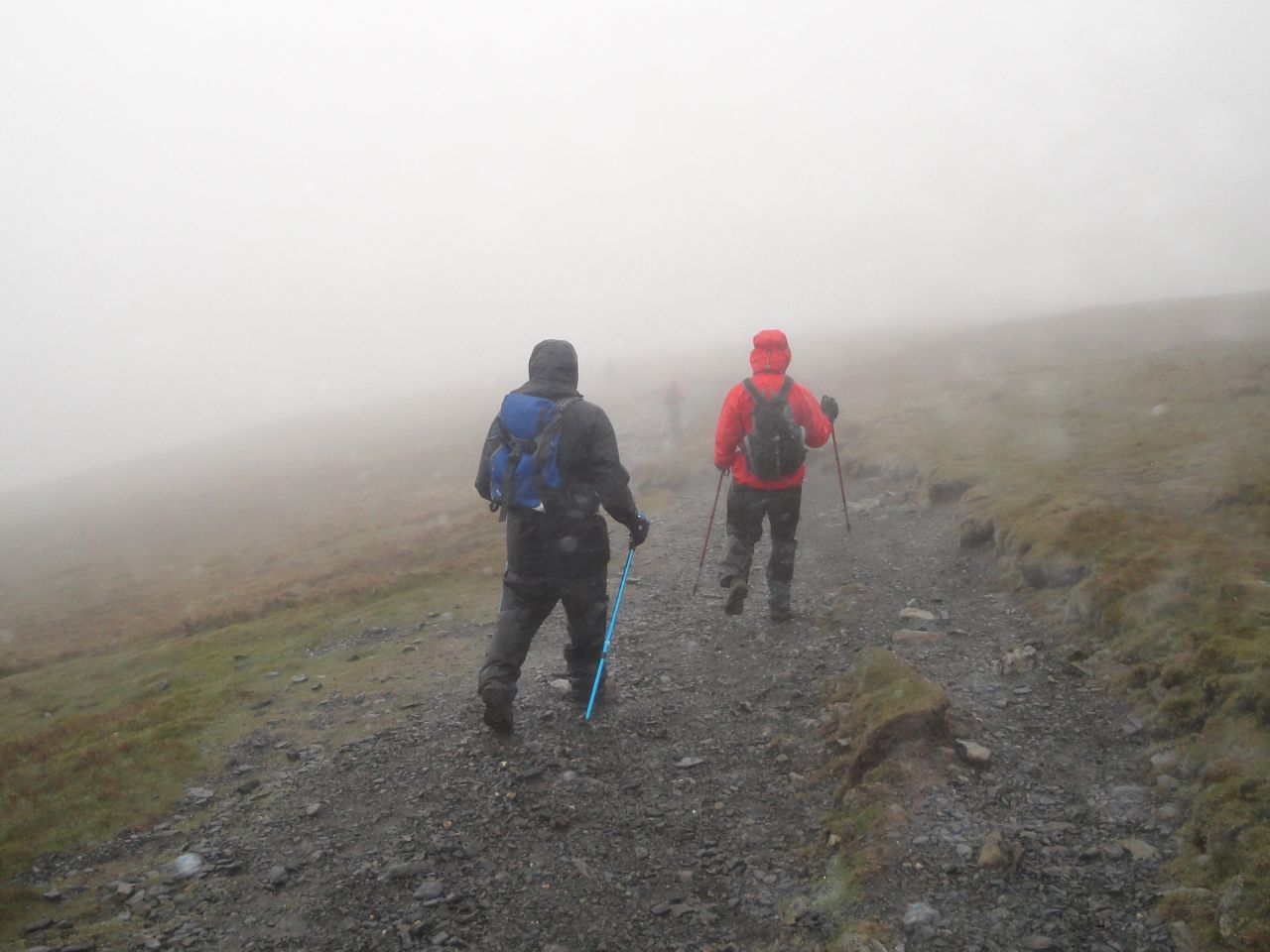
Warm, negligible wind and scattered showers was somewhat off the mark. The weather man had badly misread the Veiled One’s mood. So our ambitious plan, hatched in the belief that the goddess of winter was slumbering, a linear walk from Mungrisdale to Blease Fell via Sharp Edge, had to be adjusted.

The new plan was to climb Blease Fell, walk the ridge and assess the feasibility of Sharp Edge, with Scales Fell as an alternative descent. I regarded the downgrading of the Sharp Edge route from “planned” to “possible” as a move in the right direction. We still hoped that the weather, especially the mist, might yet clear.

The road from Threlkeld to the Blencathra centre allowed us to warm up and shed a layer of insulation before the steeper climb over Blease Fell. The path has three sections. The first 200m is a wide grassy easily recognised path which gently crosses the close contours. Several other paths cross this. The next section crosses an area Wainwright calls a grassy plateau but has 150m of climb. The path here is narrower, less obvious at times but still easy to follow. The final section, the steepest, has a wide stony zig-zag path that cannot be missed. Unfortunately the hill remained clothed in mist so our only views were of grass, stones and occasional cairns.

Our vanguard, the brothers Wylie, having forged ahead, paused for the plodders to catch up and doled out morale boosters, both physical (sweets) and psychological (we were at about 760m).  We expected to reach the ridge in another 50m or so but it seemed a lot further. The mist made assessing our position and distance difficult, but looking at the GPS track, quietly recording deep in my bag, the assessment was only 30m or so out.

View from Blencathra

Sadly the visibility on top was even worse, and the wind stronger. We were able to see the first few metres of the south facing cliffs, but nothing could be seen of the southern ridges. We made our way along Blencathra’s ridge over Gategill to the summit at Hallsfell, heads down, clothes rippling in the wind.

Lathered up

Brian by this time had begun to foam. He apparently had a bottle of shower gel in his rucksack and the top had come off allowing it to leak out down his back and legs. Elaine thought it was Lynx but I don’t think it could have been because we walked past a few female walkers and none of them ripped off their clothes or threw themselves at Brian. Perhaps the Lynx effect is reduced in cold rain.

At the summit we decided the weather ruled out the Sharp Edge route so we would head down the path over Scales Fell. I was keen to walk along to Sharp Edge to have a look at it before heading down. We followed the path but eventually came to a dead end. It seemed strange that such a well worn path would just end at a steep drop but end it did. I did wonder if there was a faint path lower down but with the mist it was difficult to see. We were in fact at the top of Sharp Edge.

almost down

The weather if anything was worsening and since we could not be certain where the various paths heading down would lead, we decided to apply David’s wisdom that the best route is the one you know and go back the way we came. So we headed down Blease Fell, the best descent of Blencathra according to Wainwright. The cloud base had risen a little to 500m or so, so on the way down we could see Derwent Water and Cat Bells.

.
Posted in Far away, Wainwrights | Tagged | Comments Off on Cailleach’s Wrath

Kirriereoch

6.8 miles    3h 40m     ascent 605m

Tarfessock-Kirriereoch

Kirriereoch and Tarfessock had been on my to-do list for a while. Unfortunately my research suggested there was no easy way up these two hills. The walk from Slaethornrig looked to be the shorter option but would include some unpleasant tussocky terrain. I had experience of this from my Shalloch walk and didn’t fancy it unless I toughened up a bit or needed some penance. The alternative was to climb from the west, but I had read that the approaches were tough, crossing areas of felled forest and required a burn crossing that seemed quite wide on the OS map.

Since the weather was good, both sunny and dry, I thought the time had come to grasp the nettle and climb these hills.

Track to Tarfessock

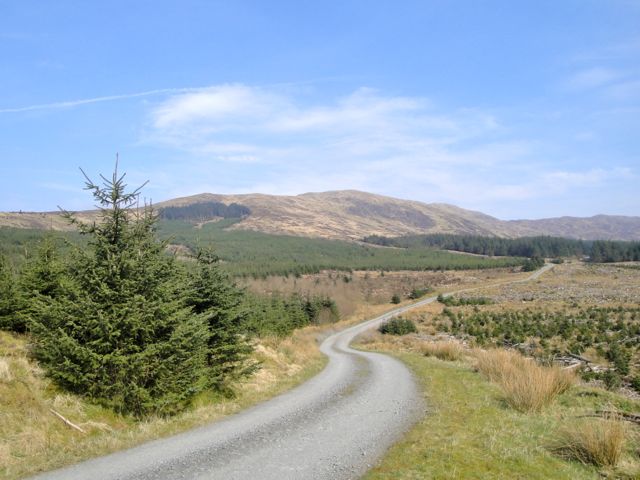
I headed for Kirriereoch Farm off the Straiton Road. My plan was to park by the picnic area or Kirriereoch Loch and walk from there. But the forestry track looked in good nick so I drove on. And on. And on. Over the Pillow Burn then right towards the trees. Here I found a group of mobile toilets. Perhaps they are for forest workers, or just stored here? There was plenty of space to park a car and still leave room for other vehicles to turn.

My plan had been to head along a forest break heading east and then strike out for the slopes of Tarfessock. But there looked to be another way, following a line of fence posts onto the hill. There even seemed to be a track, with footprints, leading that way.

It was a good choice. The track continued up the slopes of Tarfessock all the way to the summit. The first 5 minutes or so is over what would have been muddy terrain, but this was mostly dried up. Once past the tree line the ground was dry. The track led up over a couple of false summits to the top of Tarfessock. A very pleasant walk with  Shalloch-on-Minnoch and Kirriereoch to either side. Once on the summit, a rather flat rock strewn area, the views are extensive.

Tarfessock panorama

There are the buildings at Slaethornrig and Tunskeen, the alternate start to these hills. Beyond them the lochs Riecawr and Macaterick. The Dungeon Hills, Loch Enoch, Merrick, Mullwharchar, and the Rhinns of Kells made up the rest of the panorama.

From Tarfessock, a track leads off towards the lochan strewn ridge leading to Kirriereoch. This ridge tops the Carmaddie Brae below which the area has numerous boulders. The boulder covered area looks as though it would be a pleasant walk (over to Tunskeen), but I know better.

The ridge has several small lochans and is made of hillocks. The track often leads to the top of a bluff. So either many people have done as I have done, walked to the edge then turned back to find another way, or they have climbed down. Despite leaving the track many times, my route would soon rejoin it. The main problem during this section is the view of Kirriereoch which appears to have very steep sides. I had hoped that some obvious, less steep, route up would appear but it did not.

Boulder slopes of Kirriereoch

I decided  that following the track was the best hope of finding the way up. The climb is up boulder slopes interspersed with grass. No obvious path existed so I just picked my way up trying to keep on the grass where I could and occasionally scrambling up rocky parts. While climbing a worryingly steep section I heard an aircraft. I was expecting a search and rescue helicopter but it did not sound right. Once I felt safe enough to turn round I saw it was a fixed wing job, but not a light aircraft, an RAF Hercules in the usual grey camouflage. The impressive part of this was that it crossed the col lower than me, then dropped even lower to cross the Doon forests. I would have been at about 700m-750m and was looking down on it.

Kirriereoch eventually flattened out. At first I thought I could see the top of a cottage on the summit. It seemed strange that such a large structure would be built up here and that I had not heard of it. It was in fact a shelter but my mind was playing tricks regarding size and distance perception. Similar problems occurred in finding the actual summit. The shelter was clearly not the highest point and I was not convinced that either of two cairns were either. I spent some time walking to what looked to be the summit then spying somewhere that looked higher. During this wandering I often had the experience of walking towards a place that looked higher but with my other senses telling me I was walking downwards. I presume this is something akin to the gravity hill illusion which occurs when the true horizon cannot be seen.

The way off Kirriereoch is as easy as following a dyke. The terrain is easy, on close cropped grass, and a track suggests many others have walked this way. After a mile the dyke is replaced with fence posts and after a further half mile the posts take a right turn. This is to avoid the very steep Torrs of Kirriereoch. A boulder, the Carnirock Stone marks the change in direction.

Unfortunately once below about 350m the ground is water logged grassland. My main concern was whether I would be able to get over the Cross Burn. I had planned for the worse (wading then walking the rest of the way wet) and brought a full change of clothes in the car. There were several possible crossing points leading to the forest fire break.

Cross Burn and Kirriereoch

But. The track I was following continued on and would eventually join the fence line that I had started on, so I kept on it. The Cross Burn water was very low and it was actually easy to get across though the banks were pretty waterlogged and needed care. By this time I was only half a mile from the car and was spending my time thinking how much easier it had been than I had imagined.

A barbed wire topped fence was to my right and clearly I would need to cross it at some point. In one place it was sagging and it seemed a good place to get over. I placed a hand carefully on the wire and easily cocked my right leg over. Unfortunately the ground on the other side was boggy and my foot sank much lower than expected. My brain must have rapidly calculated that there was soon to be an intimate meeting of my wedding tackle and the barbed wire. Some reflex kicked in and threw my left leg up over the fence beginning a pirouette. This movement had both angular momentum (anticlockwise) and linear momentum ( sideways and downwards). Physics dictates conservation of momentum, so like a toppling spinning-top I continued rotating onto the waterlogged ground. It was only an inch or so of water once I was lying in it, but it’s amazing how quickly it can be absorbed into clothes. The camera somehow stayed dry. Surveying the damage, I had gouged both index fingers and wiped these with a handy-wipe. Antiseptic had to wait for the first aid kit at the car (ah the joy of stinging).

It was lucky I had brought the dry clothes really.

Particularly galling was the fact that the barbed fence fell apart about 50m further on and I could have just walked across it.

Overall this is a very good route. It would certainly be worth repeating but it is probably best to avoid it in wet weather. Had I headed back along the forest break as originally planned I would have crossed the burn at about 330m rather than 290m. This would have avoided the wetlands, but who knows what the forest break would be like? I’ll find out next time.

Posted in Ayrshire, Dumfries & Galloway | Tagged , | Comments Off on Kirriereoch

Blackhope Round

9.8 miles    5h 9min   ascent 970m

Saddle Yoke-Hartfell Rig-Hart Fell-Falcon Craig-Swatte Fell-Nether Coomb Craig

The Moffat hills are whalebacks, which from a distance look like drumlins that have grown into giants. This walk shows another terrain, the steep sided crags of the Blackhope and Carrifrans glens.

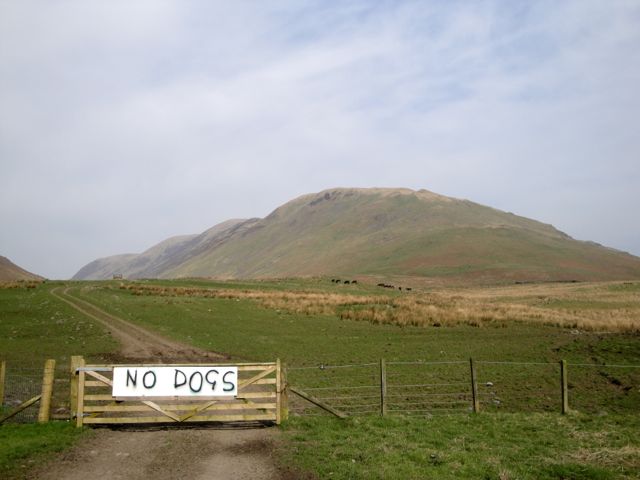
There is a parking spot large enough for a couple of cars near Blackshope cottage. If there was any question as to whether the walk was appropriate for dogs, some one had left a useful information sign addressing that very question.

Dog friendly?

Looking up Blackhope glen the long ridge running up to Saddle Yoke looks impressive, something like an elongated ziggurat. The walk starts following a farm track but at a sheep fold it is best to head off the track and up the hill. There is a stile over the fence, always a good sign that some route passes that way. The initial climb is steep but not uncomfortably so. As I climbed there were several tracks some of which seemed to gradually climb, which is unusual for animal tracks. I followed a couple of these, wondering if they might be part of a long zig zag path up, but didn’t see any switchbacks in the path so eventually just climbed straight up.

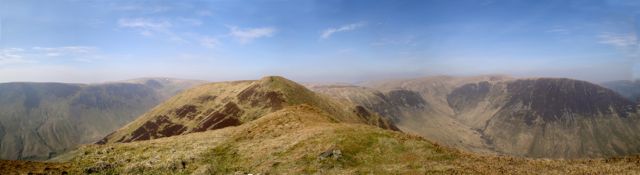
The first 45 minutes are a bit of a slog up the rises of the ziggurat, one false summit after another, but then the view opens up. A narrow path leads up to Saddle Yoke which stands between the steep sides of Swatte Fell and Carrifran Gans, each sporting 400m drops. There was even a little snow left in the shade of Hartfell Craig.

Saddle Yoke (panorama)

Once above 400m the walk was much more enjoyable with the path, and summit, ahead easily visible. There was now even a little breeze to cool the hot sun, but I suspected that sunscreen or longer sleeves might have been in order. Luckily I had brought my sunhat.

Saddle Yoke is the smaller of the Saddle Peaks, Under Saddle Yoke being 10m higher despite the name. From a distance the summit looks like an old-fashioned saddle, but up close you wouldn’t guess it. There is a small cairn just below the summit of Saddle Yoke, and I rested my rucksack on it while having a well earned snack and stowing my first water bottle, now empty. I have given up using a water bladder since I never know how much I have left and have a tendency to take sips from habit rather than need.

The small col in the Saddle is about a 35m drop and 45m climb. The path is narrow but not dangerous. All the same I wouldn’t recommend this part of the walk in strong winds. In that case it might be safer to cross the col on the right of the path. If you were to fall that way, a fence below might prevent you going all the way down.

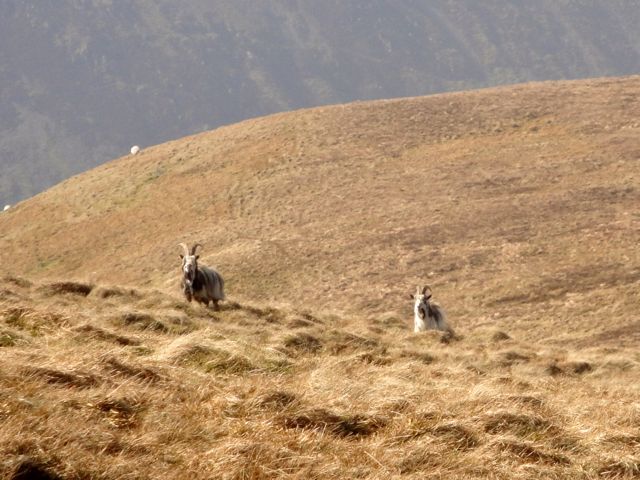
Goats on Saddle Yoke

Once over Under Saddle Yoke I was surprised how much more ascent there was ahead of me, another 200m up HartFell Rig. I followed the fence down, and had intended following it until it met the fence heading up Hart Fell. Some mountain goats stopped their grazing to watch the strange creature in a sunhat wander past. A pair of hares also stood watching me but scarpered when I got the camera out. Once I was at Priest Crag I decided that following the fence up another 100m only to come back down was a waste of energy. I couldn’t see the fence on Hart Fell Rig at first, but spotted it from Priest Crag. I headed straight across to the fence.

This may have been a false economy in effort. The terrain would in normal circumstances have been a mixture of water meadow (higher up) and peat bog (lower down). Because we had had a few dry days it was merely waterlogged (sodden footwear grade) and needed some care to avoid the standing water (partially hidden by grass). For all I know, following the fence could be just as bad, but next time I’ll try sticking with the fence.

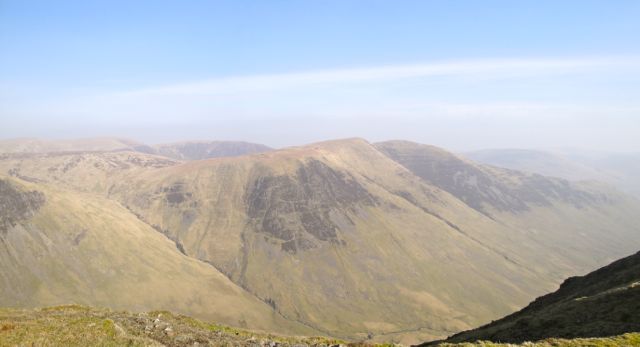
The 200m up Hartfell Rig and onto Hart Fell itself is on firm ground. It is about a mile and a half up to the summit of Hart Fell, but most of the climb is in the first half mile. The views to the south, looking down Blackhope glen are of the Ettrick hills, and to the north, Talla reservoir and its surrounding hills. The haze, unfortunately, meant the photos were poor. I had hoped that the haze might have added atmosphere to the photos, but it merely spoiled them.

Whirly Gill and Saddle Yoke

The last time I was on Hart Fell, it was covered in snow and so cold that my face was numb. This time I was warm enough in a t-shirt and had sunburn. As I arrived at the trig point, another walker was leaving, heading west, the only other person I saw on the hills. The trig point’s shelter provided a welcome seat while I checked my route on the map.

There is a well trodden route heading southwest along with the fence. This heads into a col then up onto Falcon Craig. There were no birds of prey to be seen here but one was circling on the other side of the valley over Saddle Yoke. The path is close enough to the edge to give very good views of Saddle Yoke, Redgill Craigs, Saddle Craig and Whirly Gill.

Swatte Fell (not the summit)

The next hill is Swatte Fell, one of those flat topped hills with no obvious summit. I had followed the track as it peeled away from the fence but soon realised that I was missing the summit. After some backtracking and wandering about I found a small cairn with a pole stuck in it. Unfortunately, this and another one like it seem to have been built by a practical joker since neither seem to be the actual summit.

The fence continues on over then down from Nether Coomb Craig, eventually crossing the Hang Burn. I had read that it was important to stay south of the burn so I climbed the fence and continued down the hill eventually joining a faint vehicle track leading to a gate.

From here the going was easy. A footpath leaves the vehicle track taking a slightly steeper route down than the vehicle track, though they merge again a little further down the hill. This section gives some views of Hanging Gill and the steep hill beside it. Getting down that would certainly be a challenge.

As I walked off the hill I had my only mishap, slipping in a pool of slurry. Luckily some slapstick moves with sliding and windmilling of the arms prevented me falling flat on my back. Strange how the mind works though. This event must have lasted only a second but I had time to wonder how I would drive home covered in excrement. I could have worn my waterproofs I suppose.

.


Download file for GPS


Posted in Dumfries & Galloway | Tagged , | Comments Off on Blackhope Round

Dundrennan Abbey

4.2 miles     about 1h 45m     110m ascent

Dundrennan-Port Mary-Fagra

A short low level walk to escape the snow showers that had been forecast. As it was, we had rain, hail, biting cold winds and warm sunshine, all in a couple of hours.

The walk starts at the Dundrennan Abbey car park then heads briefly, about 200m,  along the A711 before turning down a smaller road heading towards Port Mary. This road follows the Abbey Burn for a mile or so and then crosses it at Port Mary Bridge.

The road has a further junction about a quarter of a mile further along. The smaller track continues on, through a red gate (padlocked open) with various signs warning the unwary not to touch military debris. This reaches the coast at Burnfoot bridge and would have been my chosen route but the track was flooded up ahead so we turned right, towards Port Mary. A hundred metres or so along here there is a signpost pointing north which has the helpful word “footpath” on it.

So the footpath it was, with the initial agreement of, but later chagrin, of Mrs Drow n Smirr. This path rises towards Fagra farm and has good views of the Solway, England, and the Isle of Man. The cliffs at Port Mary can be glimpsed as can the Solway wind farm and Sellafield. There is a large establishment across at Girdstingwood which is, I presume, a barracks.

Dundrennan Abbey

Here, unfortunately, the weather changed. Cold, wind and rain was added to the slightly muddy ground. The rain, at least, was short-lived. Once the rain had passed we could see the shower moving over the solway, while sun bathed distant Bengairn producing a small rainbow.

As we approached Fagra the footpath took a dog-leg adding a little to the distance but now had a more substantial surface and quickly led us back to the road. Fagra Farm was the highest point on the walk but still about 40m short of Fagra Hill’s top, a third of a mile away.

The road then meanders down towards Dundrennan giving excellent views of the Abbey ruins across the Abbey Burn.

Dundrennan Abbey

Dundrennan Abbey, founded in 1142 by Fergus of Galloway, is now ruined, but nicely kept if you know what I mean. It was the first of three Cistercian Abbeys in Galloway, the other two being at Glenluce and New Abbey. The sun was considerate enough to show itself for the photos.

Lord of Galloway?

I was able to find the Knight’s grave which some think could be the resting place of Alan of Galloway, the last “king” of Galloway and one of the 16 signatories of Magna Carta. His daughter Devorguilla is the source of the phrase “Queen of the South”. It was she who endowed Sweetheart Abbey which was called  New Abbey differentiating it from the old Abbey at Dundrennan.

On 15th May 1568, Mary Queen of Scots spent her last night in Scotland at Dundrennan Abbey, before escaping to England, where she would subsequently be imprisoned and executed. I presume Mary Port takes its name from that event.

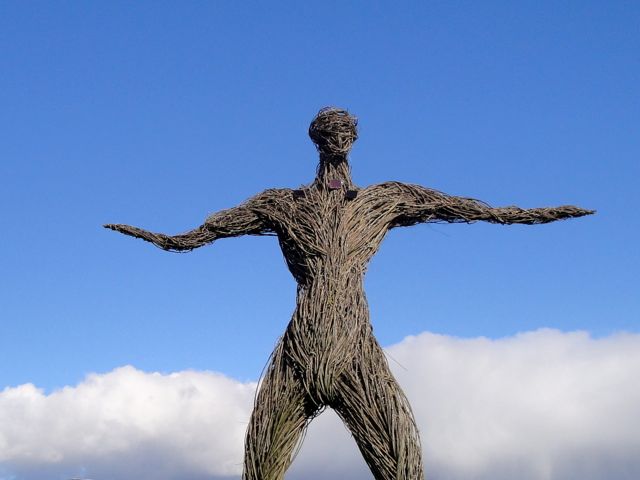
Wickerman

On the way home we passed some standing stones, by the aptly named Standingstones Burn, and a large wicker man which must be a remnant of the Wickerman music festival.


.

Posted in Dumfries & Galloway | Tagged , , | Comments Off on Dundrennan Abbey

Last of the Ettrick Donalds

8.7 miles   4h 24m  842m ascent

Selcoth-Croft Head-West Knowe-Loch Fell-Windfell Nick-some SUW

One problem with the western Ettrick hills is access. Moffat Water is too wide to cross except over bridges and the Ettrick valley is a long drive. For this walk I crossed Moffat Water at Sailfoot, signposted to the fishery. A new bridge is being built but the old one was still in use. There is a new parking area for walkers with space for about five cars.

From the car park I headed along the track towards Selcoth, passing the farm buildings and heading up the slope at a gradient enough to warm the old muscles. At 250m the path ends at a gate in a dyke. The is a noticeable track continuing up the hill but this peters out pretty quickly.

Croft head has a steep eastern face and a long less steep finger stretching west. This finger is split by the Steinstane Burn and from the lower slopes looks like two separate hills. I was climbing the northern finger which gradually develops a very steep northern face. There is a steeper section at about 400m which is a false summit (one of many in fact). Looking up I could see what looked like a group of stones about a kilometre ahead, but their positions gradually changed and I realised it was a group of walkers slowly climbing  a steep section.

By 400m I was on the crest of this ridge and had excellent views of the Moffat hills, Capel Fell with its impressive scree slopes and later the other Ettrick hills. The walkers ahead of me were hidden beyond false summits until the last pull up to the summit, where they paused then left before I arrived.

Unfortunately the weather started to deteriorate. Not terrible but enough to spoil the views as the cloud base fell and force me to put my jacket back on. Croft Head, at least with this approach has good terrain, mostly short grass without any waterlogged sections.

Croft Head

As I trudged up to Croft Head’s summit I was contemplating shortening the walk, particularly once I was back in mist, but a banana seemed to refuel me so on I went. I had been looking forward to making my way down Cat’s Shoulder with its zig-zag path and the cloud did lift enough to give excellent views along the steep sided valleys meeting here, the forest covered hills to the south, the grass covered Ettrick hills and the impressive Craigmichen Scar, a mixture of rock outcrops and scree. Unfortunately the drow n smirr put paid to reasonable photos.

The Southern Upland way crosses Croft head so my way down was on the SUW with its waymarkers. I passed the walking group on the way down and did not meet them again until we were back at the car park.

There is a sheepfold at the foot of Croft Head, a good place to rest and shelter from the elements. The SUW has alternative routes here, one climbing over the hill, the other in the valley for use in bad weather. The sheepfold is where they meet.

Craigmichen Scar

From the shelter of the sheepfold I headed along the SUW and at a large cairn left the path to head up the slopes of West Knowe. I suppose I could have headed straight up from the fold. The contour lines look similar but the reality is different. By using the SUW I was able to climb a little on a well trodden path and climb a slightly easier section.

In fact looking up from the cairn there is another cairn on the slope which I presume is there to guide folk, such as me, who are daft enough to climb the hill. The alternative is to follow the SUW further to the footbridge and climb the even easier slopes there. I chose not to do that since the SUW descended beyond the cairn.

The climb up this grassy slope was not too difficult but I would have worried about coming down it in wet weather. It was steep enough in one place to be able to reach out and touch the grass while standing up. The gradient here was 50%. I didn’t  look down. The GPS track records my zig-zagging up this section.

Unfortunately, once I was on the flatter sections of West Knowe, above about 600m, I was back in cloud, the wind had picked up, it was raining and the ground was waterlogged, squelching underfoot. (Aah, Home at last.)

Ginger Grass of West Knowe

Soon the fence atop West Knowe came into view and I gazed about wondering where the summit might be. Somewhere on the far side of the fence according to the map. I little wandering about and I found a spot that seemed higher than anywhere else.

I then followed the fence all the way to Loch Fell. There is a small rise between West Knowe and Loch Fell which fooled me at first into thinking I was at the summit but three fences meet at the summit so I realised there was further to go. I do wonder whether the hill names here have become confused. It would seem more reasonable to have the central hill, or the entire group of hills named Loch Fell, and the two outer hillocks West Knowe and East Knowe. I  lunched in the lee of the trig pillar on Loch Fell but had to cut it short since I was growing cold standing still.

From East Knowe I followed the fence, tramping through sodden grass and mud, in the pouring rain, the wind blowing so strongly that I had to hold my hood up, but at least it was downhill and brought me out of the cloud.

At Windfell Nick, the col between Loch Fell and Wind Fell I turned left and headed for the SUW near Ettrick Head. The ground here was marshy but passable by standing on heather or tussocks. Once on the SUW the way was easier to see.

SUW

The path took me across the steep lower slopes of Capel Fell and into a deep gorge between Capel Fell and West Knowe. A wooden bridge here crosses the Selcoth Burn and ahead is the zig-zag path on Cat shoulder. The SUW then climbs opposite the Craigmichen Scar to bring me back to the cairn where I had left it about an hour and half earlier.

Back at the sheepfold I had a breather and thought about my way back. Having seen the path along the Selcoth Burn I was worried about crossing the scree slopes. Should I climb back over Croft head? back over Capel Fell? No. I would take the lower path. The path is narrow and crosses steep slopes with a couple of sections across scree. The worse case scenario would be that the scree slipped and I decided if that happened, the best plan would be to fall onto the slope and slide down into the burn 50m below. It was steep but not sheer, about 45% I reckoned, so I would probably stop before I got all the way down. I deployed the walking pole adjusted to cope with the steep gradient and set off. As it was the scree sections looked worse from afar compared to close up and there are reasonable paths across the scree.

Selcoth Path across scree

Soon I was past the worrying section and walking across relatively flat farmland. A little way past a sheepfold is a vehicle track cut into the slope which, rather irritatingly, slowly climbs. On the map is a lower track which stays closer to the burn but I didn’t see it. The vehicle track cut into the hill ends at about 280m and from there I headed directly down towards the buildings at Selcoth. In retrospect it would have been easier to contour around the hill and rejoin the track I had started on, by the gate at 250m. My easiest way back to the track would have been through gardens, which isn’t really on except in an emergency, so I made my way through some trees and across a bridge to get back on the track.

Ahead of me were the group whose path I had crossed earlier in the day. They said they had had a good walk, returning over Broken Back. I didn’t ask how they got there but I presume from Capel Fell one could head down towards Sailfoot Law then join the forestry track to Broken Back.

Croft Head and Loch Fell are the last of the Ettrick Donalds, the most westerly, but also the last two of the group I needed to walk, hence the title.

.


Download file for GPS


Posted in Dumfries & Galloway | Tagged , , , , | Comments Off on Last of the Ettrick Donalds

Windy Standard in the snow

9.5 miles   4h 28m   ascent 511m

Afton-Jedburgh Knees-Windy Standard-Blackgrane-Millaneoch-Wedder Hill

A walk in the snow.

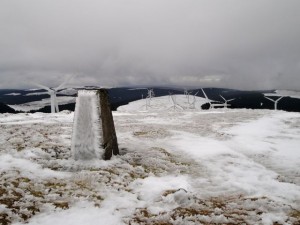
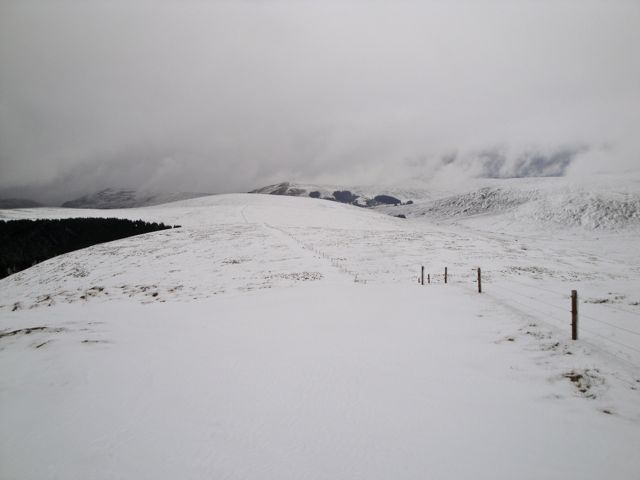
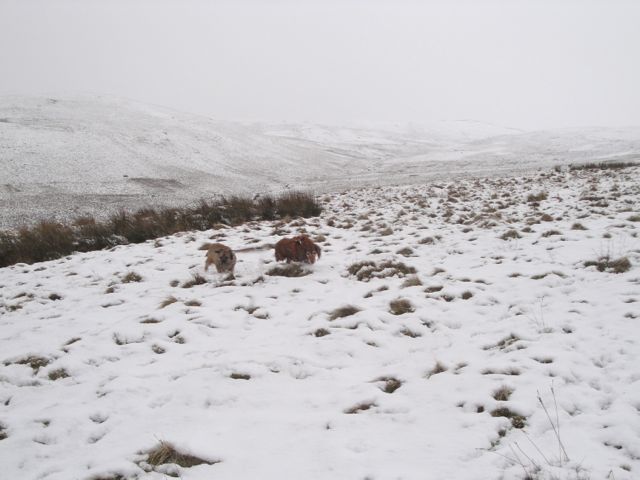
Windy Standard has eluded me on a previous walk which I abandoned in bad weather. As you can see from the picture, the weather was challenging but I made it this time.

The road from New Cumnock to Afton Reservoir is one of those that starts in a reasonable condition but gradually shrinks to single track and then becomes littered with pot-holes. After the Afton Waterworks the road was covered in semi-melted and re-frozen snow and the car=park, marked on the OS map, was closed off. I managed a seven point turn in a passing place, taking care not to slip off the road and left the car at the waterworks.

A snow covered path led up and to the back of the waterworks from where I crossed a watercourse and climbed over a small fence to get onto the slopes of Green Knowe alongside a bubbling brook with small waterfalls, Sandy Syke. This brought me to a track which I followed as it climbed the hill. At this stage the land was cloaked in mist so there was little to see other than the path, a few boulders and several sheep who watched me walk past. I looked up the hill wondering what the cloven stone, marked on the OS, might look like.

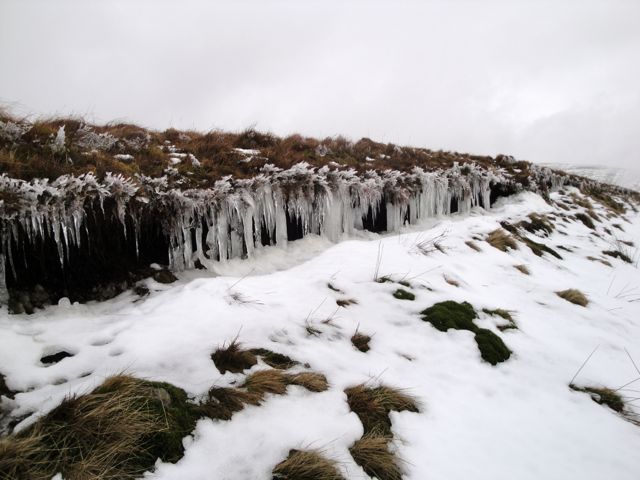
Icicles beside the path

As the path climbed it gathered patches of ice, then a full covering of ice and snow. This was a warning of what was to come. The path reaches the trees at about 520m. As I walked up the hill, I was thinking, as ever, that every metre climbed was a worthwhile effort. Once the path moved into the trees, however, it descended and the snow covered path lost the vehicle tracks that had made walking easier.

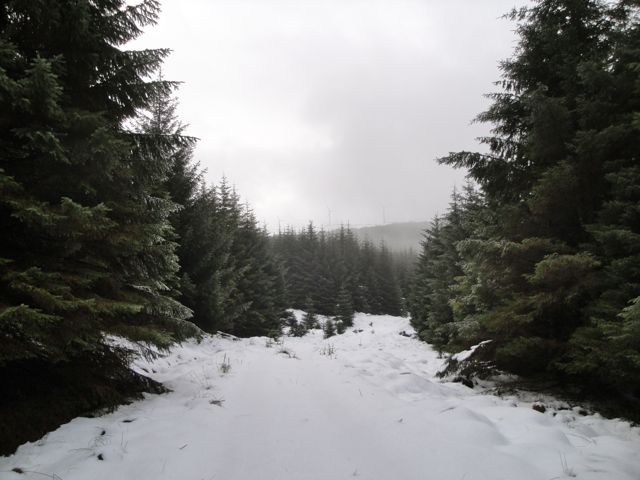
The snow here in the forest was about ankle deep, occasionally hiding puddles but was relatively easy going. In fact the main irritation was trees abutting the path and shedding water whenever I brushed against them. I took special care crossing small streams since it was difficult to know where a bridge ended and overhanging snow began.

First sight of Windy Standard

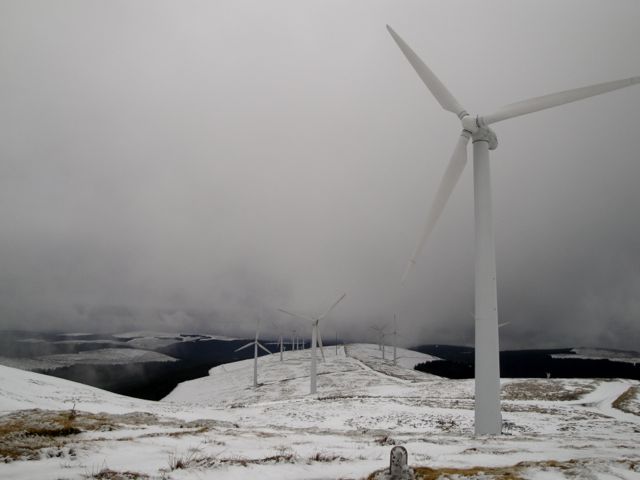
The path continued to descend as far as the Water of Deugh. The mist occasionally cleared to allow fleeting views of wind turbines on what I thought to be Windy Standard, but they were more likely on Jedburgh Knees. This did also give me a glimpse of the fire break I had planned on climbing. It looked easy on the OS but as it “stood naked before mine eye” it was obviously a non-starter without crampons and ice-axe (not included in my rucksack).

There is a small wooden bridge over the Water of Deugh, where I stood in a foot or more of snow, reviewing my options and scowling at the map. A path runs south but ends in the forest well short of Windy Standard. There are firebreaks but with crowded contours. It didn’t make the shortlist since I could see no sign of the path.

I continued along the path I was on for another half mile then headed up a wide firebreak. This turned out to be easier than I had thought. A fallen tree partially blocked the way forcing me onto a steeper section and did have me on all fours a couple of times.

The snow on Jedburgh Knees was mid calf level so I was relieved to get onto the road heading up towards Windy Standard. The snow on the road had been compacted by tracked vehicles and looked as though a piste basher had been at work. The relief however was short-lived. Every few steps my foot would sink to mid calf making the going somewhat tiring.

About this time I received a text from Mrs Drow ‘n’ Smirr asking when I would be home. The summit was just ahead so I replied that I was just near the summit and would then be heading back down. Only minutes later the mist cleared and I wasn’t as close to the summit as I had thought. There was another 45 minutes to the summit. Of course by then the phone had no service.

I continued along the compacted snow sinking every few steps. The path eventually started to descend again and it dawned on me that the path didn’t go to the summit, which was again lost in the mist. So I took a bearing and headed off the path towards my goal. The snow here was just less than knee height and hard going to say the least.

Then I had a stroke of luck. The mist cleared and I could see the the trig point, covered in ice. I say it was lucky because it was  several metres to the left of where I was heading. I suppose I’d have got there in the end just by heading uphill, but this saved me a little time.

Lunch was taken next to the trig pillar and the mist lifted to allow a few photos. Moorbrock Hill and Cairnsmore of Carsphairn were now visible, beautiful in their coating of snow but Alhang and Alwhat were still lost in mist. I headed for the nearest wind turbine so I could follow its path back to the compacted road.

The deep snow of Millaneoch

My way back over Blackgrane, Millaneoch and Wedder Hill, following the fence, was now visible and in different weather could have been an easy stroll. As it was the snow proved irritating. In places, with care, it was possible to walk on the snow but my feet would suddenly sink to calf or knee every few steps. Beyond Millaneoch the snow was softer and all steps sank, sometimes into standing water.

On the southern slope of Wedder Hill I met a group of walkers heading in the opposite direction. Their footprints gave me some warning of what lay below the surface. Deep prints in snow surrounded by brown marks identified hidden muddy puddles. Unfortunately I was eventually caught out and gifted wet feet by the accursed ground. The going was very tiring but at least I could see my goal, the path I had started on, which I rejoined where it exited the forest.

Afton Reservoir

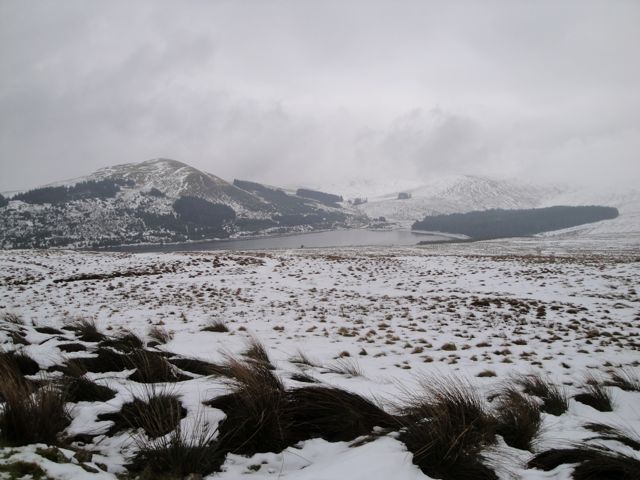
Though covered in snow and ice, the path was, relatively speaking, like a walk in the park compared with the previous 80 minutes. What was more, with the mist cleared I could now see Afton Reservoir and its surrounding hills. I couldn’t see the cloven stone but did see Castle William, a large rock formation.

I did wonder if it would be possible to get down to the dam and follow the lower path back to the car. It was only a short distance down through some trees but again the area was covered in snow and I thought it safer to just retrace my steps on this occasion.

.

Posted in Ayrshire, Dumfries & Galloway | Tagged , , , | Comments Off on Windy Standard in the snow

Sanquhar and the SUW

7.4 miles 3h  288m ascent

Along the SUW west from Sanquhar

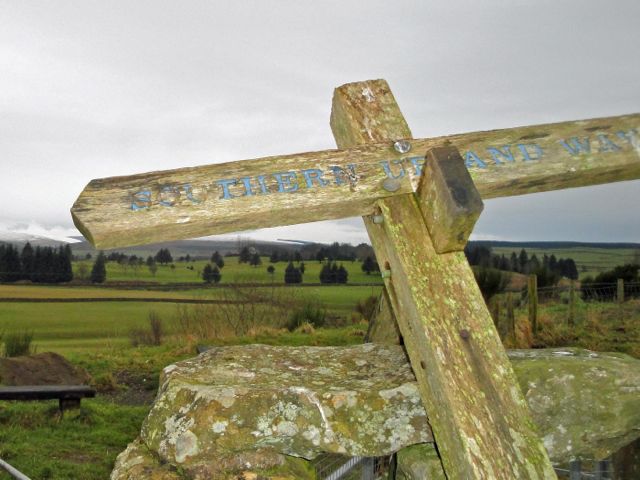
A few more miles of SUW. I decided to start   from Sanquhar and walk out along the SUW far enough to look down the Scaur valley then head back along Euchan Water.

I parked close to Sanquhar Castle and stood by the car, in multiple layered walking gear, woolly hat and gloves, gazing at the ruins through my condensing breath. As I did, two young girls (probably aged 12 or so) walked past in pyjamas and dressing gowns. They make ’em tough in Nithsdale.

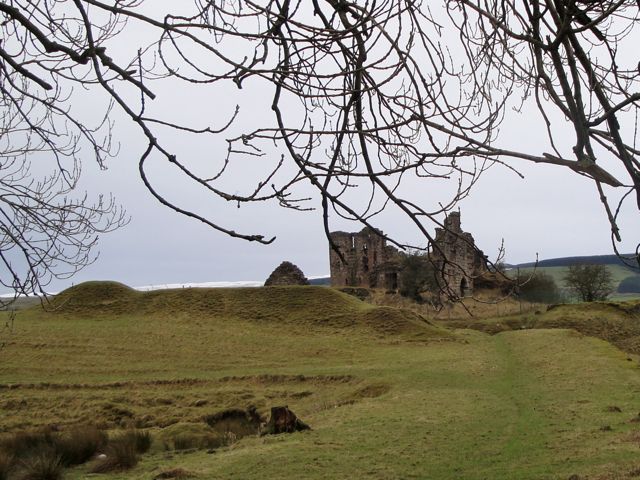
Sanquhar Castle

Judging by the extent of the earthworks this must once have been an imposing castle.  Now it is a sad sight. The castle, built by the Crichton’s in the 1400s, is now a true ruin and as such looks much more forlorn than “managed” ruins like Sweetheart Abbey with their mown lawns and pruned trees.  There is a sign by the road indicating the “easier” path but I’m hard-core so I went through a kissing gate to what I presumed was the n0n-easy path. This goes over an embankment, across what may have been a moat, and then close by the ruins then down to a couple of gates and across a muddy waterlogged area which is presumably the difficult bit.

Mantua Stone

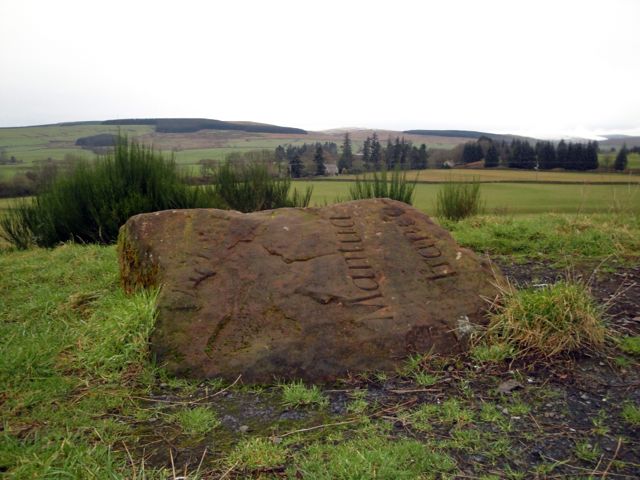
The “difficult” path then turns right and rejoins the easy path after 250m or so. The path heads towards the River Nith at a wall, marked as the Deer Dyke on the OS map. There is a giant kissing gate here, big enough for a horses. Just beyond the dyke are a couple of benches overlooking the river and a large sandstone rock with “Mantua France” carved on it. My research about the rock has not found a definite explanation for it. I can only presume it is somehow related to the Admirable Crichton, born close by at Eliock House (1560) and murdered in Mantua (1582).

The SUW follows the Nith, passing a children’s playground and then some partially derelict industrial buildings that resemble something from the 1970s. The surrounding hills, including Lowther with its radar ball were covered in snow warning me of what was to come once the SUW climbed. The route crosses the Nith at Blackaddie Bridge, then turns south to cross Euchan bridge. A field here had a pair of birds circling. I couldn’t  identify them while in the air but once they landed it was obvious they were herons. the first time I have seen herons standing in a field.

I then followed the SUW, which passed through Ulzieside Farm where chickens seem to have taken over the farmyard, but later had to make a detour because I couldn’t get the dogs over stiles. As is often the case, in straying from the beaten track the terrain got worse. Firm ground gave way to boggy, then flooded fields. Gates in particular tended to guard standing water. One dog was a bit unhappy about going through water whereas the other happily splashed crap all over me. I found I had strayed back to Euchan water just beyond Cairnhill so I headed south by the side of Ulzieside Plantation.

The fences here are electrified, or so the signs say, and several gates had been tied shut by someone practicing for the Gordian Knot tying contest. Unlike Alexander I was without a blade. Eventually I found a gate to get the dogs through and headed up on the now snow covered slopes. Up ahead I spotted a post. I hoped it would be an SUW way marker and indeed it was.

Scaur Hills from SUW

The path of the SUW was lost beneath the snow but as I reached each post the next was in view. The terrain was waterlogged and frozen but with ice thin enough to allow feet to occasionally crunch through to the cold water. Several small streams draining into Whing Burn cross the route and add to the excitement. As I climbed further the snow became heavier and the visibility worse so my views of the Scaur valley were poor. I decided to call it a day about half a mile short of Cloud Hill since it was clear that the only views were going to be white.

On the way back I followed the SUW which seemed easier heading back. I had to manhandle the dogs over one steep stile but otherwise the return leg was uneventful.


Posted in Dumfries & Galloway | Tagged , , , , | Comments Off on Sanquhar and the SUW