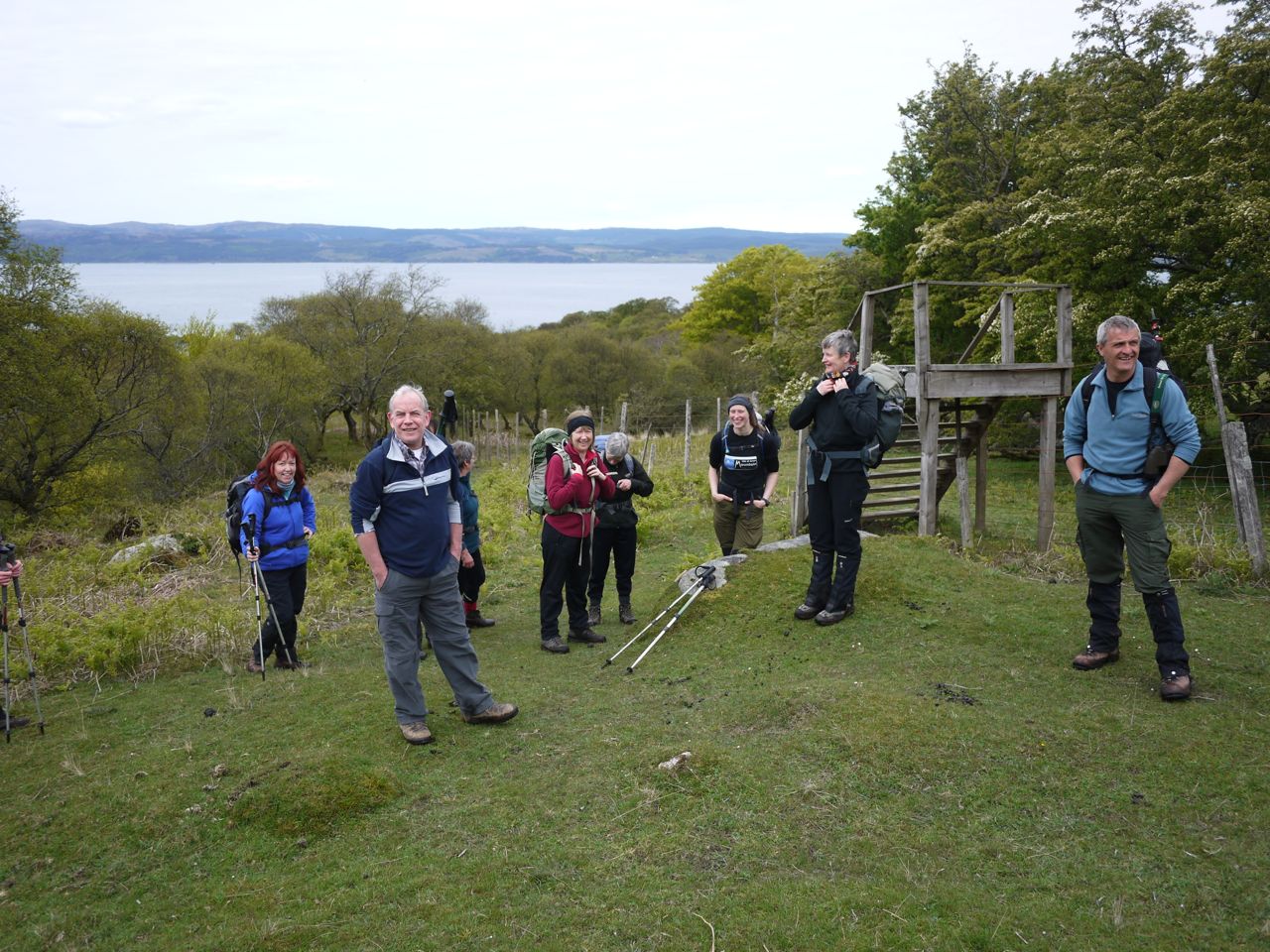
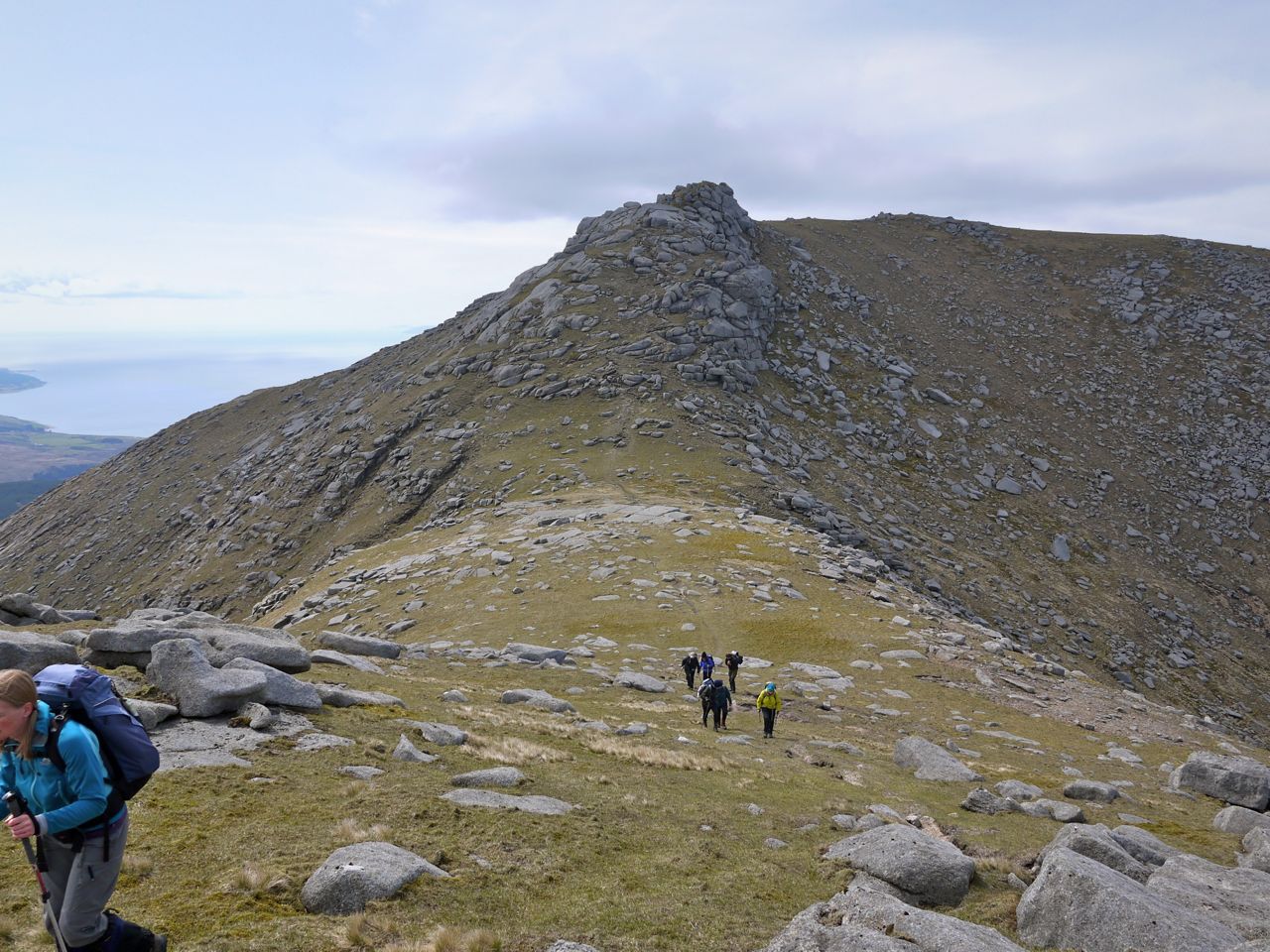
The Waterloo Monument and Criffel via the Pultarson Burn
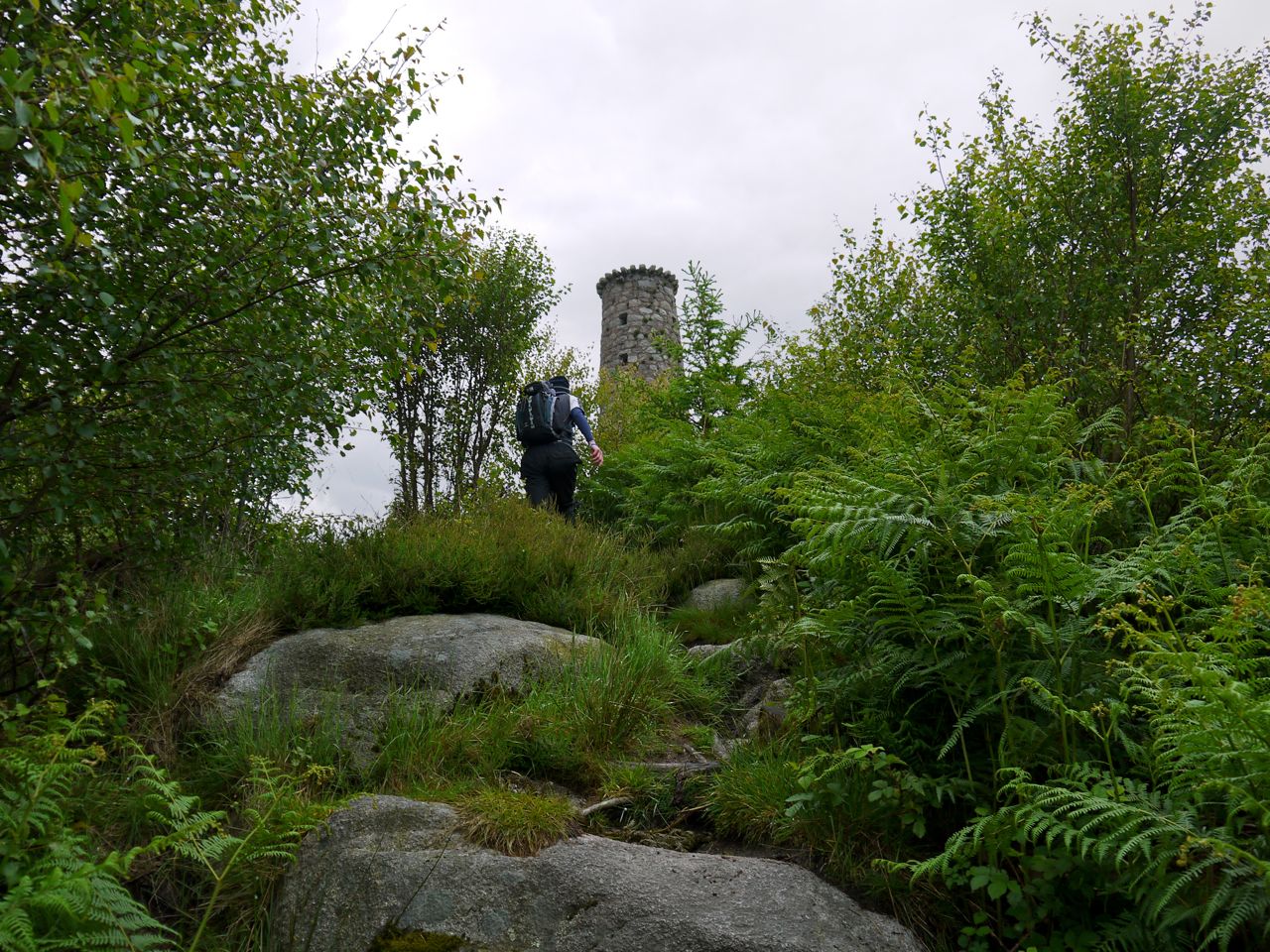
We parked in a small car park at Mid Glen, about half a mile from New Abbey. The Glen Burn runs by the car park and there is a wooden bridge across it signed “Criffel 2.5 miles”. We headed instead up to the Waterloo Monument. This is a short but steep climb. I remember this being a tree lined climb ten years ago but now the trees are gone allowing better views of Shambellie House and Sweetheart Abbey. The monument stands on a hill named as Waterloo Hill on the OS map, but referred to as Carsegowan Hill in “Rambles in Galloway” (from 1876) by Malcolm Harper.
Carsegowan is a strange name for a hill, a carse being low lying land near a river. Gowan is usually regarded as an anglised version of the gaelic for a blacksmith (gobha), but the word for goat (gobhar) is similar. I wonder if Mr Harper might have been mistaken in his name for this hill.
Almost at the Waterloo Monument
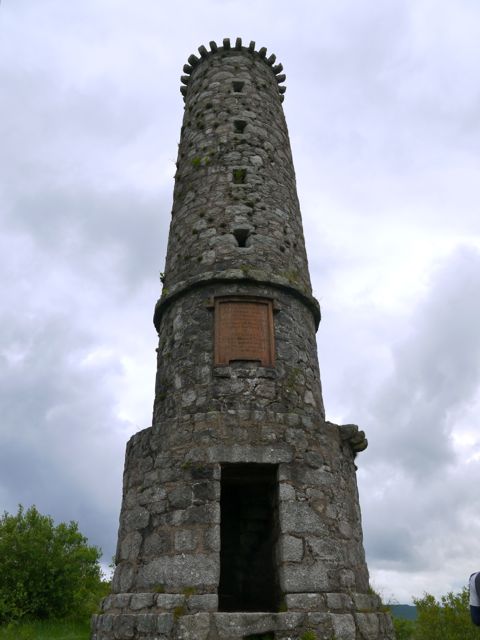
The Waterloo monument is a granite tower about 65 feet high, dating from 1816. There is a spiral stair case inside which can be climbed to the top. It is worth the climb for the views, but beware, there is no safety rail at the top. The inscription reads:
Erected AD 1816
To record the valour
of those British, Belgian
and Prussian soldiers
who under Wellington and Blucher
on the 18th of June 1815
gained the victory of
Waterloo:
by which, French tyranny
was overthrown
and peace restored
to the world
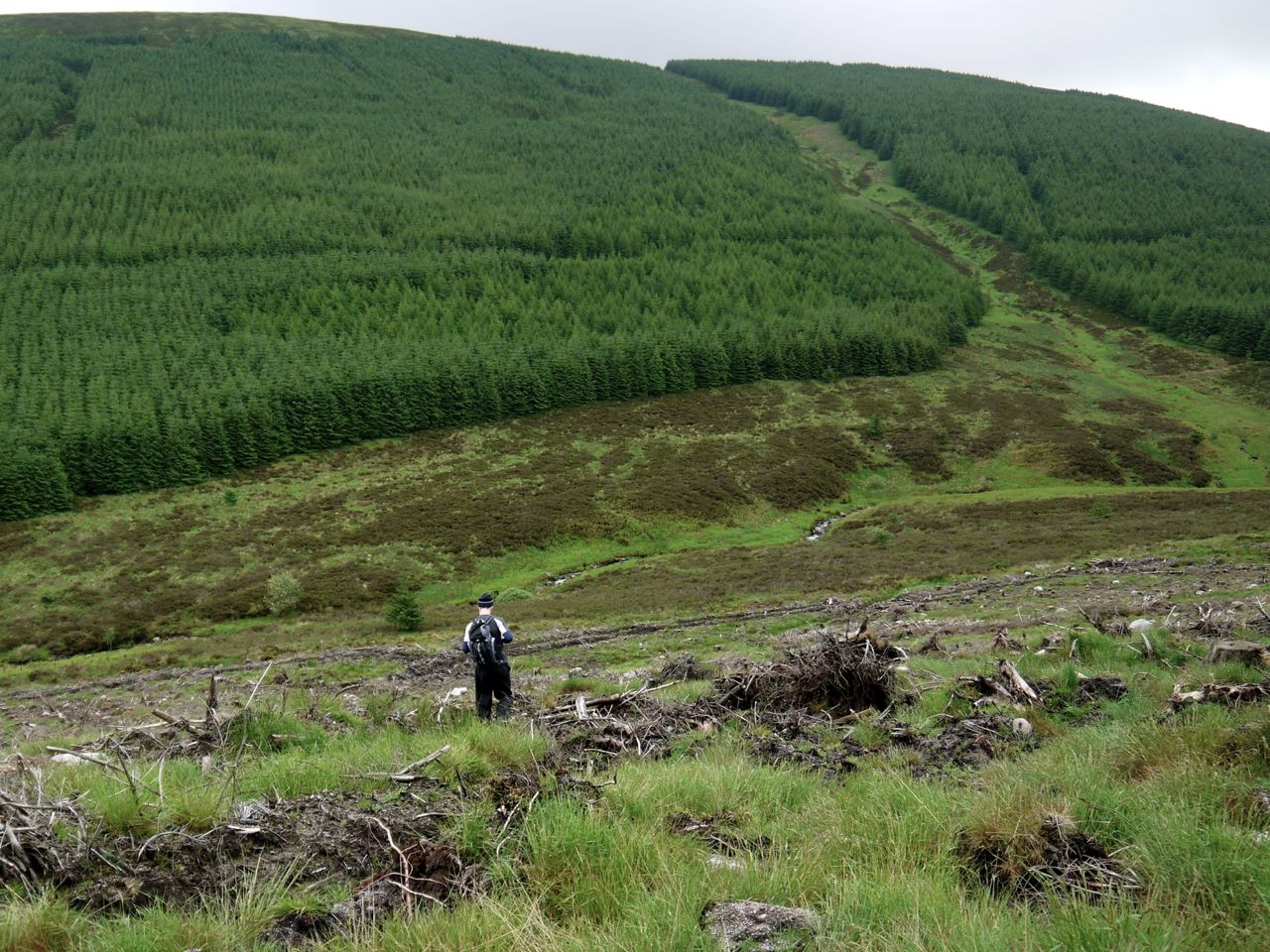
From the monument we headed SW to reach a forestry track. This was unpleasant terrain: the usual felled forest combination of tree stumps, branches, mud, peat, water filled holes (sometimes hidden) and rocks, but five minutes had us on the forestry track. It was certainly a relief to be on terra firm and not have to plan each footstep.
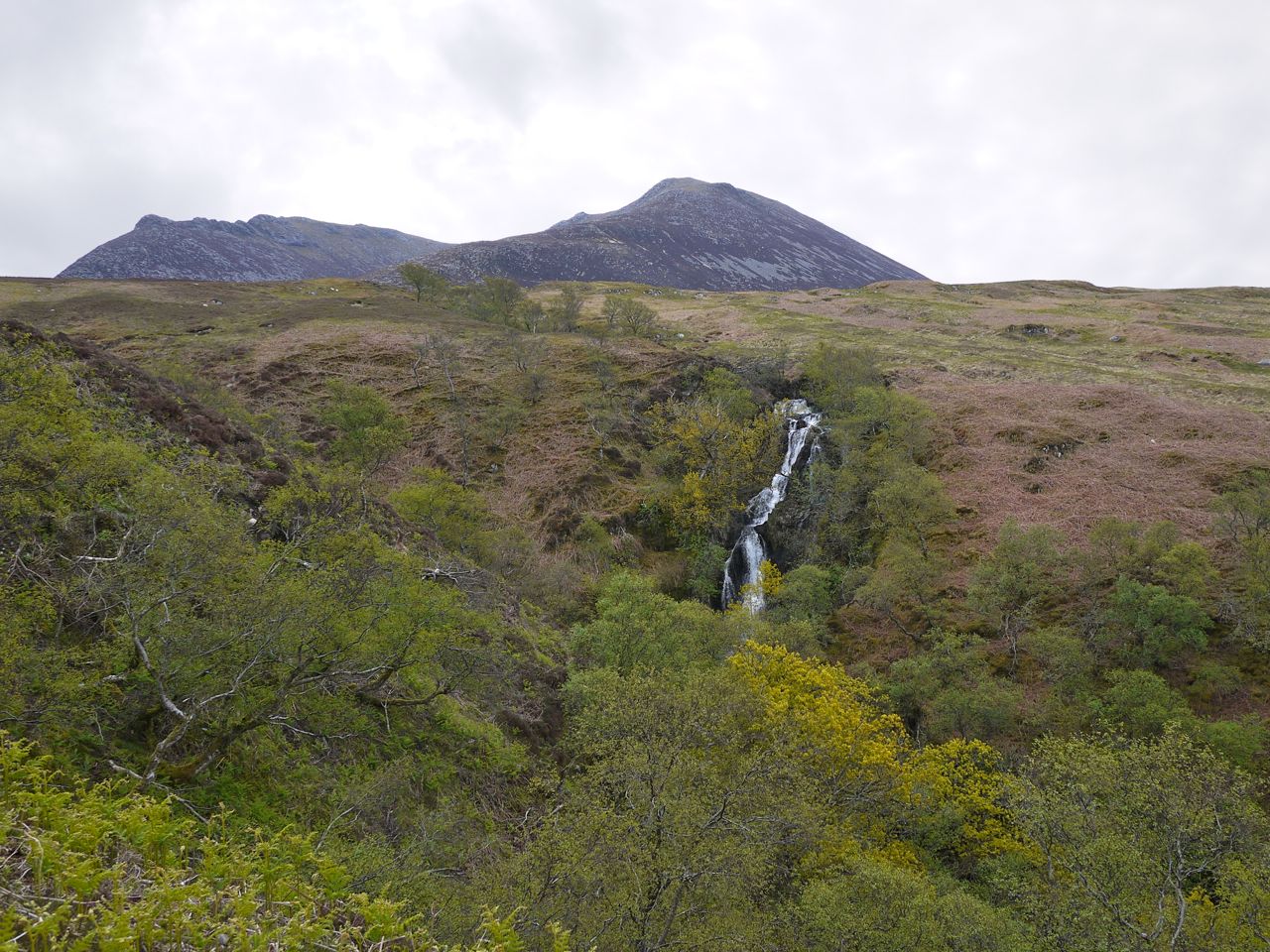
The forestry have been hard at work building new tracks which are not yet on the OS map. We followed one of these as it curved around Kinharvie and Tannock Hills slowly climbing to about 280m. The track runs past a small quarry and several huge mounds of stones. The recent rains must have saturated the higher ground since there were a great many small waterfalls cascading off the hill above us. This section gave us good views of Knockendoch and Criffel’s western slopes and our first glimpse of the forest break, with the Pultarson burn, we would be climbing later. The Pultarson burn takes its name from Poll (pool or water) and Tarsuinn (across or oblique).
Pultarson and Glen Burns
I had hoped that the track might have been extended since google earth’s pictures were taken, but I was to be disappointed and the track ended at NX944631. Below us was a 200m traverse of felled forest terrain, but at least we were heading downhill. We easily crossed Glen Burn using some handy rocks but found that the beyond the burn was bog and tussock. A hidden hole here put me on the floor.
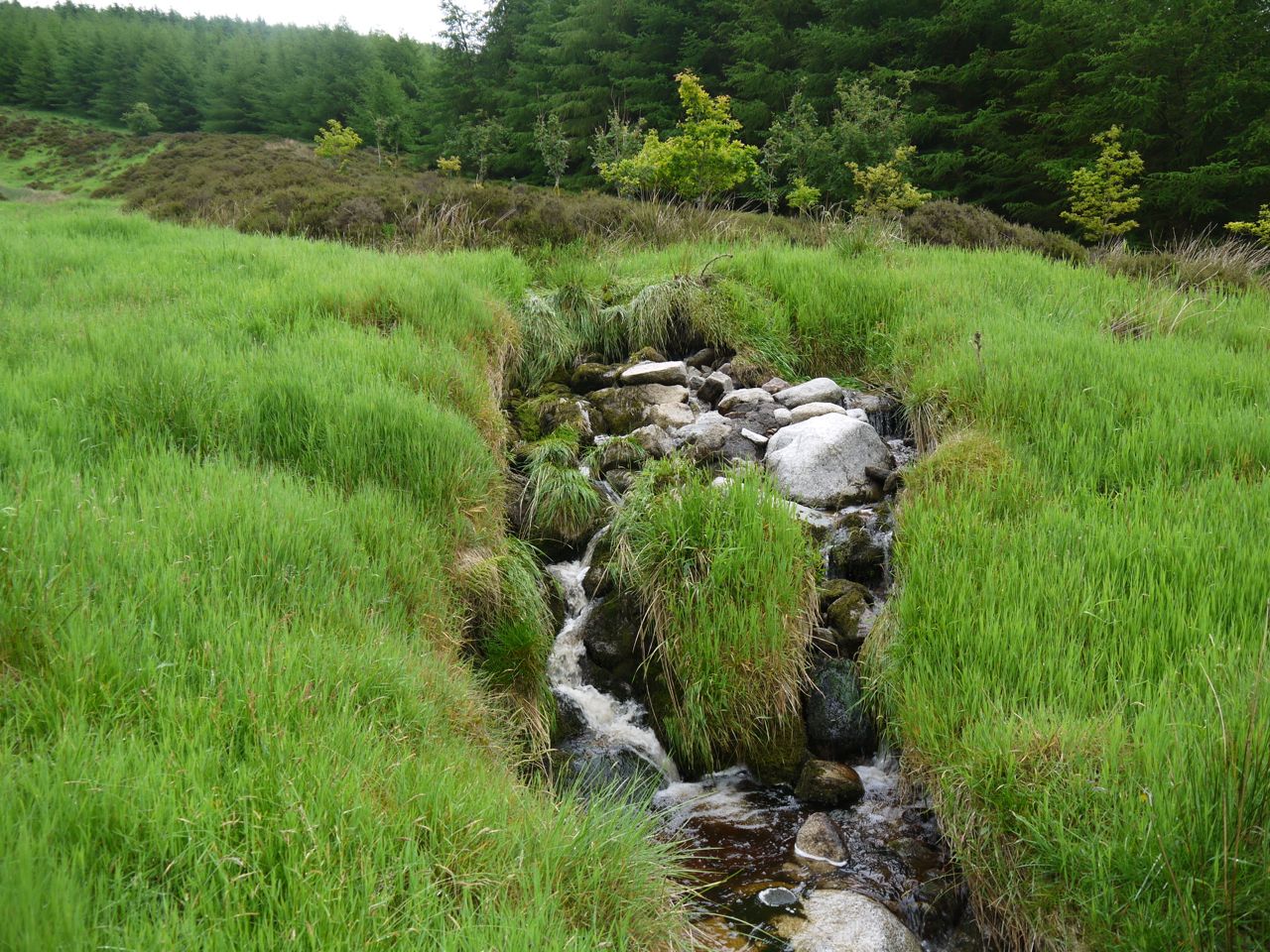
Pultarson Burn
I was beginning to worry that the ground beside the Pultarson Burn might be the same all the way up but I was pleasantly surprised. There was little in the way of tussocks and the terrain was mostly grass with small areas of heather. Presumably the ground on Criffel is very friable and rapidly deteriorates into mud if walked on repeatedly. This route by the Pultarson Burn has no discernible path and is therefore free of the mud that the ruins the other paths.
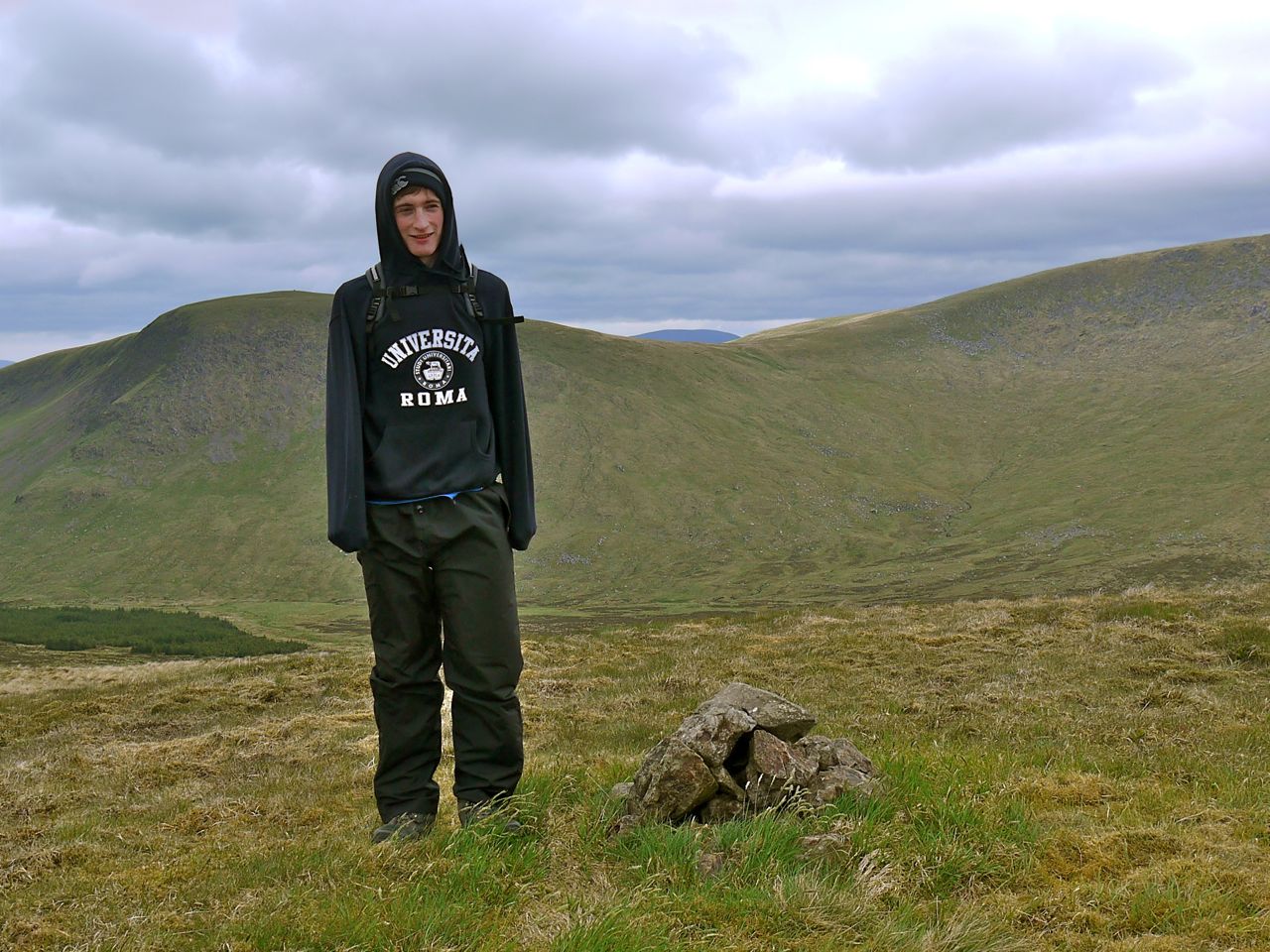
All was not, however, sweetness and light. We paused briefly to don waterproofs and were immediately set upon by a horde of vicious midges. The rain didn’t come to much but the long sleeves and hoods were needed for protection for a while. Conor even had bites on his legs despite wearing long trousers (for once).
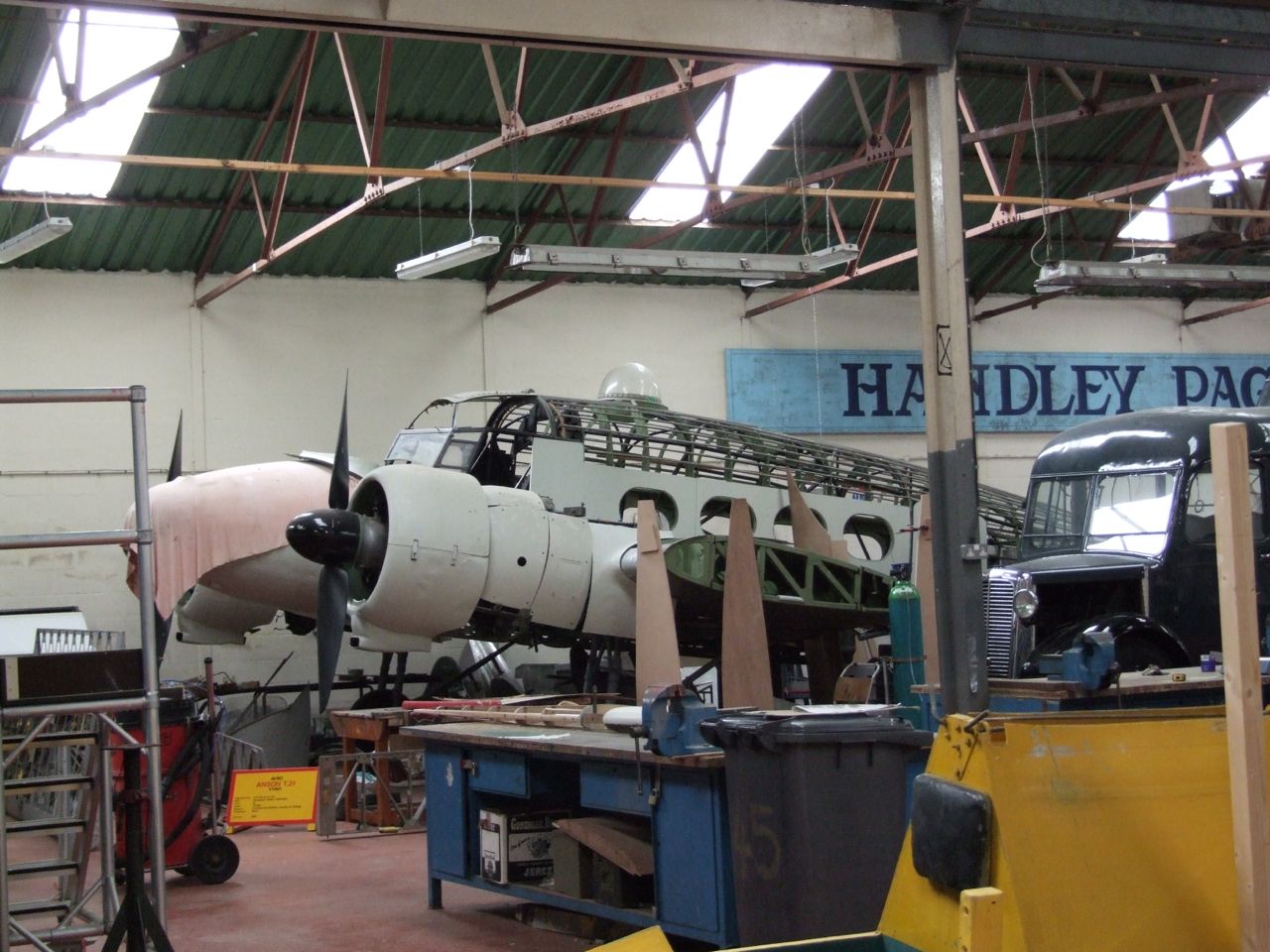
What an Anson looks like
We climbed past the tree line and crossed a fence where it had fallen down. This had us on the slopes of Criffel marked on the OS as “Old Fell”. An Avro Anson crashed here (NX953622) in 1944 but now there is just heather and peat hags.
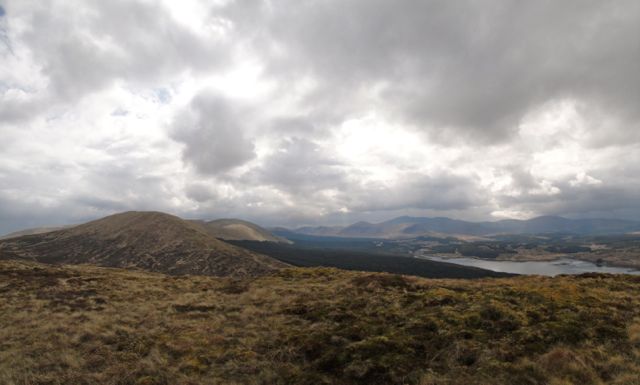
We headed over the heather to the small cairn at a secondary summit about 300m from the real top. Here we were greeted with views of the Solway, and its D&G and Cumbrian coasts. The visibility wasn’t great but we could see as far as Cairnsmore of Fleet which had its top in cloud.
Criffel Summit
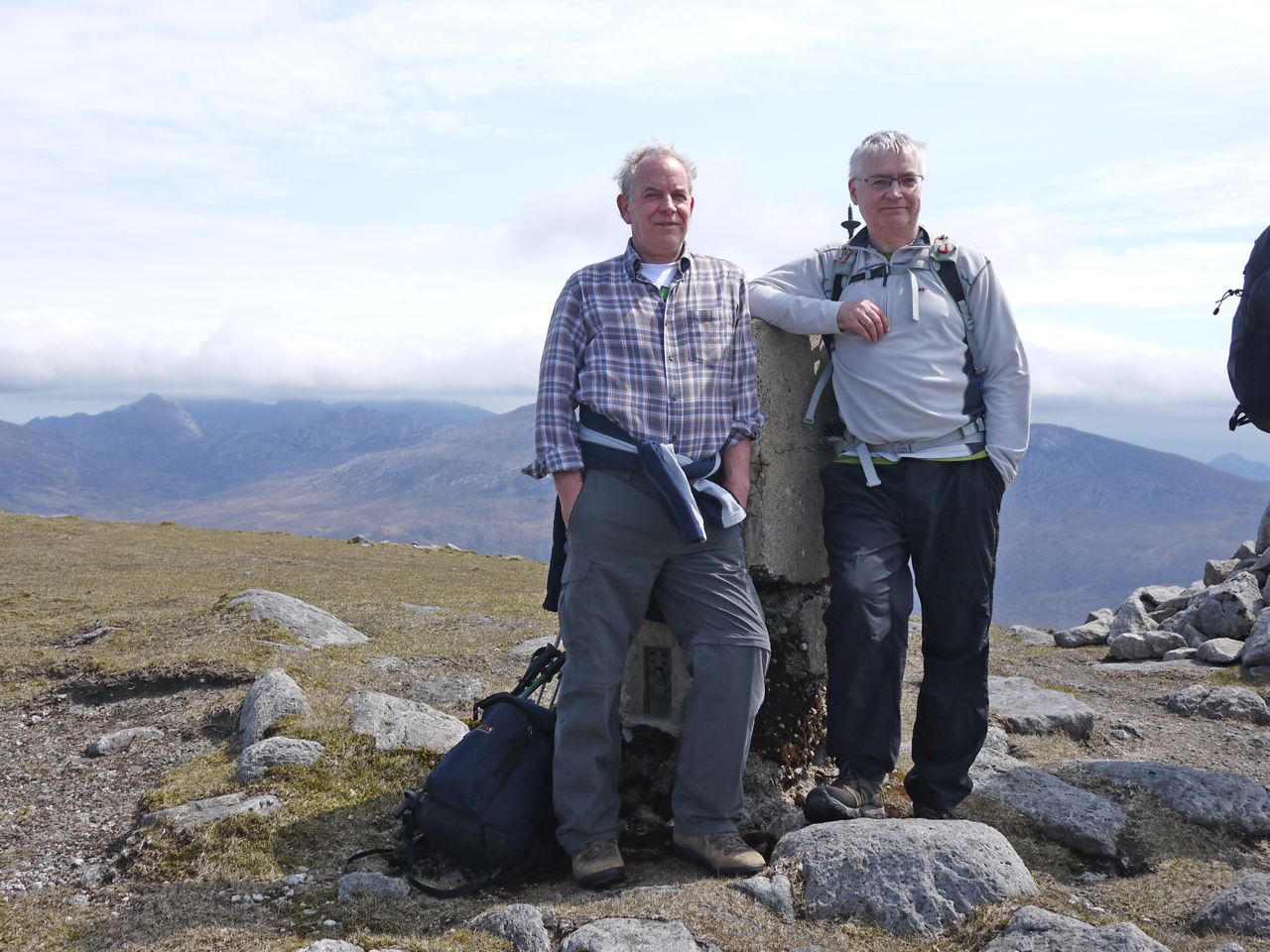
The trek to Criffel’s summit proved a little easier, with faint tracks where others had walked the same way before us. Criffel’s summit has a trig pillar with a surrounding shelter, a large Cairn, to which someone had attached a Saltire and the remains of some stone dykes. The cairn is supposed to date from the Bronze age (though I don’t know how a cairn like this can be dated), but is named Douglas’s Cairn which must be a more modern name. I can see why the summit would have been an excellent place for a lookout.
Criffel, or Mons Crefel, was recorded on a map thought to date from before 1330. The name is probably Norse, Hraka Fjall, Crow Hill.
From the summit we headed for Knockendoch (Cnoc an doch). Cnoc means hillock, but I’m less certain about the Doch. I’ve read it might come from Dubh (Black Hillock). Its covering of heather makes this believable but the sound isn’t right, unless the dubh has evolved to rhyme with the first syllable. I wonder if it might have come from Daugh, an anglicisation of Dabhach, which is an old Scots measure of land. (I claim no expertise in etymology).
The shape of Criffel places Knockendoch below the horizon when you are at the summit. A bearing sent us off along a well trodden, and muddy, path which I presumed was that heading for Ardwall so we then struck off across the heather to gain the ridge between the two hills. I’ve done this before and can’t help but think there is a path somewhere. As it was we met a path as we descended to the col. This was a definite path all the way to Knockendoch but looking back to Criffel it just seemed to disappear into the heather. Perhaps it has become overgrown.
Path off Knockendoch
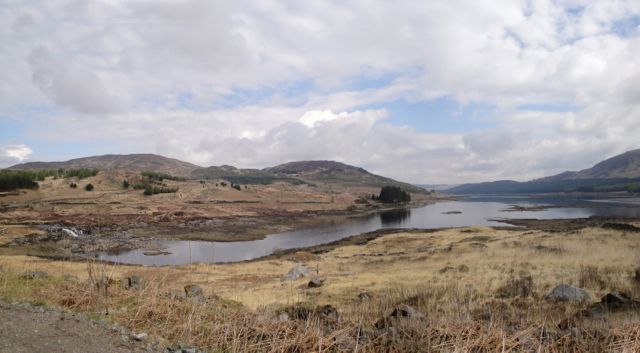
Knockendoch has a small cairn and more good views. From here we could look across to the Waterloo Monument where we had started and down the wall that would be our route back to the car. Loch Kindar with its small island, which contains the ruins of a church, and a smaller Crannog, lies below Knockendoch. This area, which is now called New Abbey, was once called Lochkinder and may take its name from the british cyn-dur (chief water).
Loch Kindar
This descent from Knockendoch requires care since it is muddy and sometimes steep. Stepping down into slippery mud is disconcerting but I am proud to say that we didn’t end up flat on our backs in the mud. Though there were a few near things.
If the mud gets to you, there is an escape by following a wall from 265m down to the forest track. But we continued down the muddy path. At 110m a small track leaves the muddy path and weaves, mudless, through the trees to join a forest track for a while before entering the trees again. This gradually changes from a forest path to a more manicured affair with planted rockeries etc by its side.
Once back at the car we were able to rinse our boots free of mud in the Glen Burn.
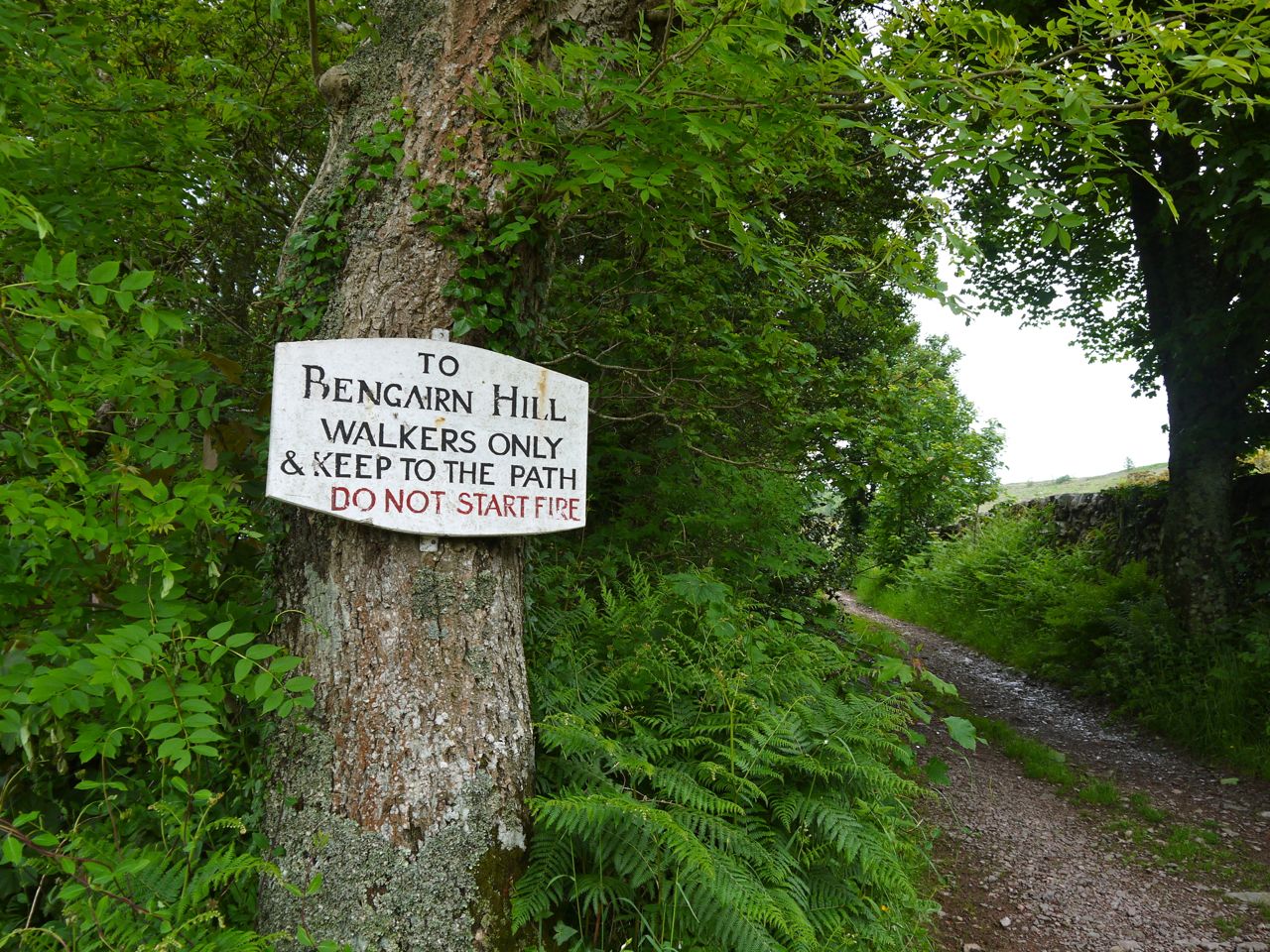
We parked at the Bengairn Hill sign (Do not start fires), on the track from the A711 to Mains of Collin, just above Bengairn Loch. A farm track climbs gently through the trees of Forest Wood, and while walking we spotted a deer. Tempted as you might be to drive further along here, don’t, there is nowhere to park.
Lying sign (it's 1.6 miles)
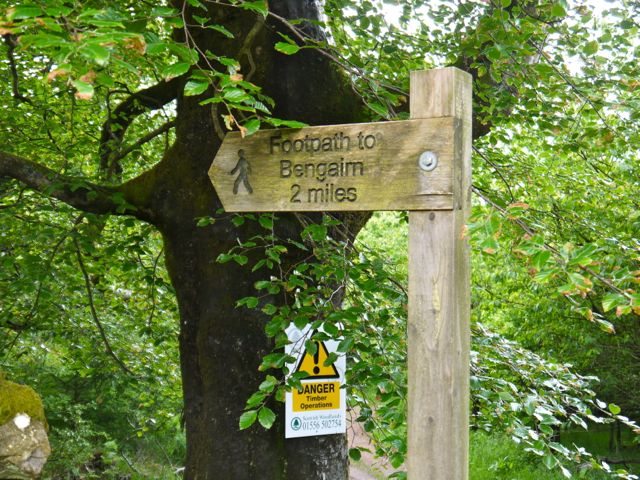
After about two thirds of a mile the track comes to a wide gate and emerges from the trees. The gate wasn’t for opening and many rungs were adorned with mud (of the farm variety), to make climbing it more interesting. A sign here states “Footpath to Bengairn 2 miles” but we made it 1.6 miles.
There is a dog-leg in the track here and a branch heads off towards east towards Greenhill, whereas we turned north. The path here runs beside Greenhill wood and the view of Bengairn is obscured by Forest Hill, which is a spur of Bengairn itself. Soon enough though the tip of Bengairn appears.
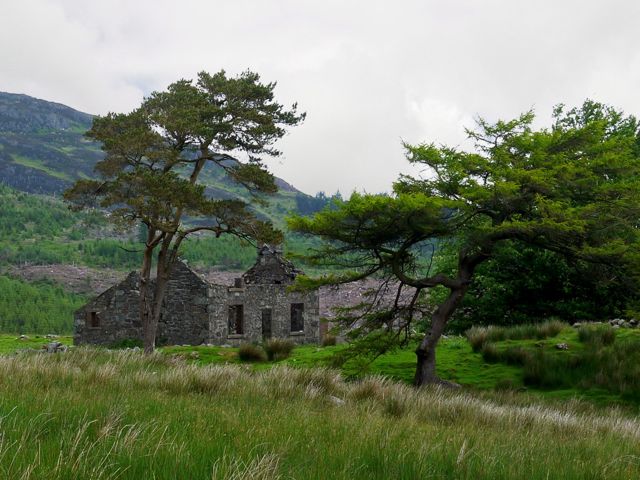
Ruins at Foresthill
After passing between Greenhill wood on our right and a stand of trees to the left we were in a wide flat area with the ruins of Foresthill Farm. At this point most of Screel is hidden behind Mid Hill, only its southerly section peeping out.
Past the ruins at Foresthill the ground looks to have been cleared and fenced in the past and remains greener than the surrounding area, due mainly I think to the lack of heather. There is a gate between these green fields and the wilder flora of the hill. I say a gate, but it would require quite some effort to open it. It sits amid a lochan in the making.
The wall either side of the gate is augmented by a barbed wire topped fence, so we picked our way from stone to stone then climbed the rickety gate. This took us from firm grassland to squelchy bog.
My original plan had been to head up to the col between Mid Hill and Bengairn but we found, and followed, a faint quad bike track which took us up a more direct route. As is often the case, having taken us off our original route this track then disappeared. Presumably quad bikes usually come up to there then turn back.
From here we headed up a cleft in the hill and wound our way to the summit avoiding the larger puddles.
Bengairn Summit
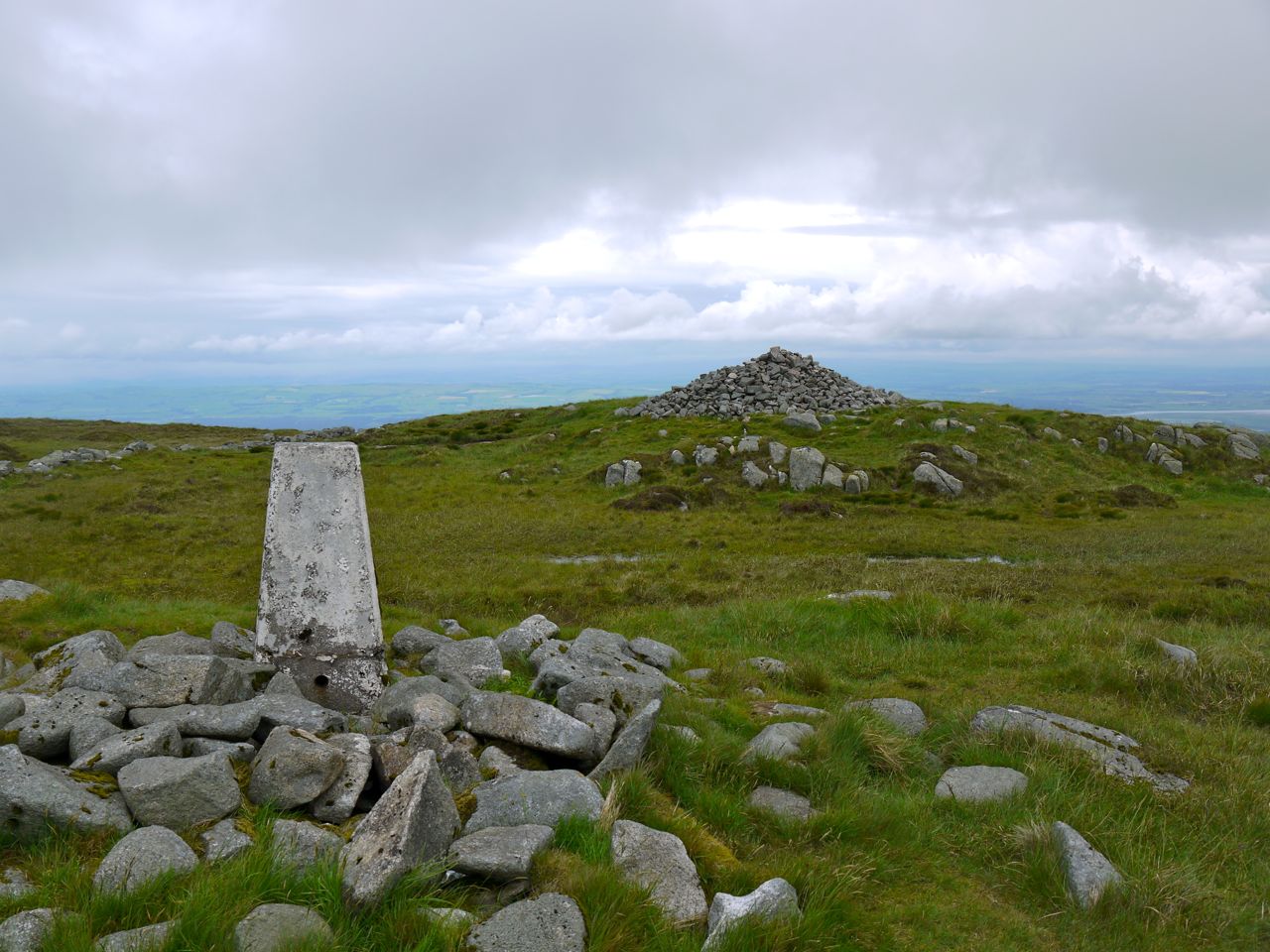
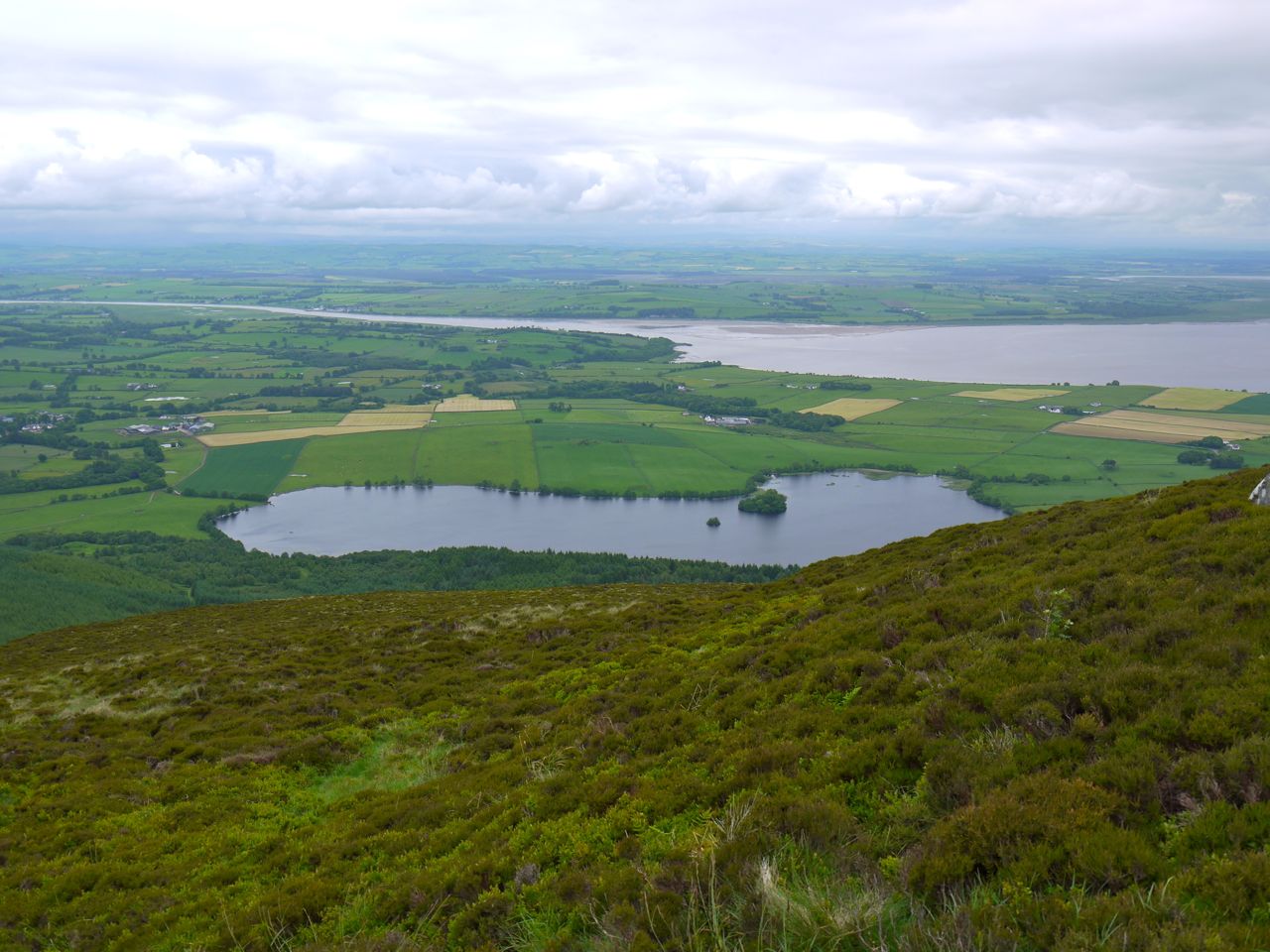
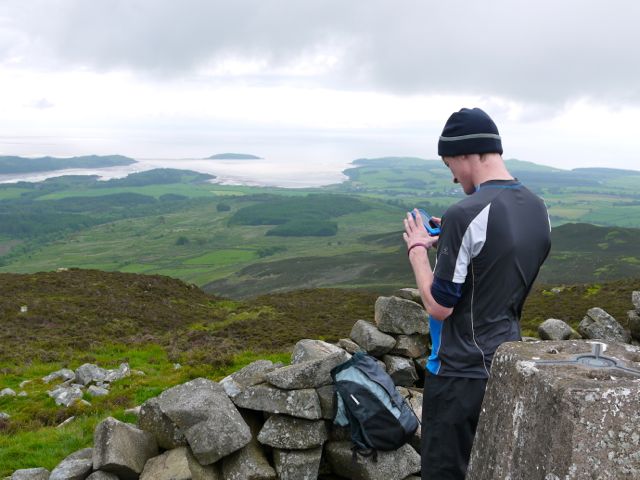
At the summit is a trig pillar surrounded by a shelter, and a large cairn, about the same size as that on Screel. We had chosen to visit in cloudy weather with rain threatening so visibility didn’t allow us to see distant features. There was however a good view of Almorness and the adjacent Islands and we could see the wind farm in the Solway.
Many of the descriptions of walks joining Bengairn and Screel recommend bypassing Mid Hill because it is impassable due to forestry. Much of this has been felled, which tends to make the terrain very difficult but there is a definite forestry track coming over Mid Hill now which could provide an easier connection between the Glen of Screel Burn and Troudale Gill. Today, however, was not a day for exploring.
Sheep-jam ahead
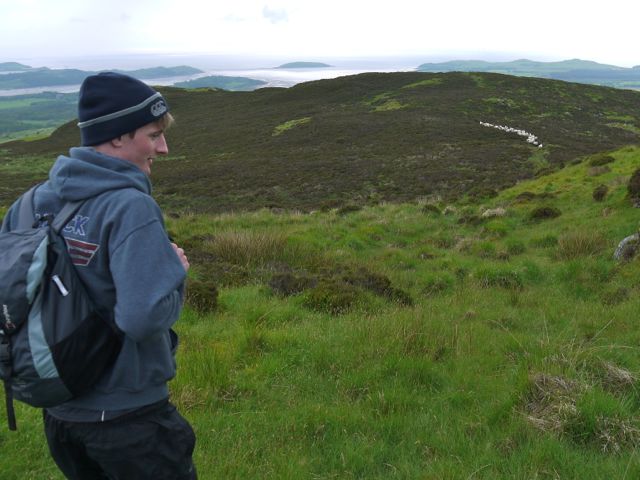
From Bengairn (Beinn na Gcairn, hill of the cairn) we decided to head down over Forest Hill since retracing our steps sounded boring. Forest Hill is a spur of Bengairn made of several heather covered hillocks. We found a track and Conor asked whether I thought it was an animal track or a sign that other humans had come this way. The answer was soon obvious when we saw a sheep jam on the path up ahead.
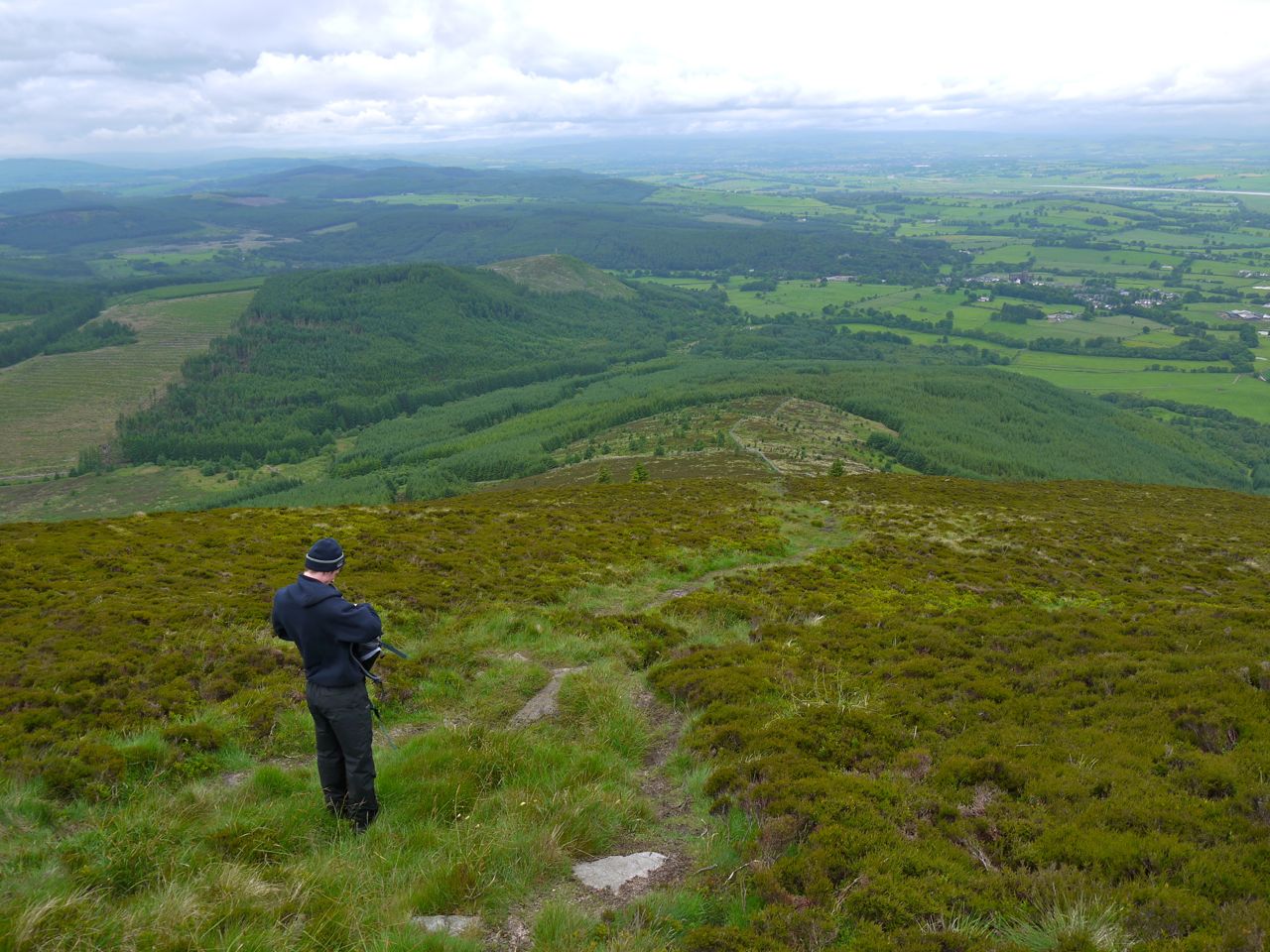
Forest Hill was mostly easy going and would seem a better way up Bengairn than our original route. It is mostly heather until the lower reaches when there is more fern and eventually a short boggy section. It was wet enough that we came across a frog. We headed down towards a stand of trees at about NX784535, where there is a gate in the wall (another one for climbing rather than opening).
From here we traced our steps along the farm track to the car.
Moorbrock Hill-Keoch Rig-Mid Hill of Glenhead-Dodd Hill
The walk starts at the entrance to Moorbrock Estate about a third of a mile beyond Craigengillan bridge. The gates were locked but there was plenty of space to park without obstructing the entrance. We had a few spots of rain on the windscreen as we approached the start, but that was the only rain we had all day.
Track to Moorbrock
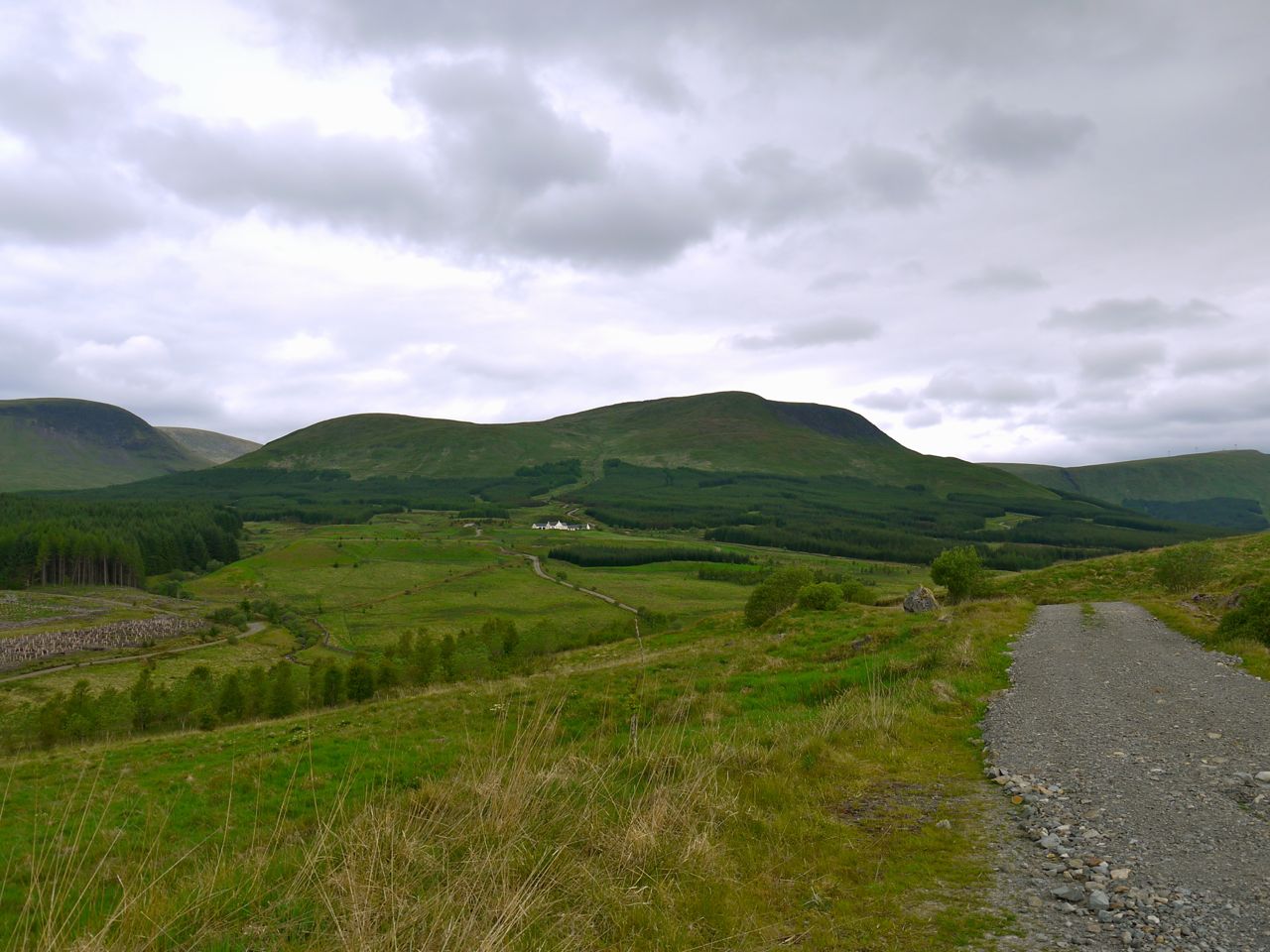
The estate road slowly climbed, through the forest, past many erratics, over a spur from Dodd Hill. As we left the trees the road began to dip down towards a small bridge over the Polifferie Burn and we had our first view of Moorbrock Hill and Benniner beyond it. The track we were on, standing out a bright white against the green surroundings could be seen winding up to Moorbrock Farm and then onto the hill itself. At this point we passed the junction with the track we were to return on later in the day. It is not on the OS map so confirmation of its existence was welcome at this stage.
The Polifferie Burn (poll a’ foithre, the stream in the woods) appears from the tree covered valley that we were to walk around, and joins the Water o’ Ken at Craigengillan. Close to Moorbrock Farm are a series of terraced ponds which must have some purpose but I don’t know it. The farm buildings were very neat and clean, looking much more like a holiday home than a working farm but it is a bit isolated for a holiday, and Conor wondered if it might be useful for a witness protection program. There was no sign of life and I was tempted to glance into the window of a building as we passed, but decided that would be rude.
The track diverges at the farm, one route heading north up the valley and the other, which we took, climbing northwest beside the Poltie Burn (poll tighe, stream of the house) onto Green Hill. The gradient here picks up enough to require shedding of layers.
Here I had my first experience of Jelly babies clubbing together. The packet had been stored in the boot of the car and I had tossed it to Conor as we set off. As we paused to divest and have a drink he opened the packet. The JBs had fused into a single mass which proved surprisingly difficult to rip apart. At least we didn’t have any of that bother about choosing particular colours, each lump torn from the mass was multi-coloured. It does say on the packet “Store in a cool dry place.”
About half a mile after the farm the track takes a sharp turn to the left to slowly climb around Green Hill, but we chose to head straight up the beside the Poltie Burn. This is a bit steeper but saves about two thirds of a mile. The way up beside the burn is amongst tussocks at first but becomes easier as height is gained. Looking back during brief pauses for breath we could see Criffel on the horizon. We rejoined the track at about 590 metres, and the going was easier after that.
The summit of Moorbrock Hill is not marked, though it is reasonably obvious where it is. Once on the top the views certainly opened up. To our left was Beninner and Cairnsmore of Carsphairn. The gairies of each don’t look inviting to walkers but there are walkable spurs at either end of these hills. I had been tempted to turn that way but decided to stick with the plan. Ahead of us was Windy Standard and the Afton Hills. To our right, Dodd Hill with a lochan at its top.
Moorbrock's North top giant cairn
Moorbrock has a secondary summit at its northern end and this was marked by a small cairn. Perhaps cairn is an exaggeration for what is really just a small pile of stones. Walkers should be asked to carry some stones up to make this more presentable. From Moorbrock we headed down, out of the wind, to the col between Moorbrock and Keoch Rig, a sheltered spot, with rocks to sit on while having a bite to eat.
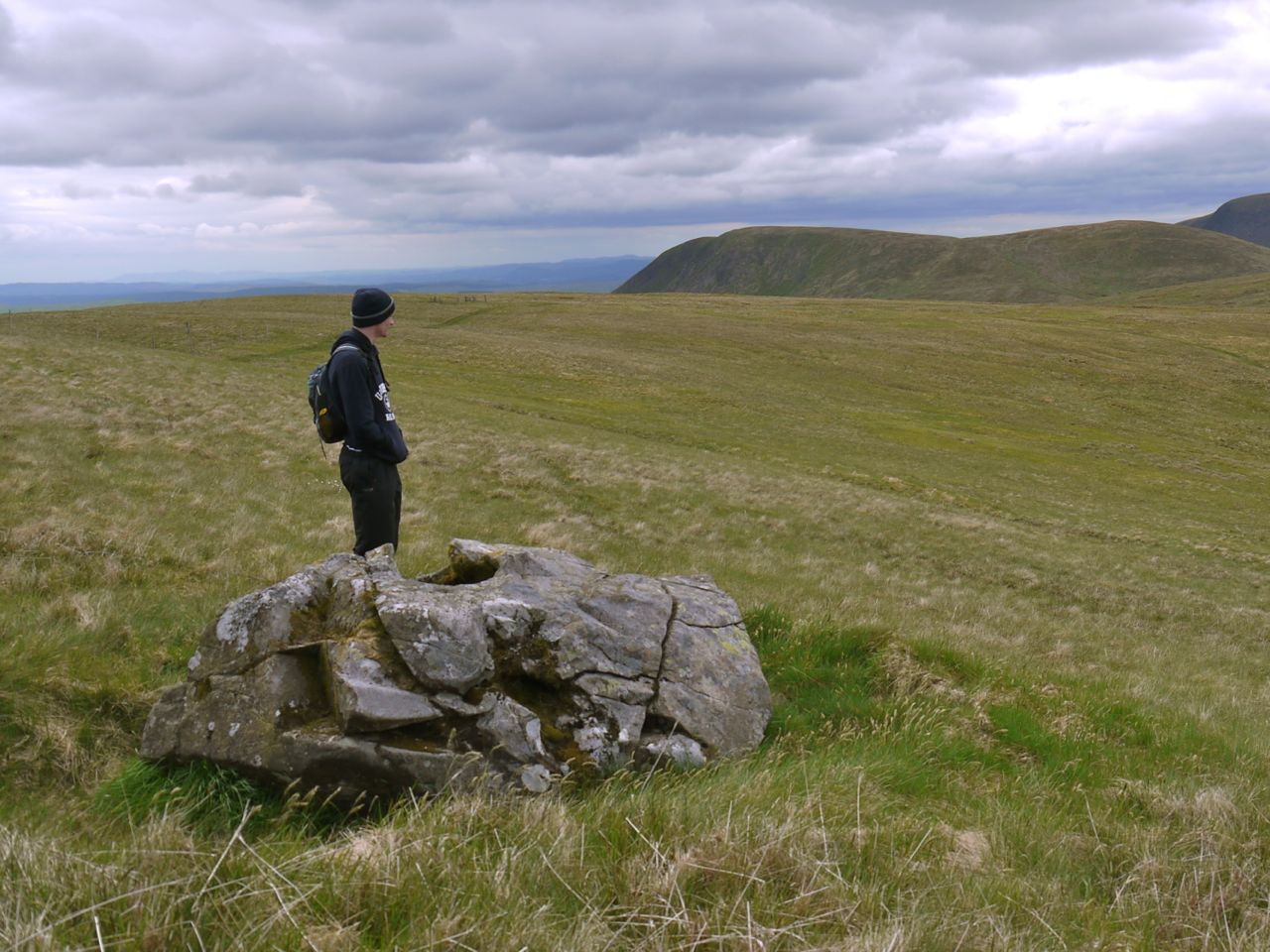
Once on Keoch Rig there were views down three glens, Clennoch, Polifferie, and Holm/Dalquairn. I decided to visit the Deil’s putting stone, an erratic with a bowl shaped hole worn in the top, since it’s marked on the map. Unfortunately it was not particularly exciting.
Deil's Putting Stone
From the stone it’s only half a mile to the top of Windy Standard, but we turned away towards Mid Hill of Glenhead. The col before this is marked as the Hags of Poljargen (pol deargdn, the red stream). There are no peat hags here now but the soil does have a red tinge. Throughout this walk we were on dry terrain but I am sure, judging by the vegetation, it is usually wet.
Climbing Mid Hill we also came close to a fox, perhaps just 15m away and once on the summit we could see the Striding Arch on Benbrack and the Radar station on Lowther.
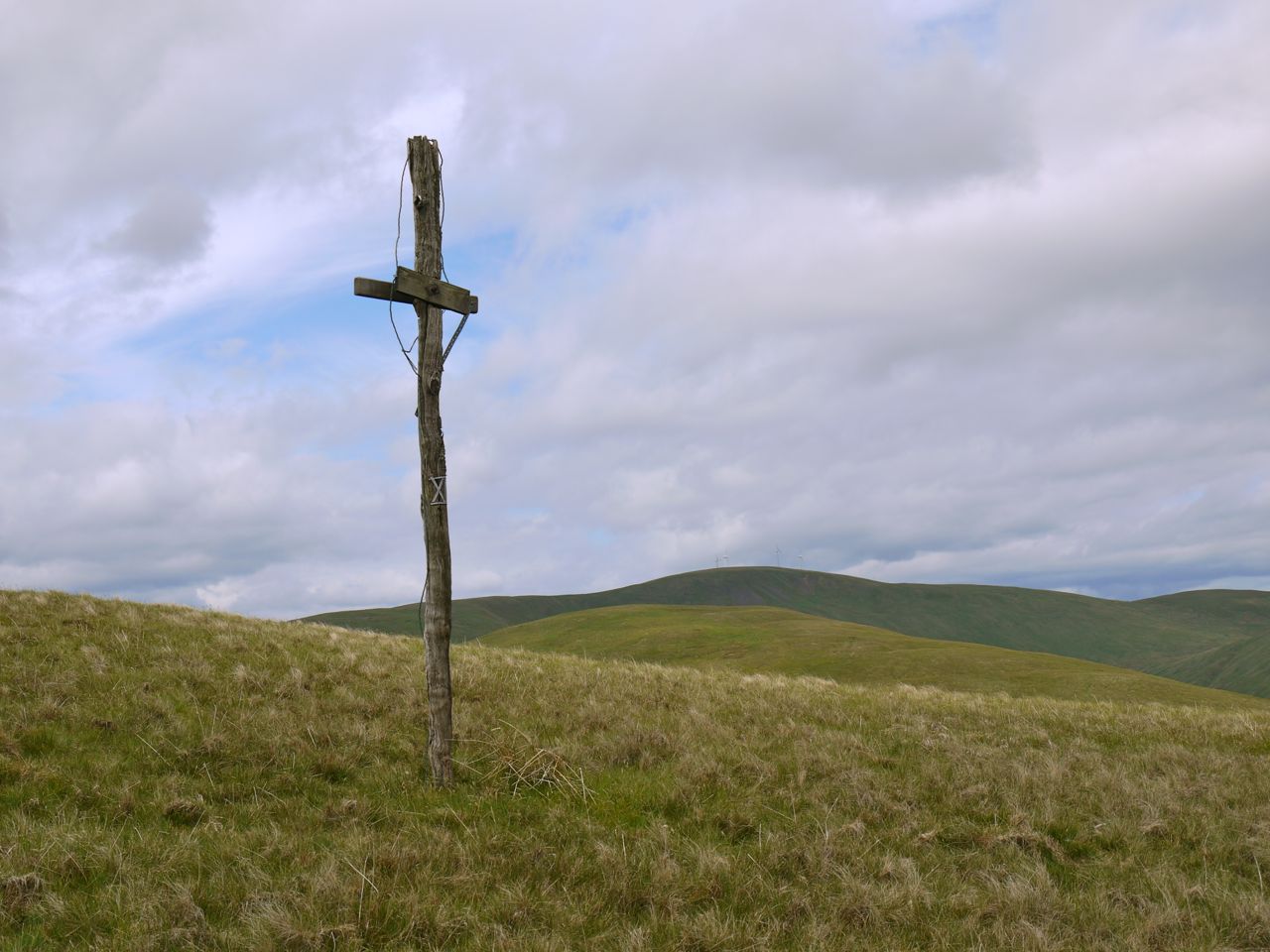
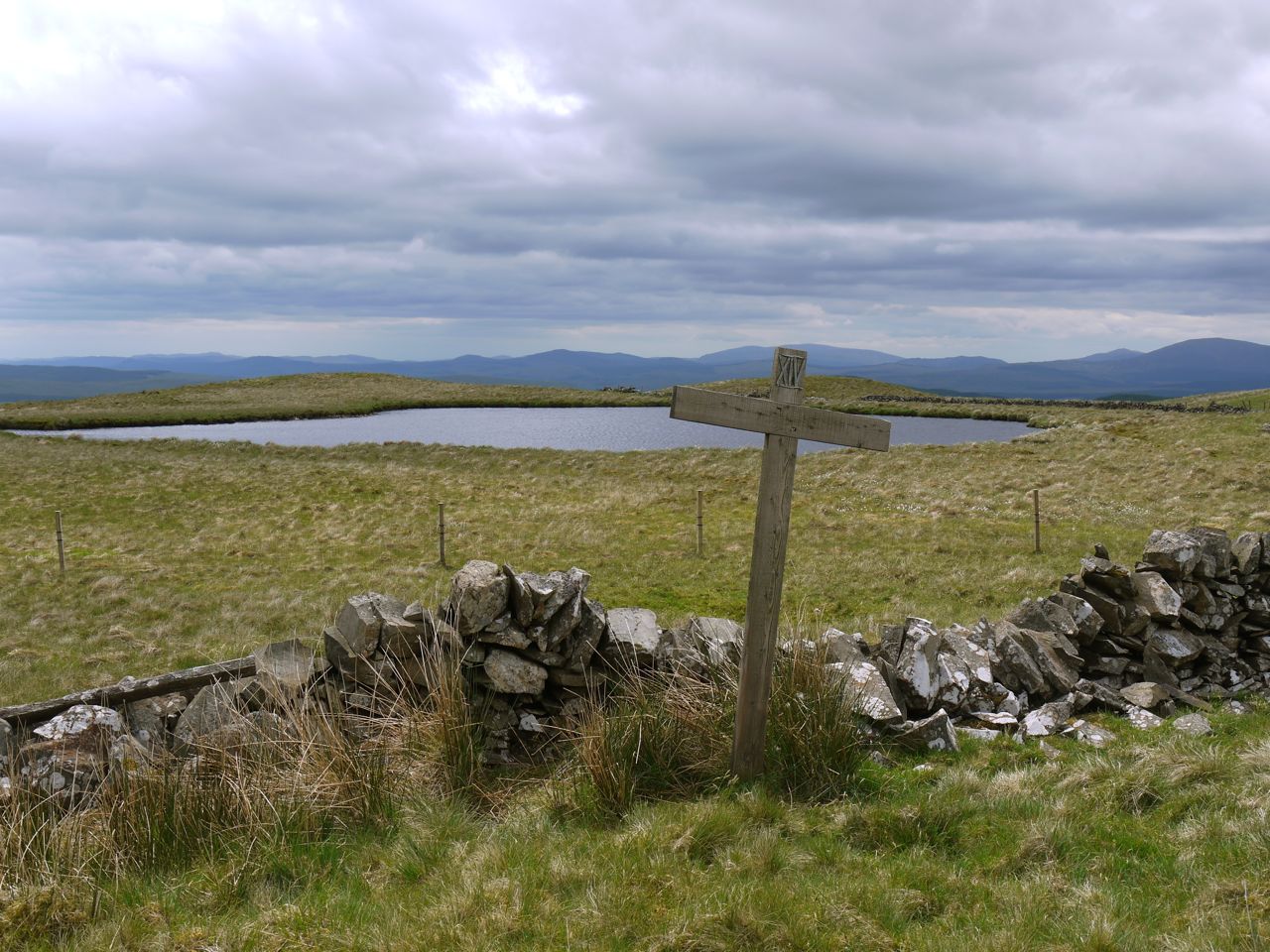
I had wondered as we walked if the crosses I had heard about on Dodd Hill would still be there, and in the col between Dodd and Mid Hill we found a large cross lying on the ground, but as we climbed we saw some others at the top.
Cross and Lochan on Dodd Hill
The crosses are marked with roman numerals and represent stations of the cross. Including the cross lying in the col we found four. I did not see any further down the hill.
Dodd Hill’s other unusual feature is the lochan at its summit.
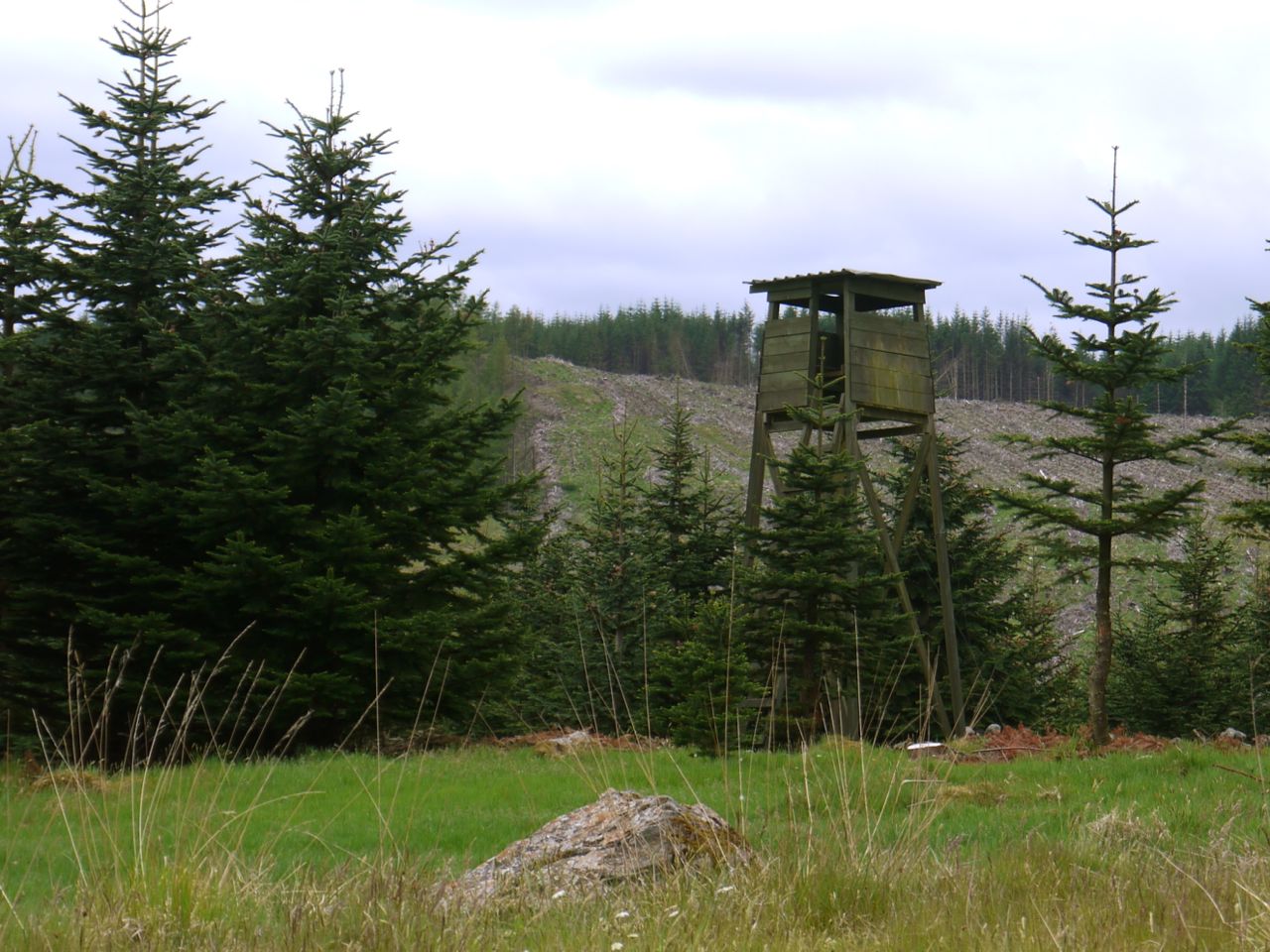
Sentry post
From Dodd Hill we headed down just west of south to join a track. This is another tussocky section that I suspect can be wet at times, but once on the track it was a straightforward walk back to the car and we were able to sneak past the sentry post without any trouble.
My hill-bagging compulsion has me on edge; just one hill to go to have completed the Corbetts, Grahams, and Donalds of Region 27/D&G. The walk was all planned. I have walked in rain, sleet, fog and snow, but….
Today was just too hot to go walking long distances. Instead I took the dogs out for their walk then popped about taking some pictures. Most are from today, a couple from earlier this month. Probably walked about 2 miles, drove the rest.
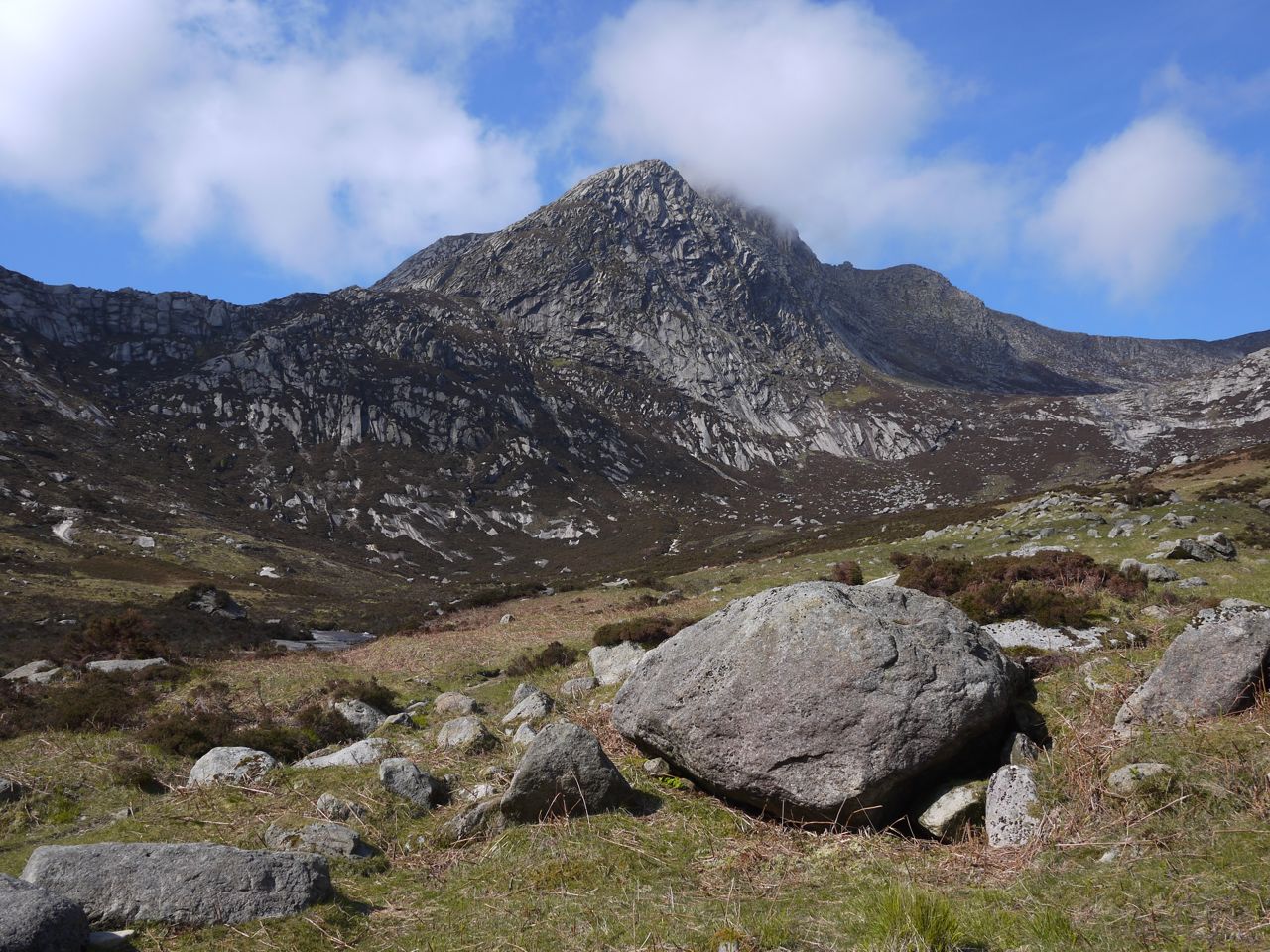
Sannox-Cir Mhor-Caisteal Abhail-Sail an Im-North Sannox
Day 2 (for us) of the Arran Mountain Festival.
Judging by the sunlight coming through the curtains when I woke up we were in for a scorcher. I made a mental note to take extra water and decided against lugging a flask of hot coffee with me. We started the day with another full breakfast. I say full breakfast since the plate was full, but there was no black pudding. Perhaps they are frowned upon on the Isles? This time we had managed to negotiate an earlier start and had bought a box of chocolates for the cook since she had come in early on a Sunday morning to make our breakfast.
Suitably fed we set off for Brodick to join our walking group for the day. This time we were wise and applied some factor 50 to our exposed parts. The wisdom was in short measure though since I failed to take it along for reapplication later in the day. My elbows and neck were to pay the price.
Corrina and Ken were our guides. Helpful, knowledgeable, perhaps a little too speedy for my comfort at times, but it must be hard for them to cope with a sloth like me, forever stepping aside to take pictures.
Sannox Burn
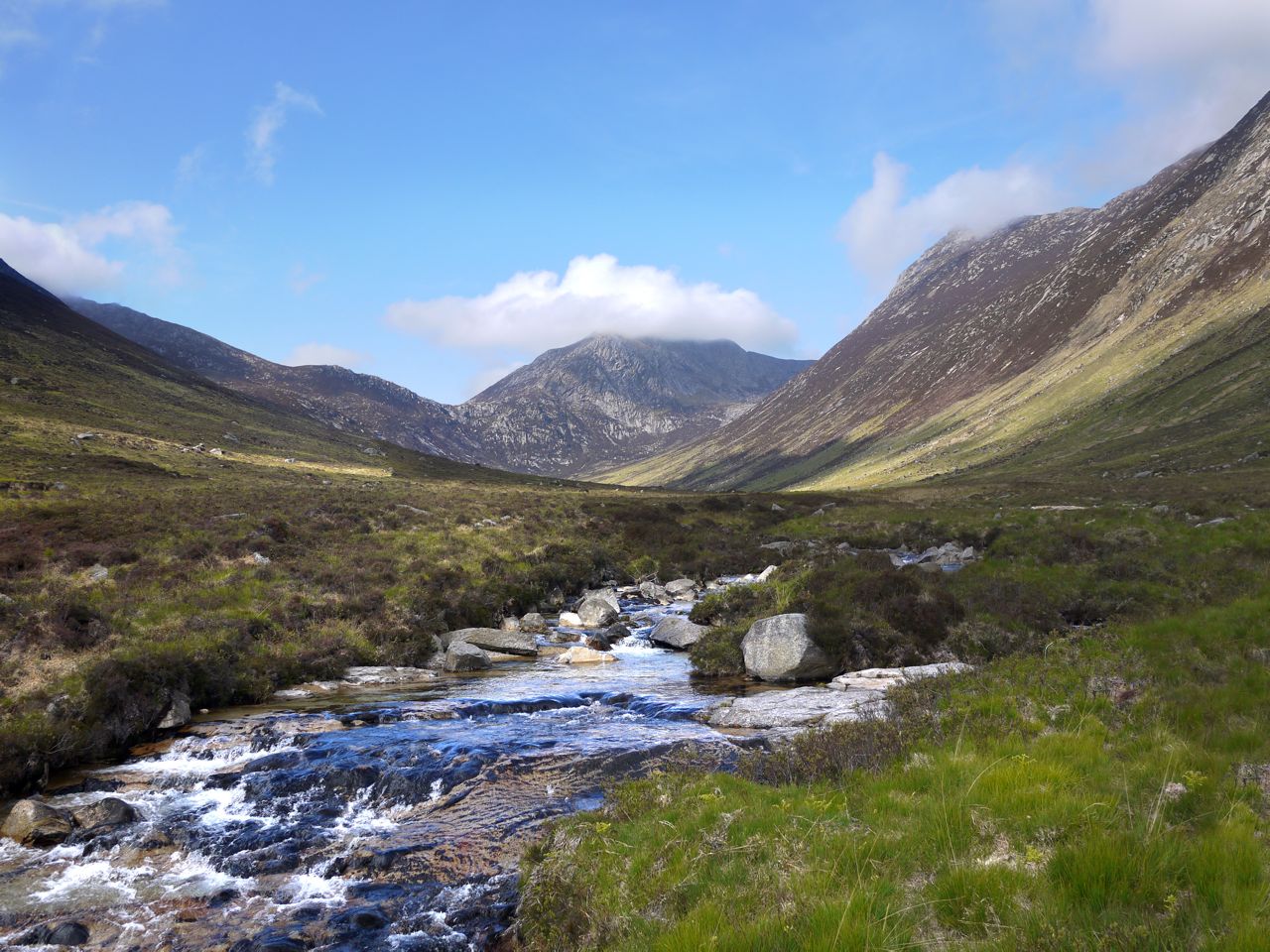
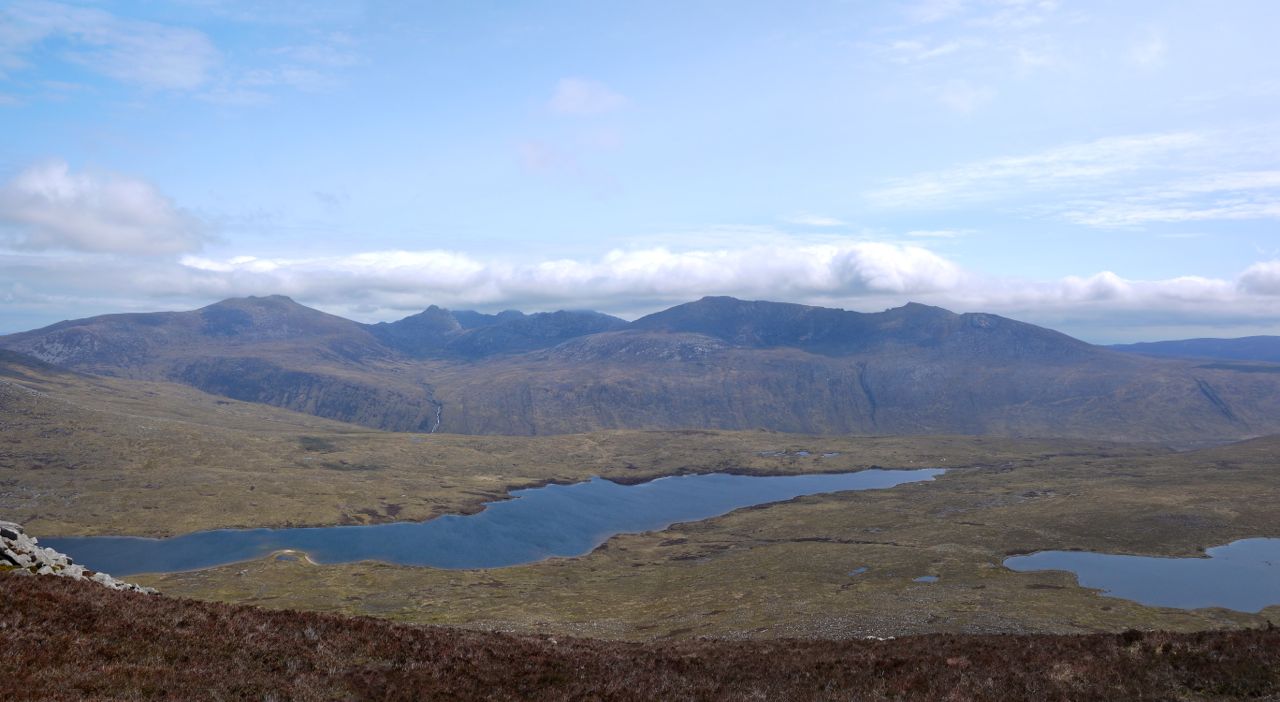
After a brief minibus ride we arrived in Sannox and set off along a good quality path up Glen Sannox. Steep hills stood either side of this glacial valley, the Bastion with the Devil’s Corrie to our left and Fergus’s Seat with the Witch’s Step to the right. Soon enough Cir Mhor came into sight which with its mountainous shape looked imposing, perhaps even intimidating, as we approached it. Sannox Burn runs close by the path, the water running over slabs of granite. Since the water level was low many of these slabs were exposed and had dried into a whitish grey giving the appearance of a bright white road. I now realised what the white strip running in Glen Catacol the previous day had been.
This area had been used in the past to excavate barytes (barium) and the remnants of the works were still visible. Apparently there was once a small railway serving the mines here. Anyway, what with me gawping instead of concentrating, I took a tumble here. It is strange how the mind works at times such as this. I somehow lost equilibrium and in a fraction of a second I was aware that remaining standing was no longer an option, yet I was able to choose where to fall (path or grass). No physical harm done.
Cir Mhor
We stopped by the burn below the 200m contour for rehydration and snacks before the steeper section to the saddle. From here Cir Mhor looked even more of a challenge. The Castles and Witch’s Step were now clearly visible, but looked decidedly less impressive than Cir Mhor. But this was because they were so far away.
The path then took us to the foot of Cir Mhor and a steady climb up rocky steps and short easy scrambles to the Saddle. We had been told at the beginning that we would be keeping a “reasonable pace”, something I had interpreted as “pretty quick”. During this section I was happy to realise my mistake. We took it at a comfortable pace with enough rests even for me. I think we took about 40 minutes from the burn crossing to the Saddle.
On the saddle we had time for rest, rehydration and tough bananas. From here we had great views back down Glen Sannox and Glen Rosa. There was time to consider Coire na h-Uaimh and its possible pronunciation (weave?) and the remaining climb to Cir Mhor’s summit. The sun was now really putting some effort into shining, so I broke out the sunhat. Luckily it was not the daftest headwear on show (by a long way). Yes I do mean that tartan hat.
on Cir Mhor
The remaining 350m was much of the same, steps and very short scrambles. We passed a spade (or was it a shovel?) stuck by the path, which had apparently been left by the guys who had been up here repairing the eroded paths. I would have taken a photo but I was probably in “OMG-when-are-we-going-to-take-a-rest-stop” mode during which I can only concentrate on walking/climbing.
Closer to the summit there were a number of grassy ledges and it was just a brief scramble to the top. It was a little crowded on top so we soon came down to one of the sun trap ledges for lunch and a post-prandial nap, watched over by a raven (the Devil’s spies. I ate my sandwich gazing over the corrie of the caves (Coire na h-Uaimh) to the forked castle (Caisteal Abhail) and the Witch’s Step. What a vista.
A' Chir
The views here also take in Goatfell, the A’chir ridge leading to Beinn Tarsuinn, and the Beinn Bharrain hills (from the previous day). We were even able to watch (through binoculars) some brave souls making their way along the A’Chir .
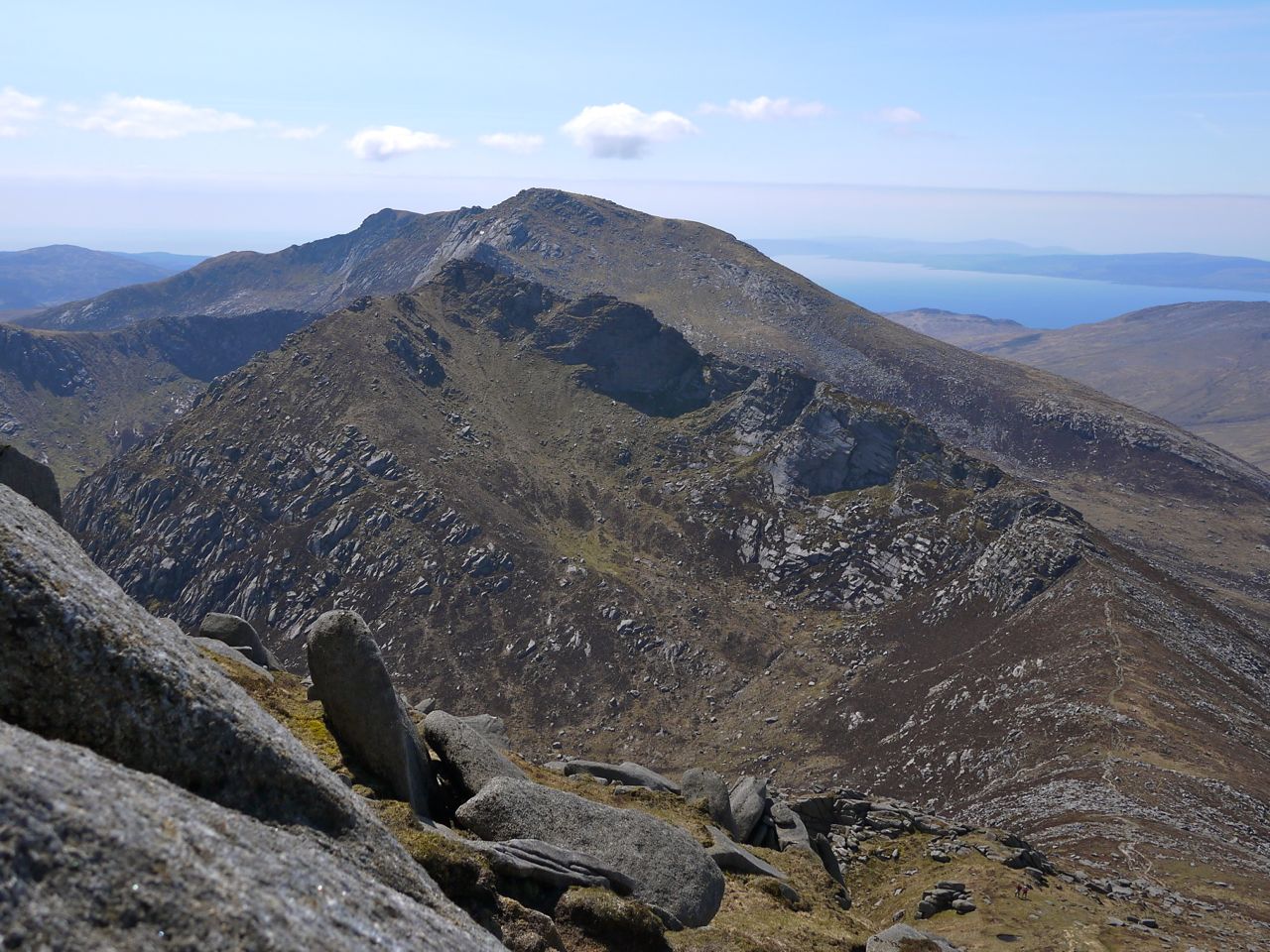
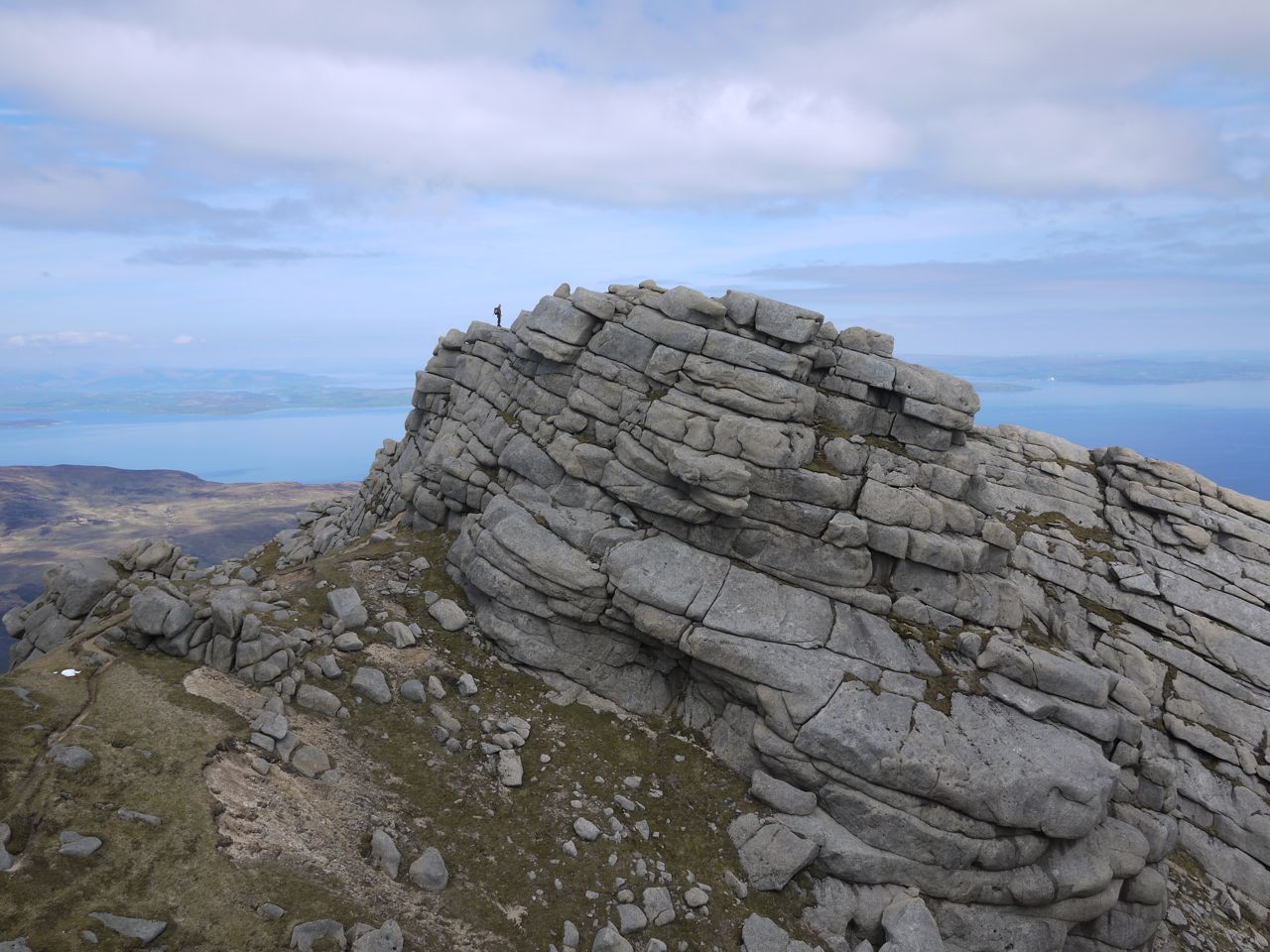
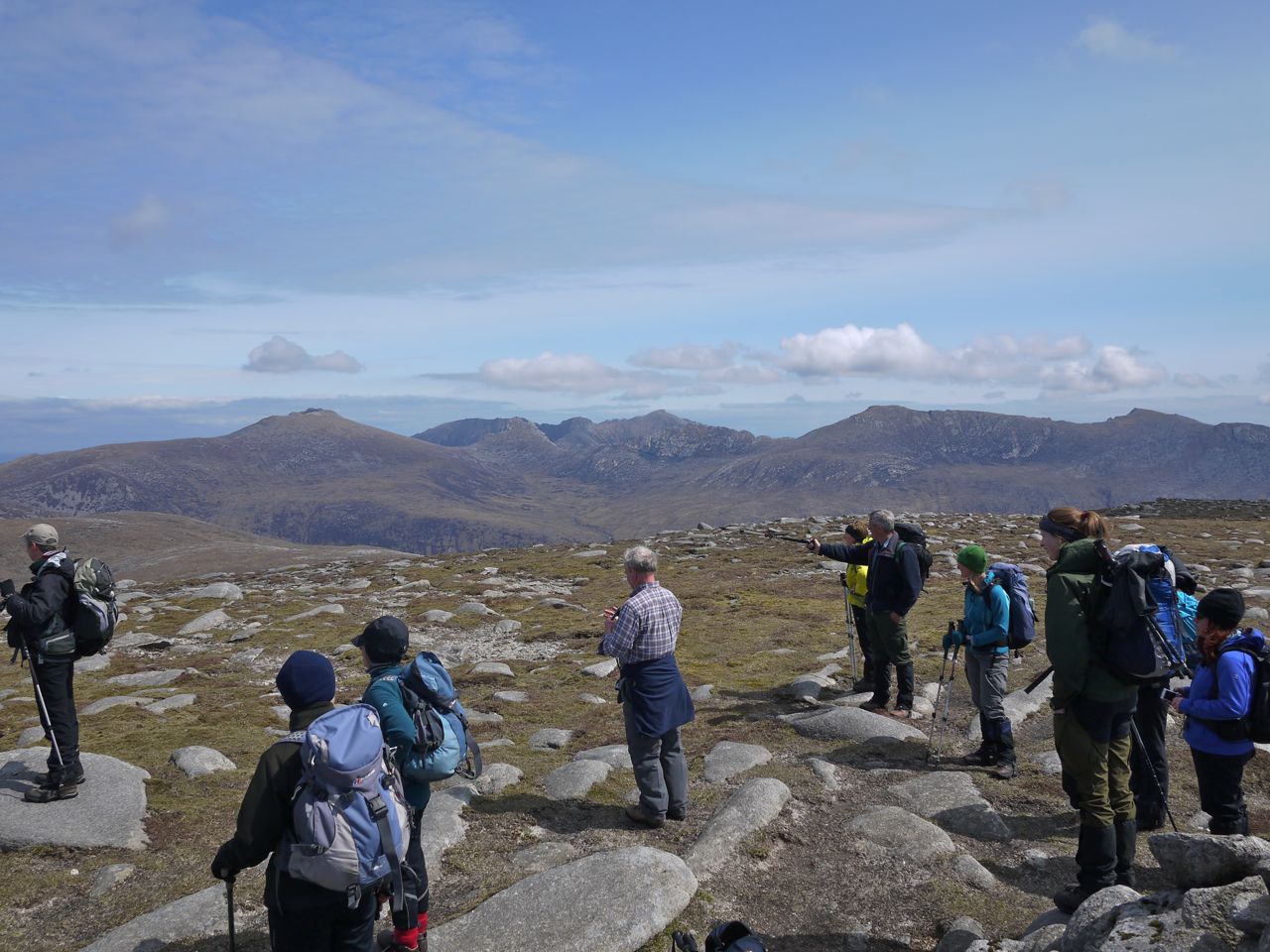
After a good dose of UV, we shouldered our packs and headed down the ridge sweeping above Coire na h-Uaimh to Caisteal Abhail, our highest point for the day. This was a long slog in the summer heat but the distant granite pillars slowly grew closer and soon enough we were clambering up to the top to be greeted by fantastic views. Up close the castles are far more impressive than they had appeared from Sannox Glen.
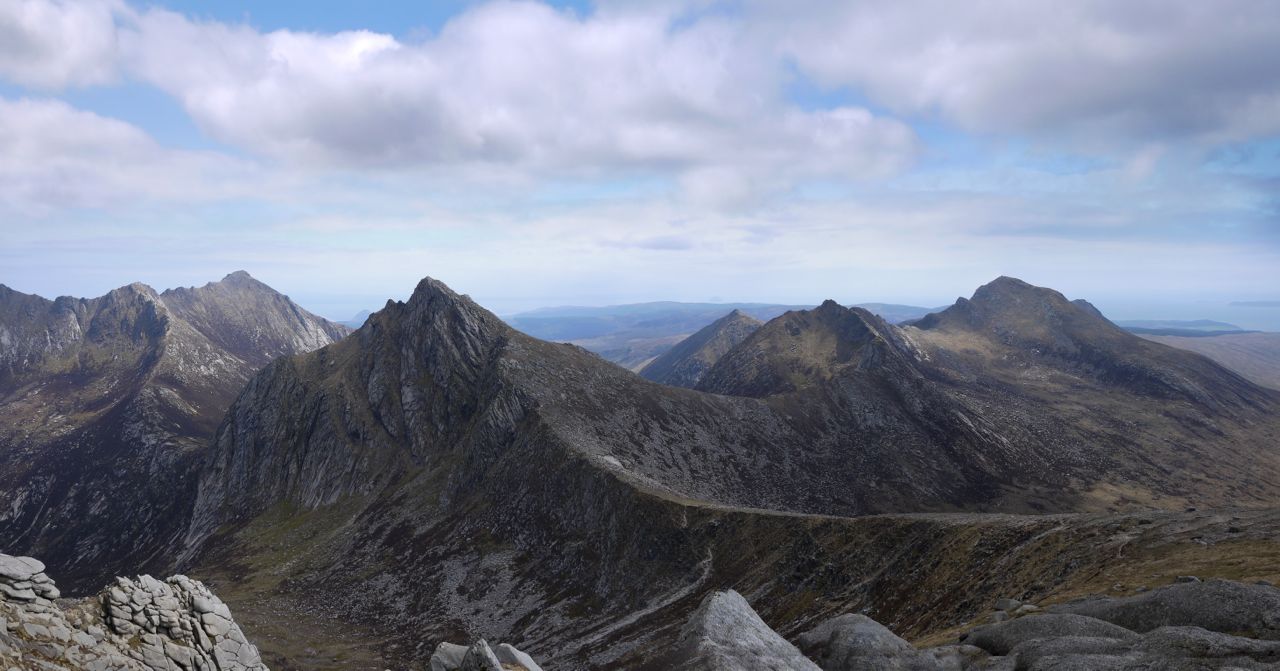
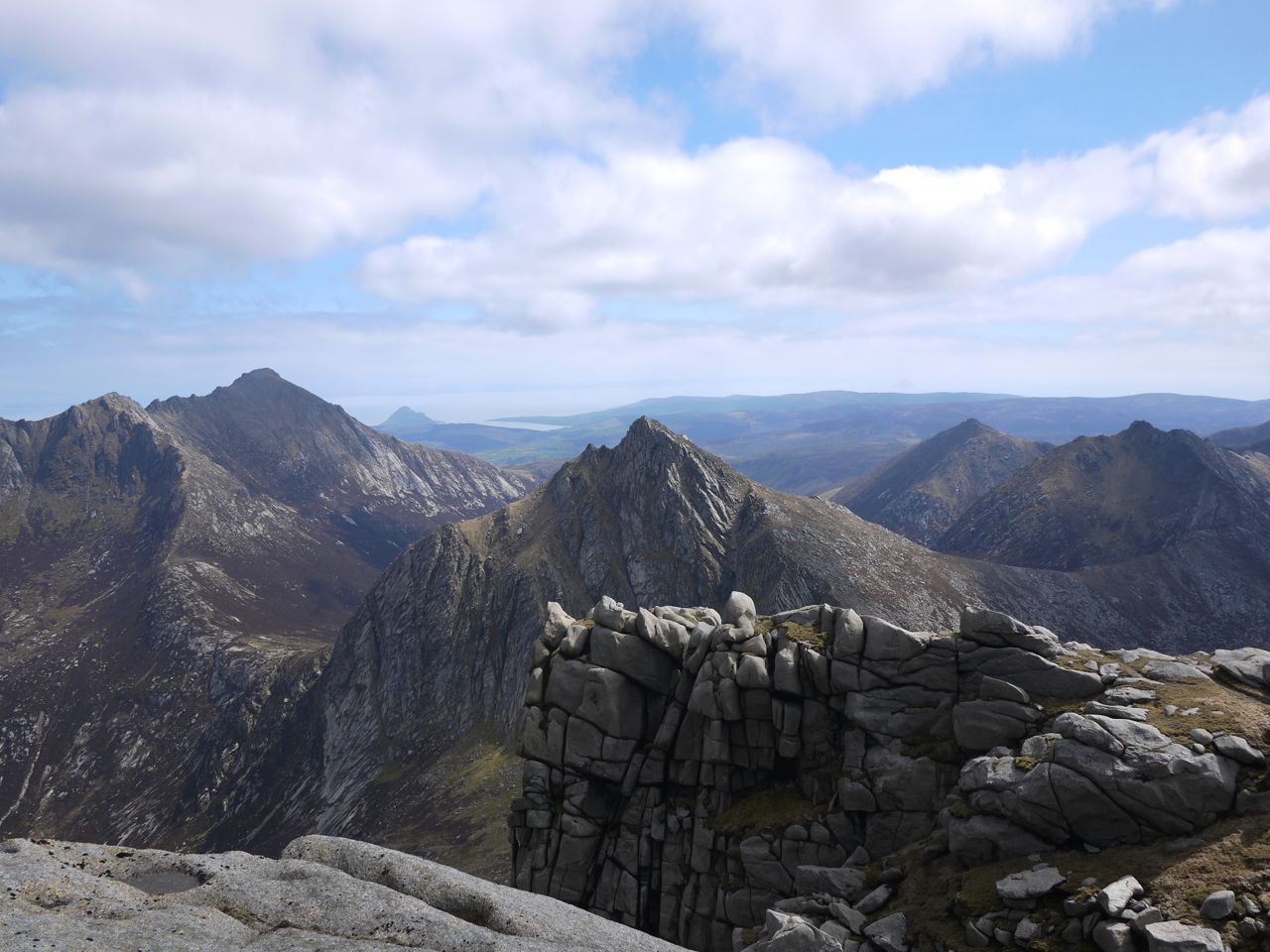
Cir Mhor from the Castles
We had short break on the Castles to rest our legs and exercise our cameras. The views back over Cir Mhor, in particular, were wonderful.
Being ahead of time, there was some question as to whether we might attempt the Witch’s Step, but the prevailing view was against this so the pick up bus was summoned earlier instead. I should admit that I was among the “no” votes since I require a period of working myself up for challenges such as that.
Caisteal Abhail
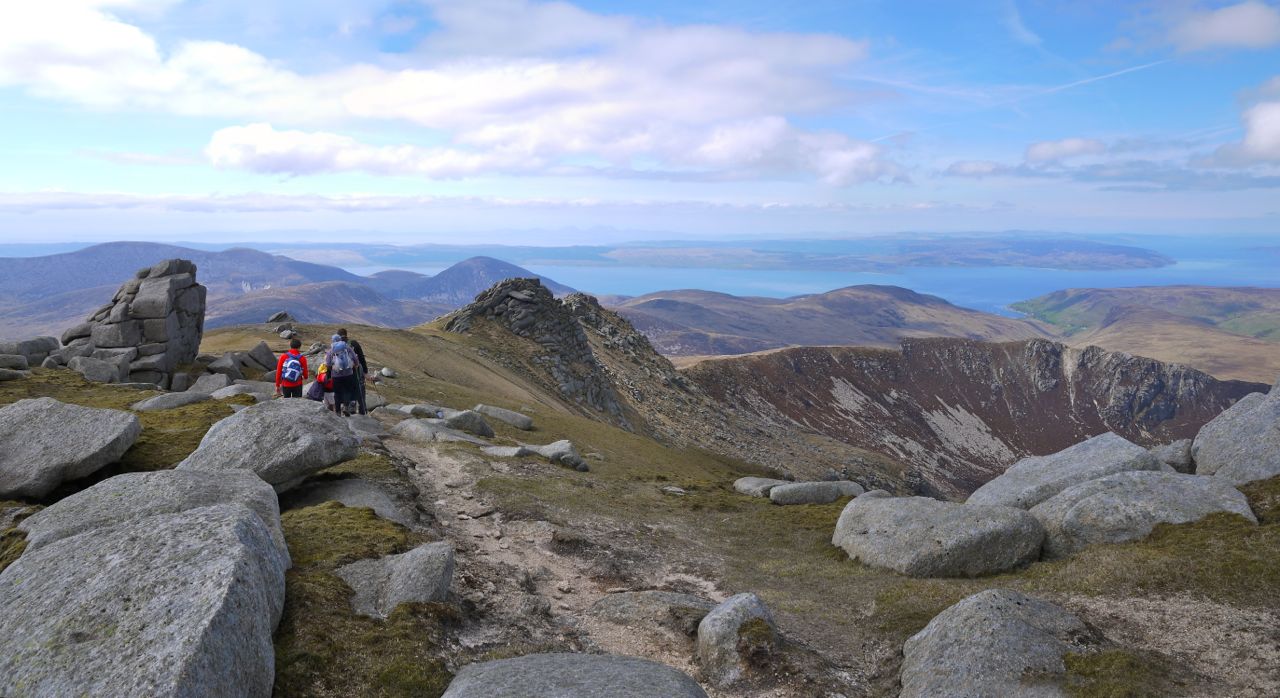
From the Castles we headed off down the long spur that sweeps around Garbh Choire to Sail an Im (the heel of butter? That can’t be right). This was a pleasant way to end a walk, a gentle gradient, easy footings, and nice views over Lochranza and back to the Castles.
This ridge is a good walk in its own right, though perhaps under-rated because of comparison with its neighbours. The path winds its way around mini versions of the castles, the Creag Dhubh, and eventually changes from gentle rocky ridge, to a steeper grassy slope.
Sail an Im
The steeper gradient placed a little more strain on older knees. I was tempted to break out the walking pole, as others had, but decided I was young enough to do without (I was born in the space age).
We descended into an area of wetland, with several small lochans glistening on the shoulder of a small hill (An Tunna) and made our way across some boggy ground to reach a path at the start of some forestry.
The path had been visible from the ridge, and had looked yellow, prompting me to point it out as the yellow brick road. Unfotunately, George was still a sharp as ever, even this late in the day. Quick as a flash he told me that I might get a brain if I got to the end of the road. Cheeky B….r. Had I mocked his hat? A temptation that St Anthony would have been hard pressed to resist. No, I had held my tongue. Admittedly, that was because I couldn’t think of anything funny to say, but that’s not the point.
North Sannox Burn
The yellow brick road was actually a light grey gravel path, which would once have been guarded by a gate in the deer fence. The tall stile was still there but the gate itself looked to have been destroyed, as had another further along the path. We actually saw a deer below the deer fences.
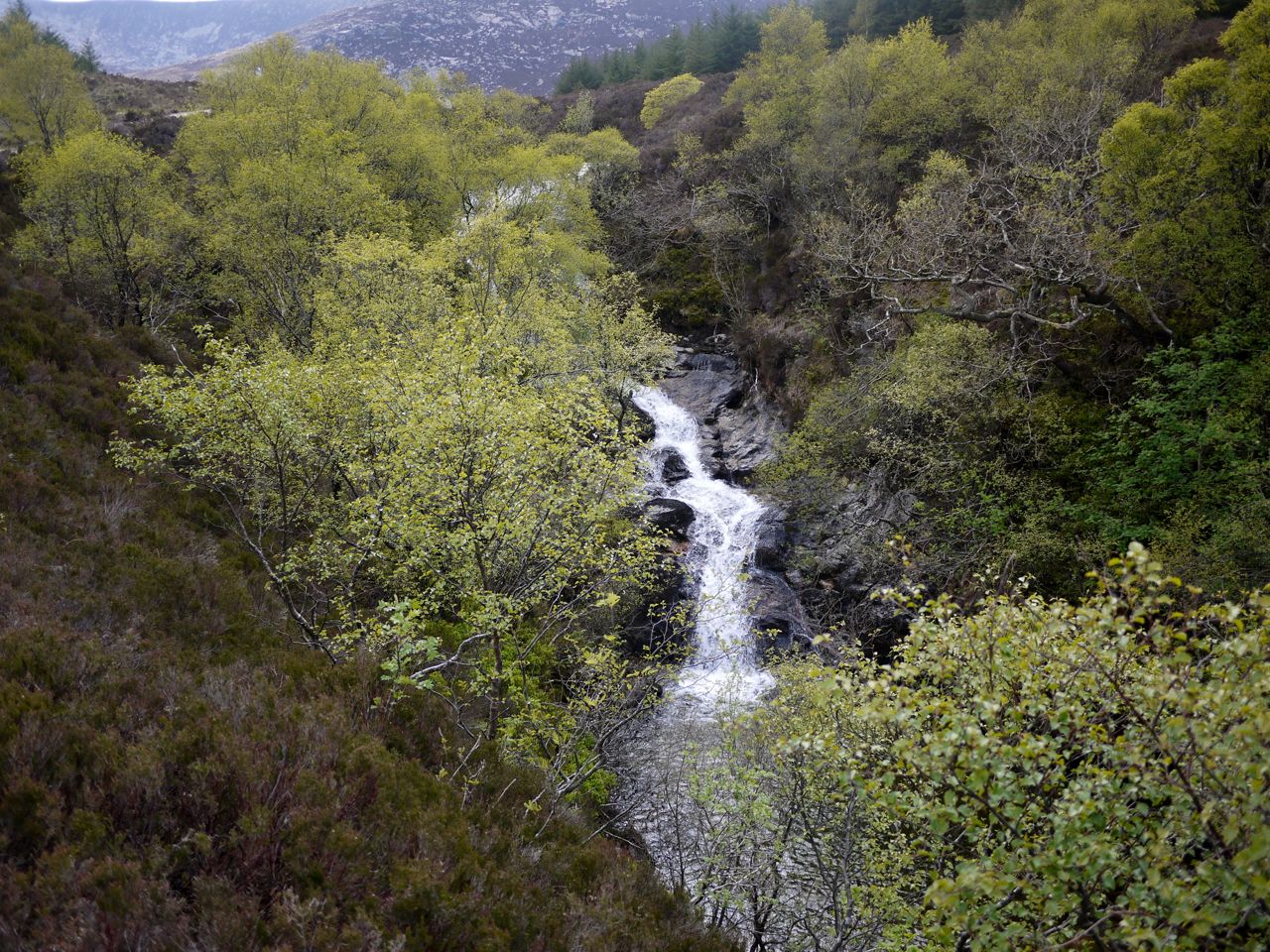
This path ran alongside, or at least close to, North Sannox Burn which had a couple of small waterfalls. After the day amongst granite strewn hills it was a pleasant change to walk by waterfalls, through the greenery of woodland, with a cuckoo calling out (or was it a dove cooing?).
This was a great day’s walk in ideal walking weather. The hills were enough of a challenge to leave me with a sense of achievement. The views were great. And all this in good company.
This was the first day of a two day outing to Arran, taking in some guided walks in the Arran mountain festival. Day one was to be a journey to the Barren Hill, the Yellow Summit, The Speckled Hill, the Brown Hill and the Fair Loch. The week running up to this had been marred by inclement weather, and even as we sailed from Ardrossan the rain was still falling. Still the fish and chips were nice on the boat.
By the Saturday morning, though, the rain had cleared and the weather forecast suggested it would stay away. Unfortunately breakfast started a little too late to allow a leisurely meal and we hadn’t managed to negotiate an earlier breakfast. So it was a speedy breakfast of bacon, eggs, sausages, tomatoes, mushrooms, potato scone and toast, without time to relax before we had to set off for our rendezvous in Brodick. There we signed up and met our guide for the day, Corrina.
Above Pirnmill
The walk was to begin at Pirnmill, once a centre of bobbin making, I believe, so the first stage was a minibus ride across the island, during which the driver, Charlie, I think, gave us his views on the various conservation and ecology initiatives taking place on the island. I suspect these differed somewhat from those presently held by conservationists, and tended to hark back to a bygone age when jolly schoolchildren would guide the bus driver into reversing onto the beach ( out of a sense of fun, rather than badness); poachers pitted their skills against gamekeepers; twenty families would farm land now tended by just one farmer; deer numbers were kept down, sparing many drivers from collisions; and land wasted by set-aside was in productive use.
The walk itself began at Pirnmill, where our other guide, Andy, joined us. We strapped on our kit and headed up past some houses, onto grassy slopes and then through some relatively young woodland. Luckily our only episode of straying off course was in the first five minutes, and was rapidly corrected with the help of a local lady who came into her garden to point us the right way.
Falls on Allt Gobhlach
Our route took us along the north bank and then across the Allt Gobhlach (the forked burn) and as we came out of the woodland, the two spurs from Beinn Bharrain, enclosing the Coire Rionn, were there before us. We were to head up the western spur, the eastern one being steeper and sharper. Along here we walked under the watchful eye of a raven and later passed its nest. Allt Gobhlach runs in a steep sided gully with some small waterfalls, but higher up the slope there was a easy crossing that led us onto a short stretch of boggy ground. I did initially rue my decision to forego gaiters but it proved easy enough to pick our way across this without submerging our boots. The terrain remained a little wet even onto the slopes but soon enough we were on firmer ground with scattered rocks. This was to be the terrain for most of the day.
Col between Beinn Bharrain and Mullach Buidhe
It was a bit of a slog up the spur to Beinn Bharrain and as we climbed the sun came out. But comfort improved as clothing was shed, and both the views and visibility improved. Jura’s mountains were clearly visible beyond Kintyre and the rocks of the Corrie Roinn just beside us began to catch the sunlight, taking on the colours I associate with the Dungeon Hills.
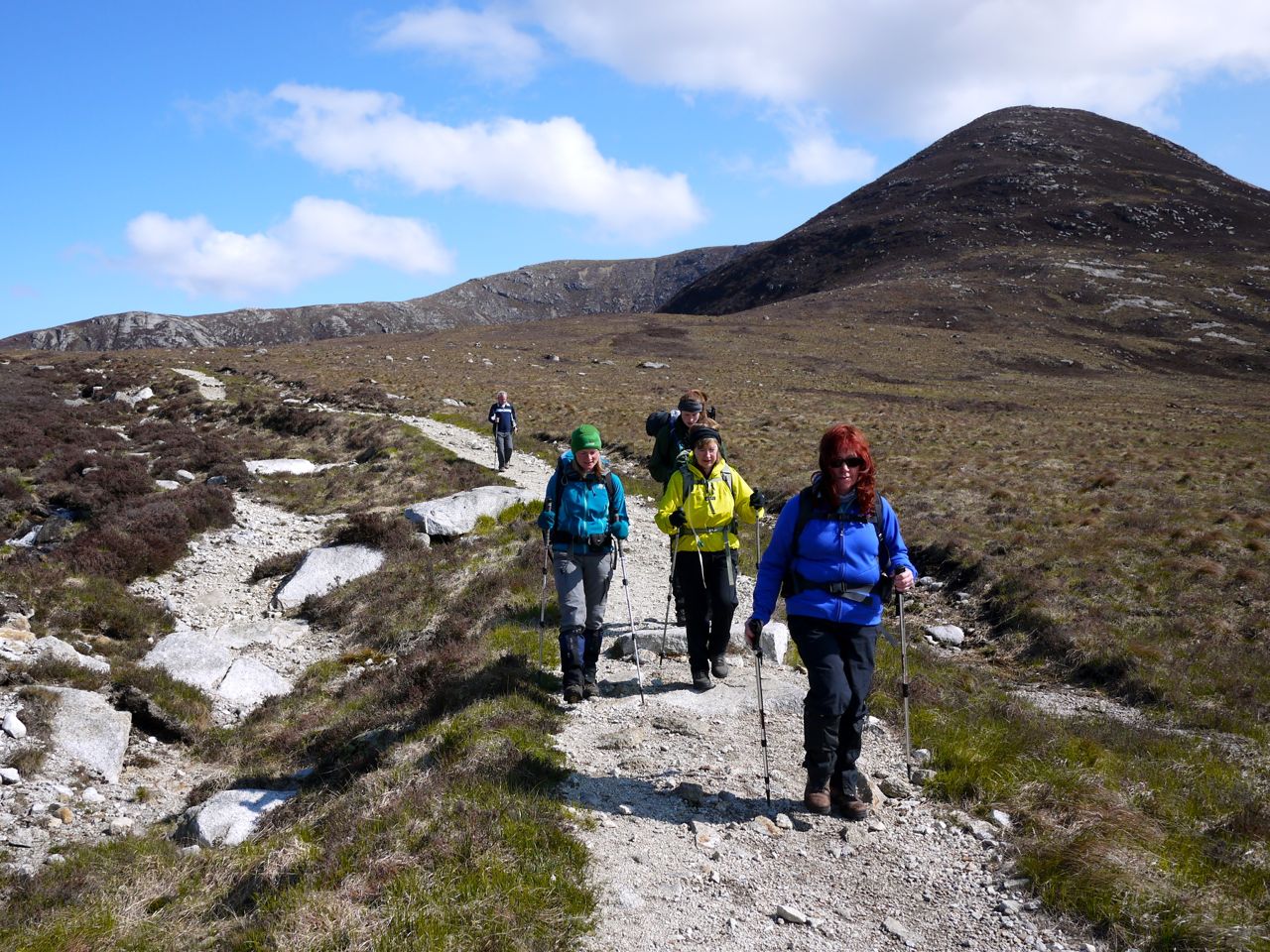
From Beinn Bharrain our route was along the ridge joining it to Mullach Buidhe (the yellow summit): a pleasant route over easy ground with gentle gradients and great views over Lochs Tanna and Dubh to the mountainous tops over by Goatfell. Initially the distant hills were topped with cloud but this lifted and as the sunlight changed throughout the day we were able to see them change with the subtly different illumination.
Mullach Buidhe summit
We stopped for lunch on the southern slopes of Mullach Buidhe, sitting on smooth granite boulders and looking down into the Glas Choirein (green corrie?). I enjoyed my lunch, basking in the sunshine, but later in the day I was to realise, somewhat red-faced, that the sunshine was stronger than I had thought. But despite the beautiful views and warm sun, my walking companion was somewhat disgruntled. His banana, chosen by me in the co-op, apparently had the taste and consistency of a turnip. What a drama queen! To be fair the banana was a little firm, but that meant it had less chance of becoming squashed in his rucksack, and in my opinion the consistency was more like that of an unripe mango.
Lochs Tanna and Dubh
After lunch we continued our stroll along the ridge to the summit of Beinn Bhreag (the speckled hill) where we had views over Bute, Kintyre, Jura, and possibly even Ireland. While standing here Corrina spotted a golden eagle and passed her binoculars around so we could all have a better look at the bird.
On Beinn Bhreac
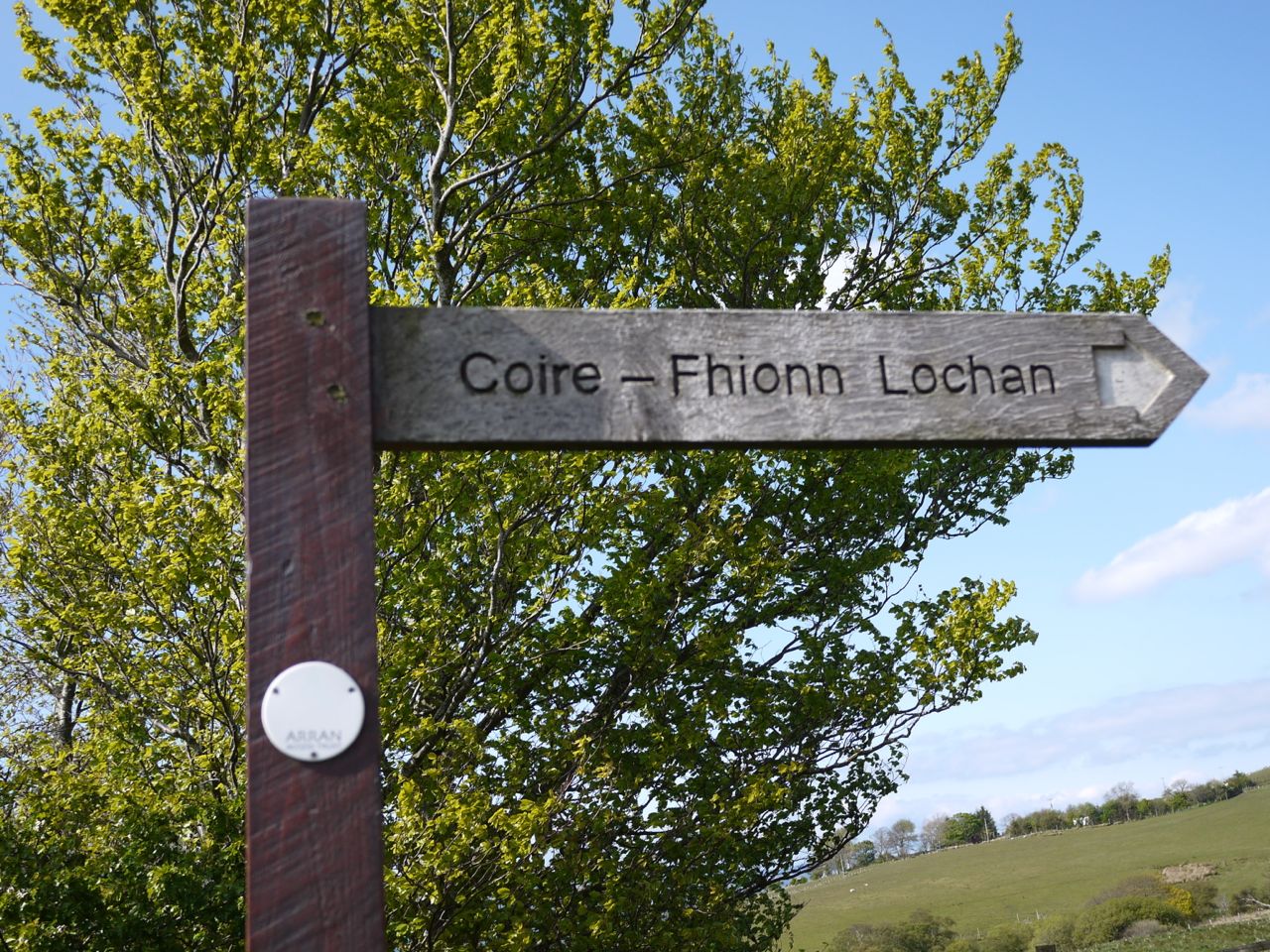
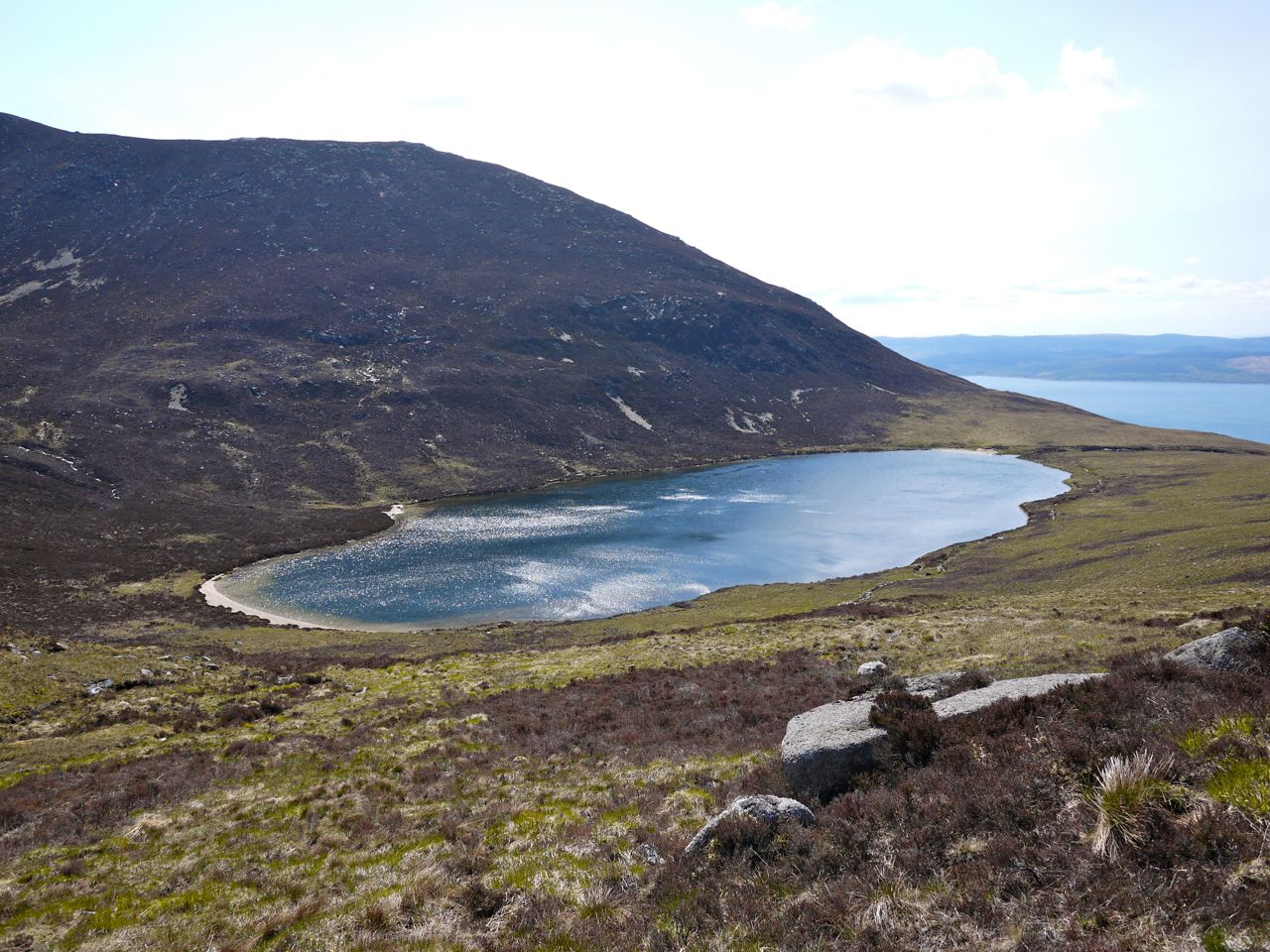
The descent to the col between Meall Donn and Meall Bhig did not feel as steep as the contours suggested, but still gave our knees something to groan about. We soon found ourselves in a rather boggy area overlooking the Coire Fhionn Lochan. This is a pretty stretch of water with white sandy beaches and great place to sit while enjoying the view.
From here it was a short walk back down to the main road at Mid Thundergay. The path follows the burn, Uisge Soluis Mhoir, by its waterfalls, so the walk is accompanied by the sound of running water, a powerful diuretic, judging by its action on several of the group.
Coire Fhionn Lochan
On the way down we heard a cuckoo, spotted a pair of hen harriers and a pair of moths, the latter engaging in a private moment. The walk ended at Mid Thunderguy where with the sun twinkling on Kilbrannan Sound we had a few minutes well earned rest waiting for our ride back to Brodick. Time to contemplate the delights of a cold beer once we got back.
Walking down by Uisge Soluis Mhoir
A very pleasant walk. Great company. Greta views. My first outing in Arran’s Hills and feel worth the journey.
PS Later that evening, after the pre-contemplated cold beer and a rather lavish dinner, we we decided to have a stroll through Corrie. In the churchyard, no more than 50m from us was a stag. Sadly the only camera with me was my phone and it couldn’t cope with the low light.
Cullendoch-Door of Cairnsmore-Knee of Cairnsmore-Cairnsmore of Fleet-Meikle Mulltaggart-Craigronald-Loch Garroch
Cairnsmore of Fleet’s Donald tops, the Knee of Cairnsmore and Meikle Mulltaggart were my main targets for the day. They could be had via the tourist route from Palnure but that would include a there-and-back to Mulltaggart, so I decided to head in from Dromore. The next question was: clockwise or anticlockwise? I’d read reports of anti-clockwise but decided to go clockwise since I thought this would leave the easier sections for the end, when I would be tired. Good reasoning but a false premise. With the benefit of hindsight I would now recommend taking this anticlockwise.
I missed the turning out of Gatehouse of Fleet, as I had last time, since the sign only seems visible from one direction. It looked as if this would be a good day and as I drove towards Dromore, the Clints were bathed in sunlight and Cairnsmore of Fleet could be seen peeking beyond them. I drove past the visitor centre at Dromore then headed to park a little way past the viaduct.
Door of Cairnmore from the end of the forest track
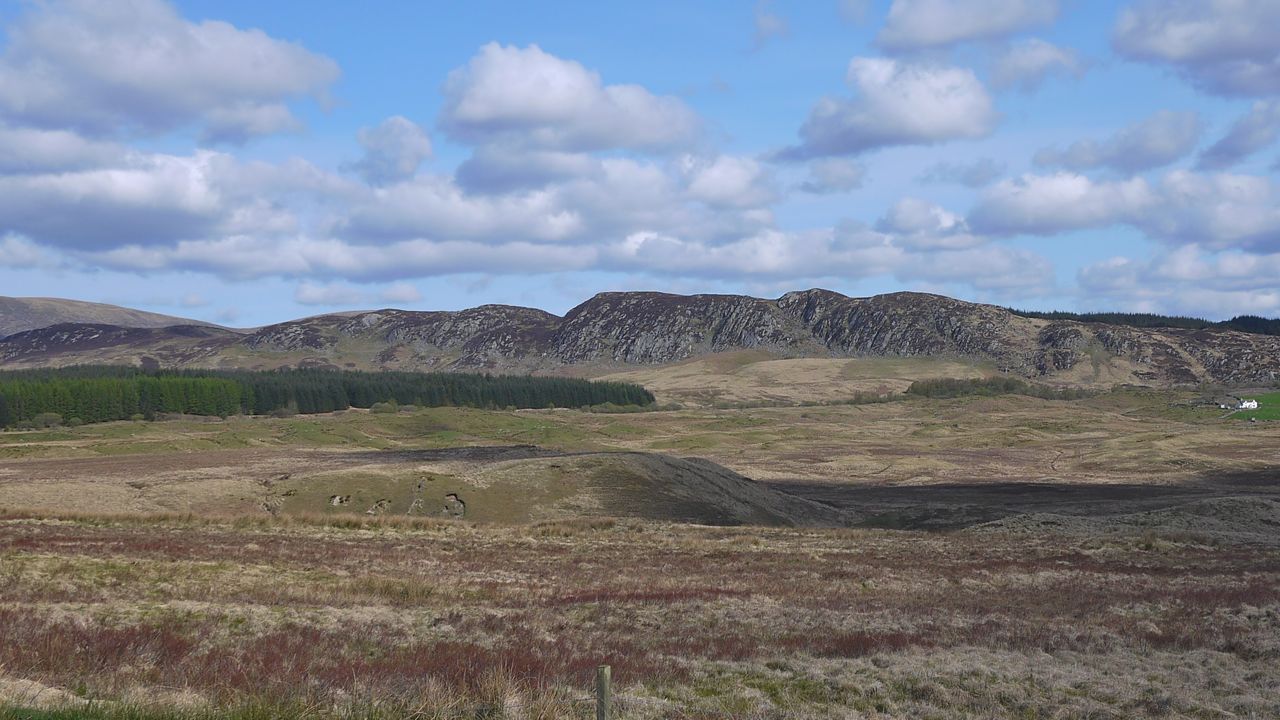
I did this walk in non-stealth mode, coughing loudly throughout. The first couple of miles were along forestry tracks with a gentle climb heading past a number of small quarries, parallel to and about half a mile north of the Clints of Dromore. After about a mile there was a large area of newly harvested forest, the wood stacks adding a fresh pine smell to the air. This opening gave me my first view of the complete Cairnsmore ridge from the Knee to Craigronald.
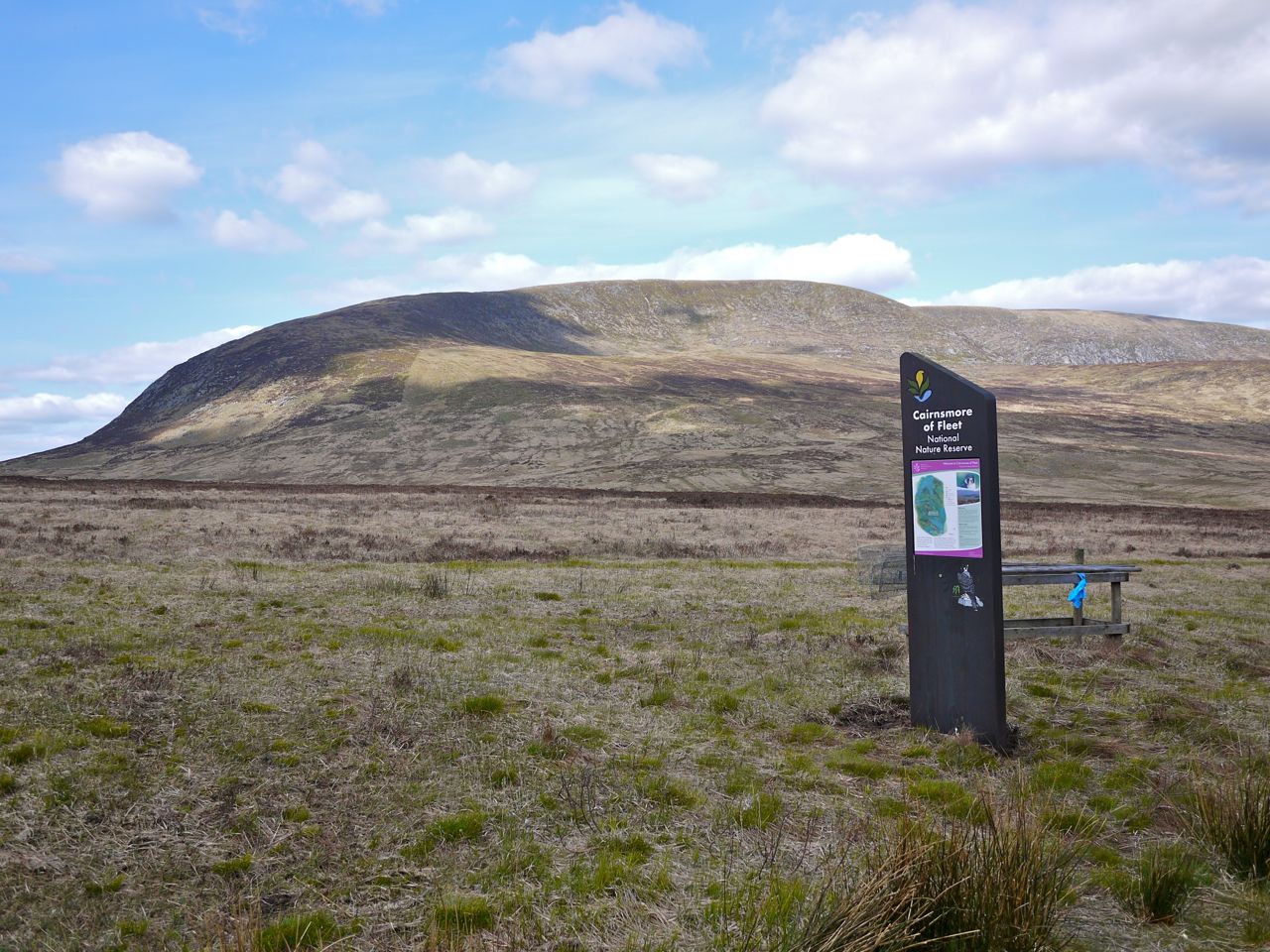
The forestry track ended with some rather impressively high gates, which are presumably to deter deer, and a National Nature Reserve sign. From here it was perhaps half a mile to the lower slopes of the hill at the Door of Cairnsmore. The flat section was grassland which was mostly dry and easy going but looked as if it has the capacity to be wet at times.
The Cardoun Burn was just too wide to jump but there where plenty of rocks to cross even if it were much fuller. Once on the steeper slopes the ground was firmer but the gradient was a bit of a slog psychologically. A recurring feature of this walk was that the summits couldn’t be seen while climbing, making it hard to assess progress. I found myself heading for features on the horizon which I thought were the tops of ridges only to find when I reached them that they were just another rock on the slope. I had to gauge progress up the slopes by looking across to distant hills and cols.
I met my first goats of the day on these slopes. Once on the flatter section of the Knee of Cairnsmore the summit cairn was close by. A welcome place to sit for a rest. Visibility was very good, as predicted by the weather forecasters, with the Isle of Man clear on the southern horizon.
Once on the flatter tops of the whaleback hills the going was much easier. There was a faint track heading up towards Cairnsmore of Fleet but this often faded away, especially in the wetter sections such as the Nick of Clashneach, where there are several lochans.
Cairnsmore of Fleet Summit
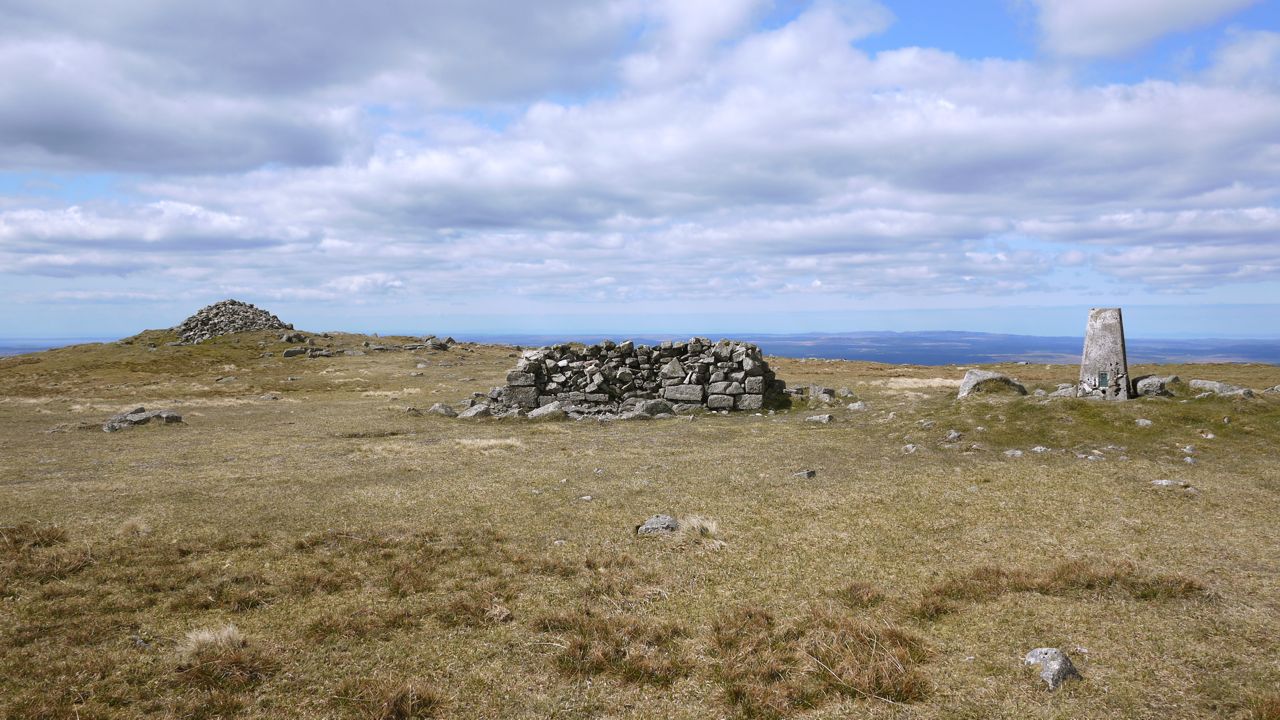
Cairnsmore of Fleet’s summit is a wide flat expanse with several features: a large cairn; a trig pillar; a shelter; and a memorial to airmen killed on the hill.
The last time I was here there was ankle deep snow and very limited visibility, so I was impressed by the views which included the Minnigaff hills nearby, the Galloway hills behind them and the Rhinns of Kells.
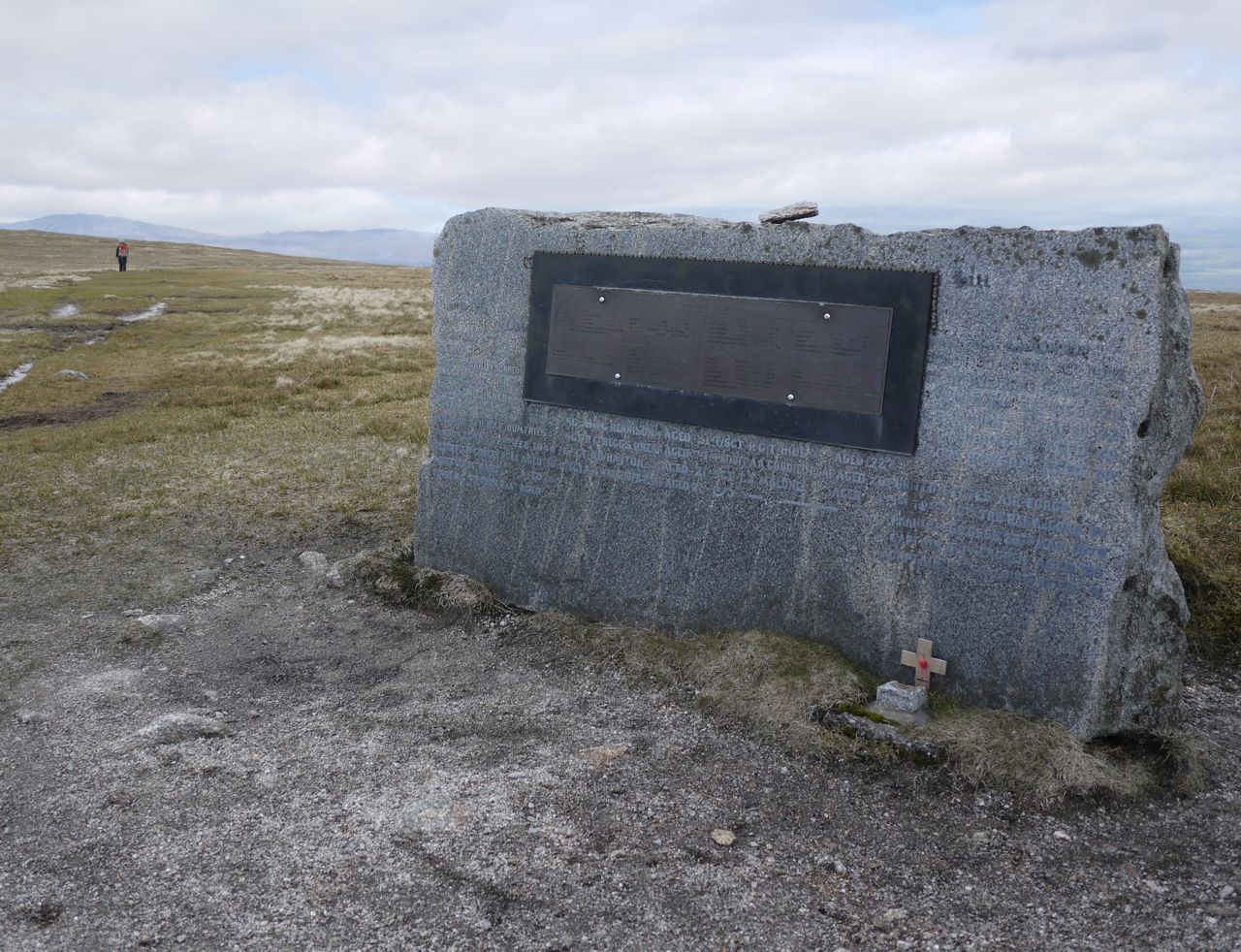
Memorial to Airmen killed on Cairnsmore of Fleet
The memorial to lost airmen lists the names of 25 British, American, Canadian, New Zealand and German airmen killed when their various aircraft crashed on this hill. Details of the crashes and names of those killed or injured can be found at Air Crash Sites in Scotland and make sad reading, all those killed being so young.
Troll’s Head
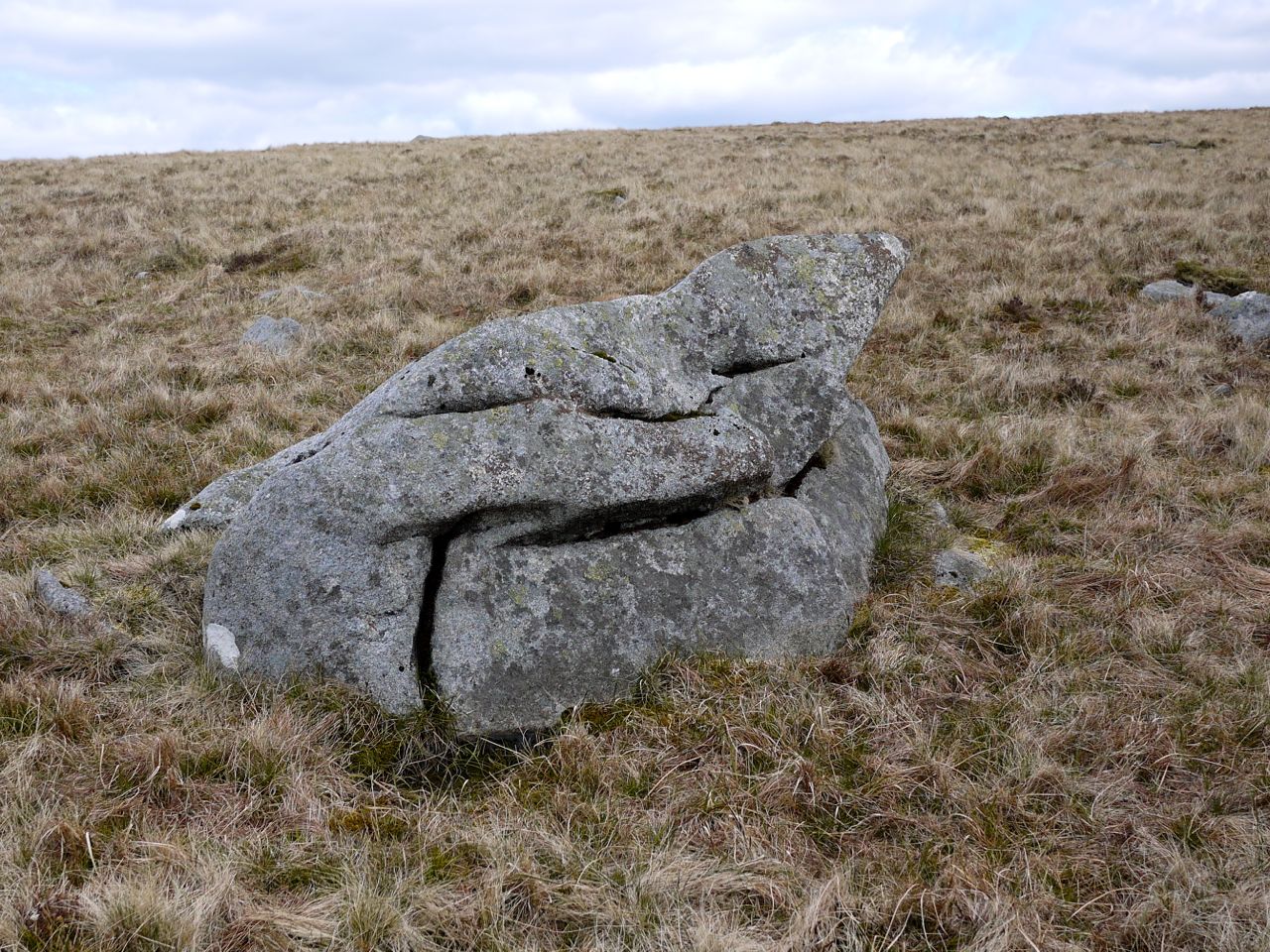
Since Meikle Mulltaggart isn’t visible from the summit plateau I headed off a little south of NE and once the hill was visible corrected my route. In bad weather a line of fence posts could be followed but these are a quarter of a mile from the summit. On the way up Meikle Mulltaggart I passed a boulder that looks like troll’s head.
So far so good. But all good things must come to an end. Craigronald was the end of the good things. The ground became waterlogged, tussock strewn and littered with rocks and hidden holes. This made the going tough but in addition, Craigronald looks as though some ancient giant has taken his hammer and smashed the hill into a concertina of rocky ridges. I decided to start a gradual descent of the hill along its southern flank rather than climb over these ridges. The final section was quite a steep descent in places but the section between the hill and the forest track was a nightmare.
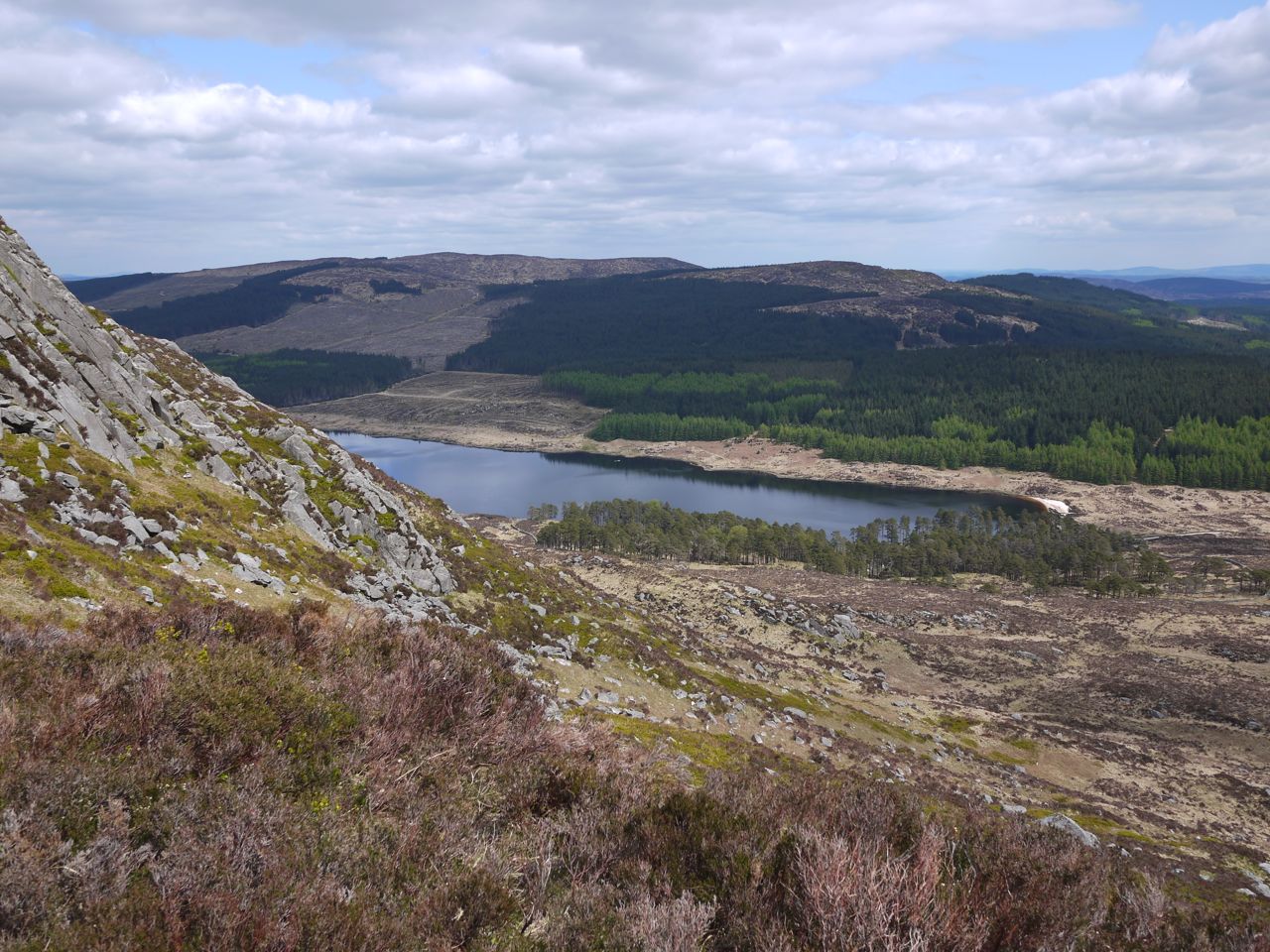
First glimpse of Loch Garroch
The ground here was tussocks and waterlogged mush, leading to at least one fall, and somewhere along here I lost the lens cap from my camera. The going was so hard, and I was so tired, that I couldn’t face retracing my steps to look for the lost lens cap. Hopefully, being non-biodegradable, it will make a future archeologist happy.
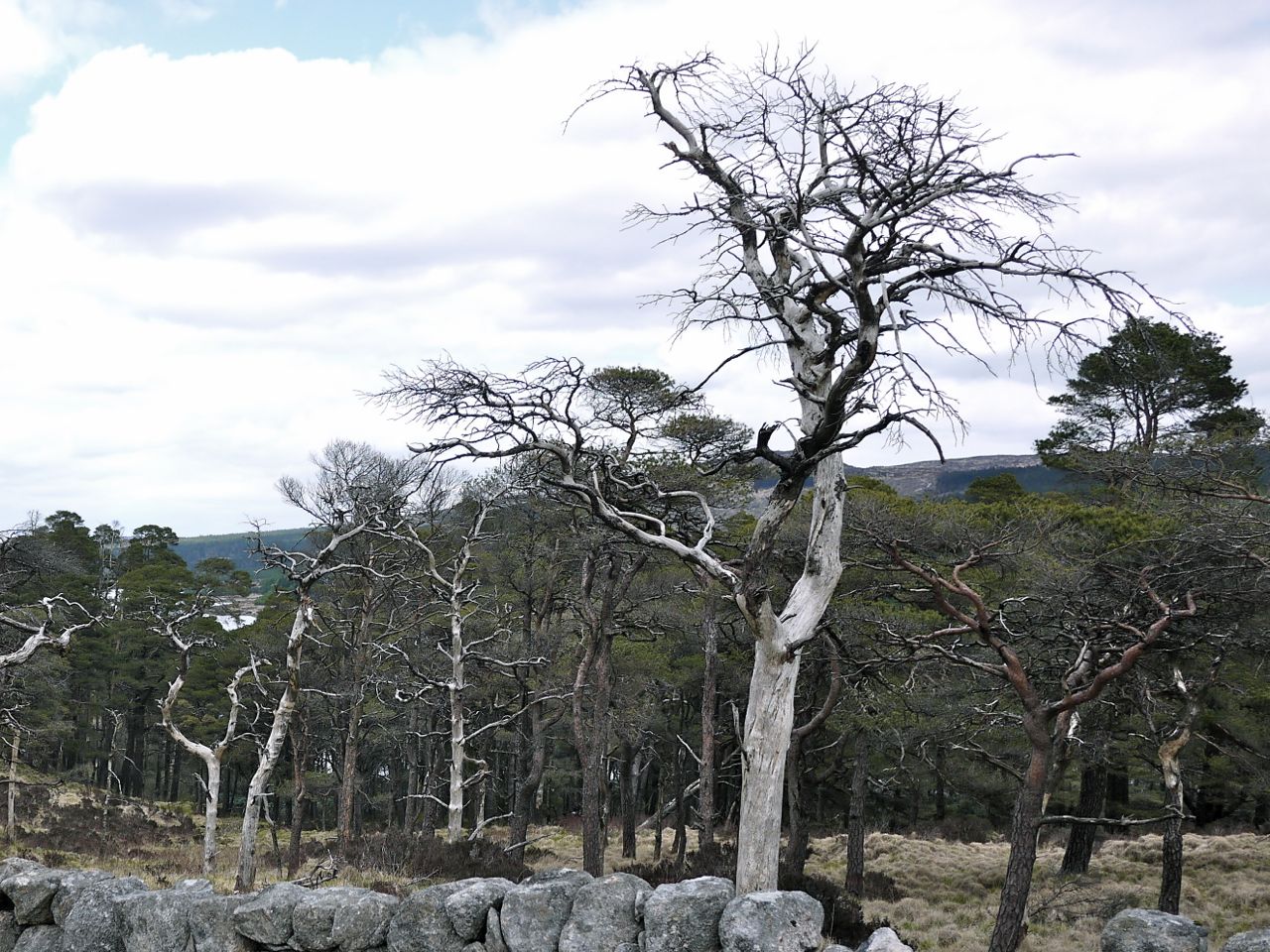
Here I made an error. I confess so that others may be spared. I had read, in the anti-clockwise report, that the way up Craigronald was to head from the lodge through the trees onto the hill. So I headed for the trees where I thought I could see the lodge. There is a wall. Before the wall the ground was very wet, uneven and unstable. Over the wall it was much, much worse. The first trees all looked dead, perhaps they had drowned? A little further in is an impenetrable wall of bushes and trees. I was forced to climb back out of the walled hell and make directly for the track at the head of Loch Garroch. Perhaps it is easier to find a way going in the opposite direction.
Zombie trees at Loch Garroch
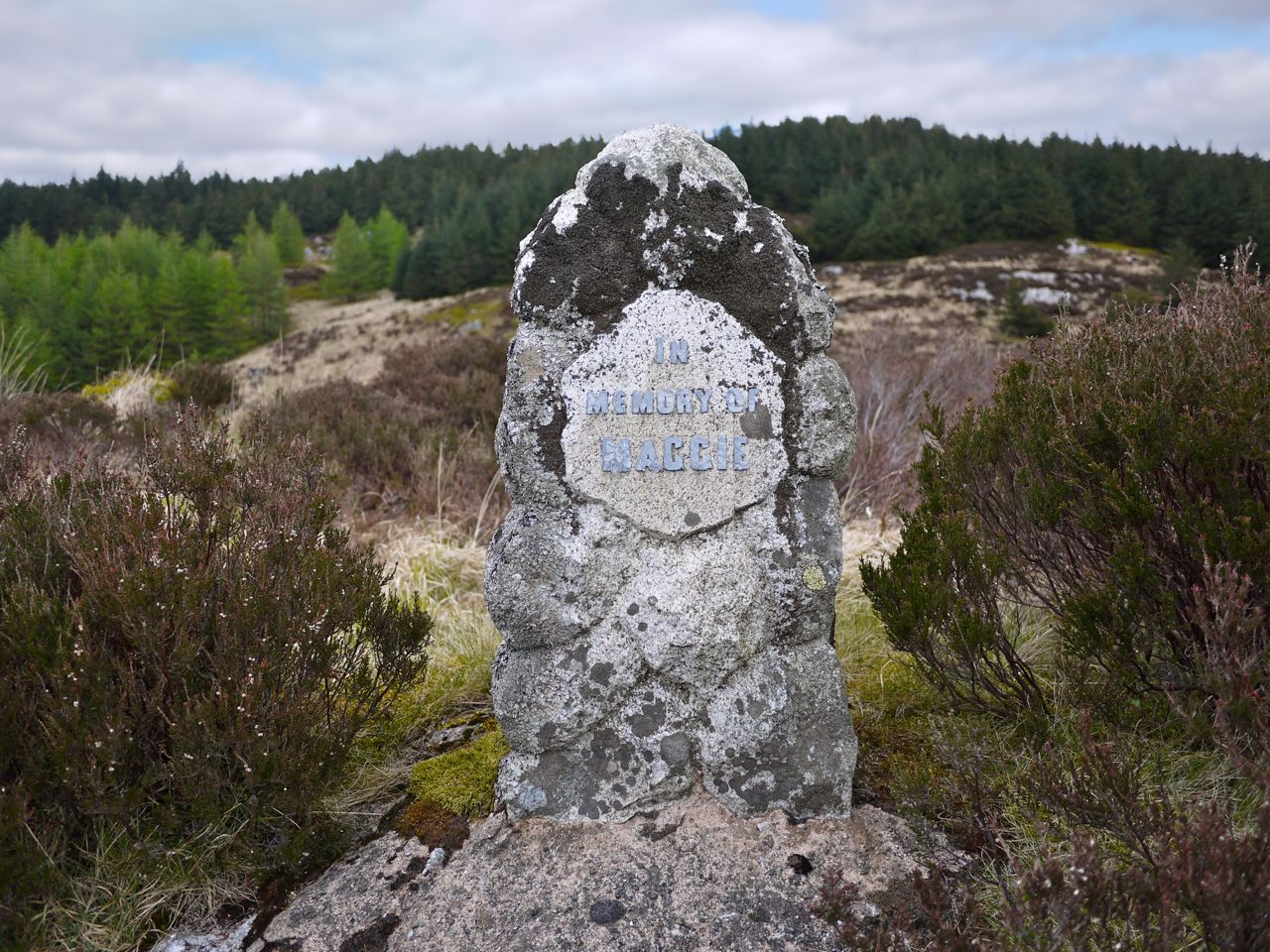
Back on the forest track from Loch Garroch I had wet feet but couldn’t be bothered changing my socks. The light had changed leaving the loch un-photogenic, and I had lost my sense of humour. The track climbed away from the loch past a small memorial to Maggie, who I believe was a pony, then through the Clough of Eglon. Even in my unhappy state it looked pretty. There were a great many bright yellow dandelions on the path and if I had been in a better mood I would have taken the time to photograph them.
Instead I remembered the sign I had seen at the beginning of the walk, “Loch Garroch 2.5 miles”. I strode out, but this 2.5 miles took much longer than I had thought it would, just under an hour. Leading me to stop a couple of times to check I was going the right way. The sign was, at the least, economical with the truth. The distance as the crow flies is 2.5 miles, but the track was 3.5 miles.
Memorial to Maggie (pony)
At Meikle Cullendoch, the ruins have been incorporated into a garden, which produces an impressive rockery. Further along at Little Cullendoch the ruins are worth a visit since they hide a small sculpted face.
As I walked the last couple of hundred metres, the Big Water of Fleet viaduct came into sight, lifting my spirits, but my car didn’t seem to be there. Surely it hadn’t been stolen from here? Had I broken some terrible forestry by-law (parked on a wildflower, blocked a natterjack toad crossing) and had it towed away? Would my mobile work out here to summon help? 100 meters of worry, then relief. The car was hidden behind a small bank of earth.
I don’t think I’ll be taking this route again. The mile or so from Craigronald to Loch Garroch, and especially the section from the bottom of the hill to Loch Garroch, spoiled the enjoyment. It would perhaps be better done anticlockwise. It might be easier to find a way up Craigronald in that direction and the climb would be done while still sprightly. There would also be the option of returning over the Clints of Dromore if energy levels and sense of humour permitted.
Loch Doon-Coran of Portmark-Bow-Knockower-Black Craig-Loch Doon
The primary aim of this walk was to climb Coran of Portmark, since previous visits to the Rhinns of Kells had come off over Cairnsgarroch, leaving Bow, the Coran and Black Craig unclimbed.
The most described route would head in past Garryhorn, take all these hills in a sweep and return over Cairnsgarroch. So why didn’t I go that way? The descent of Cairnsgarroch, or more specifically the terrain, a couple of years ago had left a lasting impression with me, and not a pleasant one. The whole area is covered with angry Dougals nestling in a hidden concoction of bog, rocks and holes, the kind of terrain that would in ages past have halted an advancing army. So I wouldn’t be going that way.
I could of course avoid Cairnsgarroch’s slopes by doing a 180 on Bow and retracing my steps. For some reason I disliked the shape of such a walk. Not rounded enough. Aesthetically unpleasing.
I looked at walking in from Drumjohn or Lamach but dismissed these for the same reasons.
Then I turned my mind to approaches from Loch Doon. Forest bars a direct assault from Loch Head to the Rhinns but there is a single dotted line on the OS map along the Loch to the slopes of the col between Black Craig and Coran of Portmark. A path? An old right of way? There is also double dotted line through the forest parallel to this about 300 metres in the forest but it stops just over a kilometre short. Would it actually continue, or would it lead me into impenetrable forest?
While musing on the options I noticed Portmark on the shore of Loch Doon. Ruined buildings. It would be nice to see them wouldn’t it? This thought was like a barbed arrow. I couldn’t shake it off. Whichever way I went, this would have to be included.
Then a second barbed arrow. I found a description of this part of the route in which the writer described the terrain here as the worst he had ever experienced in Scotland. Having tramped through tussock infested bogs and slipped in my fair share of mud, I was intrigued. More research suggested said author was well walked, and not one to moan over trifles. It couldn’t be that bad, surely? Another definite place for the walk.
This would still leave me with a route exhibiting too high a circumference:area ratio. Not round enough. I turned my mind back to a traverse of the forest from Loch Head to the foot of either Meaul or Bow. There were several forest breaks on the OS and these were discernible on Google earth’s 2010 imagery.
Forest breaks, in my limited experience, are not ideal paths. Better than quicksand or dense forest, I’ll admit, but all the same best kept to a minimum. I found the route that required the minimum distance on the breaks (just 0.75 km). It would need a final push through forest at the end, but only 100m I reckoned.
It is interesting to analyse the planning process since it offers me insights into the workings of my mind. I clearly have weaknesses. That’s the introduction over. Now on to reality.
Craiglee and Loch Doon
The forecast was occasional heavy persistent showers and hail but the drive in was in glorious sunshine. I had hoped to be able to leave the car at Starr. Indeed secretly I was hoping to be able to drive all the way to Loch Head. Sadly the gated bridge over Carrick Lane was locked so I had a mile and half to walk to Loch Head. At Carrick Lane there were a number of tents, vans, dirt bikes and hardy looking chaps drinking (tea?) from battered mugs. I smiled benignly at them and offered a good natured “morning”. Well, what do you expect, I was setting out on walk, well fed, and the sun was shining. I gave the dirt bikes little thought. Arrrgh!
There was a slight climb up to the old cottage at Starr. The place looks abandoned but has obviously had a new driveway built recently so perhaps there are plans for it. From Starr to Gala Lane the road descends which I dislike since it means ascent on the way back. At this time the Rhinns of Kells were bathed in sunlight and the Loch’s waters still, reflecting the sky and hills. Paradise must be like this.
Gala Waterfall
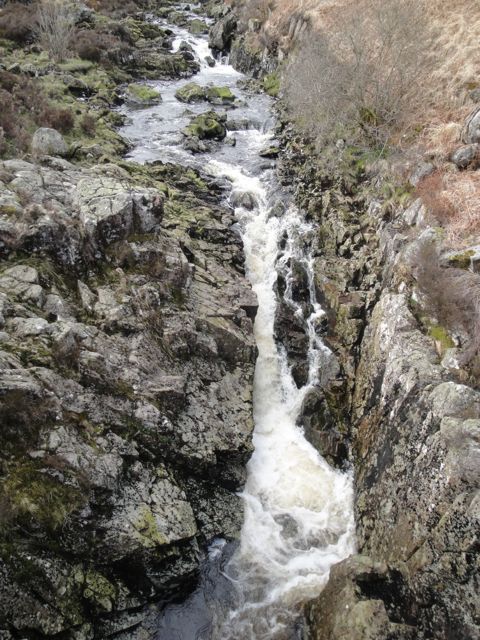
Gala Lane is relatively narrow where the bridge crosses it and has a pleasant small waterfall just by the bridge. This belies its power which has at times washed away bridges upstream of here. The road then turns up the eastern side of Loch Doon, past the sheepfold, one possible route into the forest and over a small bridge at Loch Head Burn, another possible route. I had decided to use the loch-side path for my return route, climbing back into the forest to find the forest track if the terrain was really that bad.
My way through the forest was to initially follow the Small Burn, which is the one after Loch Head Burn. The plan being to take the first forest break on the right ( about 100m), then the next on the left (another 100m). This would take me to a long straight forest break heading just south of east which would climb to the foot of the hills between Meaul and Bow. The option then would be to go directly through the forest which was only a short distance, 50 metres at most, or turn right along another break which was a longer route but likely to be easier.
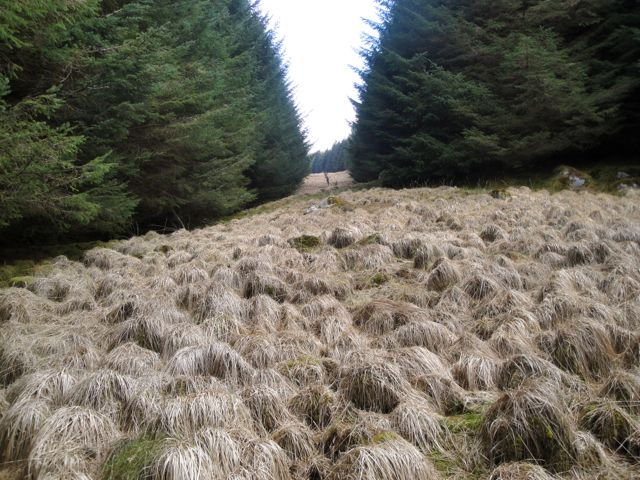
Dougals in the forest break
The going was relatively easy initially over moss covered rocks later giving way to the expected tussocks and boggy ground. Sadly my planning was to be upset and I was not destined to walk as I had planned. The smaller forest breaks can be difficult to spot close up and, without realising, I had missed the first right turn but stuck with the “first right first left” plan and found myself as expected on a wide straight break along which I made excellent time. There seemed no reason to check a compass bearing and within the forest all the landmarks were hidden. Eventually I came to the T junction where I would either head straight through the trees or take a turn for a little more forest break.
I chose the direct route but the forest was impassible, the trees’ branches interlocking right down to knee level. I don’t think a machete could have managed it. An elephant perhaps, but I hadn’t brought one.
This then was a good time to stop, rest, have drink of water, some carbohydrate and chose an alternative path. The pre-decided way was to turn right but I wondered if left might be better. Not much to choose between them on the map but the right turn did get the whole way in forest breaks. Then the first moment of consternation. These forest breaks weren’t going in the right direction. Perhaps the compass wasn’t working properly. I should check it before setting off, but I rarely do. Perhaps I was stood near some compass-confusing metal object. A buried alien spacecraft, secret cache of spears and shields?
I dug out the phone (GPS enabled and tracking the route for posterity) from its waterproof bag in the rucksack and looked on stunned as it displayed my position. Nooooooooo! Suddenly it all fell into place. The forest break hadn’t been climbing as much as it should. In fact it had hardly climbed at all. Having missed my first correct turn, the forests breaks had with each turn led me further off course. The last half mile had been heading nearly north rather than east, hugging the contour and making no headway across the forest.
I couldn’t face backtracking to where I had gone astray and I had been gradually putting more forest between myself and the hill. If I turned left the break would lead me to the forest track in 250m and I would take it from there.
The forest track was in good repair and gave my legs some respite from the harder forest breaks. But all good things come to and end and so too did the track, but a good path led on from it. I could follow this to the edge of the forest then head up Coran of Portmark.
Now, do you remember those dirt bikes, caked in mud at the beginning of my walk. They were now forced back into my consciousness. One man’s enjoyable pastime can be another’s source of annoyance. There had obviously been some kind of dirt bike extravaganza here the previous day. Once off the metalled path the ground was well and truly churned up. I can only presume that the aim was to ensure no section was left passable for those with the temerity to proceed on foot. And the bikers obviously didn’t care how dirty they got ( private joke: a comment from my nephews when they were very young and watching a war/action film with soldiers covered in mud.)
Before the mud got bad
Had I been in a film the music would have changed at this point to emphasise the change in mood. Nature has its own music. The sun went for a coffee break and a few spots of rain started to fall. Not enough to require waterproofs, but enough to place them on the list of options.
A little heavier. I should probably put a jacket on but won’t need trousers. It wouldn’t hurt to put the rucksack cover on though. Heavier still. I wish there was somewhere I could sit to put the waterproof trousers on, but at present I’m stood in a motorcycle induced mud bath. OMFG heavy. Leans against a tree and manages to get over-trousers on without falling over.
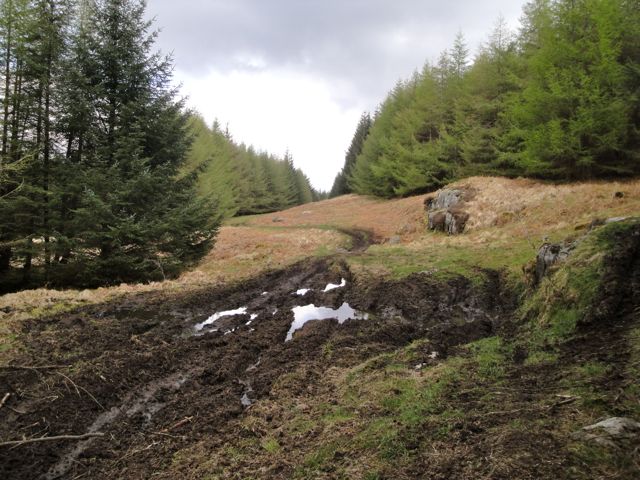
I then picked my way along the muddied forest break. There was a tumbled down wall but the bikes had used both sides of it. Here’s a learning point for the unwary. Just because mud has a tyre track in it doesn’t mean it can support your weight. Indeed my experience now suggests that your leg could sink to the upper calf in it. This was almost a full mud bath but there is a reflex in newborns (the Moro reflex) where they fling out their arms if their head moves back and this must have remained enabled in me allowing me to instinctively grab the nearby wall and fall onto it rather than the ground.
This ground needed crampons. Soon though I emerged from the forest and began the climb up Coran of Portmark. The bikes had been here too but the ground was better drained and only a few sections had been churned to mud. The going underfoot was much easier but the gradient worked me into sweat.
The rain turned to hailstones for a while then slowly stopped to allow the sun to begin baking me in my foul weather kit. But like a cat toying with a mouse, the weather toyed with me, throwing some rain at me whenever I took off my jacket.
Hills of the Awful Hand
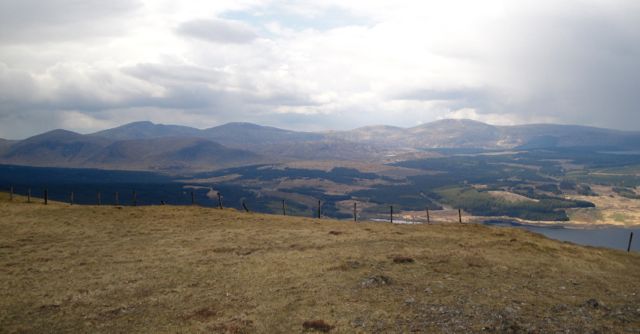
The walk then began to come into its own with beautiful views of Loch Doon and Loch Finlas beyond Craiglee, the Rhinns of Kells separated from the Dungeon hills by an apparent sea of trees, and beyond them the hills of the Awful Hand. Once onto the col the Carsphairn hills lay curled up like a dog in the sunshine. Heavy showers crossed these hills throughout the day sometimes leaving me dry, sometimes wet, but changing the appearance of the hills. I had hoped to capture something of the changing appearance but the old camera functions poorly in the low light of these wee storms.
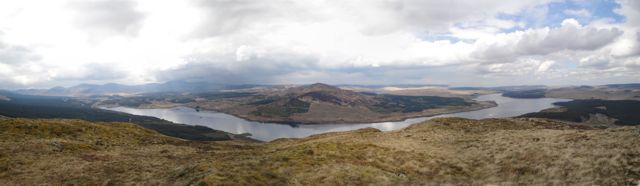
Loch Doon
I’m not sure which is my favourite view of the Galloway hills, that from the Rhinns of Kells or that from Lamachan. It’s a close call.
After the slog up Coran of Portmark I enjoyed the views and pondered how un-local my snack was. Certainly not something the Gallovidians of yore would have had (coffee, banana, corned beef and Pickle).
It was then a short jaunt over to Bow and a look down to the forest where I had hoped to have emerged. The slopes of Bow would certainly have been no problem.
Rather than climb the Coran again I decided to contour around it just above the steeper western slopes and head for Knockower. The climb up this wee hill, and down it to the shoulder between it and Black Craig was hard going. I was tired and the ground was wild with heather, moss and bog taking an extra toll on my energies. At least the rain seemed now to have passed. That I even visited Knockower must mean I have a hill-bagging gene.
On the map there is little to chose between Black Craig and Knockower in height but the former seems much more imposing, probably because it is a more defined (steeper) hill. Its ascent and descent are wild and tiring. The views from its summit however are worth the effort. Loch Doon can be seen in all it’s glory and the sight of the Rhinns and Dungeon hills from here is a joy.
I looked down on the small rocky outcropping of Craigencolon to the north and tried to decide if it should be regarded as the last part of the Rhinns of Kells. I had intended including it in this walk if I was ahead of time, but sadly I was not. Perhaps one day I will walk the whole of the Rhinns of Kells in one walk, Darrou to Craigencolon, then I’ll have something to boast about.
I headed off Black Craig towards the forest break I had emerged from earlier but the going was difficult. Not especially so but I decided to make it easier for myself by heading for the path up Coran which would involve less wild walking. This would require care in poor visibility as I found myself looking over a steep gap in which the Polmeadow burn runs. I had to follow this down a way to below the waterfall to cross the burn. Then I was back on the track about 250m from the tree line. From Black Craig I could see the forest break I wanted to take down to the shore (along the dotted line on the OS map). I’m pleased I did this since once there the break was not easy to see. It begins just about one or two trees along the path I had come along earlier but heading SW.
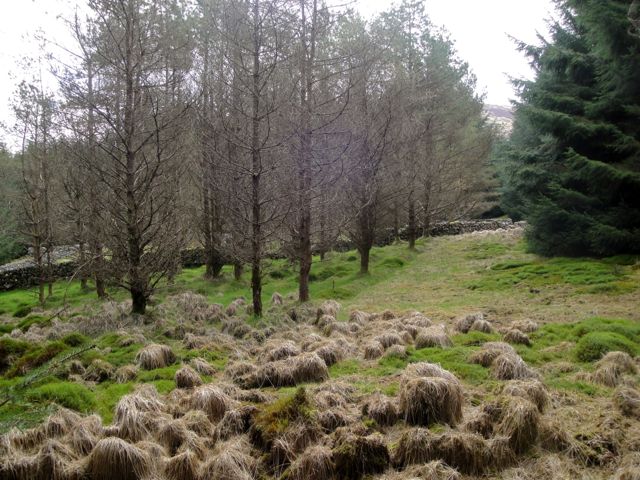
This was the usual tussocks, but interspersed with tussock free zones made of deceptively slippy moss covered slick. One section of Dougals had small bushes of bracken that appeared dead, perhaps due to the bogginess, but could have still been in winter mode since the light here was markedly limited by the trees. I remember thinking how unpleasant this would be to walk through if the bracken grew larger. In retrospect, this was a little like one of those horror films where whatever you think about (your worst nightmare) is spun into reality by an evil being.
Dougals running for cover
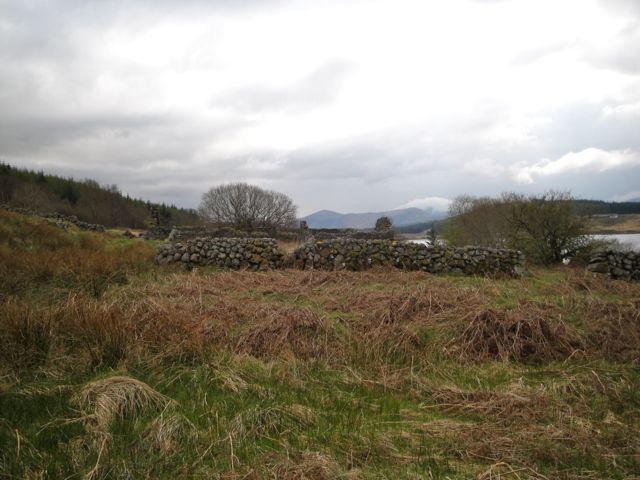
The path, if you can call it that, eventually passed a long lost sheiling which now encircles mature trees rather than livestock. My photo of this looks as though the Dougals are rushing out ahead of me. I wonder if they do that, run about until I come by and then freeze in place? Perhaps the forest sprites were driving me crazy.
Eventually I came to the edge of the woods and was able to experience the devil’s terrain: bog, rocks, mud, tall tussocks AND mature bracken. This is what Sauron must use to guard Mordor. And to the writer of that previous report, I concur, it is the worst terrain I have walked as well. (Addendum: how easy it is to forget, this isn’t actually the worst terrain. I’d forgotten Cairnsmore of Dee, all of the above plus recent tree felling.)
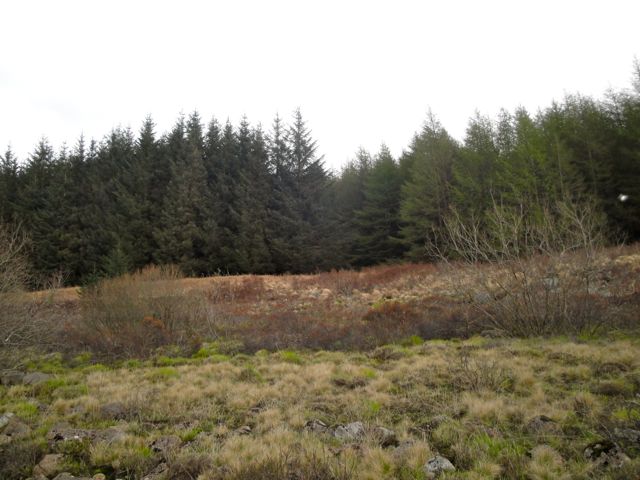
The way into the forest break
How you would ever find this forest break if coming the other way, I do not know. It is two burns beyond Portmark and just short of a large boulder on the shore.
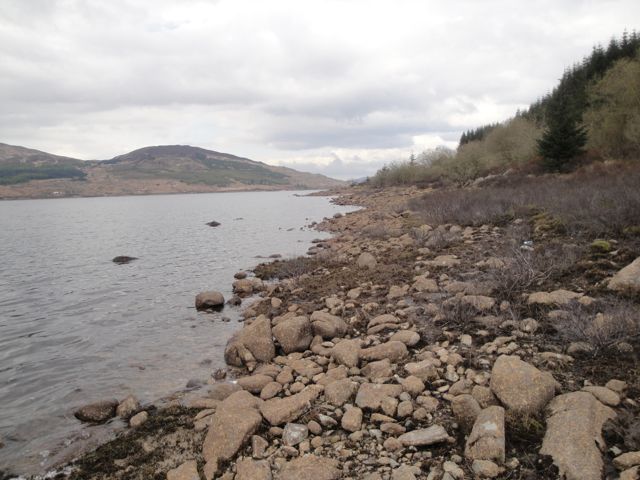
From the Sheiling to Loch Head took me just shy of an hour. There is no path or track to follow, the ground is hard going and boggy with plenty of bracken, sometimes quite large growths barring the way. Since the loch’s waters were relatively low I walked some of the way on the rocky shore. This wasn’t ideal but did give my ankles and balance a good workout. Sometimes the shore was quite squidgy and care was needed to avoid losing footwear in mud.
The Beach
The lapping of the water was relaxing though and there were nice views of the loch and the distant hills. Every now and then I would glance up the shore and see what appeared to be a path. I would fight my way over rocks and through bracken only to find it was an illusion and almost always worse than where I had come from.
Portmark Ruins – no effort in photo
This went on and on. I had been walking a long time but seen no signs of Portmark. I presumed I had somehow missed it, but I was just making very slow progress. Eventually the ruins appeared. By now I really couldn’t be bothered climbing up the shore for better pictures and the light was poor. On the plus side there did seem to be a faint path but it didn’t last long.
Along here there were several concrete bridge structures over the burns. These were not useful to me since their approaches were often overgrown and they were mere skeletons, the widest sections being about 6 inches across. They look as if they may once have carried a railway. They look too modern to be contemporary with the lead mines and I can’t think why they would be there. There are no signs of tracks between them, but admittedly I wasn’t specifically looking for them.
Once back at Loch Head I was able to climb up onto a vehicle track lined with junior fir trees, the very small ones covered in small buds giving them the appearance of decorated Christmas trees. My penance was over and the remaining half hour was on good quality forest roads, retracing my steps past Starr to the car.
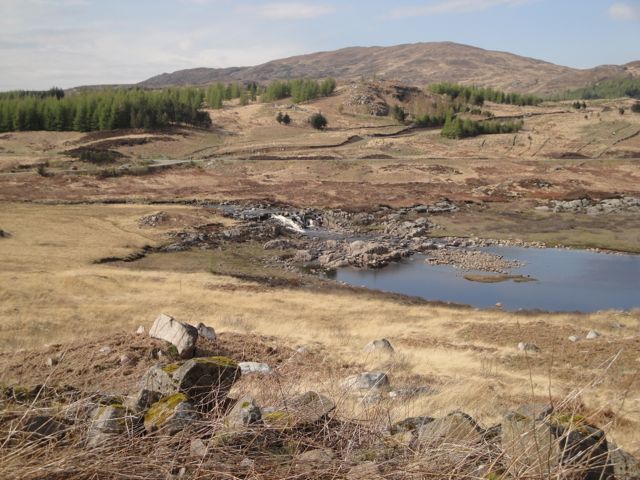
Carrick Lane waterfall – spot my car
The sun decided to shine again during this section, defrosting my soul. The dirt bike guys and their equipment were all gone but they had obviously considered future archeologists and left a selection of rubbish behind. It’s surprising how much rubbish there was on the far shore of the loch, mostly carried by the water I presume.
Most hill walks mature in the mind. The hardships and misfortunes metamorphose into jolly japes and proud achievements. The joy of completing the challenge and the wonderful views become fixed in the memory and linked strongly with positive feelings. As I trudged along Loch Doon’s shore I reckoned it would take a year for those changes to occur in my memory, but it is only two days since and I find it is already filed under “happy memories”.
If you feel inclined to take a similar route, I would recommend taking more care than I in navigating the forest breaks, taking a brief rest ( and some jelly babies) before climbing Knockower, avoiding the single dotted line and taking the forest track back to Loch Head. If you are as daft as me and decide you have to see the hidden sheiling and the ruins at Portmark, then grit your teeth and take your time, but from Portmark take one of the forests breaks up to the forest track, it’s only 300m.
 6.25 miles 3h 45m ascent 613m