Summary
A Journey of Friction, Persistence, and Sudden Grace
To walk the Mull of Galloway Trail is to engage in a delicate, ongoing negotiation with nature, agriculture, and the whimsical imagination of mapmakers. Across thirty-five miles from the exposed, wind-scoured tip of the Rhins to the quiet borderlands of Glenapp, the overarching feeling of the journey is not one of polished, postcard perfection, but rather a deeply human interplay between mild adversity, wry humour, and moments of unlooked-for serenity. Like a good recipe, the trail balances its sweetness with a generous, invigorating dose of acid.
The Fragile Promise of the Map
From the very outset at the lighthouse, exposed to a wind that flattens dogs’ ears and chills bones, this trail that has been allowed to mature back into its surroundings, in parts reclaimed by nature and in others annexed by agriculture. The trail rejoices in a gentle friction between expectation and reality. Official waymarkers sometimes appear to have been positioned by a committee working from aerial photos rather than boots on the ground; leading the näif unapologetically into impenetrable, briar-laced hedgerows, dead-ends or fences newly fortified with barbed wire.
Yet, the friction creates a rhythm of its own. Navigation becomes an act of psychological resilience as much as physical effort. There is the distinct, quiet triumph in “classing a field as impassable,” beating through a tangle of brambles, or locating a obscure gap where plastic wrapping mercifully shields a leg from barbed wire. Every minor unpleasantness heightens the relief of finding open grass, a firm sea wall, or a quiet avenue of trees offering welcome shade.
The Texture of the Coastal Edge
Along the southern sections, the emotional landscape is reflected in the tactile terrain underfoot. There is the rhythmic, grounding trudge over loose shingle, where every forward step feels halved by the sliding gravel, contrasted against the effortless, mind-wandering ease of a grassy dune path.
The coastal atmosphere is rich with sensory detail: the salt air, the sudden flash of pink beach rocks at Portalennie, the distant silhouette of the Isle of Man across thirty miles of open water, and the vast assemblies of seabirds on offshore rocks. There is a charm in passing through coastal hamlets like Drummore, with its unexpected palm trees and painted stones, or pausing by quiet bay waters where dozens of swans drift lazily offshore.
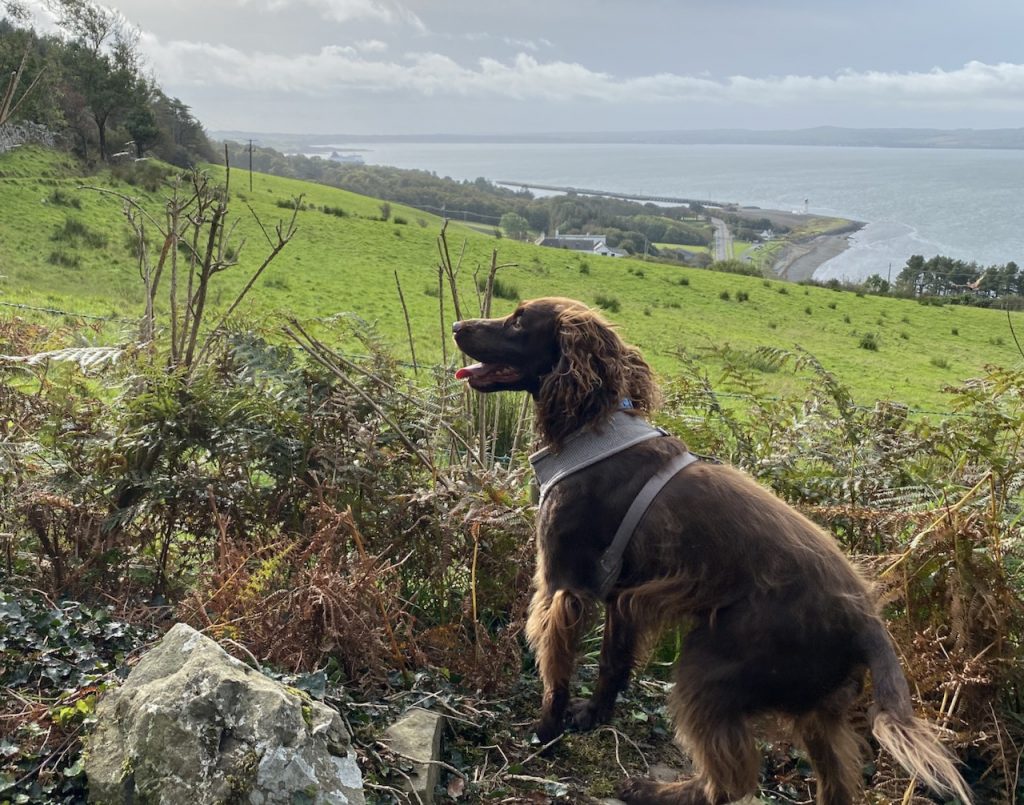
However, the coast also brings its own peculiar brands of frustration. Misleading beach markers invite knee-jarring scrambles over concrete sea defences, and narrow paths above the water require delicate, high-stakes maneuvering when trailing canine companions along eroding turf. The terrain constantly demands attention; it refuses to let the walker slip entirely into autopilot.
Briar, Beasts, and Detours
If the trail has a mid-journey climax, it is found in the sudden, unexpected obstacles that turn a straightforward stroll into a lighthearted saga. There is the memorable “jalapeño in the sandwich”; a section of the route near High Barnultoch where farmyards vanish into dense brambles; locked gates display handwritten signs to STRANRAER resembling the script of a six-year-old, and curious, formidable bullocks block smashed kissing gates.
Such moments induce a specific blend of exasperation and amusement. Pushed off-piste onto unstable slopes of discarded rubble, manure, and nettles, the walk becomes an exercise in improvisation. Later, near the Loch Ryan ferry terminals, the path narrows into a veritable jungle of leaning gorse and grabbing brambles, scratching legs and forcing smaller companions to be carried like precious cargo. Yet, even here, the absurdity of the situation keeps bitterness at bay; the scratches are real, but are best borne with a quiet, philosophical humour.
Uplands, History, and Wet Feet
As the trail turns inland and climbs away from the shore, the sensory quality of the walk shifts dramatically. Climbing the steep, historic coach road above Cairnryan opens up the high, windswept expanse of Laight Moor. Here, the feeling is one of vastness, ancient memory, and isolation.
The moor is a tapestry of marsh grass, fallen dykes, and wartime relics—concrete gun emplacements staring mutely out over the loch. Standing by the ancient Taxing Stone, a 1.7-metre monolith rounded by millennia of weather, history feels immediate and personal. Whether marking an ancient boundary, a medieval toll, or the fallen King Alpin mac Echdach, the stone stands as a silent anchor in a shifting landscape.
On these upper reaches, the negotiation with the ground becomes absolute. The path dissolves entirely into trackless, spongy peatland. Walkers learn to listen for the distinctive, heavy “ker-plunk” of the dog plunging into hidden bog-holes—a clear, reliable signal that standing water is imminent. But there is a liberation in the inevitability of wet boots: once the water has infiltrated, caution gives way to confident, splashing strides across the moor.
The Warmth of Completion
Ultimately, what lingers from the Mull of Galloway Trail is not the memory of bramble scratches, missed turns, or missing ice-cream options at the end of a long, hot walk. Rather, it is the profound satisfaction of having witnessed a wild, quiet corner of Scotland on its own terms.
It is a journey measured in simple, memorable textures: the shade of Big Plantation, the quiet solemnity of Glenapp’s graveyard with its noble tombs, the triumph of folding a trail seat single-handed, and the sudden, breathtaking emergence onto Finnarts Bay with views stretching toward the distant horizons. The trail demands effort, adaptability, and patience; and repays them fully with a deep, lasting sense of human connection, humour, and quiet accomplishment.