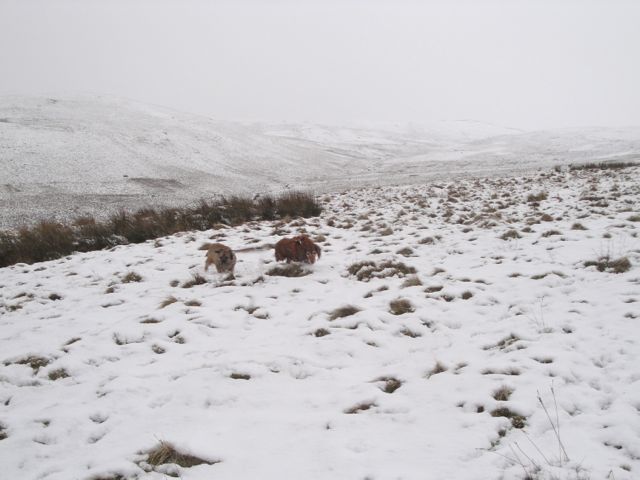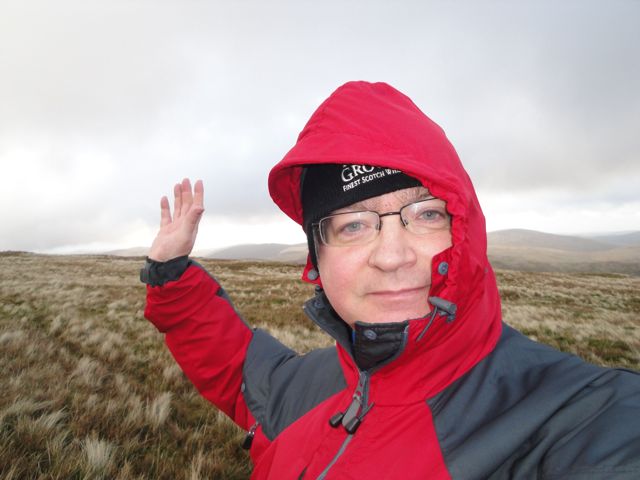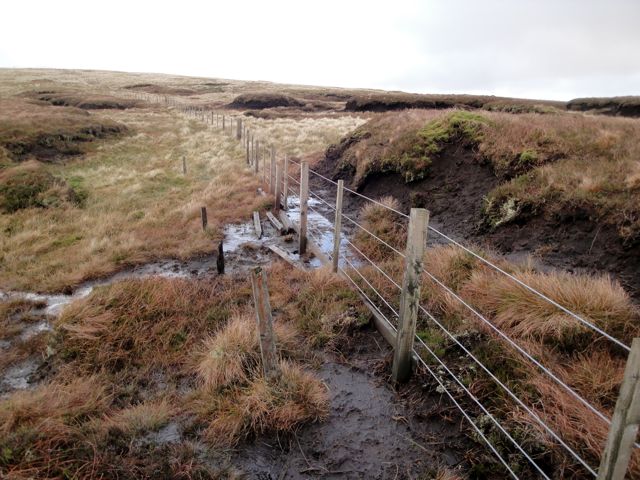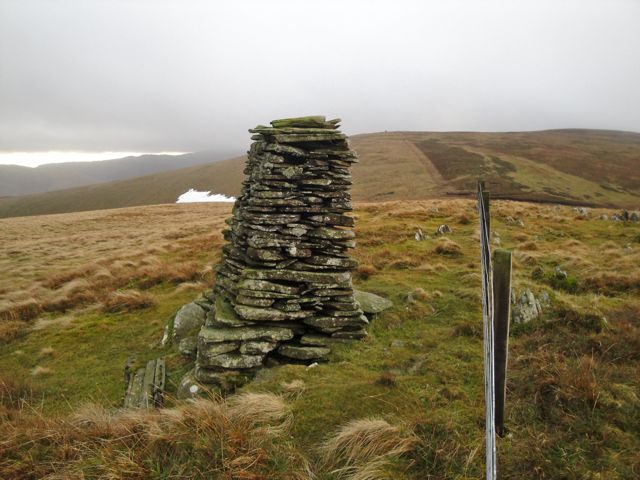
Last of the Ettrick Donalds

8.7 miles   4h 24m  842m ascent

Selcoth-Croft Head-West Knowe-Loch Fell-Windfell Nick-some SUW

One problem with the western Ettrick hills is access. Moffat Water is too wide to cross except over bridges and the Ettrick valley is a long drive. For this walk I crossed Moffat Water at Sailfoot, signposted to the fishery. A new bridge is being built but the old one was still in use. There is a new parking area for walkers with space for about five cars.

From the car park I headed along the track towards Selcoth, passing the farm buildings and heading up the slope at a gradient enough to warm the old muscles. At 250m the path ends at a gate in a dyke. The is a noticeable track continuing up the hill but this peters out pretty quickly.

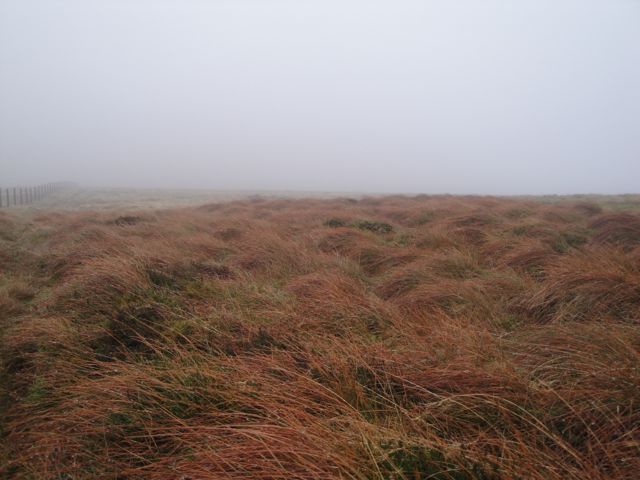
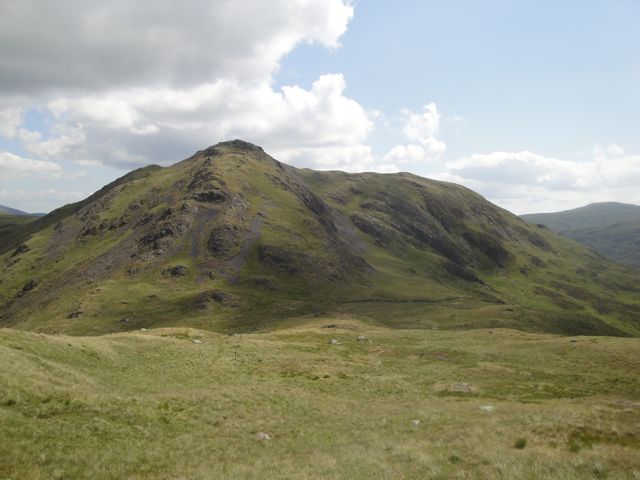
Croft head has a steep eastern face and a long less steep finger stretching west. This finger is split by the Steinstane Burn and from the lower slopes looks like two separate hills. I was climbing the northern finger which gradually develops a very steep northern face. There is a steeper section at about 400m which is a false summit (one of many in fact). Looking up I could see what looked like a group of stones about a kilometre ahead, but their positions gradually changed and I realised it was a group of walkers slowly climbing  a steep section.

By 400m I was on the crest of this ridge and had excellent views of the Moffat hills, Capel Fell with its impressive scree slopes and later the other Ettrick hills. The walkers ahead of me were hidden beyond false summits until the last pull up to the summit, where they paused then left before I arrived.

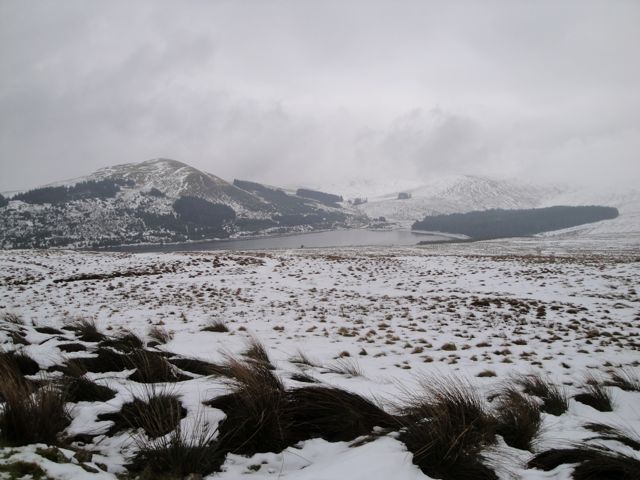
Unfortunately the weather started to deteriorate. Not terrible but enough to spoil the views as the cloud base fell and force me to put my jacket back on. Croft Head, at least with this approach has good terrain, mostly short grass without any waterlogged sections.

Croft Head

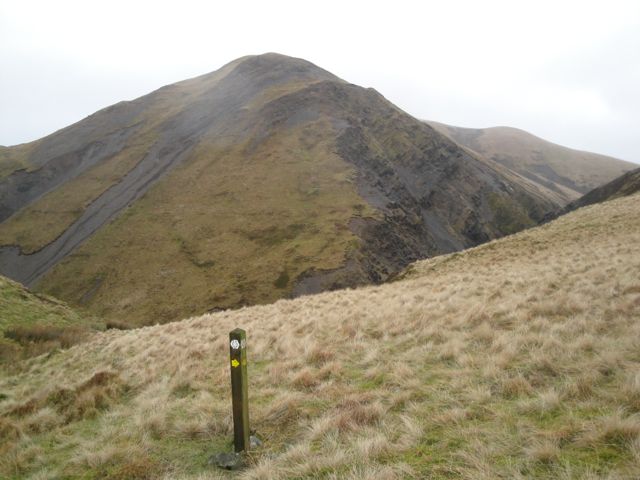
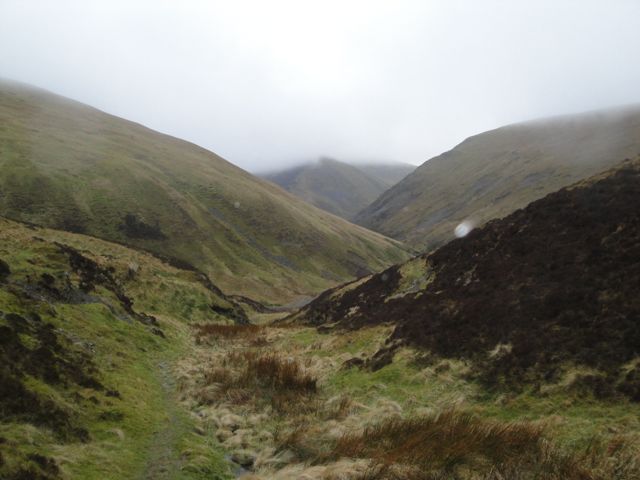
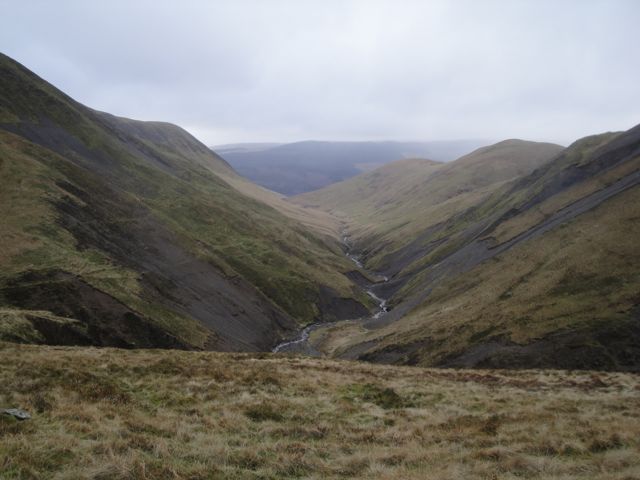
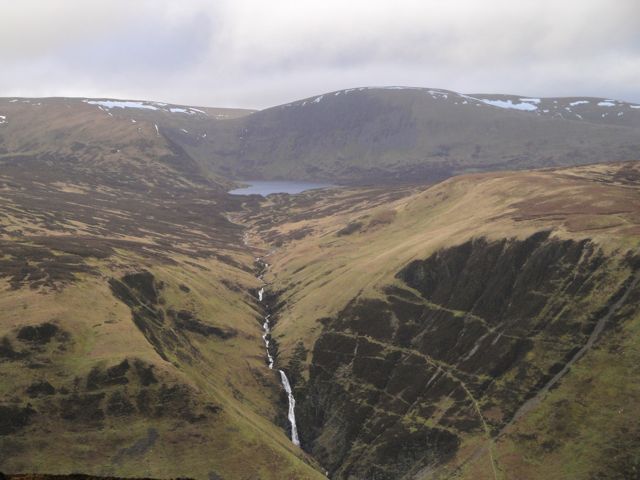
As I trudged up to Croft Head’s summit I was contemplating shortening the walk, particularly once I was back in mist, but a banana seemed to refuel me so on I went. I had been looking forward to making my way down Cat’s Shoulder with its zig-zag path and the cloud did lift enough to give excellent views along the steep sided valleys meeting here, the forest covered hills to the south, the grass covered Ettrick hills and the impressive Craigmichen Scar, a mixture of rock outcrops and scree. Unfortunately the drow n smirr put paid to reasonable photos.

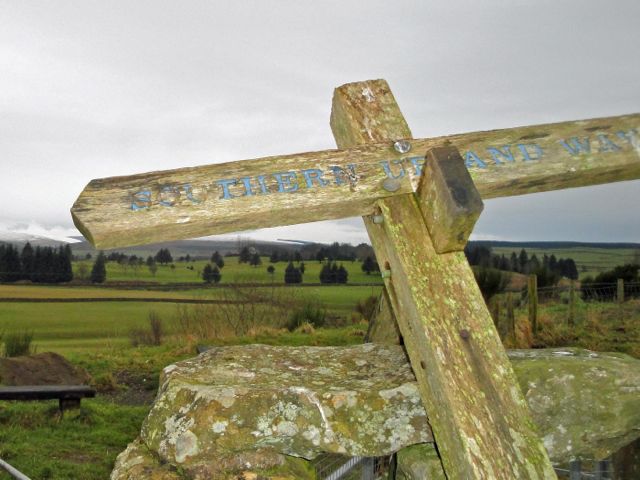
The Southern Upland way crosses Croft head so my way down was on the SUW with its waymarkers. I passed the walking group on the way down and did not meet them again until we were back at the car park.

There is a sheepfold at the foot of Croft Head, a good place to rest and shelter from the elements. The SUW has alternative routes here, one climbing over the hill, the other in the valley for use in bad weather. The sheepfold is where they meet.

Craigmichen Scar

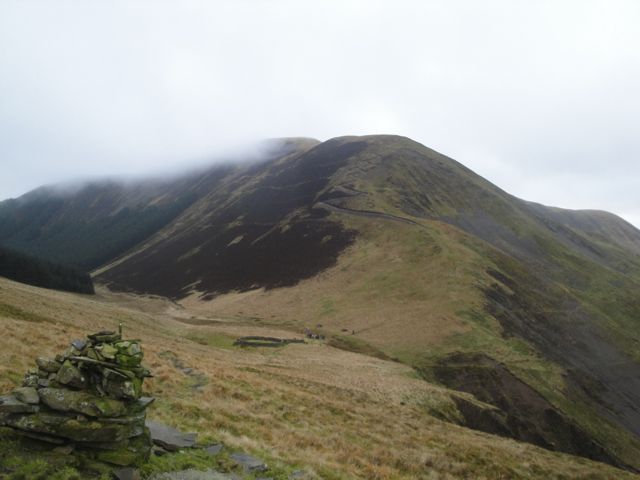
From the shelter of the sheepfold I headed along the SUW and at a large cairn left the path to head up the slopes of West Knowe. I suppose I could have headed straight up from the fold. The contour lines look similar but the reality is different. By using the SUW I was able to climb a little on a well trodden path and climb a slightly easier section.

In fact looking up from the cairn there is another cairn on the slope which I presume is there to guide folk, such as me, who are daft enough to climb the hill. The alternative is to follow the SUW further to the footbridge and climb the even easier slopes there. I chose not to do that since the SUW descended beyond the cairn.

The climb up this grassy slope was not too difficult but I would have worried about coming down it in wet weather. It was steep enough in one place to be able to reach out and touch the grass while standing up. The gradient here was 50%. I didn’t  look down. The GPS track records my zig-zagging up this section.

Unfortunately, once I was on the flatter sections of West Knowe, above about 600m, I was back in cloud, the wind had picked up, it was raining and the ground was waterlogged, squelching underfoot. (Aah, Home at last.)

Ginger Grass of West Knowe

Soon the fence atop West Knowe came into view and I gazed about wondering where the summit might be. Somewhere on the far side of the fence according to the map. I little wandering about and I found a spot that seemed higher than anywhere else.

I then followed the fence all the way to Loch Fell. There is a small rise between West Knowe and Loch Fell which fooled me at first into thinking I was at the summit but three fences meet at the summit so I realised there was further to go. I do wonder whether the hill names here have become confused. It would seem more reasonable to have the central hill, or the entire group of hills named Loch Fell, and the two outer hillocks West Knowe and East Knowe. I  lunched in the lee of the trig pillar on Loch Fell but had to cut it short since I was growing cold standing still.

From East Knowe I followed the fence, tramping through sodden grass and mud, in the pouring rain, the wind blowing so strongly that I had to hold my hood up, but at least it was downhill and brought me out of the cloud.

At Windfell Nick, the col between Loch Fell and Wind Fell I turned left and headed for the SUW near Ettrick Head. The ground here was marshy but passable by standing on heather or tussocks. Once on the SUW the way was easier to see.

SUW

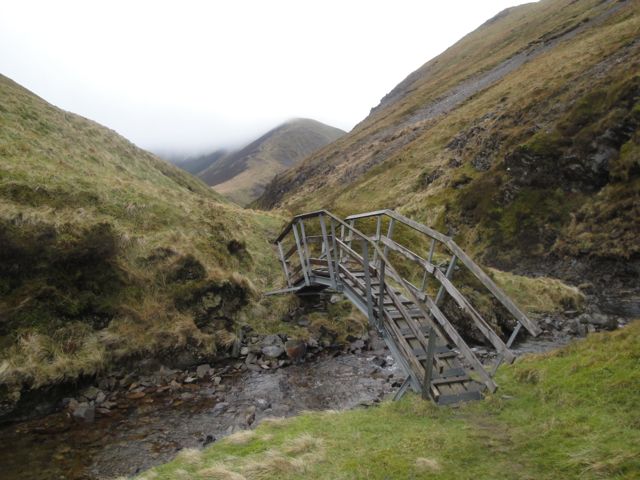
The path took me across the steep lower slopes of Capel Fell and into a deep gorge between Capel Fell and West Knowe. A wooden bridge here crosses the Selcoth Burn and ahead is the zig-zag path on Cat shoulder. The SUW then climbs opposite the Craigmichen Scar to bring me back to the cairn where I had left it about an hour and half earlier.

Back at the sheepfold I had a breather and thought about my way back. Having seen the path along the Selcoth Burn I was worried about crossing the scree slopes. Should I climb back over Croft head? back over Capel Fell? No. I would take the lower path. The path is narrow and crosses steep slopes with a couple of sections across scree. The worse case scenario would be that the scree slipped and I decided if that happened, the best plan would be to fall onto the slope and slide down into the burn 50m below. It was steep but not sheer, about 45% I reckoned, so I would probably stop before I got all the way down. I deployed the walking pole adjusted to cope with the steep gradient and set off. As it was the scree sections looked worse from afar compared to close up and there are reasonable paths across the scree.

Selcoth Path across scree

Soon I was past the worrying section and walking across relatively flat farmland. A little way past a sheepfold is a vehicle track cut into the slope which, rather irritatingly, slowly climbs. On the map is a lower track which stays closer to the burn but I didn’t see it. The vehicle track cut into the hill ends at about 280m and from there I headed directly down towards the buildings at Selcoth. In retrospect it would have been easier to contour around the hill and rejoin the track I had started on, by the gate at 250m. My easiest way back to the track would have been through gardens, which isn’t really on except in an emergency, so I made my way through some trees and across a bridge to get back on the track.

Ahead of me were the group whose path I had crossed earlier in the day. They said they had had a good walk, returning over Broken Back. I didn’t ask how they got there but I presume from Capel Fell one could head down towards Sailfoot Law then join the forestry track to Broken Back.

Croft Head and Loch Fell are the last of the Ettrick Donalds, the most westerly, but also the last two of the group I needed to walk, hence the title.

.


[osmap gpx=”http://www.screel.co.uk/walks/wp-content/uploads/2012/02/RK_gpx-_2012-02-25_1106.gpx”]


Posted in Dumfries & Galloway | Tagged , , , , | Comments Off on Last of the Ettrick Donalds

Windy Standard in the snow

9.5 miles   4h 28m   ascent 511m

Afton-Jedburgh Knees-Windy Standard-Blackgrane-Millaneoch-Wedder Hill

A walk in the snow.

Windy Standard has eluded me on a previous walk which I abandoned in bad weather. As you can see from the picture, the weather was challenging but I made it this time.

The road from New Cumnock to Afton Reservoir is one of those that starts in a reasonable condition but gradually shrinks to single track and then becomes littered with pot-holes. After the Afton Waterworks the road was covered in semi-melted and re-frozen snow and the car=park, marked on the OS map, was closed off. I managed a seven point turn in a passing place, taking care not to slip off the road and left the car at the waterworks.

A snow covered path led up and to the back of the waterworks from where I crossed a watercourse and climbed over a small fence to get onto the slopes of Green Knowe alongside a bubbling brook with small waterfalls, Sandy Syke. This brought me to a track which I followed as it climbed the hill. At this stage the land was cloaked in mist so there was little to see other than the path, a few boulders and several sheep who watched me walk past. I looked up the hill wondering what the cloven stone, marked on the OS, might look like.

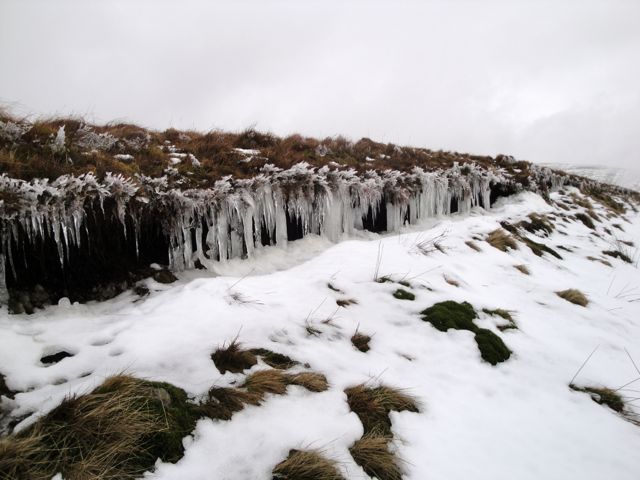
Icicles beside the path

As the path climbed it gathered patches of ice, then a full covering of ice and snow. This was a warning of what was to come. The path reaches the trees at about 520m. As I walked up the hill, I was thinking, as ever, that every metre climbed was a worthwhile effort. Once the path moved into the trees, however, it descended and the snow covered path lost the vehicle tracks that had made walking easier.

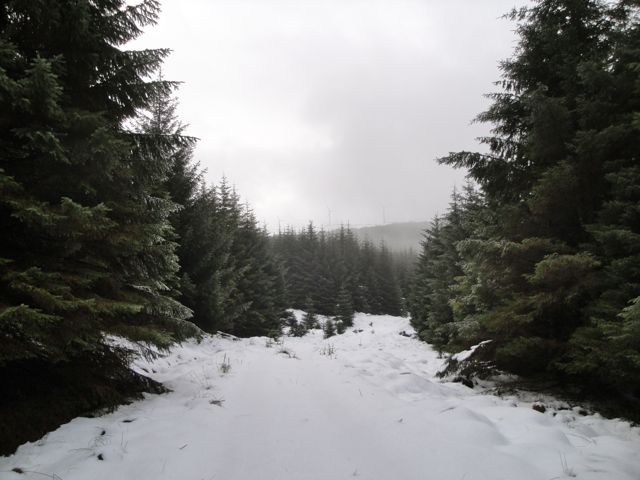
The snow here in the forest was about ankle deep, occasionally hiding puddles but was relatively easy going. In fact the main irritation was trees abutting the path and shedding water whenever I brushed against them. I took special care crossing small streams since it was difficult to know where a bridge ended and overhanging snow began.

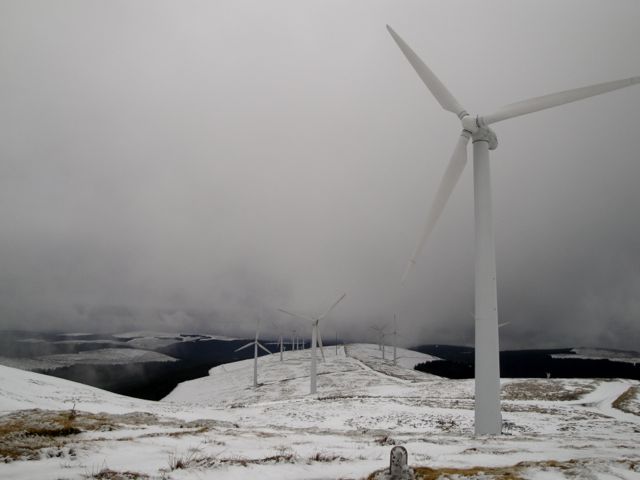
First sight of Windy Standard

The path continued to descend as far as the Water of Deugh. The mist occasionally cleared to allow fleeting views of wind turbines on what I thought to be Windy Standard, but they were more likely on Jedburgh Knees. This did also give me a glimpse of the fire break I had planned on climbing. It looked easy on the OS but as it “stood naked before mine eye” it was obviously a non-starter without crampons and ice-axe (not included in my rucksack).

There is a small wooden bridge over the Water of Deugh, where I stood in a foot or more of snow, reviewing my options and scowling at the map. A path runs south but ends in the forest well short of Windy Standard. There are firebreaks but with crowded contours. It didn’t make the shortlist since I could see no sign of the path.

I continued along the path I was on for another half mile then headed up a wide firebreak. This turned out to be easier than I had thought. A fallen tree partially blocked the way forcing me onto a steeper section and did have me on all fours a couple of times.

The snow on Jedburgh Knees was mid calf level so I was relieved to get onto the road heading up towards Windy Standard. The snow on the road had been compacted by tracked vehicles and looked as though a piste basher had been at work. The relief however was short-lived. Every few steps my foot would sink to mid calf making the going somewhat tiring.

About this time I received a text from Mrs Drow ‘n’ Smirr asking when I would be home. The summit was just ahead so I replied that I was just near the summit and would then be heading back down. Only minutes later the mist cleared and I wasn’t as close to the summit as I had thought. There was another 45 minutes to the summit. Of course by then the phone had no service.

I continued along the compacted snow sinking every few steps. The path eventually started to descend again and it dawned on me that the path didn’t go to the summit, which was again lost in the mist. So I took a bearing and headed off the path towards my goal. The snow here was just less than knee height and hard going to say the least.

Then I had a stroke of luck. The mist cleared and I could see the the trig point, covered in ice. I say it was lucky because it was  several metres to the left of where I was heading. I suppose I’d have got there in the end just by heading uphill, but this saved me a little time.

Lunch was taken next to the trig pillar and the mist lifted to allow a few photos. Moorbrock Hill and Cairnsmore of Carsphairn were now visible, beautiful in their coating of snow but Alhang and Alwhat were still lost in mist. I headed for the nearest wind turbine so I could follow its path back to the compacted road.

The deep snow of Millaneoch

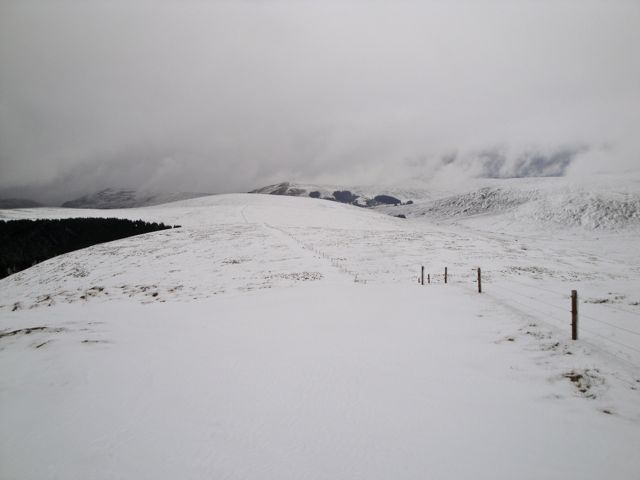
My way back over Blackgrane, Millaneoch and Wedder Hill, following the fence, was now visible and in different weather could have been an easy stroll. As it was the snow proved irritating. In places, with care, it was possible to walk on the snow but my feet would suddenly sink to calf or knee every few steps. Beyond Millaneoch the snow was softer and all steps sank, sometimes into standing water.

On the southern slope of Wedder Hill I met a group of walkers heading in the opposite direction. Their footprints gave me some warning of what lay below the surface. Deep prints in snow surrounded by brown marks identified hidden muddy puddles. Unfortunately I was eventually caught out and gifted wet feet by the accursed ground. The going was very tiring but at least I could see my goal, the path I had started on, which I rejoined where it exited the forest.

Afton Reservoir

Though covered in snow and ice, the path was, relatively speaking, like a walk in the park compared with the previous 80 minutes. What was more, with the mist cleared I could now see Afton Reservoir and its surrounding hills. I couldn’t see the cloven stone but did see Castle William, a large rock formation.

I did wonder if it would be possible to get down to the dam and follow the lower path back to the car. It was only a short distance down through some trees but again the area was covered in snow and I thought it safer to just retrace my steps on this occasion.

.

Posted in Ayrshire, Dumfries & Galloway | Tagged , , , | Comments Off on Windy Standard in the snow

Sanquhar and the SUW

7.4 miles 3h  288m ascent

Along the SUW west from Sanquhar

A few more miles of SUW. I decided to start   from Sanquhar and walk out along the SUW far enough to look down the Scaur valley then head back along Euchan Water.

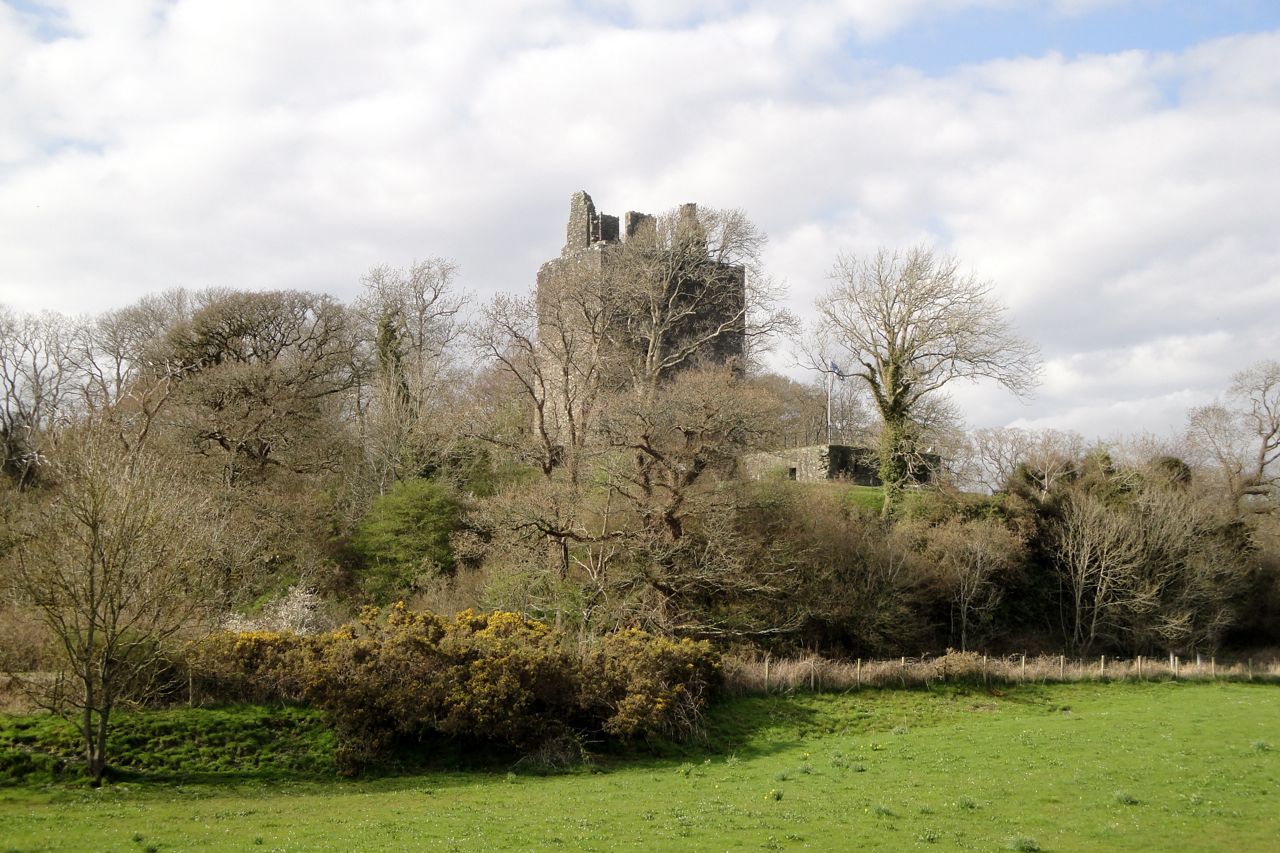
I parked close to Sanquhar Castle and stood by the car, in multiple layered walking gear, woolly hat and gloves, gazing at the ruins through my condensing breath. As I did, two young girls (probably aged 12 or so) walked past in pyjamas and dressing gowns. They make ’em tough in Nithsdale.

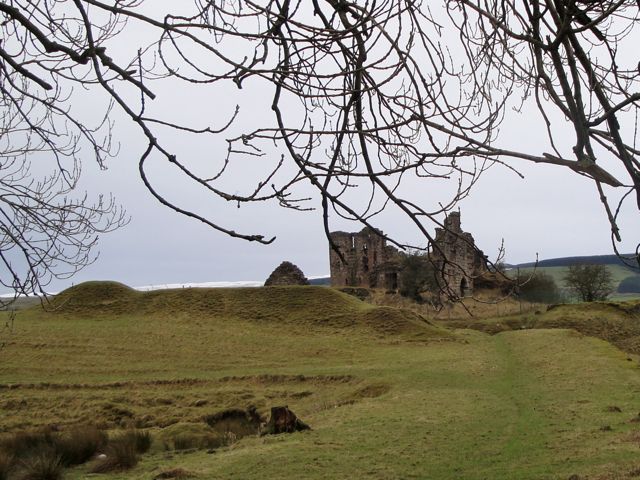
Sanquhar Castle

Judging by the extent of the earthworks this must once have been an imposing castle.  Now it is a sad sight. The castle, built by the Crichton’s in the 1400s, is now a true ruin and as such looks much more forlorn than “managed” ruins like Sweetheart Abbey with their mown lawns and pruned trees.  There is a sign by the road indicating the “easier” path but I’m hard-core so I went through a kissing gate to what I presumed was the n0n-easy path. This goes over an embankment, across what may have been a moat, and then close by the ruins then down to a couple of gates and across a muddy waterlogged area which is presumably the difficult bit.

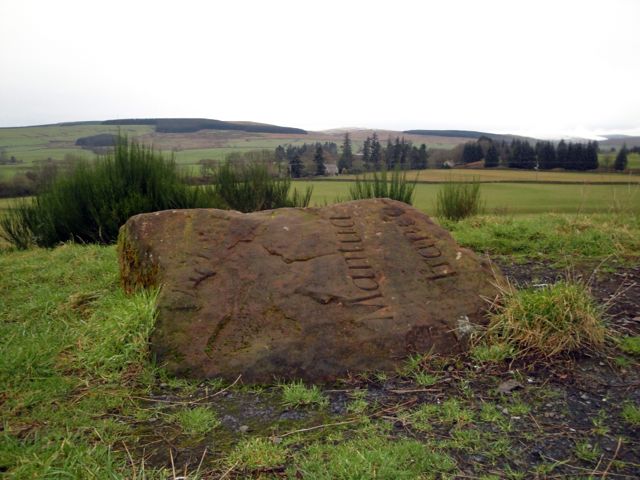
Mantua Stone

The “difficult” path then turns right and rejoins the easy path after 250m or so. The path heads towards the River Nith at a wall, marked as the Deer Dyke on the OS map. There is a giant kissing gate here, big enough for a horses. Just beyond the dyke are a couple of benches overlooking the river and a large sandstone rock with “Mantua France” carved on it. My research about the rock has not found a definite explanation for it. I can only presume it is somehow related to the Admirable Crichton, born close by at Eliock House (1560) and murdered in Mantua (1582).

The SUW follows the Nith, passing a children’s playground and then some partially derelict industrial buildings that resemble something from the 1970s. The surrounding hills, including Lowther with its radar ball were covered in snow warning me of what was to come once the SUW climbed. The route crosses the Nith at Blackaddie Bridge, then turns south to cross Euchan bridge. A field here had a pair of birds circling. I couldn’t  identify them while in the air but once they landed it was obvious they were herons. the first time I have seen herons standing in a field.

I then followed the SUW, which passed through Ulzieside Farm where chickens seem to have taken over the farmyard, but later had to make a detour because I couldn’t get the dogs over stiles. As is often the case, in straying from the beaten track the terrain got worse. Firm ground gave way to boggy, then flooded fields. Gates in particular tended to guard standing water. One dog was a bit unhappy about going through water whereas the other happily splashed crap all over me. I found I had strayed back to Euchan water just beyond Cairnhill so I headed south by the side of Ulzieside Plantation.

The fences here are electrified, or so the signs say, and several gates had been tied shut by someone practicing for the Gordian Knot tying contest. Unlike Alexander I was without a blade. Eventually I found a gate to get the dogs through and headed up on the now snow covered slopes. Up ahead I spotted a post. I hoped it would be an SUW way marker and indeed it was.

Scaur Hills from SUW

The path of the SUW was lost beneath the snow but as I reached each post the next was in view. The terrain was waterlogged and frozen but with ice thin enough to allow feet to occasionally crunch through to the cold water. Several small streams draining into Whing Burn cross the route and add to the excitement. As I climbed further the snow became heavier and the visibility worse so my views of the Scaur valley were poor. I decided to call it a day about half a mile short of Cloud Hill since it was clear that the only views were going to be white.

On the way back I followed the SUW which seemed easier heading back. I had to manhandle the dogs over one steep stile but otherwise the return leg was uneventful.


Posted in Dumfries & Galloway | Tagged , , , , | Comments Off on Sanquhar and the SUW

(Sans-)Bodesbeck Ridge

8.1 miles 4h 8min Ascent 629m

Here I am at 2012 feet in 2012.

Herman Law, Trowgrain Middle, Mid Rig, Andrewhinney Hill, Bell Craig, Mid Rig.

The Bodesbeck ridge runs SW-NE beside Moffat water. The NW face which looms over Moffat Water is steep, certainly too steep for me, whereas its SE side has several grassy fingers with gentler gradients, giving the appearance of a hand, albeit a little deformed. The ridge is a good choice for a short point to point walk, but since I was solo I had decided to start at the NE end and do a return (there and back) as far as Bell Craig. As it was I went one wee summit beyond Bell Craig.

Since this was the first walk of 2012 I had looked for any local hills of height 2012 feet, but since there were none, I headed for some just a little higher so I could at least get a photo when I was at 2012 feet.

I parked alongside the road just a little way past Birkhill, over the county border in the Scottish Borders. There is a path visible snaking up to Trowgrain Middle from Birkhill and I planned to use that for descent but climb directly up Herman Law following the fence which marks the county border. I went through a gate to some sort of relay station with an aerial. I had presumed there would be a gate on the other side but was to be disappointed. Instead I climbed a wall and found myself between the wall and a barbed wire fence. This space I followed for a little while then climbed another wall to get onto the open hillside. At the end of the walk I noticed the public footpath sign near Birkhill which informs the observant of an easier way.

The route up Herman Law is steep but not exceptionally so. There were arrows on the fence pointing up the hill which seemed weird at the time but I can see now that the public footpath (not visible to the naked eye, but signposted) probably meets the fence here. Looking back over Birkhill, on the opposite side of the valley is a waterfall, Dob’s Lin. The hills across the valley have slopes which are very steep but despite this there were plantations of trees adhering to them. These must be wild growth, because I can’t see how the forestry could get up there to plant them. Unfortunately the cloud was low so there wasn’t much else to see. As I climbed Herman Law I pondered whether St Mary’s Loch might be visible from the summit. Standing at the summit, however, did not resolve these ponderings, since the visibility was poor except looking towards the Ettrick Hills.

I had hoped to get a photo of myself at 2012 feet on the way up so I kept checking exactly where I was with the GPS, but I walked past it. Rather than walk back down I decided to get the photos at the next 2012 feet, just a little way further on. The wind was pretty strong and I was unable to get the camera to lie still enough for the automatic shutter. The 2012 (feet) photos are therefore handheld self portraits in the biting wind.

Amid the peat hags

The route followed a fence so navigation at least was a no brainer. There is a collection of peat hags, languishing like hippopotamus in thick mud, in the col leading to the next hill, Trowgrain Middle. This hill has a cairn which leans, though not as impressively as the tower of Pisa admittedly. There are also numerous flat stones sticking out of the ground all around here which would be a major tripping risk in poor visibility. These presumably reflect a rocky layer that has been folded up but why they are so prominent here is a mystery to me.

Trowgrains’s name has a Norse origin. A grain is a branch, and several streams hereabout carry the name: East Grain, Black Grain. A trow is a trough, so Trowgrain is a branch in a trough. Looking from the south, Back Burn produces a trough in the hill and the hill between its two branches is Trowgrain Middle.

Trowgrain

After Trowgrain there is another col with wallowing hags. The way through the mud is aided by bundles of rusting wire cast here and there that can be used as stepping stones, but sometimes a short diversion is the only way to avoid a mud bath. It is then a brief climb to Mid Rig, the first of two Mid Rigs on the ridge. If that isn’t confusing enough there are also two adjacent Mid Hills. From here the Moffat hills and Grey Mare’s tail should have been visible but were shrouded in cloud. The cloud would occasionally clear but never for long enough to get the camera fired up. It was so cold that the water from my bottle was painful to drink so I had to keep the camera inside my clothes when not in use since it gets sluggish in the cold. And I thought silicon chips worked better when cool. In contrast the Ettrick hills were bathed in sunlight.

Andrewhinney Hill at 677m is the highest point on the ridge, so it seems unfair that the ridge is referred to as the Bodesbeck ridge. I would be really interested to know where the name comes from but haven’t been able to find out. Was there an Andrew Hinney or is it an anglicisation of another name? This hill should have provided the best views of White Coomb, Loch Skeen and Grey Mare’s Tail, but they remained shrouded in mist, just occasionally allowing tantalising glimpses.

Heading down Scawd Law towards Bell Craig, I emerged from the cloud and had some better views of Loch Skeen. By the second Mid Rig it was time to head back since I had been going for two and a half hours and sunset was just over three hours away. I walked over to the cairn which is about a hundred metres from the summit in the hope it would offer some protection from the wind while I had a bite to eat. It didn’t. Whichever side I sat on was just as blowy. So I headed down towards the col and leaned against the fence while I had my coffee and Christmas Cake, with banana for dessert. I had had the foresight to wrap the vacuum flask in a spare woolly hat so it had remained warm.

This ridge walk had been quite tiring and I was tempted to head on to Bodesbeck, possibly contouring rather climbing it and then walking back to the car along the road. It would be further but much easier going underfoot with less re-ascent. My quick assessment was that this would be an additional 6 miles and from my previous experience of Bodesbeck I doubted the terrain would be amenable to shortcuts. So I decided to head back the way I came. It wasn’t quite as bad as I had thought, the wind was mostly helping me along on the return trip. Once on Bell Craig I looked up to Andrewhinney Hill and decided contouring would save some effort as well as giving better views of the Grey Mare’s Tail. The mist had cleared somewhat by now.

Loch Skeen and the Grey Mare

The contouring plan worked well, there were sheep tracks to follow at times and the ground wasn’t too steep or boggy. Unfortunately Strang Cleuch was filled with snow and I didn’t fancy walking across this and risking a slip so I abandoned my 610m contour and headed back up to the ridge and over Mid Rig.

My plan from here was to walk down to col before Trowgrain Middle then contour round until I found the path to Birkhill. There is a cairn marked on the OS map and I presumed that it would mark the path. Once in the col, however, the plan changed. I looked up at Trowgrain Middle and its cairn. It looked as though the summit was a little way from the cairn, so I went back up to check.

Standing at the cairn it certainly looked as if there was an area about 100m away that was higher. As I walked towards it, I felt I was going uphill. Once there I turned around and looked back. The cairn now seemed higher than me. Weird. I’ve checked the coordinates for the summit on the web and it seems the cairn is the top.

So I set off heading NW looking for the cairn. I didn’t see it even though my GPS route has me passing right by it. There was a blue plastic feed bin but I can’t think that is the cairn. The gradient gradually steepened and at last the path appeared.

Now from below this looks like a path, and I am sure it is. But it is quite eroded and is covered in mobile stones giving it the consistency of scree. Those who have seen me descending such paths (recall Skiddaw) will know that I left the queue when confidence was being doled out so this was slow. The only saving grace was that there was no one else there to experience my pathetically slow descent. It would be a great path for ascent or even for descent when dry.

As I walked back to the car I sighed as I saw the sign for the public footpath.

.

Posted in Dumfries & Galloway | Tagged , , , | Comments Off on (Sans-)Bodesbeck Ridge

Cluden’s Sacred Sites

11.7 miles 4h 11m ascent 127m

Cluden Water and Nith Riverbank walk, Lincluden Abbey, Twelve Apostles and a lowly Trig Pillar

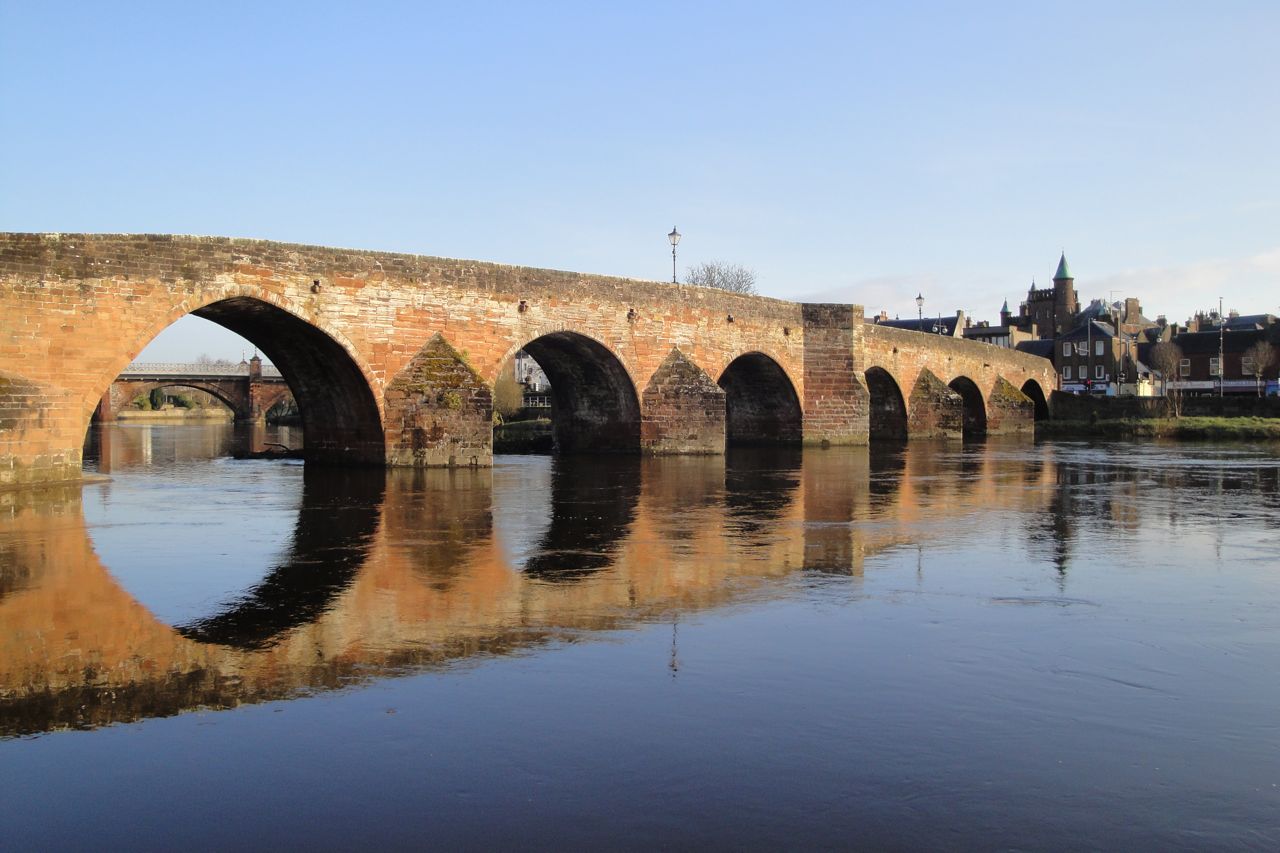
A beautiful crisp cold day with blue skies. I thought it would be appropriate to start this walk somewhere historic so I walked into town, passing the McGowan Memorial Fountain, and crossed the Auld Brig (Devorgilla Bridge). The original bridge here was built in 1260 by Lady Devorgilla, the stone bridge replacing it two centuries later. On the riverbank is a life-size relief of Devorgilla of Galloway, one of the most powerful women of the age, and 4great-grand-daughter of William the Conqueror.

Devorgilla Bridge

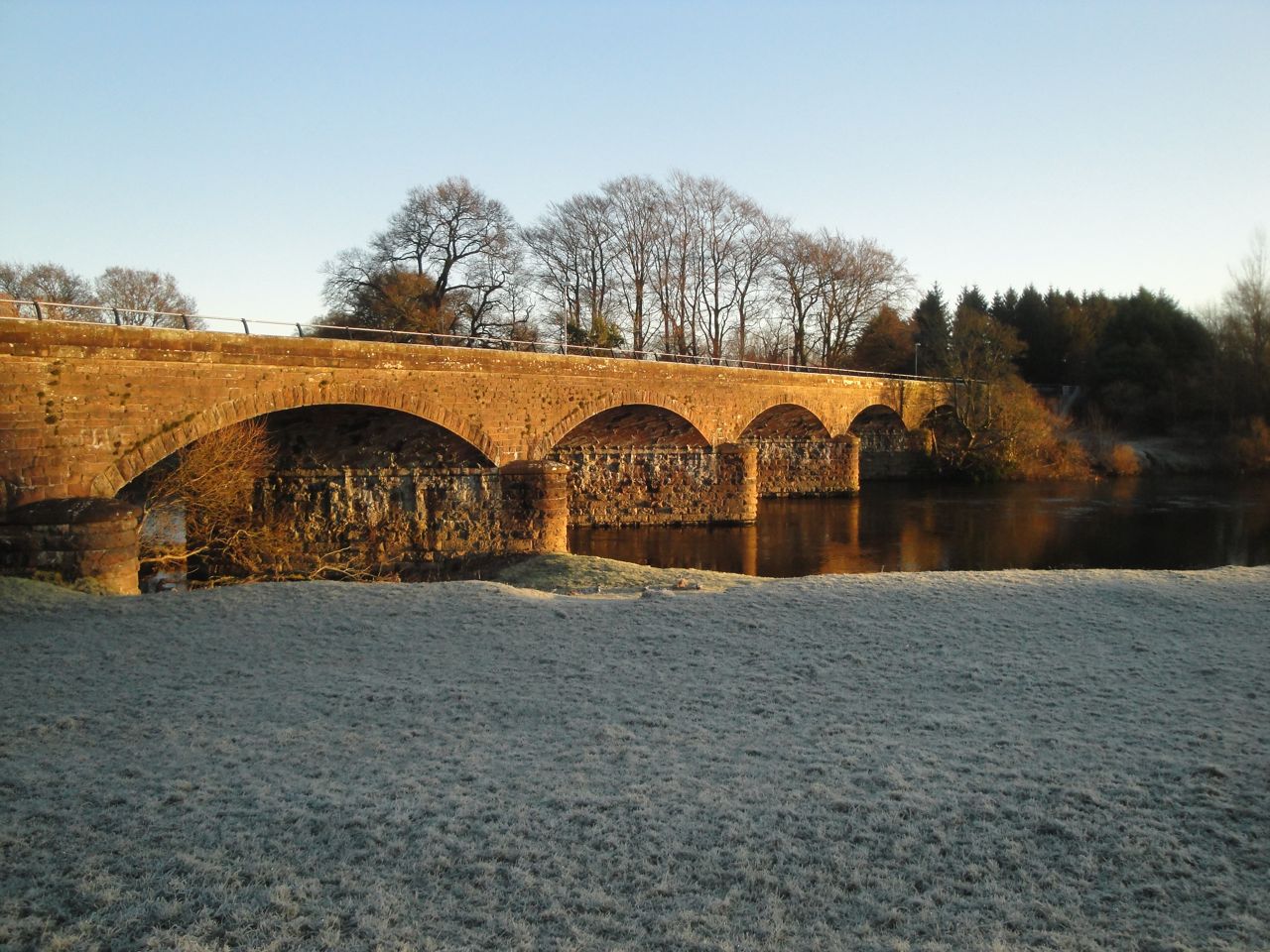
I then turned left and headed under Buccleuch Bridge (originally called the New Bridge, built in 1793) and onto the Greensands. Just as there is now none of the white sand that gave the Whitesands its name, the Greensands shows no clue as the derivation of its name, but a little further along the route there is some actual greensand.

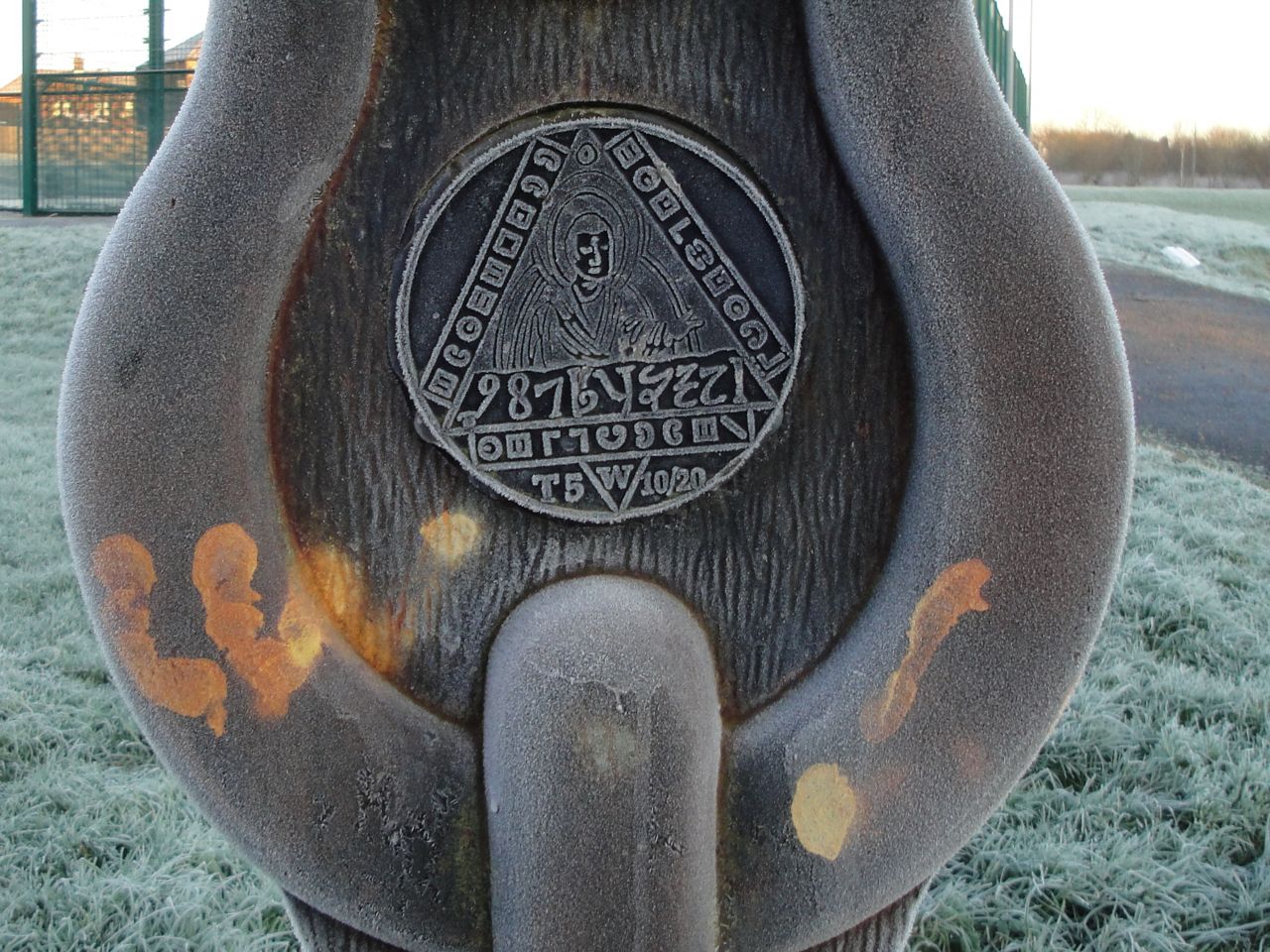
Detail on Cycleway Sign

The Loreburn Bridge, built in 2001, carries National Cycleway Network route 7, and across this foot and cycle bridge is one of the Andrew Rowe designed cycleway mileposts. I then walked along the bank of the Nith opposite Nunholm. There is a very small caged footbridge across an unnamed burn even though the burn is narrow enough to easily step across. Here the Nith has another footbridge, the Academy Bridge, which was padlocked shut. The Stakeford weir would have been somewhere around here in ancient times and been a place to ford the river. The river bank beyond here shows signs of marked erosion, and there are areas of sand with grass growing through them. I presume the Greensands was once made of similar material.

Queen of the South Viaduct

The view from these fields is surprisingly good with Criffel, See Morris Hill and its neighbours, Queensberry, the Glasgow Road footbridge and the spires of the town all visible. The next crossing of the Nith is the Queen of the South Viaduct, which on this leg of the route I passed under. This 170m bridge was built as the Nith Viaduct in 1859 and carried the Port Railway to Stranraer. The railway closed in 1965 but the bridge survived and was revamped, renamed and reopened in 2008 as part of the national cycleway. Beyond the viaduct is a pathway alongside the factory which has an unfortunate amount of litter. The trees here look as if they have been coppiced, but I’m no backwoodsman and they may just grow like this. Unfortunately the A75 blocked my way along the riverbank but there are steps up to the road where I used the Green Cross code then took the steps back down to the river bank. The road wasn’t too busy this early in the morning but I would recommend those following in my tracks to make a short detour and cross the A75 by the footbridge.

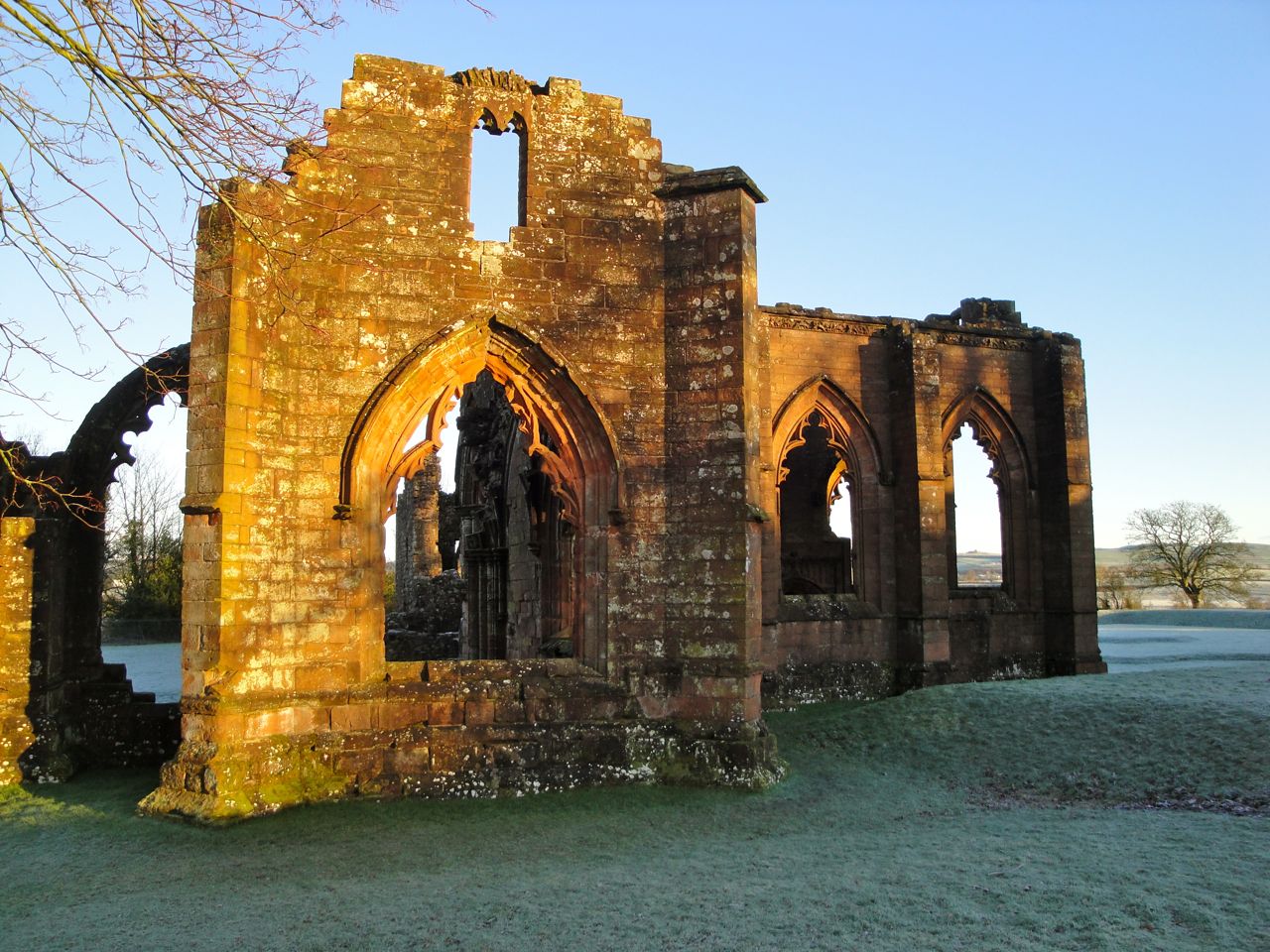
Lincluden Abbey is soon visible, standing close to the meeting of Cluden Water and the River Nith. There is a motte next to the abbey which would once perhaps have held a fortification but now has a grove of trees. The climb up was a little steep what with the slippy leaves. There is a gentler route up from the far side of the gardens but I only saw this once I’d slipped my way up the direct route. The best views of the ruins are from the mound but my mistake had been to set off too early, so the sun was still a little low for good photos. Another place for the revisit list.

Burns captures the atmosphere better than me, not surprisingly.

As I stood by yon roofless tower,
Where the wa’-flower scents the dewy air,
Where th’ howlet mourns in her ivy bower
And tells the midnight moon her care;

The winds were laid, the air was still,
The Stars they shot along the sky;
The fox was howling on the hill,
And the distant echoing glens reply.

Lincluden Collegiate Church

The Priory was established in 1160 by Uchtred, Lord of Galloway but in the 14th century the nuns of the priory were dismissed by Archibald the Grim, (Archibald the Black, Lord of Galloway, Earl of Douglas, scourge of the English etc). The nuns were said to have broken their vows of chastity, but bear in mind that the Earl sat in judgement on the matter and stood to gain much from the priory’s estates. In 1389, with papal backing (or perhaps pressure), he ordered a new church built and established a College of Canons to pray for his soul and those of his immediate family.

From the Abbey I headed back to the riverbank, this time of Cluden Water. The undergrowth here was quite thick in places but easily overcome. There is what looks like a small sewage treatment facility adjacent to the river, but in the freezing weather I was spared the smell. Glancing in I noticed that they had lifebouys, so those tanks must be deeper than they look.

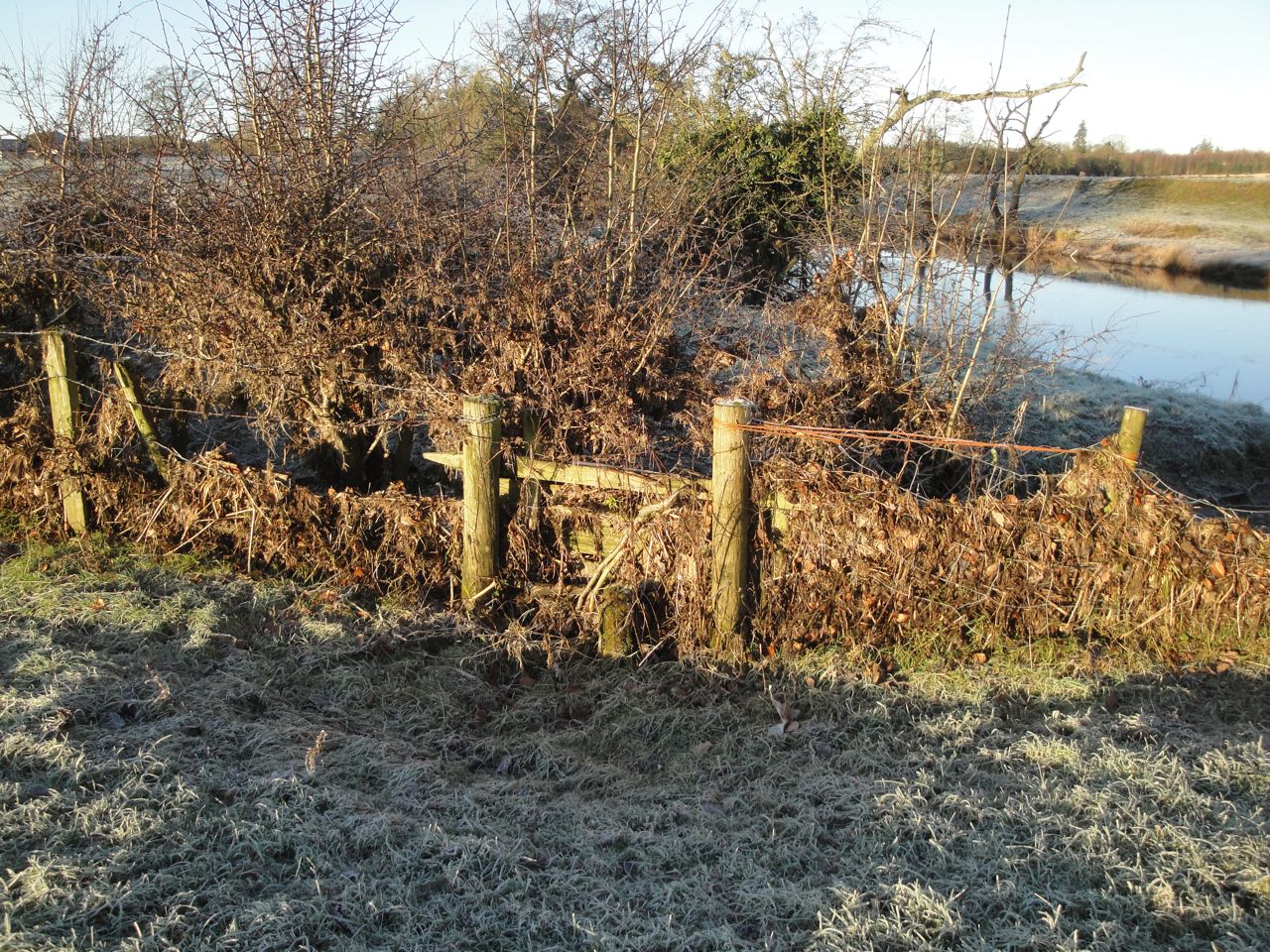
Overgrown and barbed-up stile

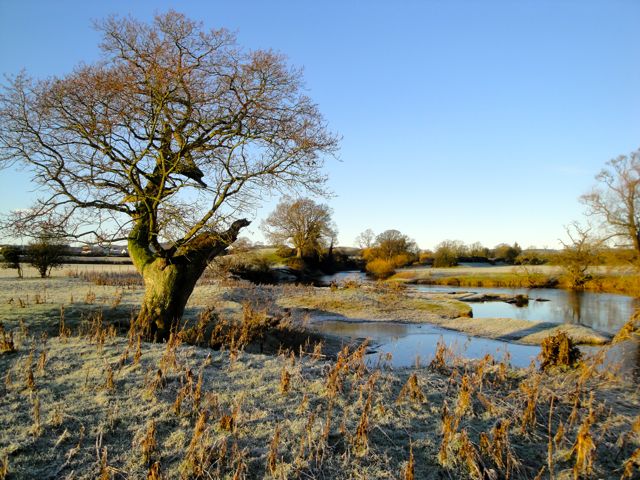
The Cluden itself is a pretty river (see the picture above), and though there was no sign of Mole, Ratty or Toad, there were plenty of ducks, geese, some rabbits and even a heron. The OS map shows a path along the Cluden, but it is more in the mind than on the ground; perhaps it’s just a right of way. There were well maintained stiles on the farmland but at the old ford near Hardlawbank, the stiles are overgrown and festooned in barbed wire, requiring a bit of a diversion. Further along the bank there are some houses whose gardens I suspect contain the right of way but it seemed impolite to climb into their gardens. As it was I found myself edging along a rather narrow steep overgrown muddy area between the gardens and the water. It would probably be better to take to the adjacent road and rejoin the riverbank 100m further on, especially if it has been raining or the river is high. The section between said cottages and Newbridge has a good stile over the fence (thank you, farmer). Across the river is a large house that I presume is Dalawoodie House. Once I had crossed the A76 I was in Newbridge, where I joined what once was the old route of Glasgow road and crossed the new bridge (built 1759).

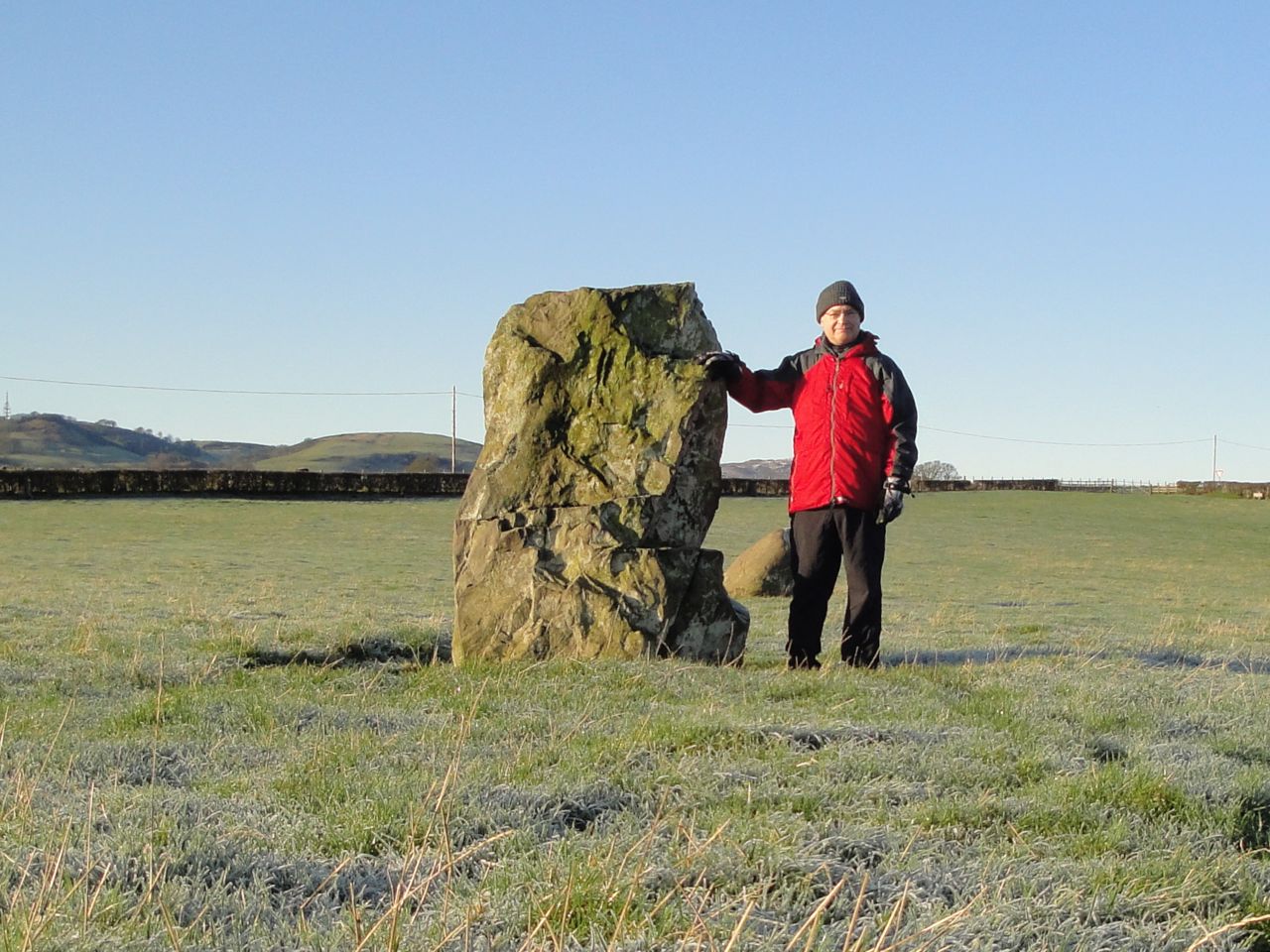
One of the Apostles

I then turned left and headed up to the field containing the Twelve Apostles. This is the largest stone circle in Scotland with a diameter of 89 m. There are eleven stones, but prior to 1837 there had been twelve. Local folklore says Judas has been removed. Historians think there were originally eighteen stones. Early writings, from the medieval period, refer to this as the Druid’s Temple, and a nearby village was even named Druidsville, but the Stone circle dates from 1500-3000 BCE, so it predates the Druids by a millenium. From the Druid’s Temple I followed the road to Holywood village where a couple of Christmas trees stood before the Church Hall. The holy wood has long since gone but was a forest of oak stretching for 6 miles north of here. This iteration of Holywood village is relatively new having developed after WW2; the original village (Druidville) had been a mile or so north, where the petrol station is now.

Holywood Church

An Abbey was established at Holywood in 1121 and housed white canons (Augustinians) who included Joannes de Sacrobosco (John of Holywood), author of an influential book on ptolemeic astronomy, which was required reading in western universities for over four centuries. The abbey fell into disrepair following the reformation and was dismantled in 1778. The present church, constructed using stone from abbey, stands on the site of the old abbey, of which no visible signs remain.

The Holywood War Memorial is in the church grounds. It is inscribed 1914-1919. Many memorials carry these dates for WW1, reflecting the official conclusion of the war with the Treaty of Versailles on 28th June 1919, rather than the cessation of fighting with the armistice in 1918. From the rear the church bears a striking resemblance to the haunted church in the Mad Monster’s Mansion level of Banjo-Kazooie (ah, the heady days of N64). Behind the church runs a line of trees along the dismantled Cairn Valley railway branch line. I had originally planned to use the old railway line as part of the route but it is quite overgrown and would only be useful if one wished to recreate the experience of passing through dense jungle. I had not brought a machete, so walked on the road instead. I must be a towny at heart.

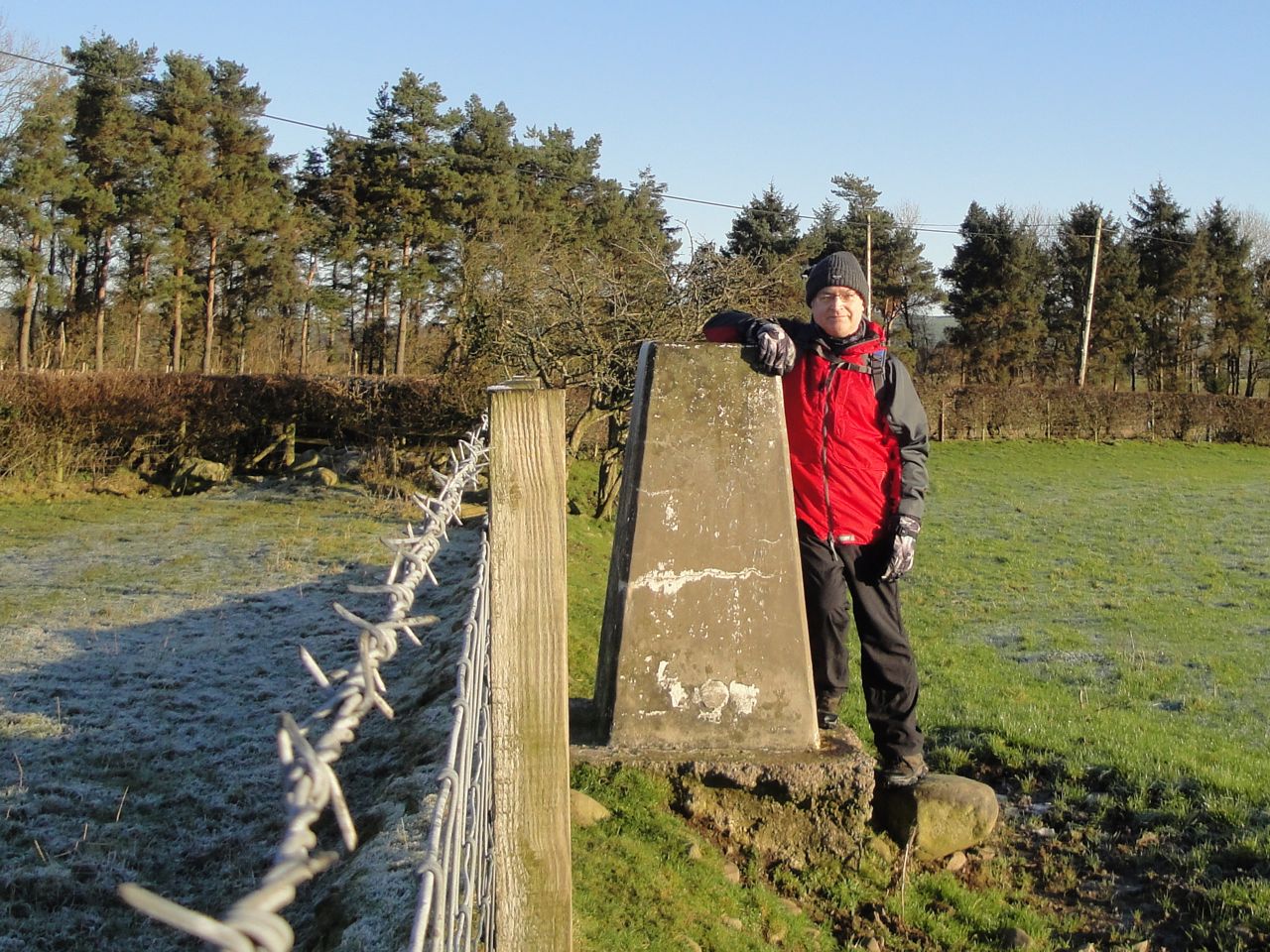
Trig Point at 27m

A little past Holywood church is a trig Pillar in a field of docile sheep. I had not seen one in open countryside before. It stands at the impressive elevation of 27m and is the lowest in the county, if you ignore those on the coast. This was the half way point. I then headed south along a single track road trying to place my feet where the sun had melted the ice and squinting into the sun. I was now walking in the tongue of land lying between the waters of the Nith and the Cluden, towards the site of the old Martinton ford. Since all was flat around me there were good views of Criffel to the south, See Morris Hill and friends, and the hills beyond Amisfield.

Rather than continue along the track directly to Nunholm, I took a left through a concrete ginnel under the railway. This had a pool of frozen slurry filling it. Did I say frozen? Not once I was in the middle of it when the surface gave way. Luckily it was only a couple of inches deep but enough to coat my boots. To cap it all the outside tap was frozen when I got home as well. From here it was across open pasture with huge flocks of geese circling above me until I fought my way through fence and hedgerow to get onto and across the A75 near the A701 junction. The road was busier now and the crossing took some time. I suspect it would have been possible to pass under the bridge on the river bank which would have been easier and safer. The reason for this detour was so I could walk along the riverside levee that I have seen so often when driving along the ring road. Well I’ve done it now and that’s all I can say about it. If I did this route again I would either miss this section out or cross the Nith on the pavement of the road bridge and walk along the other bank, which has a path.

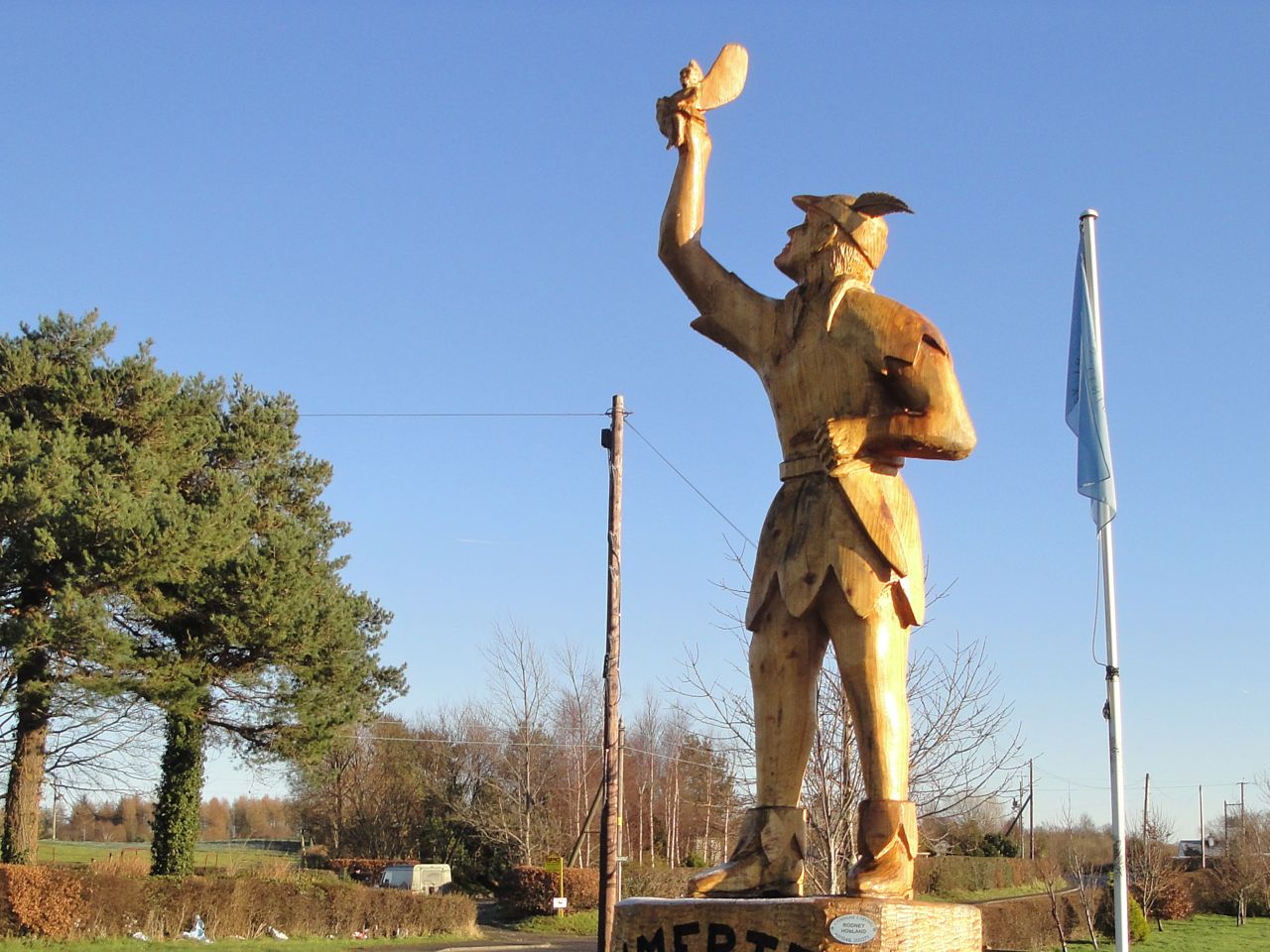
Peter and Tink

Once along the levee I passed under the Martinton Bridge, carrying the railway. This dates from 1849 and I presume is close to the ford so loved by Burns. There was then a short tramp through some more overgrown undergrowth and a climb back up to the ring road, to cross the Nith on the road bridge to bring me back down to where I would have been, had I not chosen the slurry filled ginnel.

I was now in Nunholm, a name which reflects this was the route to the “Islet (holm) of the Nuns” at Lincluden Abbey. This route would have crossed the Nith at the (now lost) ford whereas I used a road bridge. From Nunholm, the cycleway with its bicycle statue crosses the Nith on the Queen of the South Viaduct and heads west then south passing, as the railway once had, under several bridges.

At Castle Douglas Road I turned back towards the town, pausing to look at the statue of Peter Pan and Tinkerbell, which I have to admit has yet to grow on me.

This was an interesting walk, with several antiquities to visit. Burns apparently enjoyed these areas. Allan Cunningham in The Works of Robert Burns (1834) says:

While he lived in Dumfries he had three favourite walks; on the Dock-green by the river-side; among the ruins of Lincluden College; and towards the Martingdon-ford, on the north side of the Nith. This latter place was secluded, commanded a view of the distant hills, and the romantic towers of Lincluden, and afforded soft greensward banks to rest upon, within sight and sound of the stream

.

Posted in Dumfries & Galloway | Tagged , | Comments Off on Cluden’s Sacred Sites

Cairnharrow’s Jewels

10.6 miles 758 m   6h 12m

Cairnholy-Barholm Hill-Ben John-Cairnharrow-Cambret Hill

Despite having to defrost the car, and turning up in cold weather gear, most of this walk was tee-shirt weather.

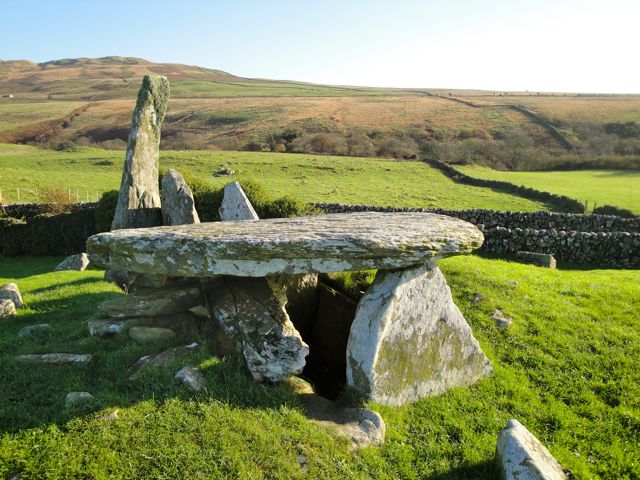
I parked at Cairnholy where there is space for two, perhaps three, cars and had a wander about the 5000 year old chambered cairns of Cairnholy I and Cairnholy II before hitting the hills.

Negotiating Cairnholy Farm was my first task. I didn’t want to go wandering through the farm’s private areas so picked my way along a slurry filled track, past some bemused sheep and headed down the slope to Kirkdale Burn. There is a ford which is obviously in use since either side of it has boot sucking churned mud. A little frost here would have helped.

There was no obvious path or track so I just made my way up towards Barholm Hill, cutting across the track to Claughreid. I couldn’t see any nearby gates in the fence so climbed rather gingerly over the first of many barbed wire topped fences. By the end of this walk I had become a dab-hand at barbed wire, using my OS map as protection.

The climb up Barholm was easy going, with great views over Wigtown Bay, Fleet Bay’s Islands in the foreground and the Isle of Man on the horizon. I had originally intended to go from Barholm Hill to Cairnharrow but Ben John sat there tempting me across. Perhaps the view down its far side would be worth a photo? I succumbed.

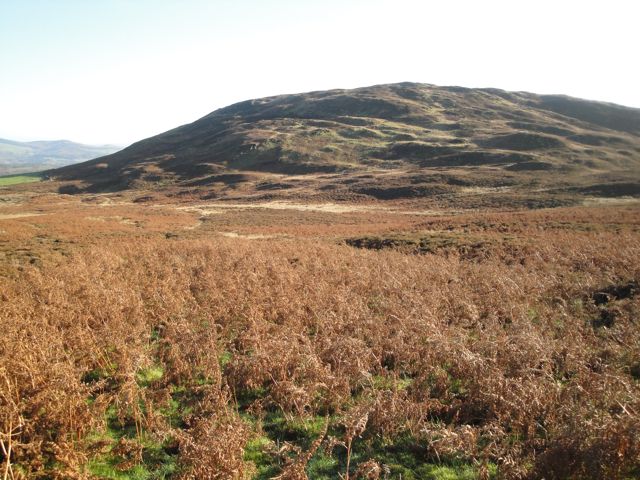
Bracken below Ben John

The eastern slopes of Barholm Hill had swathes of burned heather which was easy going underfoot. The lower slopes were unburned heather but lower still, there was first bracken then the dreaded marsh grass, and boggy ground. Too quick for my camera, a white bird rose from the bracken and as I wondered what it was, it flew around revealing itself as an owl.

Ben John itself is a relatively easy hill to climb, but has many minor bluffs to impede descent. Atop the hill the views were similar to those from Barholm Hill, but now Gatehouse, Sandgreen and the Glengap Hills were visible as well. I had hoped to see the Rutherford Monument from here but was disappointed. I should have looked more carefully, though, since I can see it in the photographs.

I had considered the Ben John diversion when planning the walk, and intended dumping my rucksack on Barholm Hill, then doing a there and back to Ben John. Once on Barholm Hill however it looked better to head directly from Ben John to Cairnharrow across the Whiteside Burn, so I kept the rucksack. The climb up Cairnharrow was slow due to the terrain, though a pair of deer ahead of me made short shrift of it. Barholm, Ben John and Cairnharrow form a culvert of sorts, so the lower slopes of Cairnharrow don’t offer much of a view. This tends to make one concentrate too much on the ground underfoot. I had chosen to climb to the left of a dyke, alongside the burn, but I wonder if the other side of the wall might have been easier. It did look greener on the other side of the wall.

Cairnharrow's Cairn

Eventually I made it to the summit of Cairnharrow where I found myself separated from the Trig pillar by one wall and the summit cairn by another. After clambering over one wall to the trig then over another I was at the cairn. Unfortunately I developed Elvis legs in the last few metres of climb so needed a bit of a sit down, with some lunch and coffee. The views here were impressive. The Machars were now becoming covered in cloud which I found myself looking down on, as if in an aeroplane, but the other directions were clear revealing Ailsa Craig in the far distance, but also the Minnigaff Hills,  Clints of Dromore, Pibble Hill, Knockeans, Fell of Fleet, Cairnsmore of Dee, Cambret Hill and the Rhinns of Kells. Cairnsmore of Fleet dominated the view, a massive hulk despite being seen end on.

Cairn on Cambret Moor

Cambret hill with its TV transmitters lay ahead. I headed down the heather covered slopes aiming for the large cairn on Cambret Moor. Close to the cairn are the remains of a stone circle, best seen from the top of the cairn itself. From there I had about ten minutes wandering from one large stone to another, looking for more megalithic remains, then headed up to Cambret Hill. The transmitters gradually got closer, and I realised they were bigger, and so further away, than I had thought. I was definitely flagging by the time I reached the transmitters so it was time to stop, have some emergency carbohydrate and decide what to do.

Options: follow the original plan of walking down the road from Cambret Hill, along the military road to the stone circle near Glenquicken then along the path to Cambret farm; head straight across to the stone circle (saving 1.5 km); or miss out the stone circle and head for Cambret Farm (saving 3 km). After some chocolate I felt rejuvenated and decided that I shouldn’t leave out the stone circle. So I texted Mrs Drow ‘n’ Smirr that I was making slower progress and would be another two hours getting back to the car, then set off for Englishman’s burn and its stone circle.

This side of Cambret Moor proved relatively easy going. The tussocks were small and the many drainage channels were easily crossed. Englishman’s Burn would have been difficult to cross but someone had helpfully placed a sheet of corrugated iron over it. The Stone circle was well preserved, the best of those I had seen on the walk. A larger stone stands surrounded by a couple of dozen smaller stones, with Cairnsmore of Fleet as a background.

Stone circle near Englishman's Burn

From the stone circle I headed across another burn, climbed a fence then stopped to review the map since the expected path to Cambret Farm was nowhere to be seen. There is a cist marked on the map near here but I forgot all about it in my annoyance as I realised the path was back on the other side of the stone circle, meaning I would need to cross back over two burns. I couldn’t find the corrugated iron this time.

The path to Cambret Farm exists as a dotted line on the map but not on the ground, but twenty minutes or so had me at the farm. Here was a rotting sign which on close inspection read “Footpath” and directed me along a faint quad bike track that faded and reappeared.

Horse below Cairnharrow

Between Carsluith Burn and the next stone circle is a flat area which really fits the epithet “moor”. By now the sunlight was taking on the golden light of very early dusk giving the grass a rich hue. A black horse stood watching me as I passed and it had seemed so still at first that I wondered if it was a statue.

After the final stone circle there was another course choice to make. The original plan had been to climb Cairnholy hill but it looked much bigger with tired legs. I could take the track from Claughreid and follow the road back or cross the Kirkdale burn and contour the lower slopes of Cairnholy Hill. The latter saved 2.5 km and seemed a no brainer. It was the wrong choice.

I headed down to cross the burn but had waited too long and found myself climbing down the steep sided Cleugh of Claughreid. The burn was easily crossed here but there was a moss covered dyke at the bottom, too tall to see over and too slippy to easily climb. I should have taken the hint but instead I found a tree that had fallen on to the wall and clambered over. The far side of the Cleugh was steeper still and covered in slippy rotting leaves.

Cairnholy I

Once out of there all I had to do was walk back to Cairnholy Farm, but as it turned out I had twenty minutes of battling through thick tall braken ahead of me. I had thought the bracken was difficult, but it had nothing on the partially flattened bracken that caught my feet in every step. The clouds had by now settled on Cairnharrow and Barholm Hill, giving each a crown of cotton wool, but the lower slopes were still bathed in golden light. The chambered cairns at Cairnholy also looked different in the late evening light so I felt obliged to take a few more photos before getting back to the car.

The bracken did at least clean my boots but sadly I had to walk through farm slurry later on which re-coated them.

The weather had been excellent, warmer than I expected and with good visibility. I don’t think this was a particularly difficult route, though the last section was a mistake. I may have found it hard because of being under the weather or perhaps adding Ben John, an extra 3.5 km and 200m of ascent, was a mistake.

Posted in Dumfries & Galloway | Tagged , | Comments Off on Cairnharrow’s Jewels

The Seventy-five

I’ve been limited to short walks of late with little to report so I thought I’d write something a little different to keep my hand in. I had hoped to be out and about this weekend but Mrs Drow ‘n’ Smirr has decreed it stupidity to go out in the cold, wind and rain while still coughing, spluttering, whining and disturbing her sleep. So instead, here is my homage to the A75.

I have travelled along the A75 between Dumfries and Stranraer regularly over the last 18 years. The villages, buildings, monuments and hills along the way have gradually stirred my rather sluggish curiosity and led me to find out more about them.

The A75 is part of the 1,170 mile European Route E18 running from Saint Petersburg, Russia to Craigavon, passing through Norway, Sweden and Finland. In Dumfries & Galloway the road runs through countryside and a few villages, bypassing the larger towns it once bisected. In places it follows the path of an old military road built in the 1760s to aid troop movements to Ireland. There had been a major programme of military road building in Scotland in the early eighteenth century aimed at improving troop movments in controlling the rebellious Jacobites. The project was led by General Wade, who is mentioned in the notorious anti-scots verse, oft mentioned but not actually in the official national anthem.

Lord grant that Marshal Wade
May by thy mighty aid
Victory bring
May he sedition hush
And like a torrent rush
Rebellious Scots to crush
God save the King.

General Wade’s assistant was Major William Caulfeild, a fellow Irishman, and following General Wade’s removal from command after failing to prevent the Jacobite army’s incursion into England in 1745, Major Caulfeild took charge of the construction of military roads in Scotland. Caulfeild’s road from Gretna to Portpatrick is in many places an upgrade of older routes. Some of these may be military routes dating back to Roman times, and pilgrimage routes to the holy sites at Whithorn will have been used for centuries. The A75 is in short stretches on Caulfeild’s route but the military road tends to take a more direct route than the modern A75. The military road can be seen at times, in use as a minor road or footpath, near its modern counterpart.
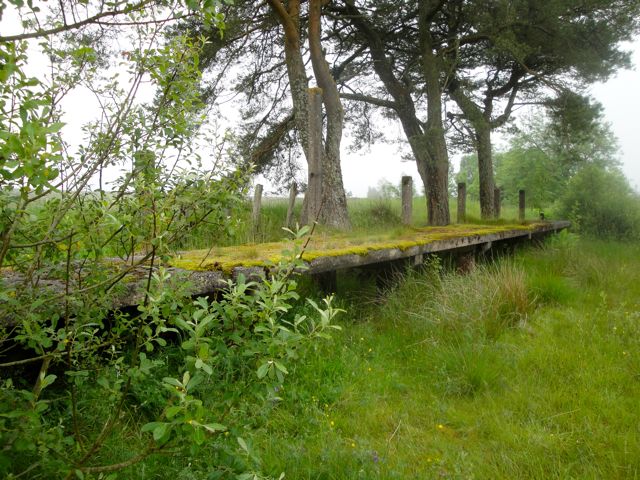
Remains of Skerrow Halt

Another reminder of past times are the railways, these came about a century after Caulfeild’s road but were dismantled in 1965 following Lord Beeching’s recommendations. They remain now as overgrown embankments and redundant bridges. The old Paddy line lies close to the road at Dumfries but leaves to head further north before rejoining the route closer to Newton Stewart.

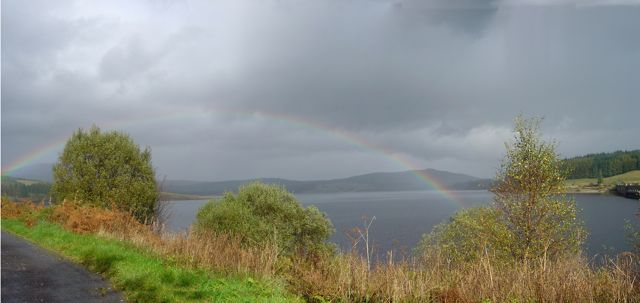
In places the A75 runs between grassy embankments hiding the views and in others between trees or hedgerows. In these stretches there is little to be seen other than that which is directly ahead, but there is always the rain to admire, and the magnificent rainbows. Despite the predominance of fir trees throughout the forestry commission’s lands in Dumfries and Galloway, the trees that line this road are mostly deciduous and they are a study in colour when autumn paints their leaves yellow, brown and gold.
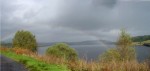
Galloway Rainbow

Part of the A75 is said to be haunted, but that is a section between Annan and Gretna so the only ghosts on the more western stretches are those we bring ourselves.

Leaving Dumfries the old dismantled railway is close to the road, crossing Cargen water on a small viaduct and the older A75, unbelievably narrow, can be seen snaking its way up the glen. The road climbs the glen over a ridge of hills joining the two local marilyns, Woodhead Hill and See Morris Hill, the latter with its aerials, and there is little to see other than the road before you. On the return trip, however, the whole of the Nith valley and Dumfries lie basking before you. The hospital stands out white amidst the more natural colours of the town and its surroundings. When the weather has been wet, flooded fields glint in the sunlight and on the northern horizon there is a conical hill, Queensberry, whose near neighbour Gana Hill collects the headwaters that will become the Clyde. When there air is clear, just to the right of Queensberry are the Moffat hills, making Hart Fell the only Corbett visible from the A75.*

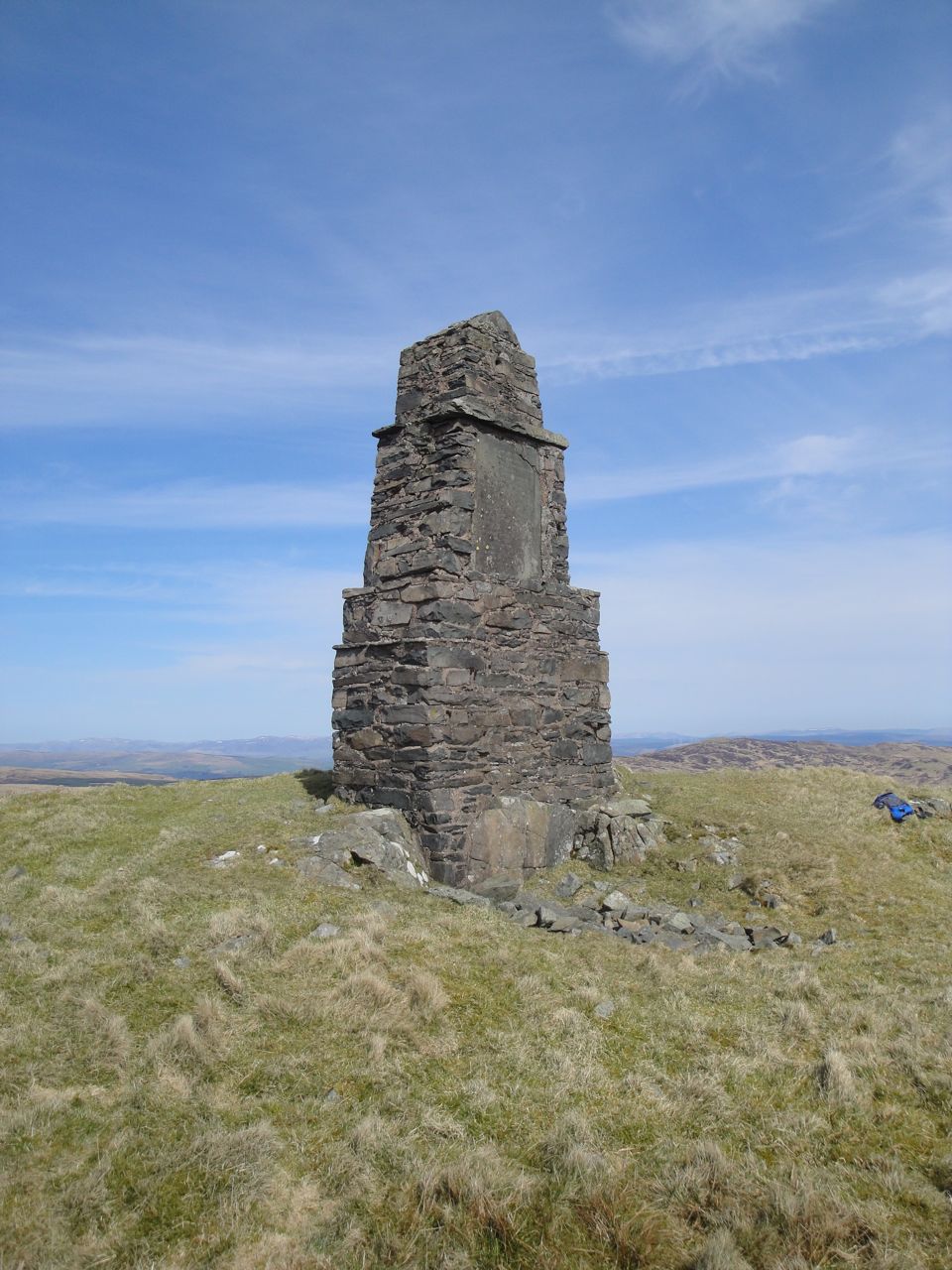
Once over the lip of the glen there is undulating farmland. Criffel, and the smaller Lotus Hill can be briefly glimpsed to the south but the north tends to catch the eye with Bishop Forest Hill with the longer ridge of Bennan Hill running westwards from it. Turner’s monument is definitely visible on Bennan and the cairn atop Bishop Forest Hill is just identifiable.
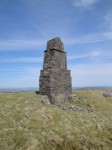
Turner's Monument on Bennan Hill

Turner’s monument marks the resting place of John Turner. He was an itinerant worker, visiting farms to repair tack and make such things as cutlery from horns and bones. He may also have been a preacher and the inscription he has left suggests he was an educated man. He bought a plot of land on the the hill, prepared his own grave and erected the monument. The story goes that local youths filled in the grave with stones and damaged the monument; vandalism is not new. John repaired the damage and then kept it intact until it was needed. Apparently the guilty youths were made to carry his coffin up the hill which must have been quite a feat. The climb took my breath away just carrying a rucksack. The inscription now much faded reads

In memory of John Turner who
died at Glen 1st December 1841 aged 60 years.

Jordan I have passed through many a weary day
On earth I wandered waiting to be free
Honest and poor I trod life’s thorny way
No comfort here save hope in Heaven for me.
Though on this bleak hilltop my body lies
Under this stone it moulders into dust
Remember stranger it will yet arise
Nor taste of death again, but with the just
Eternal Anthems to my Saviour raise
Redeeming love will be our theme of praise.
Here in this place I made my grave
Four years before I died
And I did ask some decent men
To see me safe interred
As I did get the grant of it
From J. Lennox Esq. of the land
Which he did grant to give me
As long as time doth stand.

Many of the farms around this particular area are painted pink and at least two can be seen from the road as you drive. The first village the road passes through, nine miles from Dumfries, is Crocketford. The licensing laws of old prohibited the sale of alcohol within 9 miles of Dumfries on Sundays hence Crocketford’s other name, Ninemile Bar. The A712, with the Galloway Arms and the Nine Mile Bar Toll House either side, leaves the A75 here, taking a more more direct, but slower, route to Newton Stewart.

Crocketford has pride of place as the highest point of this journey at 122 metres. It was founded by a religious sect, the Buchanites in 1787 after they had been expelled from Irvine and then from Closeburn. When the last sect member died in 1846 the mummified body of Elspeth Buchan, the sect’s founder, was discovered in his house. He had been awaiting her resurrection, and that of the other members of the sect buried nearby. The Buchanites had believed that Elspeth Buchan could confer immortality by breathing on another person, though it is implied that other methods were used as well. The Buchanites were said to have behaviours that contravened social norms and are described in letters by Robert Burns, who may have had a paramour amongst the sect.

A little after Crocketford the road passes Auchenreoch Loch, and Springholm village. Both Crocketford and Springholm are mentioned in R.S. Crockett’s The Raiders and are the only two villages the A75 does not by-pass. After crossing the River Urr, Screel hill comes into view almost directly ahead. This is a rhomboidal shaped hill and will remain the main sight as far as Castle Douglas. I’ve read that Screel Hill takes its name from the Gaelic sgreamhail meaning disgusting or nasty but having climbed this hill several times I can only presume this is incorrect or something about the hill has changed over the years. An alternative sgrath-eileach, meaning turf bank or mound sounds more plausible.
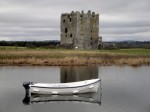
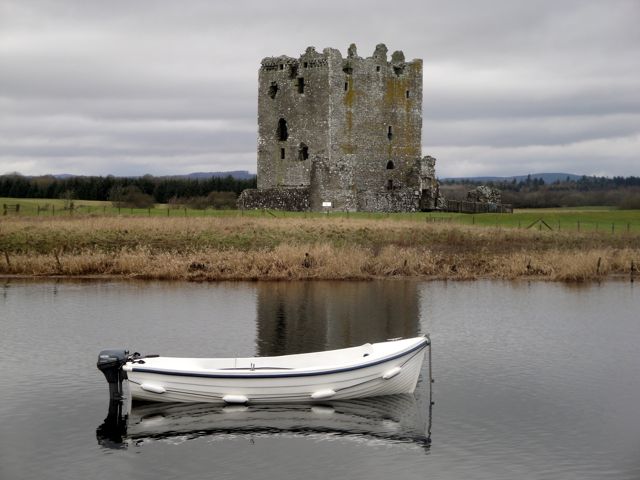
Threave Castle

Once the road approaches Castle Douglas there is a change in terrain with a swarm of drumlins. The town’s clock tower is visible south of the by pass, and directly ahead, where the road begins to descend, Threave Castle, once the home of Archibald the Grim, Lord of Galloway and scourge of the English, is briefly visible with the Glengap hills as a backdrop.

The road then crosses the River Dee, at Threave bridge, and immediately north of the bridge is the tree covered Lamb island. This now houses a bird watching hide but once carried the Kirkcudbright to Castle Douglas railway. Further along the road, near Ringford the railway’s embankments are alongside the road, on the south side. The road here is also on the route of the old military road.
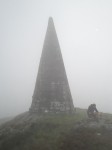
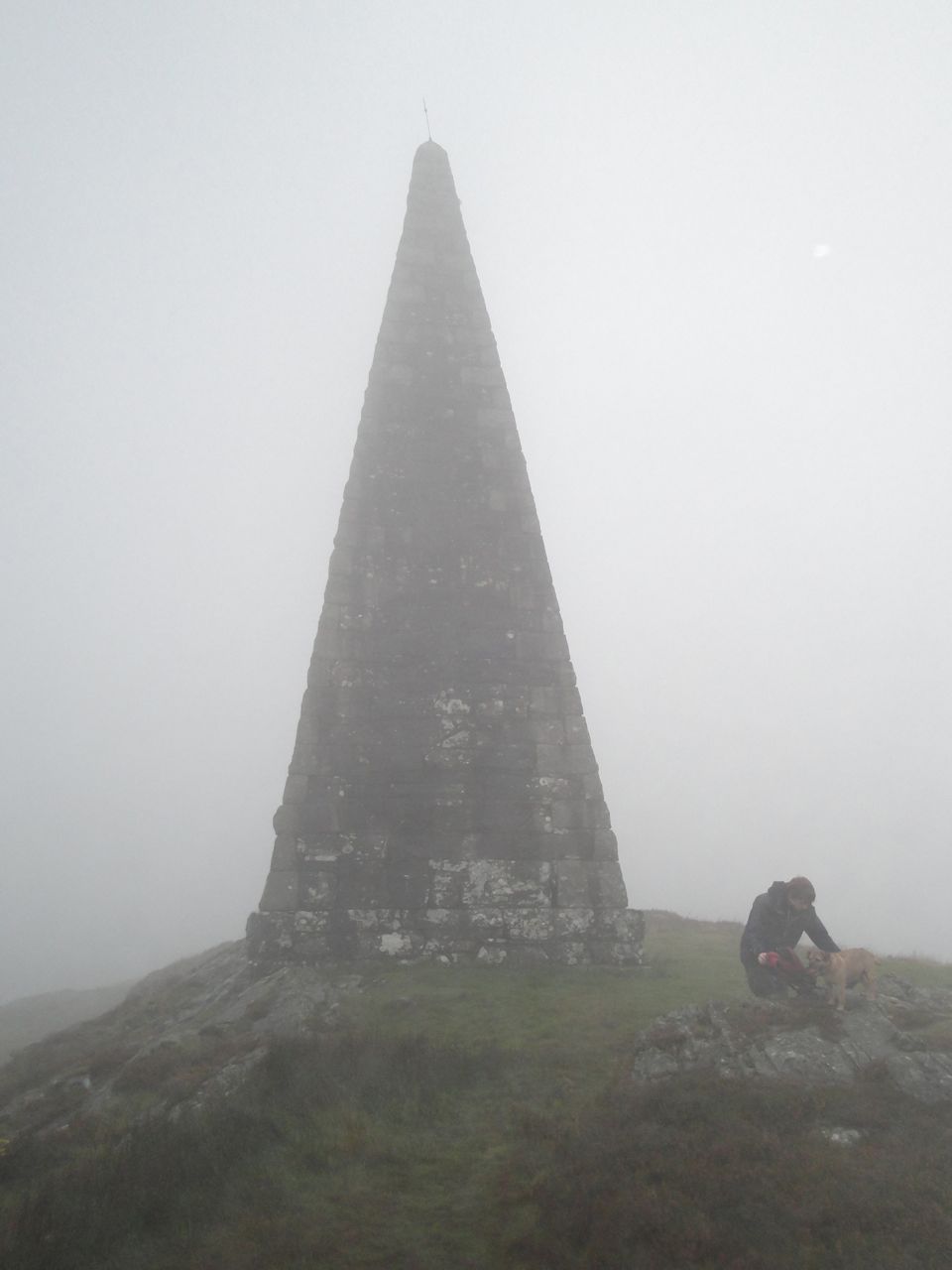
Neilson Monument

There are a couple of unimpressive hills to the north of the road here. The first is Barstobrick Hill, which in Roman Times was topped by a fort, the Giant’s Dyke, but now has the 12 metre pyramidal Neilson monument, commemorating the inventor of the hot blast process in iron smelting. The second, unadorned group of hills has the unusual name of the Towers of Kirkconnell. The two L’s differentiating it from the Kirkconnel on the A76.

The old sandstone railway station house at Tarff, now amongst a collection of newer buildings, is on the hill just south of the road. Once the road crosses the River Tarff there is a slow climb past the village of Twynholm, which boasts the David Coulthard Museum and a chocolate factory. When heading east, Bengairn, Screel’s taller neighbour, is the large hill seen directly ahead.

There is then a slow climb, to the second highest point of the journey at Glenterry, 117 metres. At this point Cairnharrow and Cairnsmore of Fleet appear ahead in the distance. The road descends into Fleet Valley, the jewel of the drive as far as views go. Directly ahead stands Cairnharrow hill, with its smaller companions Barholm and Ben John standing before it like pawns before their queen. Behind it is Cambret hill with its collection of aerials and behind that the bulk of Cairnsmore of Fleet, the most southerly Donald. The Old military road passes behind Cambret Hill. Cairnharrow and its surrounding hills have several ancient stone circles and the ancient burial grounds of Cairnholy. The lower slopes of the hills are forested, their colours changing with the season.
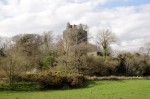
Cardoness Castle from the A75

In the valley itself runs the river Fleet, and guarding its entrance is Cardoness castle, a tower house built by the McCulloch family in the 15th century. When built this castle stood on the coast but is now several hundred metres from the sea. The castle was abandoned following the execution of Sir Godfrey McCulloch in 1697. He was beheaded for the murder of a neighbour, one of the last to be executed using the Maiden, an ancient form of guillotine.

South of the road, and across the Water of Fleet is an area of flat land with Boreland of Anwoth sitting on a raised area. This is a white farmhouse dating from 1771. To its left is a large earthwork, the Green Tower Motte, the remnants of a motte and bailey castle dating from about 1160. This castle was built by David fitz Teri, an Anglo-Norman lord who is likely to have received or seized lands from the Lords of Galloway and then built himself a strong castle to maintain his position. The descendants of fitz Teri had the name Kerdenes (Cardoness) by 1220.

The Cardoness estates passed to the McCullochs by marriage. There is a local tale that the Laird of Cardoness, a robber baron and violent man, had grown exasperated with his wife who had provided nine daughters but not the son and heir he desired. When she became pregnant again he threatened to drown her and all her daughters if she failed to produce a son. Much to the relief of all concerned a son was born and the delighted Laird arranged a midwinter feast on the thick ice of the Black Loch. Unfortunately the ice gave way and the whole family, save one daughter were drowned.

The Saltire flies by Cardoness castle, and the Rutherford monument, a 17m granite obelisk stands on the hill behind it. The monument commemorates Samuel Rutherford who had been minister of Anwoth in 1627, but was subsequently expelled by the Bishop of Galloway for non-conformist beliefs. He would later become Professor of Divinity at St Andrews. Following the restoration of Charles II, Rutherford’s book, Lex Rex, The Law, The King, which called for limited government and disputed the divine right of kings, was ordered burned. Lex Rex included many ideas regarded as deeply seditious at that time. “The law is not the king’s own but given to him in trust; power is a birthright of the people borrowed from them”. Rutherford was accused of high treason. He received the summons on his deathbed and answered,

“Tell them I have a summons already before a superior judge and judicatory, and I behove to answer my first summons, and ere your day come I will be where few kings and great folks come”.

Rutherford had suffered previously with tertian fever and one wonders if the same illness finally killed him. The other covenanters condemned at the same time all went to the scaffold as would Rutherford had he not died of natural causes.
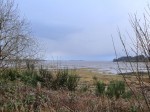
Fleet Bay from the A75

To your right it is usually possible to see another Saltire flying above the Cally Palace Hotel within the trees. To the left is Fleet bay with two of its islands visible, the flattened Murray’s Isles and larger Ardwall Isle. The third of the larger Fleet Bay Islands, Barlocco Isle can be spotted from a little further along the road.

Fleet Valley looks at its very best when rain has enhanced the colours and the sky behind Cairnharrow is a dark brooding purple but with the sunlight still bright. I’m not the first person to think this part of the route is special. Queen Victoria asked Thomas Carlyle for his opinion as to the most beautiful route in her realm, and he told her that it was the road from Gatehouse-of-Fleet to Newton Stewart. When she asked him what was the second most beautiful route he replied “Why surely, ma’am, it is the road from Newton Stewart to Gatehouse-of-Fleet!”

Having crossed the Fleet, the Garvellan rocks, a small promontory are seen a little way after crossing the Fleet. The road then follows the western side of Fleet Bay. Though trees initially obscure the view, where the Skyre Burn is crossed there is a good view of Fleet Bay. Though the eyes are naturally drawn to the bay, if you glance inland the old bridge over the Skyre Burn is still there carrying an older version of the road. The lay-by after Skyreburn has the Teapot Cafe, a wooden affair in the lay-by, with picnic tables for hardy types. Good for a bacon butty (personal communication, CGI).

Then we have a further three castles. The most easily seen is Carsluith Castle, dating from the early 15th century, which is very close to the road. This is a typical fortified house of the time and really more of a tower house than a castle. It had been built originally by the Cairns family, but passed to the Browns as a Dowry. It is now ruined but tidy. The adjacent Marberry Smokehouse cafe offers the opportunity to have a closer look. The white Barholm Castle, is north of the road about half way between Cardoness and Carsluith castles and is best seen when heading east. Barholm was a McCulloch stronghold, just two miles from their sworn enemies the Browns at Carsluith. Sharp eyes will spot the 16th century Castle Cary east of the road just before Creetown.

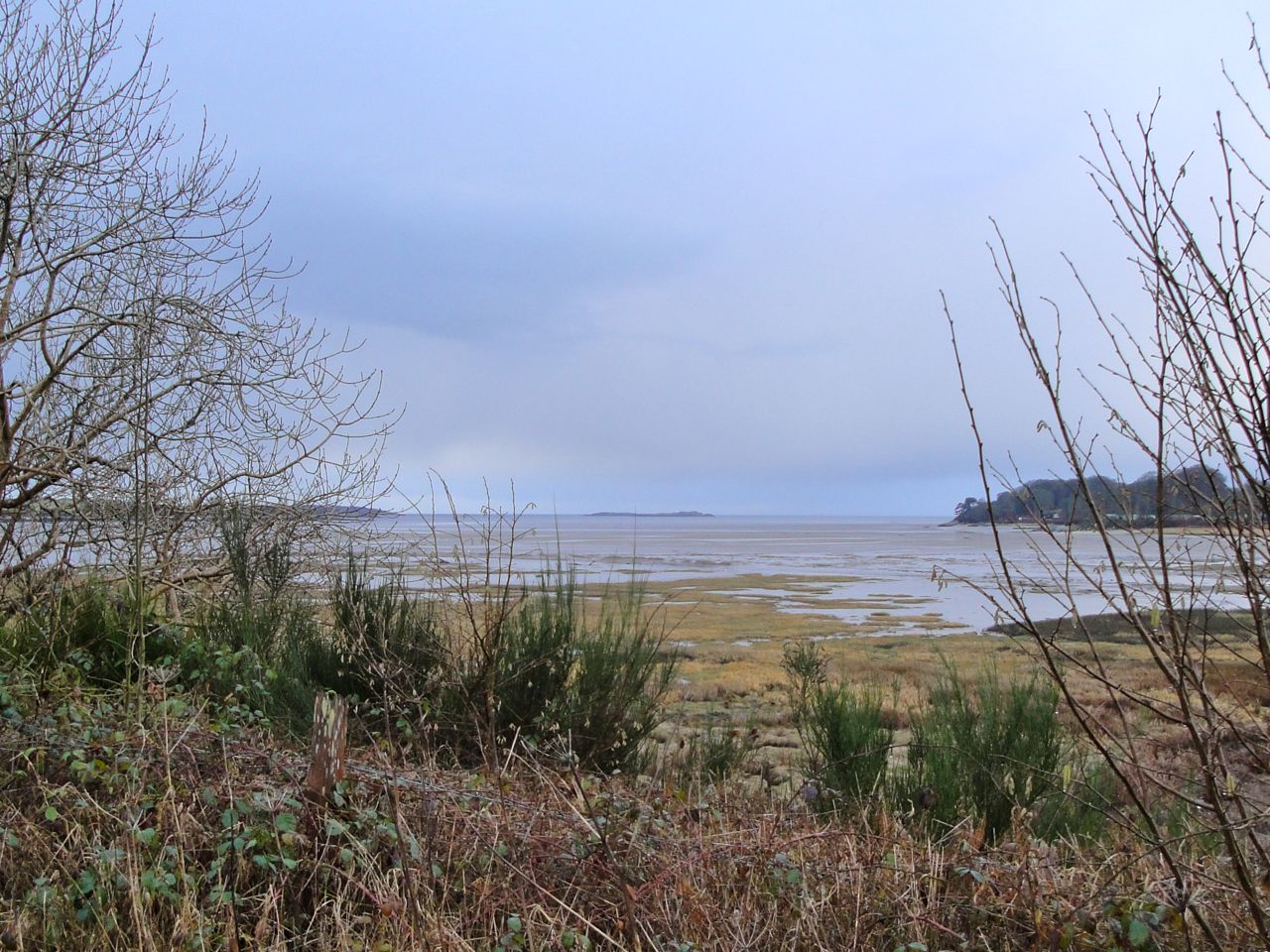
Past Carsluith, the road runs close to the coast giving a view, across Wigton Bay, of the Machars peninsula. The term Machars derives from the Gaelic machair, meaning low lying level land. It certainly has no hills but I think I would call it rolling rather than flat. The town of Wigtown is immediately across the bay, across Wigtown Sands and Baldoon Sands, which are uncovered at low tide. Though small and relatively isolated, Wigtown has the honour of being Scotland’s National Book Town, and has a great number of second hand bookshops. Immediately south of the town is the disused RAF Wigton airfield. This is one of several airfields in the area, most dating from the second world war and built to house training units moved from the then dangerous south coast of England. The airfield’s runways were originally grass but had to be concreted due to the ground’s propensity to flood. Truly Gallovidian. Looking further south still there are two headlands visible, Eggerness point which shelters Garlieston and the Isle of Whithorn itself. Garlieston’s beaches were used in testing and modifying the Mulberry harbours used in the invasion of France because of their similarity to those of Normandy. The Isle of Whithorn is where Christianity was introduced into Scotland by St Ninian in about 390 CE and was a place of pilgrimage for centuries. Little is known of St Ninian, since no contemporary descriptions survive. The first brief mention of him in writing is by St Bede three centuries later. There is a suggestion that he was actually Finnian of Moville and his name has been transliterated. He is also known as St Trynnian. There are other, more modern, connections between Whithorn and the cinema with the town claiming Scotland’s most southerly cinema and many scenes from the cult classic The Wickerman being filmed hereabouts. The modern Wickerman festival, however, is held across the bay near Dundrennan. The Isle of Man is usually visible from here on the horizon, in good weather.

The route then runs along the river Cree beside Creetown, which houses a Gem Museum. There is an expanse of tidal land between Creetown and Wigton Bay, best seen when the road crosses the Moneypool Burn. I can’t help but think the name Moneypool must have a interesting history, but as yet my researches have failed to uncover it. Since Creetown was once called Ferrytown of Cree I imagine the river has silted up over the centuries. Cairnsmore of Fleet stands behind Creetown and later the smaller Crammery hill can be seen standing beneath it. When the road crosses the Palnure burn the old railway makes another appearance, as an embankment.

Curleywee

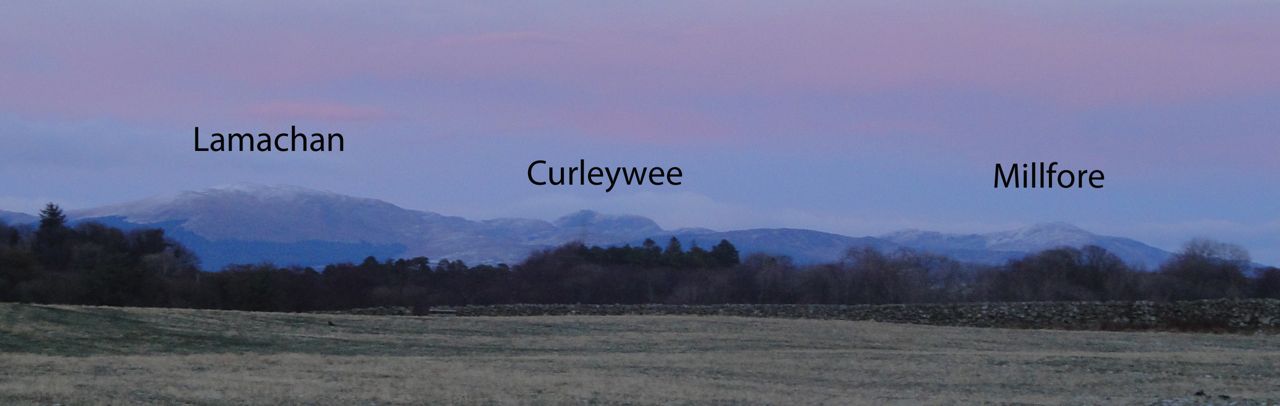
The Minnigaff hills now start to come into view, though they are perhaps seen better when traveling east and on the western side of Newton Stewart. Larg hill, Lamachan Hill and Millfore are rather featureless but Curleywee lying between Millfore and Lamachan has a characteristic shape. I often think it looks a little like a dog curled up in sleep. There is another hill visible beyond the western end of Larg Hill, and as much as I would love this to be the Merrick, it is more likely a lesser hill such as Bennan (a common hill name)*. The lower Garlick Hill stands below the Minnigaff hills. I wish it was named for Magrat Garlick, for whom I have a soft spot, but the hill will have been named long before Terry Pratchett created the character. The weather on these hills is reflected in the origins of their names. Curleywee, Cor Le Gaeith (pronounced gwee), the hill in the wind and Millfore, Meall Fuar, cold hill. The names we have for the hills of Scotland probably became fixed with the military mapping of the eighteenth century, the original ordnance survey, which was prompted by the Jacobite risings. I wonder if the locals just made some names up for them.
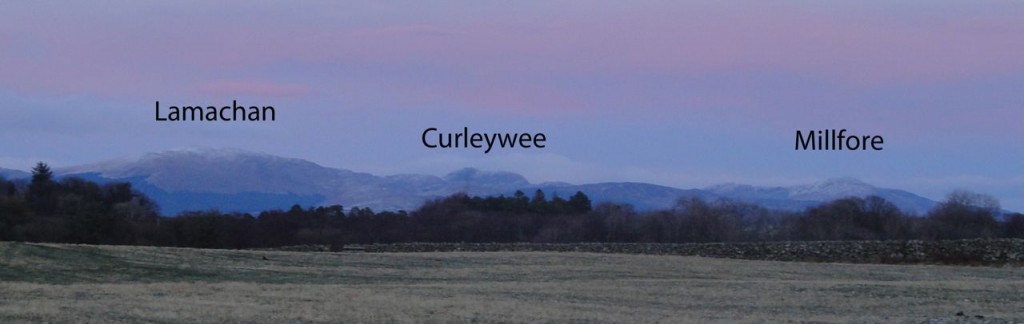
Minnigaff hills from the A75

Once over the river Cree near Newton Stewart the surrounding land has a wilder appearance, the granite outcroppings being much more evident than further east. The road now heads across the base of the Machars and joins the routes of the dismantled Paddy line and the Old Military Road, the remnants of both being evident at times. Indeed in places the A75 is on the original Caulfeild road.
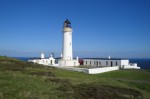
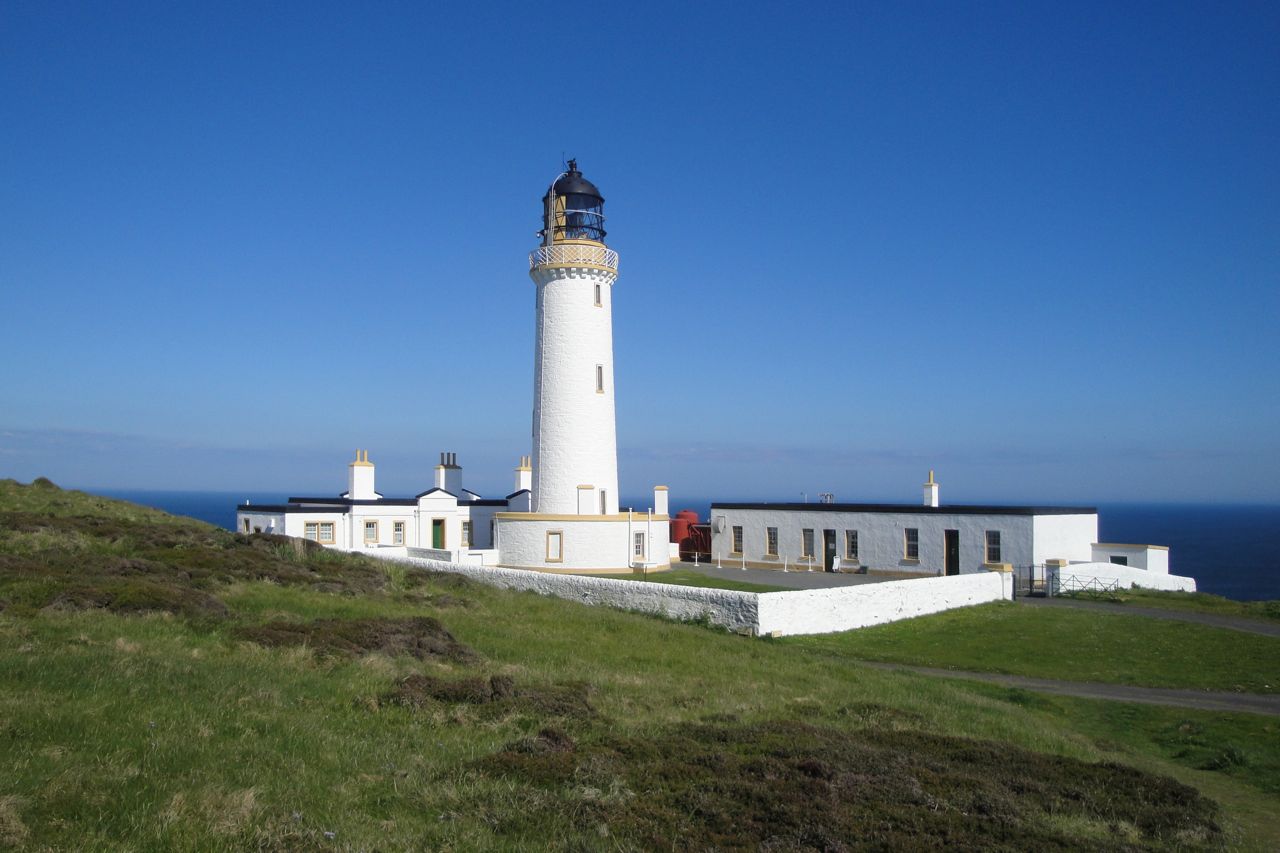
Mull of Galloway Lighthouse

On the eastward journey the Minnigaff hills and Cairnsmore of Fleet dominate the views here. Heading westwards the views are less impressive. The road passes just south of Culvennan Fell, a minor hill, if you can call it that, then slowly climbs around Barlockhart Fell near Glenluce. Challoch hill stands across the River Luce behind Glenluce village, and Luce bay comes into view with the southern arm of the Rhins of Galloway. The southern tip of the Rhins is the Mull of Galloway, the most southerly point in Scotland, where there is an active lighthouse. I imagine it should be visible at night from the A75 at Luce Bay, but I have not seen from there. Luce sands were once, and perhaps still are firing ranges. The airfield at West Freugh can be identified by its white golfball radar equipment. West Freugh was involved in the UK’s most reported UFO incident. On 4 April 1957, while monitoring a bombing exercise, radar operators found an object as large as a ship which was stationary at an altitude of 15km for ten minutes then climbed vertically to 21km. The UFO, and three smaller echoes were tracked for 36 minutes heading initially towards Newton Stewart then turning towards the Isle of Man.

Across the River Luce the road is joined by an active railway at Dunragit and then the final run into Stranraer is amidst flat farmland then treelined road. A little way after an electric information sign the trees thin a little and in the field beyond, on the north side of the road, is Castle Kennedy airfield, another remnant of the last century’s wars. The Southern Upland Way crosses the A75 at the entrance to Castle Kennedy gardens and those with an eagle eye should be able spot the SUW way marker with its thistle badge.

The A75 becomes London Road as it enters Stranraer and northern arm of the Rhins can be seen across Loch Ryan. The last of the disused railway bridges is passed before entering the town and a little way afterwards an active railway is crossed, but easily overlooked. I leave the A75 here to drive along Station Road, named for a railway station that is long since gone.

The A75 can be a frustrating road, being single carriageway for much of its length and carrying its fair share of HGVs which vie, often unsuccessfully, to overtake each other on the short sections of dual carriageway. But with its views and history the A75 is still king o’ the roads for a’ that.

Cairnsmore of Fleet, River Cree and Wigton Bay from Millfore. Taken at noon!

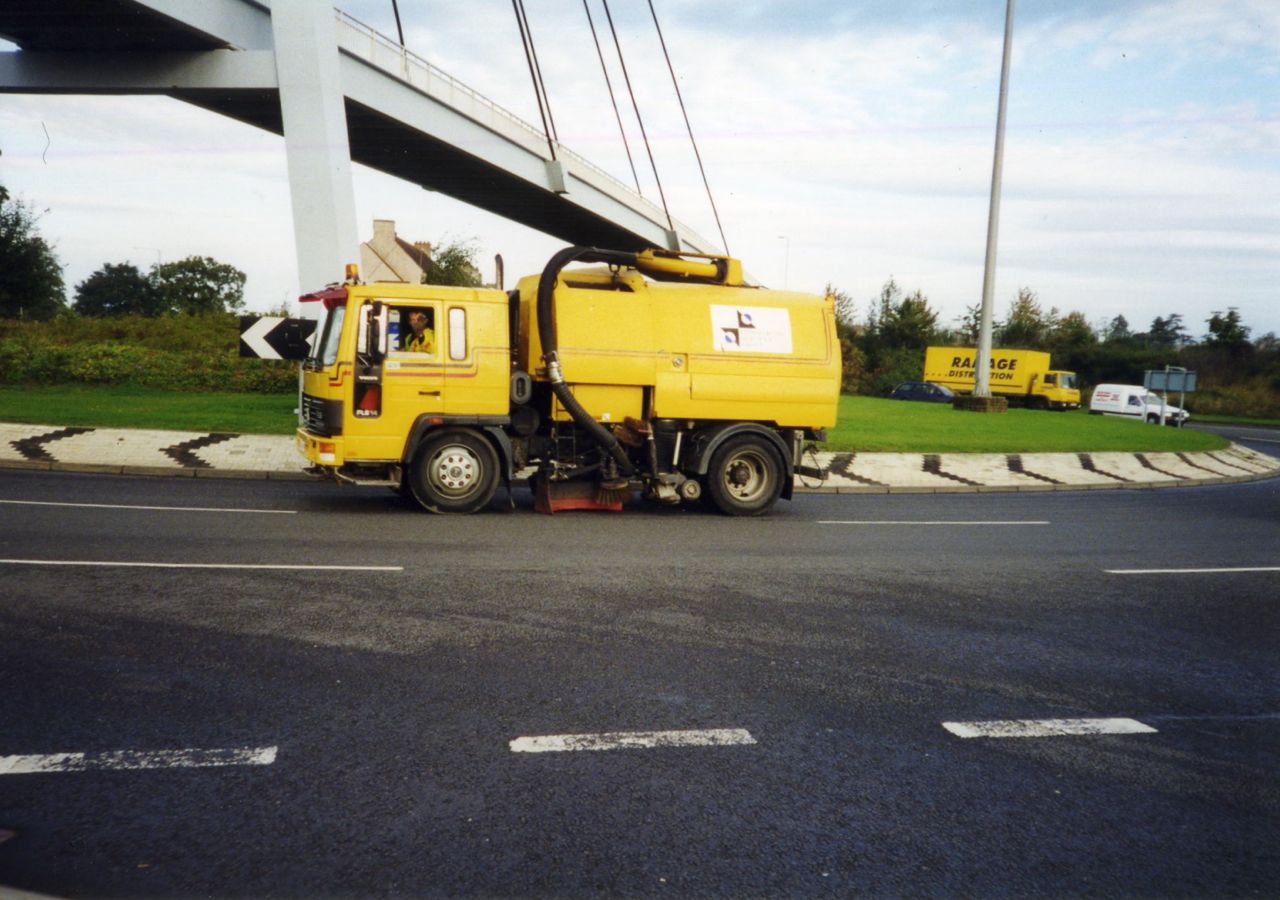
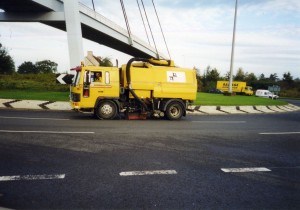
PS I seem to have taken many photos taken from the A75, but none have captured the road itself even by mistake. I even looked to see if I had cropped it off, but no. Only four of the pictures in the post are taken from the A75. The first picture of the post, the cleaning truck, is the only actual picture of the A75 itself in my collection. It was taken by Conor as part of a school project (primary school) 11 years ago and also shows the Glasgow Road Footbridge which won the Saltire Award for Design and Saltire Award for Construction. Those with a careful eye will spot Conor somewhere in the post’s pictures. It sounds as if the A75 will have to be a photo project now.

Thank you to Jim, Chris and Ewen for explanations, confirmations and suggestions.

The research for this piece has got me interested in the Machars for low level walks when the weather dictates.

*Post Scriptum (July 2012): I have now had a chance to make the journey as a passenger on a day with excellent visibility, and must therefore correct some errors. The Awful Hand Mountains (including Merrick) can be seen from the road. A pyramidal hill is visible between the Awful Hand hills and Minnigaff hills. It looks the right shape for Mullwharchar but is more likely Buchan Hill.
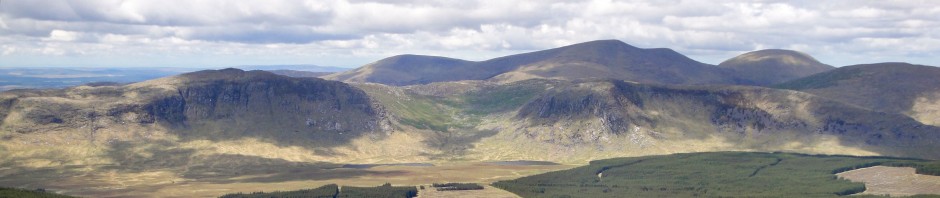
Posted in Dumfries & Galloway | Tagged , , , , | Comments Off on The Seventy-five

Hot Blast in the Mist

2.2 miles   100m ascent

Barstobrick Hill and the Neilson Monument
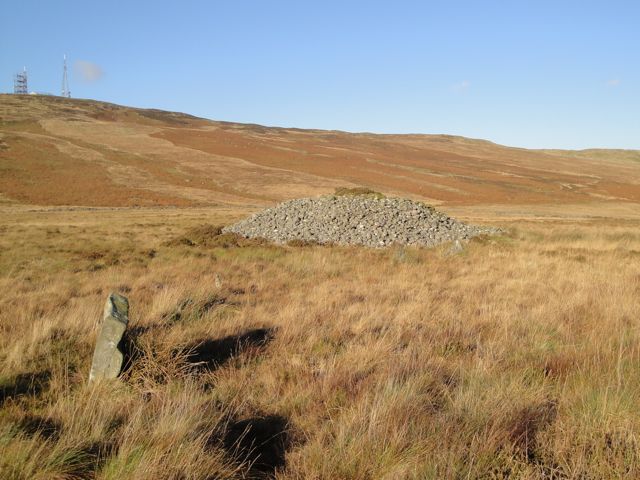
A straightforward walk. I parked at the Barstobrick visitor centre where I had hoped to get some information on routes for walking. Various signs suggested that maps for walks would be available but I could not find any.

As you can see from the picture, we were not blessed with good weather. Barstobrick hill is usually visible from the A75, but not today. It was visible from where I parked though.

We followed a meandering path along some ponds that would I am sure be pretty in better weather and then struck off on a faint, but clear path heading up towards the obelisk. This proved to be an easy climb and looks to be well trodden. Unfortunately there were no panoramic views today.

The 10.6m monument atop Barstobrick Hill commemorates James Neilson (1792-1865) who invented the hot blast process for iron smelting, apparently improving efficiency significantly. It is set on the site of an ancient fort, the Giant’s Dike, but it was difficult to see anything of the fort.
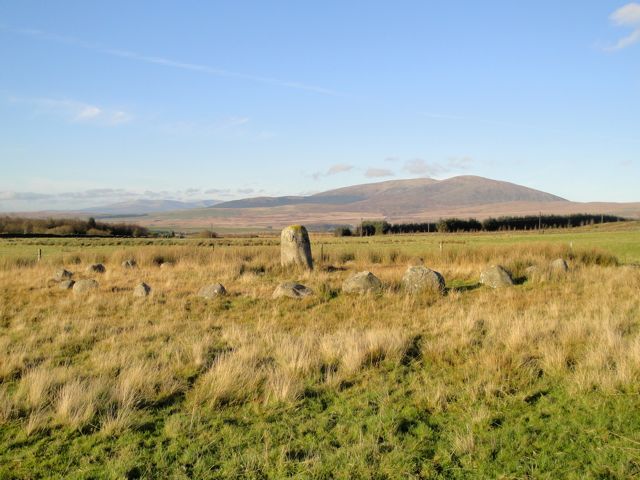
The Neilson Monument is inscribed on one side

NEILSON
HOT BLAST
1828

and on the other side

MDCCCLXXXIII
W M N
FECIT

My schoolboy Latin had Fecit as “he did” which I presumed meant “built”, but for some reason part of my brain kept recalling Father Jack of Craggy Island.

There was a much fainter track, really just slightly flattened undergrowth, heading NNE from the monument and it seemed more interesting than simply retracing our steps. As you can guess it soon deteriorated and had us snagging clothes on brambles, wading through sodden undergrowth and slipping on grass and mud. Not for long though.

Once off the hill we made our way through ankle deep farm slurry before reaching terra firma. From the bottom of the hill I could see a path down its eastern side, which would be an easier route down if there is a next time.

I managed to coax Sweep into a pond in the hope that it would remove at least some of the mud/cows**t that he had been jumping through but both he and Leo still needed hosing down on arrival home.

In better weather I think it would be reasonable to extend this walk to include the Towers of Kirkconnell.

Posted in Dumfries & Galloway | Tagged , | Comments Off on Hot Blast in the Mist