Nature and Nurture

Portrack Gardens 2.3 miles
Crichope Linn 2.8 miles

Today was a compare and contrast walk. The Garden of Cosmic Speculation at Portrack is open just one day per year, and today was the the day. There are photos in the gallery below.

The garden is adjacent to the railway and areas close to the railway retain a railway theme with an old engine mounted on tracks, pathways made of tracks and two small representations of the bridge carrying the railway over the Nith. There are large earthworks with walkways and several artificial lakes.

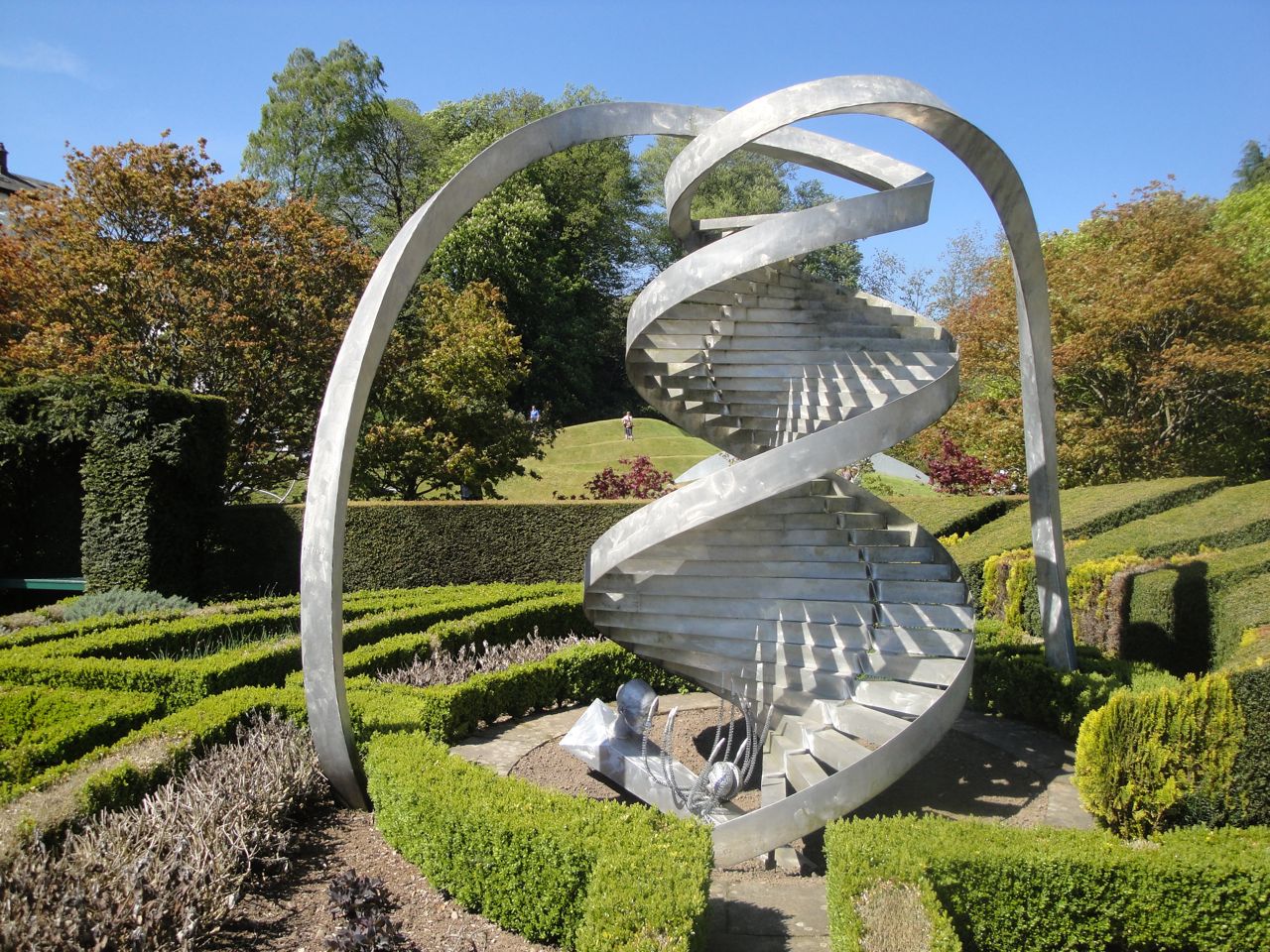
There is a strong science theme with a DNA garden containing several sculptures with helical shapes.

It proved to be a lovely day for wandering around the garden, listening to the pipes being played, looking at the sculpted land and the sculptures placed within the gardens.

Interestingly, I found my camera drawn to wildflowers and the river and set to musing about the artificiality of such gardens. I decided it would be an idea to visit somewhere a little wilder later in the afternoon. Crichope Linn was nearby and I hadn’t been there in many years, so it seemed a good choice.

My internal navigation system failed me at first. I turned off the A76 at Kirkpatrick but missed the Closeburn Mains road. The road started climbing and approached the trees. When I noticed a small sign for Loch Ettrick I realised it must be the road to Mitchellslacks. I didn’t have a map and couldn’t remember if the road was passable to cars if I carried on, so retraced my route back and found the right road.

There is a small parking place for Crichope Linn, just enough for a couple of cars, and it was empty. There is a Covenanter’s trail sign for Crichope Linn, and a Scottish Rights of Way Society sign for Public footpath to Beattock (14 miles via Kinnelhead, or Long Cairn). That would be some walk.

So I set off along the overgrown path, clambering over long fallen trees and edging along narrow bits with sheer drops beside me. There were fewer colours here than in the Portrack gardens, but many more insects and butterflies, and no other people. Even the dead leaves beneath my feet gave the place a feeling of being more real. The waterfall was not as impressive as the last time I was here, during a deluge, but the rocks were drier, and safer.

I presume the Covenanter’s Trail signpost is there because the Covenanter’s used to hide out in the gorge. It must have been uncomfortably wet.

Once I reached the footbridge at about a mile, I had the choice of going back the same way, or heading back on farm tracks and the road which was almost twice as far. I chose the road and although it was further it was quicker.

Which did I prefer? Hard to say, but probably the gardens.

Crichope Linn Photos:

Portrack Gardens Photos:


Posted in Dumfries & Galloway | Tagged , | Comments Off on Nature and Nurture

Winding down with Walla Crag

5.9 miles 3h 3m 403m ascent

Our fourth and final day was a free choice. On previous days we had thought about Blencathra, since Elaine fancied climbing it and it would be on the way home. Injuries from the earlier days, however, meant we needed a less taxing day and my “Weekend Walks in the Lakes” book gave us some options. Walla Crag was chosen since we could do the outward walk then get the ferry back. We had after all, walked the lakeside part last year.

Since this was a short low level walk there was no need for packed lunches or portable pies, and the weather meant we dispense with our foul weather gear We checked out of the hotel, got our boots on and headed up Keswick high street, past the George pub and out of town, turning onto Spring lane and walking up through Spring Woods. Waling without rucsacs is certainly easier.

Once out of the woods and onto open farmland we passed many sleeping lambs and calves. The lambs here, and those at the back of Skiddaw, were much larger than those we had seen by Seathwaite.

Our route took us along the Brockle Beck past Rakefoot farm with a gentle but increasing incline. This gave us fantastic views of the Derwent Fells, The Skiddaw hills, Derwent Water and Keswick, bathed in sunlight beneath a cloudless sky. In fact the whole route showed us this same view from a variety of angles and heights.

Unfortunately Elaine had to do some stretches just before we got to Walla Crag. They looked pretty painful, but must have worked since she was able to continue.

Most of the first half of our walk we were close by a young couple who managed to argue most of the time at high volume, yet were often spied holding hands. Married for a couple of years I should think. Their accents sounded north-eastern to me but David reckoned it was Cumbrian.

Near the top we passed through a gate onto Walla Crag itself for more fine views, but now also including the Borrowdale Fells and Sca Fell hills. Blaeberry Fell blocked views of the Eastern fells.

Then our descent took us around Lady’s Rake and the deep cleft of Cat Gill, then down by Falcon Crag, beneath Brown Knotts to Ashness Bridge.

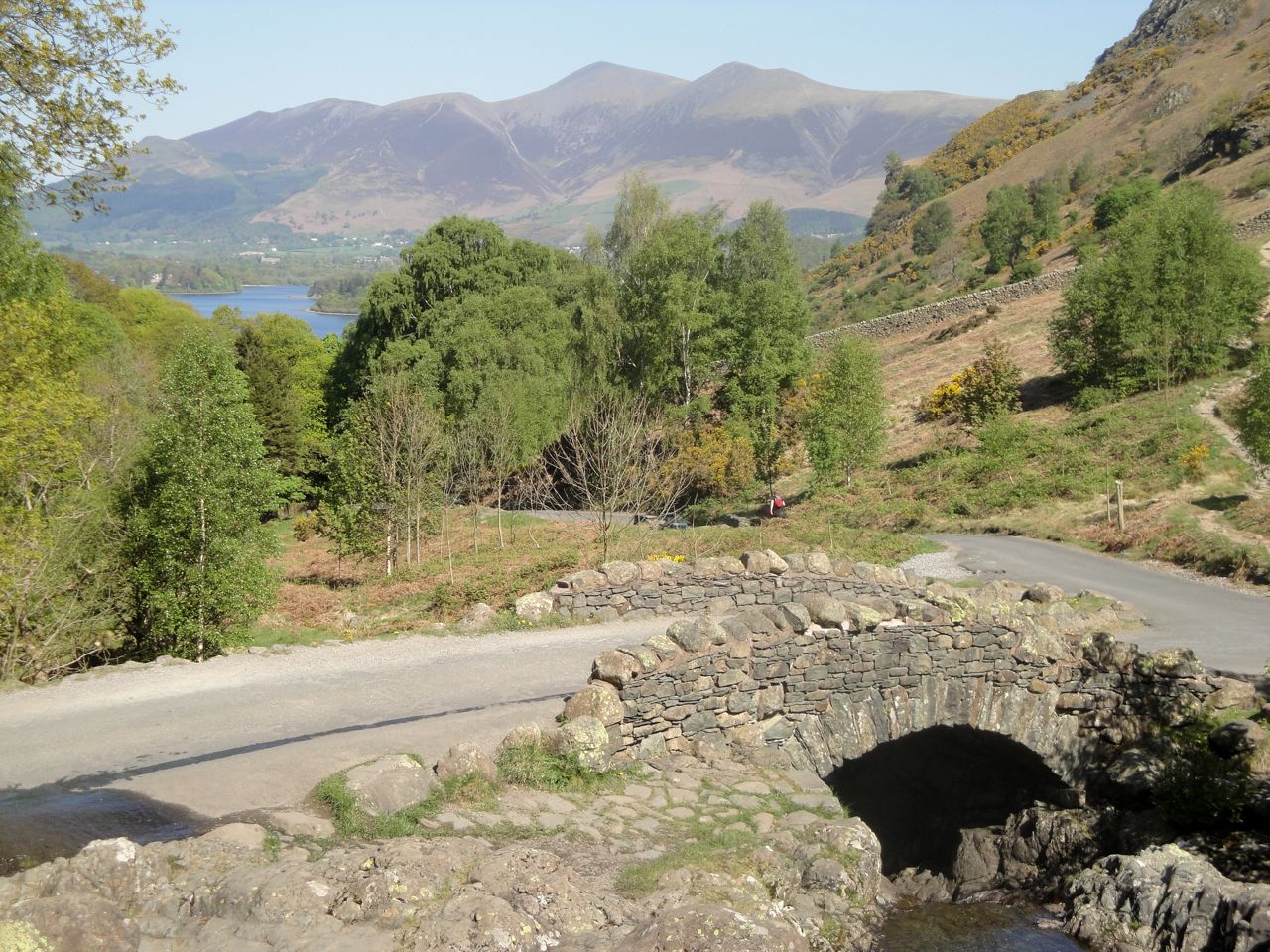
Apparently Ashness Bridge is the most photographed bridge in the Lake District (but I can’t recall where I read that). Certainly it is one of those that would not seem out of place with Gandalf riding over it in a horse and cart. The fact it crosses the Barrow Beck also gives it a LOTR feel. As it was we were given the opportunity to watch a gas truck edge its way over with inches to spare.

I decided it would be nice to have a photo of Skiddaw seen from beneath the bridge and since the water level was low this was easy enough. I must have sat somewhere damp however to get a wet posterior, that’s my excuse anyway.

There is a single track road leading from Ashness bridge to Derwent Water and it seemed to have several cars whose drivers could not get their minds round the concept of a single track road.

Once at the Lake we found a jetty, but little to suggest that a ferry would stop there. It looked a little on the small side as well. So we set off south along the lakeshore path to find a ferry stop.

Nature put on a show for us with some ducklings close to the lake shore and several pairs of geese. Catbells, just over the water had several paragliders around its summit.

Refreshments were taken at the Mary Mount Hotel, where we heard that the lake water level was too low for the ferry to stop there but it did stop at the jetty we had passed twenty minutes walk back along the lake. An alternative was to walk up to the Lodore Hotel, five minutes away, and get the bus back to Keswick. This would also give us a chance to visit Lodore falls.

A brief walk on a woodland path got us to the falls where David took the opportunity to soak his aching feet and I crawled around on the rocks looking for a good photo of the falls. I was not particularly successful, but David did mange to numb his sore feet.

We then rode an open topped bus back to Keswick and ended the outing with Goulash at the Dog and Gun. Substantial portions, but we did our duty and finished it off.

A surprisingly good walk (chosen by Elaine) with great views in excellent weather.

Wainwrights: 1 (Walla Crag)
Walking: Mike, David, Elaine, Andy

Posted in Wainwrights | Tagged | Comments Off on Winding down with Walla Crag

Pies and The Back o’ Skiddaw

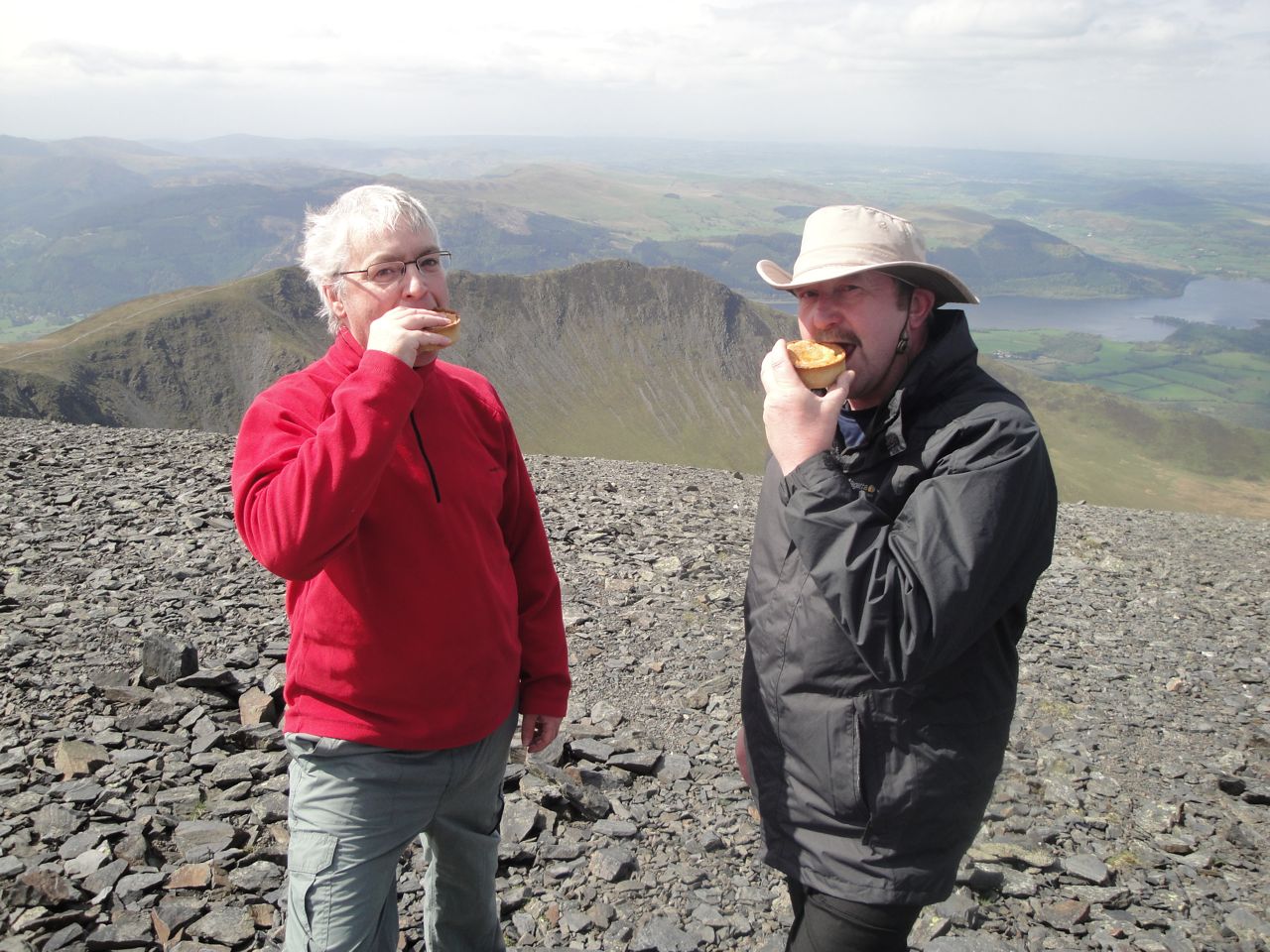
Mike & Andy tucking in to pies

8.2 miles 5h 55m 833m ascent

Our third 3000 footer in as many days so the muscles and toes were tender. We decided that it was time for a change from the packed lunches, nice as they were so David went foraging before the walk and purchased three meat and potato pies from a local shop. Since they were wrapped in a single packet, he also carried them up the hill for us. Talk about taking three for the team.

Our walk started at Peter House Farm, which we found following a minor detour. At the parking spot was a curious sign informing us that Skiddaw house was 3 miles and Dash Falls 7 miles. But Dash Falls is on the way to Skiddaw House. I spent most of the day and some of the next brooding about this and contemplating who should be informed of the error. On reviewing the evidence (a photo of the sign) however it all became clear. The sign actually reads:

Skiddaw House 3 miles
Threlkeld via
Dash Falls 7miles

The route follows a farm track up to Dash Falls and the impressive Dead Crags of Bakestall, starting with a gentle climb that slowly steepens. At the col between Bakestall and Little Calva is a gate, a good place for a breather, and the addition of some warmer clothing since the wind was getting stronger. We could not see a path up Birkett Edge, though one is marked on the OS map. Andy carried on up the path to see if one could be seen but found nothing. We decided just to head up the grassy slope, and within a few paces the invisible path became obvious. This section steepened further and reminded me of the steep path off Durisdeer Hill. Indeed when we stopped for a breather I Iay down on the ground and was not that many degrees off standing up. While David and Andy charged on straight up, I practiced my zigzagging.

Bakestall summit, really just a shoulder of Skiddaw, is marked by a cairn, and offered another spot for contemplating the surrounding hills such as Blencathra and the now visible summit of Skiddaw itself. The grassy slopes gave way to broken shale as we climbed to Skiddaw and once on the summit itself there was not a single green thing growing.

Our local friend, Criffel, was just visible on the horizon and closer at hand we could see the rest of our planned route over Long Side, Ullock Pike and The Edge, the fourth “edge” in two days.

We made use of one of Skiddaw’s many short shelters to take in some fluids and eat our pies, and very nice pies they were.

The next stage, the descent to Carlside tarn, down a steep slate and shale covered path adjacent to an impressive 400m+ drop was an experience to say the least. David had recommended I get the walking pole out for this one, and he was right. Two people who I passed on the way informed me that if I slipped I’d be at the bottom in no time, which was not really what I needed to hear. I found my steps were getting shorter and had to force myself to make each pace at least the length of a foot. David and Andy seemed to fly down and sat waiting at the bottom for me for ages. In fact by the time I got down to them they had both grown beards and were covered in cobwebs.

David tells me that I looked like an old age pensioner making my way down the path. I’ve wondered if that was meant as constructive feedback, but suspect he was just taking the piss. But he was good enough to mind mine and Andy’s bags while we went to the top of Carlside.

Once back at the Tarn we got our rucsacs back on and headed for Long Side, Ullock Pike and the Edge. The path here is well defined, safe and offers great views of Bassenthwaite Lake and Skiddaw. There are short scrambles but all have bypassing paths which we took.

On the way down there is a rock outcrop which looks almost like a stone circle but is I think natural. It is marked on the OS as Kiln Pots. There are photos in the gallery.

The final mile and a half, after coming off The Edge, is through farms and mostly on tracks or roads. We did pass several small arrows of the kind found on the SUW but none were at junctions and did little more than remind us the we were on some kind of route, though without any idea about destination. The fact that we came across stiles was more of a sign that we were on a route of some sort.

Another good days walking in fine weather. Meat and potato pies on the summit, Lamb Henry at Oddfellows that evening, and five Wainwrights in the bag.

Wainwrights: Bakestall, Skiddaw, Carlside, Long Side, Ullock Pike
Walking: Mike, Andy, David

Posted in Wainwrights | Tagged | Comments Off on Pies and The Back o’ Skiddaw

OMG, Helvellyn via Striding Edge

8.2 miles 5h 40m 907m ascent

This was my major personal challenge of our Lake District visit and I looked forward to it with equal portions of trepidation and excitement. There had been some concern that the clouds would be covering the summits but the weather forecast at breakfast time was perfect.

We had some aching muscles from the previous day’s hike up Scafell Pike, so I felt obliged to have the full Cumbrian breakfast to fortify myself for the day’s work.

After picking up our packed lunches (no chocolate bar, but kit-kat included), it was a short walk to the car and a drive to Glenridding, where we met up with Carolyn and Colin and set off through the town.

Our route took us past Gillside campsite then along a good path beside Mires Beck heading for a minor ridge heading up to Birkhouse Moor. This was an easy climb, with little to see ahead but a gradually improving view behind us, taking in Glenridding and Ullswater. I had a picture of me on this path about 20 years ago, in very different weather (wet, misty and cold) and managed, by chance, to get a repeat photo in much the same spot.

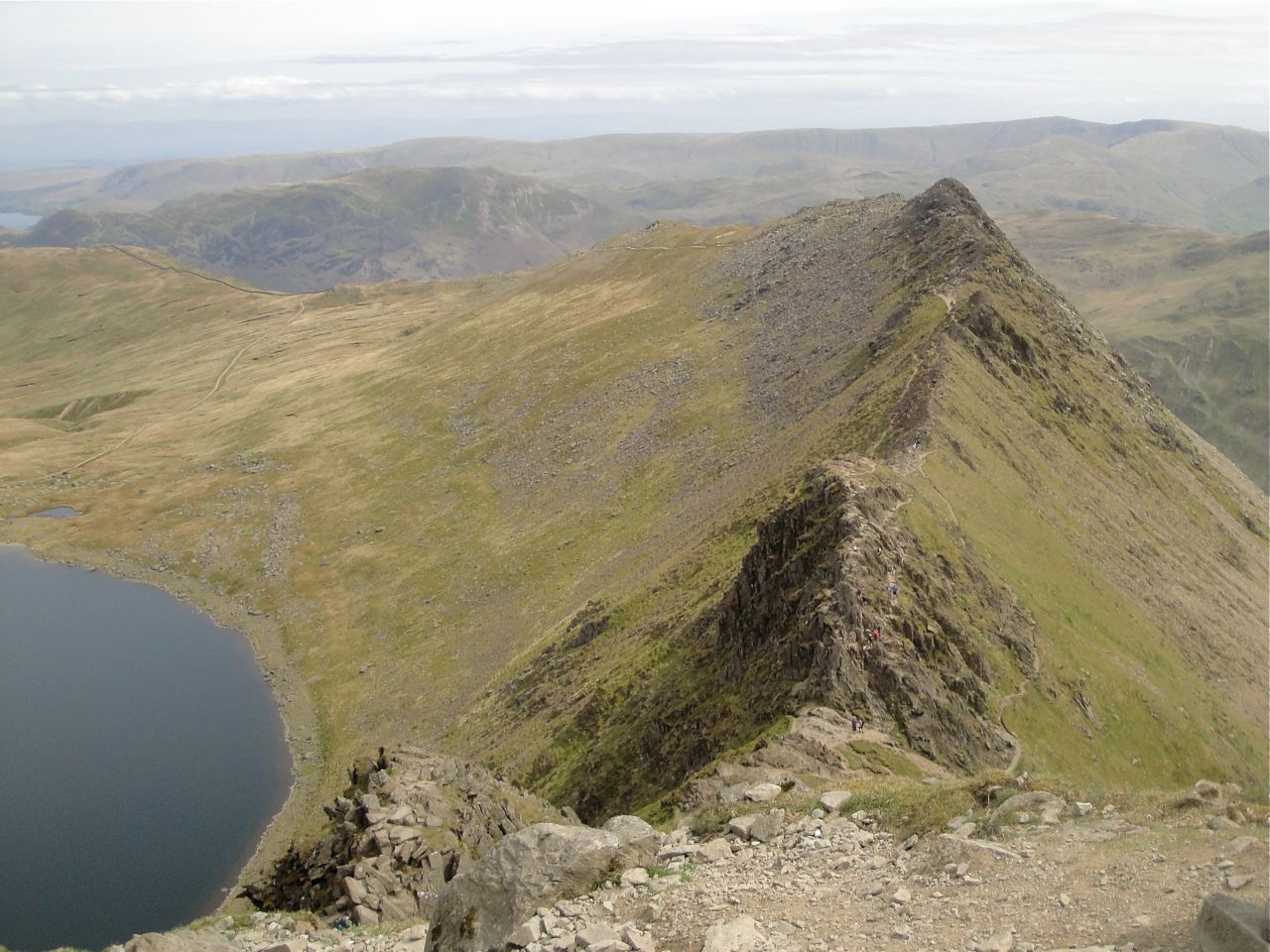
Once over the summit of Birkhouse Moor, our challenge was in sight, Helvellyn showing us its massive north-eastern cliffs framed by Striding Edge and Swirral Edge. A few metres further on and Red Tarn was added to the picture.

At Striding edge the team split into ridge walkers and path walkers, me with the latter. I found the path pretty daunting at times especially the places where it crumbled away into a the very steep drop and required scrambling over rocks above the path to escape the drop. I wonder in retrospect whether the top of the ridge might have been safer.

My real trouble came as I approached the rock chimney. The path here splits into a variety of less distinct routes. The one I should have taken crosses to the opposite side of the ridge and descends pretty steeply. I decided to stick to the summit of the ridge but met up with my quicker comrades who were heading back to find another way down having looked at the scramble down the chimney. I followed Andy down the southern slope to get back to the path and this was quite a scramble in itself. What’s more, the path itself was narrow, made of slipping stones and in places absent altogether where it had fallen away.

This path took us lower than I would have liked and presented us with a final steep scramble over unpleasantly stoney ground that often shifted underfoot. Then it was all over, we were on Helvellyn. Unfortunately, Striding Edge had taken my appetite away so as the others chomped through their sandwiches I made do with two fingers of kit-kat, waiting for the Elvis legs to settle.

Well, that was Striding Edge done. I can well understand how people can come to grief there. I don’t think I’ll be doing it again soon. How did I feel about it?

I was unable to convince the party to visit Little Man, and had I been doing this walk alone I would not have returned by Swirral Edge, but that was the team’s route so along I went. Perhaps I shouldn’t have looked up the recent deaths before doing the walk. Then I wouldn’t have known that there have been more deaths recently falling from Swirral rather than Striding Edge.

Swirral Edge didn’t seem too bad, a bit of scrambling at first then a wide easy path. I can see though how one could come a cropper if not careful. The path later splits with the larger fork heading down to Red Tarn. We headed up the pyramidal Catstye Cam, which is a pretty lofty hill in its own right, with a brief pause for photos at the summit. From there our path back to Glenridding was laid out before us. I wondered if the path down the other side of Catstye Cam would be too steep, but with the help of a walking pole it was none too bad.

Once back to the path it was a mere stroll back to Glenridding. We followed Red Tarn Beck, then Glenridding Beck where we crossed a wee bridge armed with a super-powered spring loaded gate that almost finished off Carolyn.

Once into the village we took some liquid refreshments at the Travellers Rest (no apostrophe) and since my appetite had returned I was able to polish off the sarnies.

A very good walk in excellent weather and a personal challenge completed without injury. And the icing on the cake: pie, chips, mushy peas and gravy at the Keswickian that evening.

Wainwrights: Birkhouse Moor, Helvellyn, Catsye Cam
Walkers: Mike, Andy, David, Elaine, Carolyn, Colin.

Posted in Wainwrights | Tagged | Comments Off on OMG, Helvellyn via Striding Edge

Stepping stones on Scafell Pike

11 miles 7h 20m 1007m ascent

Seathwaite farm car parks were full but with a little backtracking we found a spot, got kitted up and set off. The path passes through the farm and heads up alongside a rather weedy stream (the young River Derwent). At this stage we appeared to be on a path so crowded that I was half expecting to be queuing to get through any narrow bits.

The first staging point was Stockley Bridge. This stone bridge wouldn’t have looked out of place in Hobbiton. There were some inviting pools of turquoise water and we wondered about dipping our feet on the way back. The colour of this water was seen in many streams and pools on the way up and must have been due to the rocks I presume.

At the bridge we had the choice of following Grains Gill or climbing more steeply around Seathwaite Fell to Styhead. I thought it was six of one and half a dozen of the other, but having completed the walk I think our choice of the Styhead route was the right one.

The path was steep, not enough to erase smiles but walking up in the bright sunlight did force me to roll up my trousers. For some reason this gave me a strong desire to wear a knotted hanky, presumably a genetic thing related to my northern roots. Luckily I was sans hanky but still felt like the bloke off Monty Python’s. Better comfortable than fashionable though, eh?

The path took us past Taylorgill Force, with more turquoise pools by which time the person density had noticeably reduced. Where had they all gone?

As we turned more westwards the Scafell pikes came into view, framed between Great Gable, Seathwaite Fell and a deep blue sky. The easiest path was often in the stream bed of Styhead Gill which was relatively empty. The path crosses the gill on a narrow footbridge that presumes walker’s BMIs are less than 30. The gill was pretty empty though and though the bridge wasn’t absolutely necessary, everyone used it.

Styhead Tarn was only a few hundred metres further on. A beautiful spot. The Tarn stands at a crossing of paths, the one we had followed along Styhead Tarn, those to Esk Hause, Wasdale, Great Gable and the Corridor route. Our interest was caught by the mountain rescue stretcher box and we were drawn towards it like moths to a flame. In doing so we failed to notice the path off to the left that we should have taken. Luckily once we were past the box our minds cleared and we could see where we should have been. It was as though the stretcher box had enchanted us. Perhaps it’s a magic box. I see that Wainwright mentions it is easy to miss the path where we did.

The corridor route was visible climbing up the western slopes of Great End and Broad Crag to Lingmell Col. The path was easy to follow and even had steps built in places. There was a brief scramble at Skew Gill but nothing to dent the spirits.

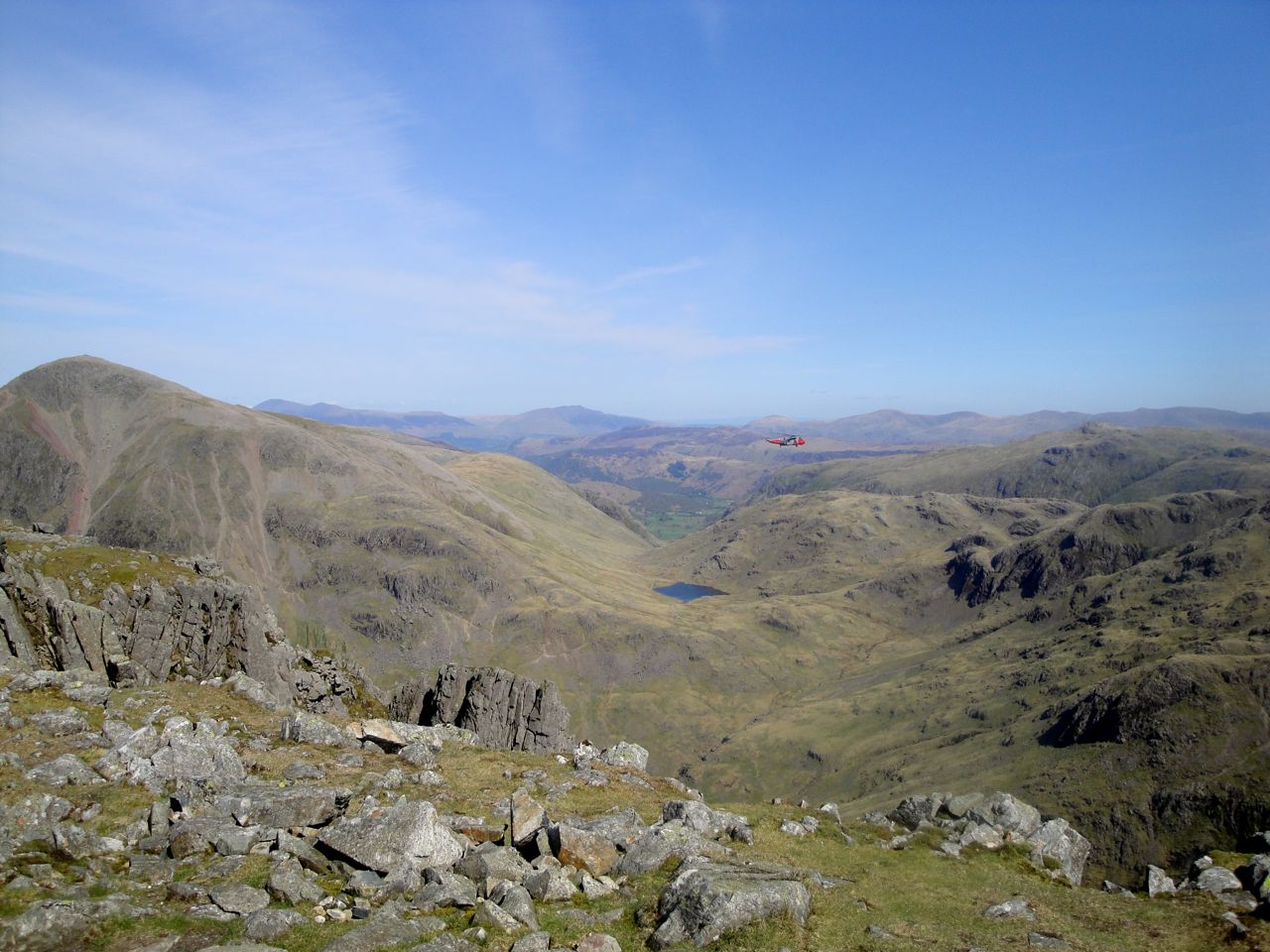
At Lingmell col we eyed up Scafell Pike and Lingmell. It was decided that lunch should be taken on Lingmell since it looked less crowded than the Pike. The views from Lingmell were impressive: Wast Water, Seascale, the Isle of Man, the Gables, the Scafell hills, Styhead Tarn, Derwent Water and a Navy Sea King. The path up Scafell Pike looked well defined, and busy.

We walked down Lingmell’s scree like path, across the grass of Lingmell col and then started up the Pike’s rocky path amidst the many other walkers of all ages and sizes, with their varying appropriateness of attire and numerous dogs. Yes, everyone and his dog was climbing the Pike that day.

Scafell Pike’s summit is rock covered with a large war memorial where we climbed for our photos. Not surprisingly the views were again impressive. Sca Fell was invitingly close and the gully to Foxes Tarn easily seen, but it will have to wait for another day, probably to be approached from the south.

After chatting with some folk on the summit we headed off towards Broad Crag. Because the summit is covered in rocks and boulders there is no obvious track and the cairn marking the way is difficult to spot, what with it being a small pile of rocks amidst a mountain top full of similar rocks. After a wee scramble we were heading along the ridge past Broad Crag, stepping from one large boulder to the next. I’m pleased we were doing this in dry weather and could trust our feet not to slip. This would have been much slower going in the wet.

After Broad Crag the boulder field ends and the ridge beside Ill Crag is littered with small cairns to guide walkers. Great End was only a short diversion, so how could we say no? Unfortunately, Andy started to get pain in his thighs during this climb, but with a bit of stretching was able to make it.

Great End does offer good views including a look back over the Scafell ridge, Esk Pike and Bowfell. And what’s more, from there it was all downhill.

As we walked down towards Esk Hause I became aware that my bladder had passed into the uncomfortable stage where the sound of running water is no longer a joy. This coincided with an increase in the numbers of walkers on the path and a complete lack of hiding places. I wonder if there should be some generally recognised signal when attending to the call of nature, perhaps a raised walking pole, or the singing of a particular song, that warns folk off.

Springing Tarn could be seen from the Hause and we walke towards it then turned right alongside Ruddy Gill. The path down from there was easy enough and in good nick. A small bridge took us across Ruddy Gill just before it joined Grains Gill. We followed this stream down to Stockley Bridge to join the path by the River Derwent back to the car.

A great walk with three Wainwrights and we couldn’t have asked for better weather.

Wainwrights: Lingmell, Scafell Pike, Great End

Walking:
David: Point man and navigator
Elaine: Dispenser of morale boosters, alternate point man Andy: Wisecracks, occasional rearguard
Mike: Rearguard and speed limiter

Posted in Wainwrights | Tagged | Comments Off on Stepping stones on Scafell Pike

Rehabilitation on Glen Hill

The crutches had been returned. The limp was fading. I didn’t think I could yet run or attempt a penalty kick but I was only 3 minutes slower than usual on the Georgetown circuit.

It was time to try my leg on a wee hill.

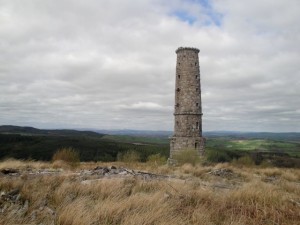
When last I visited the Waterloo monument, my children were little angels, I had some non-grey hair and the path was shaded by trees all the way to the summit. All the trees are now gone. So where once I would have seen only stones and trunks there is now a view of the Solway, Loch Kindar, New Abbey and Criffel. The steep climb seems to have become steeper than it was a decade ago.

Once at the top I felt obliged to climb the additional 65 feet of the tower itself. The lack of a parapet at the top had me hanging on like a scaredy-cat as usual, but the views were good (see gallery).

The tower’s inscription reads:

Erected AD 1816
To record the valour.
Of those British, Belgian
And Prufsian soldiers:
Who under
WELLINGTON and BLUCHER
On the 18th of June 1815:
Gained the victory
Of
WATERLOO:
By which, French Tyranny
Was overthrown:
And Peace restored.
To the World.

Now I remember there used to be a sign pointing out the alternative path down. No sign now. The only candidate path was heading off in the wrong direction. Then I spotted a stump of wood about 18 inches high and thought it might be all that remains of the old sign. I set off that way and, lo and behold, a path appeared. Well, there were footprints…at first.

As faint paths do, this one faded out and I found myself stumbling over piles of rotting wood and weaving through unpleasant undergrowth. I suppose is was a good test of the leg though.

I could hear running water and my heart sank at the thought of trying to get across New Abbey Pow. Luckily my navigation was a bit out and I was well short of the pow. I found a wee burn that could easily have been crossed. Even better though, there was a well trodden path running alongside it which led me back to the village.

On the lower reaches there were plenty of lambs and calves about, reflecting the time of year. There were ducks on the pond and even a field of bulls. Spring is here.

2.75 miles 204m ascent (including tower) 1h 2m

Posted in Dumfries & Galloway | Tagged , | Comments Off on Rehabilitation on Glen Hill

Threave’s drumlin swarm

5 miles 1h 45m ascent 76m

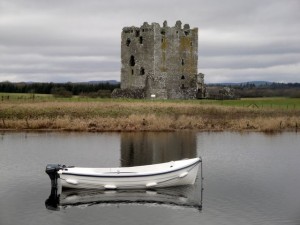
Overcast, and unexpectedly dry. This easy stroll meandered around several wee hills that are part of a drumlin swarm near Castle Douglas. A new looking, or perhaps just well maintained track towards Threave Castle, and the first drumlin, Port Hill. Unfortunately the ferry was not in use so we had to gaze across the River Dee to see the Castle.

There has apparently been a castle on the site since about 1000 AD, but the original was destroyed by Edward Bruce, brother of Robert, in 1308. Archibald the Grim, Lord of Galloway, built the present castle in the 1370’s. He was given his title and made Warden of the Western Marches in return for his efforts to purge Scotland of the English. He led many raids against the English and gained the epithets grim, or black, because of his “terrible countenance” in battle.

After the castle we came to an osprey viewing point. There were no ospreys to see but there were a couple of nests visible in the trees across the river. I have no idea if these belonged to the ospreys. Perhaps we should start taking our binoculars along on walks.

From here the path leads away fro the river and along the side of our second drumlin, Meikle Wood Hill. This gave some good views across to Threave island, with the castle, and Lodge Island further south. From here we rejoined the path back to the car park and set off on the Threave estate walk, which is marked by red arrows and sometimes yellow hoops.

At a cattle grid we turned right onto the disused Castle Douglas to Kirkcudbright railway line. This carried trains from 1861 until 1965 (B the D). Andy, our local expert, let us down by not remembering trains on this section of the track. “I was only three”. What kind of excuse is that?

The railway line took us under a couple of stone bridges and over a stone and iron affair onto Lamb Island and its hide for birdwatchers. Who decided to put those windows so low? We then retraced our steps to a minor road, turned right and crossed the A75 on a small bridge. This led us around our next drumlin, Brownie Hill, across a minor road (with a sign admonishing us to take care on the “busy road”) and over another, unnamed drumlin to the Old Military road.

This military road was built in the 1760s, under the command of Major Caulfield, to aid troop movements to Ireland. We followed it only a short distance to Hightae Cottage where we turned north along a path which led to some holiday cottages, the Old Exchange, which includes a converted telephone exchange.

The path then led along a bank for about 50m before crossing the B736, passing through some “farmland mud” then over the A75 again. This had us at our last drumlin, Barley Hill, which we walked around to rejoin the old railway. From there it was back to the car park then on to Castle Douglas for refreshments.

Posted in Dumfries & Galloway | Tagged , , , | Comments Off on Threave’s drumlin swarm

What Roman Fort?

9.1 miles 720m ascent 3h 43m 2 Donalds

The first dry weekend for a while, so we decided to make the most of it. Rendezvous at the forgettable lay-by between Holywood and Auldgirth then off to Dusrisdeer in sunshine, under blue skies.

Durisdeer is a peaceful, pleasantly appointed village in the middle of nowhere. It lacks only one thing according to David: a pub. I noticed that it also lacked: shops, bus stop, petrol station, tea room/coffee shop and duck pond. It was once, however, on the main route from Edinburgh to Whithorn and would have seen Kings and Queens of Scotland passing through on pilgrimage. In more modern times, it was a location in the 1978 film the Thirty-nine steps.

We set off down and past the cemetery and had about half a mile of relatively flat walking before the real work started. At a sheep pen, filled with dark brown semi-formed slurry, the path forks. We scoffed at the gentle slope and headed up the steeper path, climbing Farthing Rig. Much height was gained in short order, and as we climbed higher, the Lowther Hills, Drumlanrig and Thornhill came into view.

The path eased a little as it passed close by Scaw’d Law, which had a light dusting of snow. This gave us our first view of Wedder Law as the warmth of Durisdeer was replaced by a bitingly cold wind. (I do like a cold wind on a hill.)

We also saw that a further 150m climb up Wedder lay ahead, but once up there we had great views of the Solway, Moffat Hills and the nearby Queensberry with its neighbours Gana and Earncraig. The summit of Wedder Law is not marked but I had read it was marked by a lone fence post, so we headed for that across some extremely springy moss covered in places with ice/snow. From the fence post we saw an even higher area so headed there for our photo opportunity.

It was decided, using democratic means, that we should leave Gana Hill for another day. Our next decision was to follow the boundary fence to Scaw’d Law or retrace our steps along the track. The distance and climb looked about the same but the ground near the fence was an unknown factor whereas the track was firm. So we walked back down the track to the bothy that had seen better days and up towards Scaw’d Law. There we followed a quad bike track up to the wall at the county boundary. This wall is made of quite small flat rocks quite unlike most of the dry stone walls in D&G.

We then followed the wall across Scaw’d Law, Little Scaw’d Law and Durisdeer Hill, across slightly wet but passable ground. The other Donalds, Ballancleuch Law and Roger Law were to our right.

The way down from Durisdeer hill to the Wald Path was steep but Andy managed to sniff out a path down. Well Hill lay ahead of us, and the path up did look challenging (steep). The democratic method seemed to fail here. Having said I would rather leave it for another day it seemed everyone else was able to claim they wanted to head up it, but in deference to my lack of effort would give it a miss.

I don’t know why the path from Durisdeer to Troloss March is called the Wald path. In fact until I saw the signs I had thought it was the Well path. Wald is an old word for a forest but can apparently mean a once wooded area and is often applied to rolling uplands.

The views walking down the Wald path are impressive. Well Hill, Penbane and Black hill are steep sided grass covered hills and were looking their best bathed in sunshine.

About a mile from Durisdeer is the remains of a roman fort (or a fortlet according to the signs and OS). It is set on the lower slopes of Penbane and is well positioned to cover the path through the valley. I had fallen behind the main group at this point, having stopped to take some photos, and came upon them pointing at the fort while Andy asked “a fort, where?” Should have gone to specsavers.

I had hoped to have a look inside Durisdeer church, but the doors were all locked. The graveyard was mostly covered in snowdrops but the photo doesn’t really capture the moment.

I imagine we will be back to walk the hills to the west of the Wald path.

Posted in Dumfries & Galloway | Tagged , | Comments Off on What Roman Fort?