Wanlockhead nestled in the green-brown mist covered hills smothered in drizzle. We swaddled ourselves in waterproofs, spied the southern upland way sign and set off up the track.
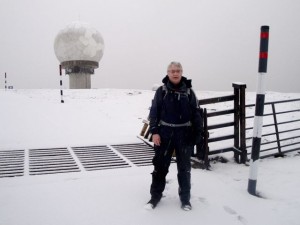
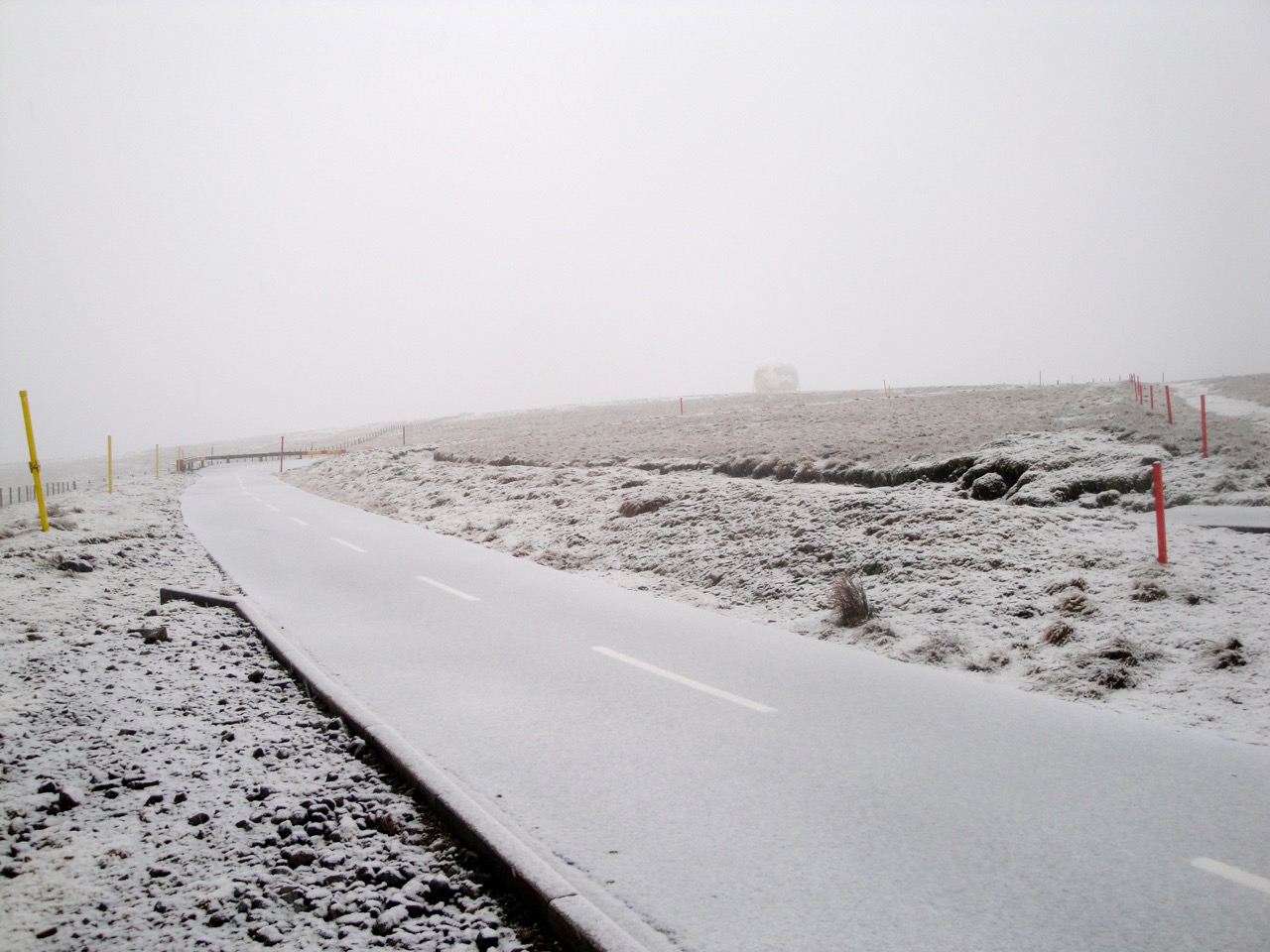
The rain gradually changed to sleet and then to snow. The ground from green to white. The SUW track crosses a road several times and as we climbed higher the road became white with accumulating snow. Initially thin enough to allow the white road markings to show through but soon hiding them completely. By the time we reached the summit of Lowther with its golf-ball radar we were in a winter wonderland.
Road to Lowther
The road from Lowther to Green Lowther is in the picture above.
This walk has well defined paths. The SUW joins the vehicle track to Lowther’s radar station which then goes on to Green Lowther. Sadly the visibility was poor, so we might need to return on a day with blue skies.
We retraced our steps to Lowther, ours being the only footprints in the snow. On the way back down from Lowther, a small track leads off across a col and up to Auchenlone (East Mount Lowther). Auchenlone has a viewpoint marker at its summit pointing to various hills but they were all hidden in mist.
Blue skies….Hart Fell beckoned. The old Edinburgh road was passable and we parked at the community hut near Newton. Once past the first kissing gate we found what was in store for us; 6 inch deep snow.
Before us we could see Well Rig, our first challenge and walking in the snow was tough. Ball-breaking was the phrase that kept passing through my mind, but in retrospect that is a little over dramatic. But I certainly warmed up pretty smartish and wished I had trained by stepping through old tyres like you see them doing in military training in films.
After the fifth kissing gate we turned left and started up steeper slopes making our way onto Well Rig with many false horizons. You know the drill. You look up and see the top, thinking that you’ll press on and rest when you get there. But once you are there, it turns out you are not quite there yet. Good practice at kicking steps in the snow anyway.
Once up onto the wee ridge of Well Rig we could see the long walk up to Arthur’s seat and Hart Fell beyond it. There were some footprints to follow at first but they turned off part way up. So from about halfway up we were in virgin snow and it did became a little less deep towards the top.
The wind picked up here and was bitterly cold. Despite pulling down my woolly hat and tightening my hood, there was a small part of my face exposed to the wind and this became numb. I was forced to walk with my hand sheltering my face. James spilt some of his water while having a drink and it froze where it landed on his rucksack. It was COLD.
The going was slow, and though James was much faster than me it took us 2h 20m to get to the top. The views were fantastic. The Moffat hills (Swatte Fell, Carrifran Gans, Whitehope Heights, White Comb etc) were all clothed in white. The Lowther Hills were very clear and even Criffel and Screel were visible. The cumbrian hills were just visible on the horizon.
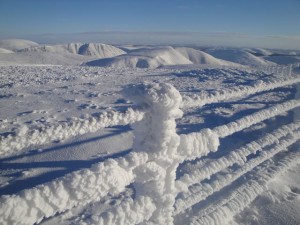
The fences at the summit were covered in snow as you will see in the gallery and though these look like wooden fences covered in snow, they are in fact wire fences.
The return journey, downhill, seemed considerably easier and was quite a bit faster.
I’ve read that Screel Hill may take its name from the Gaelic sgreamhail meaning disgusting or nasty. Having walked this hill several times I can only presume this is incorrect or something about the hill has changed over the years. An alternative is sgrath-eileach, turf bank or mound sounds more reasonable.
The weather forecast was for snow so we opted for a low level walk close to home and since David had missed the Screel outing in March, Screel it was. As it turned out we had excellent weather and the best visibility I’ve had on this hill.
We set off from the usual car park and up the forest track, staying on the track to make the walk a figure of eight. So we followed the track as it wound round and then climbed up the Glen of the Screel Burn. The last time we walked up here it was boggy and slightly hard going. Today the ground was frozen under a thin layer of snow, not much actual ice to slip on.
I had expected a very cold day and heated up rapidly walking up the path in sunlight. It was a little chilly on the ridge but not the biting chill I had expected.
We climbed the western end of Screel which is steep but not quite a scramble. From the summit we could see all the major hills: Cairnsmore of Fleet, Merrick and the awful hand range, the Rhinns of Kells, Cairnsmore of Carsphairn, Hart Fell and the Moffat hills, and the hills of Cumbria.
Bengairn sat just to the south, begging us to conquer it. There even seemed to be a path, albeit made for tracked vehicles that went much of the way. Another day.
We were of course able to see Almorness, and having been bitten by its accursed flora I am drawn as if by a geas to return. Another day.
It would appear however that I was tarrying a little too long to take in the views. The vanguard struck on without me.
The top of Screel is usually boggy but today the ground was solid. At the eastern end of the ridge we met a trio of paragliders who were using high tech equipment to assess the wind direction (wet fingers). The camera toting member of this trio suggested we take a different path down which was less steep and likely to be easier in the icy weather.
The downward path was the more direct way and passed through forests on pine needle covered paths. I seem to remember these being treacherous for slipping when wet but today the moisture was all frozen. In summer time this part of the walk is less well lit when the trees are better covered and it has a magical look.
The clouds had been gathering as we stood on the ridge, and by the time we were in the forest light snow was falling.
A good outing for a short walk, fantastic views but only decaffeinated coffee afterwards. I was forced to have a proper coffee once I got home.
Descriptions of this walk on the net include such comments as “Beware! Much of the ground on this route is horrific- tussock grass, boggy, rocky and felled forest areas. Its hard work” and “the going here is tough – wet, with deep heather and much tussocky ground.” As I found reading after the walk.
I had intended doing the quick route up Hart Fell today but the forecast said the cloud base would be at 700m and I didn’t fancy another walk in the mist. Delightful and soothing it may be, but the views and photo opportunities are somewhat reduced.
So where to go? As chance would have it, LOML was reading her magazines and said there was an article about Millfore. I had a glance and my mind was made up. Millfore it would be, another Donald to add to the list.
I parked by the Black Loch and though dry it was bitterly cold. So cold in fact that I kept my hat, gloves and coat on for the entire walk, which is unusual for me, since I’m not fully exertion-enabled and quickly heat up. Since it was a solo walk I decided to take my new hat, which has a bobble on top and presumably makes me look like Noddy. (Message to self – remember not to wear hat with red fleece and blue shorts.)
I decided as well to take my anvil-weighted bigger camera out as well to see if the pictures were any better. I don’t think they are but the camera added to my experience by twice bumping up into my face while I was climbing down some steep sections. This made me bite my tongue on one occasion and cut my lip on another. Damn camera must be cursed.
Anyway, with said camera I was able to take some more shots of the Eye at the end of Black Loch, though the light was rubbish and the shots are not much better than the last visit when it was overcast.
The forest track winds around the end of the Loch and climbs steadily. I took this as a good omen. The more climbing on nice tracks, the less on gallovidian terrain. Since there is no all encompassing adjective to capture wet, boggy, pathless, deep heather and tussock covered, I will in future use the term “gallovidian”. As it was, about half the walk was forestry and the other half gallovidian.
My first glimpse of Millfore was from the forestry track just after I passed beneath some electricity pylons. It looked grim and seemed to have steep rock strewn sides. Then as the track wound on Millfore’s summit dropped below a smaller hill, Kirkloch, and I forgot about the rocks.
There is a ridge running down SSE from Millfore and the I joined it it where the track runs near Poultrybuie Hill.
I left the track for gallovidian ground following a rather faint path and just to highlight the difference, within 20 paces of leaving the forestry track my right foot sank beneath the tussocks into ankle deep water. I managed to do the same at the same spot on the way down as well.
The path did not last long and then it was tussocks, heather and hidden pools as I made my way up. There were several very steep climbs, some up heather, others up rocks and my main hope was that on the way down I would spot a better way or even a path.
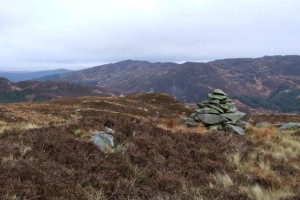
I came then to a barbed wire fence, much rusted and in disrepair. One area was trampled down by, I presumed, the passage of many walkers, so I used the gap, and followed the fence a while since it had tussock free ground near it. This led me a little to the east but took me away from the crags facing south. Eventually I spotted a cairn, and then another. These marked Kirkloch which is at about 400m. It had taken an hour to get here.
The views from Kirkloch were surprisingly extensive, with Cairnsmore of Fleet, Wigtown Bay, and even Criffel visible. To the east were Craignell and Darnaw as well as the dark lump of Black Craig of Dee.
From Kirkloch the ridge leading up to Millfire and a further 250m climb lay before me. There is a picture taken in summertime on the geograph site that says “this grassy ridge provides a very straightforward route to the summit”. It may look grassy but it isn’t. There was more gallovidian terrain and even a brief spot of scrambling.
As I climbed the last few metres to the top of Millfore I realised that the strange sensation on my face was snow. I was able to get some photos of Loch Dee and the White Lochan of Drigmorn but then the cloud started to fall, as did the temperature and much more snow. I had just finished messing about with the camera’s timer to get a photo of YT when the weather turned much worse very quickly and I decided that bottling it was the appropriate response. I stuffed the camera in my bag and headed down quickly, going eastwards to avoid the crags I had recently climbed.
Millfore means cold hill (Meall Fuar), and it certainly was. And I have to mention the White Lochan of Drigmorn again. Apparently this was a favourite spot for curling in bygone days. I take my hat off to those who would toil all the way up there to curl. I used to moan about driving to Lockerbie for curling. I presume they chose stones when they got up there rather than carting stones up with them.
My hopes of finding a more obvious path down were not to be fulfilled. The easier descents always led off towards Munwhul. That would be an extra mile or more on forest track, but I was wary that the ground might turn out to be just as bad so I stuck to returning the way I had come.
Once the forestry track was in view my spirits lifted and perhaps that’s why I wasn’t paying enough attention to prevent me dunking my foot again.
Once back on the track the rest of the walk was a breeze, mostly downhill. in fact on the way up I felt it was all uphill, but going back down there were some uphill sections. There is a shortcut from above the Black Loch which avoids walking all the way around the loch but requires fording the Tonderghie burn. I thought a fall in the burn would spoil the day so chose the longer route. The eye was better lit in the evening sun so more photos were required.
The rain didn’t start to fall until I was in the car.
Donald count = 1
Wet foot count = 1
Bitten tongue count = 1
Feeling of achievement = hell yeah
PS despite driving along the Queensway several times I had not noticed the old heather covered bridge next to the modern road bridge (see gallery). The Black Water of Dee looked black, as did the Black Loch for that matter, and from up on the hills Cairnsmore of Dee lived up to its alternate name of Black Craig of Dee. I got on photo where it just looks like a black lump, but by the time I climbed higher for a better picture, it was lost in cloud.
An uneventful walk under the traditional grey skies of D&G, wet underfoot but not on the head, snow topped hills in the distance, avec les chiens. One of the latter snuggled up against me just now.
Well, its been a while since we walked Mabie’s flat paths and I for one had forgotten that Craigbill Hill is actually a hill.
The MTB riders were out in force though we only saw them on the larger, flatter, paths. Our own route took us past the old stables, then the ghost stane and onto the phoenix trail which after several windings led us back to the brown walking route. Then it was a gradual climb, overtaking a woman and her terrier towards Craigbill Hill. Looking north from this path the windfarm at Dalswinton could be seen bathed in sunlight.
The viewpoint a Craigbill was an excuse to take a breather. Criffel was topped with cloud, Knockendoch standing before it cloud-free. Changing the viewpoint from distant to near there was a noticeable difference in below-knee spatter between myself and Andrew or Elaine suggesting that we have different gait patterns. Perhaps I tread more carefully and quietly having grown up in a house with a father working nights?
Looking across Lochaber Loch, Bishop Forest Hill was topped in snow though it is only 100m higher than Mabie.
For once our walk along the path towards Dalshinnie Glen was in the downwards direction. I still remember trudging up this section with the wind and rain in my face last year – character building. Much better descending than climbing. (The last sentence has been edited because the original was open to misinterpretation.) There seems to be a new raised walkway around Dalshinnie Loch, but we have left that for another day. I do feel uneasy about calling Dalshinnie loch a loch, pond would seem more apppropriate.
Here we began another minor climb past the lunatic section of the MTB areas and up towards the Wigwams. These look to be in use at present with smoke coming from their chimneys. Then from Marthrown it was all downhill, the sunlit Solway visible and Mabie in its best Autumn colours.
Our only strange sight was a rather diminutive dog carrying a stick that was almost as large as it. (see gallery). Coffee was taken next to a warming fire and no mention made of the next outing.
So that is one week without anyone falling, getting lost or finding an impassable path. I suppose I did drop my camera in the mud but I don’t think anyone noticed.
PS both dogs are sleeping soundly, one snoring (takes after his mistress).
Mike’s evil twin, the one who takes over his body and mind when choosing routes, surpassed himself with this easy, flat stroll in the solway riviera.
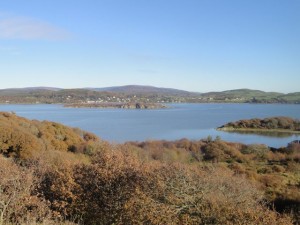
A short walk, on OS paths, so no need to take the map. We left the car in Palnackie, which is world famous for its flounder tramping, and headed south on the west side of Urr Water past the North Glen Glassworks. The road then passes through Tornat Woods and we left the the main track to head over fields. The height gave good views of Glen Isle, Rockcliffe and Rough Island.
Unfortunately the path petered out and we crossed a stile to climb a little higher and having negotiated an electric fence followed some vehicle tracks. I had thought that we had strayed off the path but looking at the aerial photos in bing maps we were actually very close to the true route.
The vehicle tracks led us, through slightly boggy ground to the upper corner of a field with a drystone wall and electric fence. The fence had a stile next to steps in the wall. Although the nearby shrubs and trees had almost overgrown the area it seemed the most obvious way to go. The actual route was out from the bottom corner of the same field.
Our new route allowed us to practice our quagmire crossing skills, something you don’t get to do on namby-pamby paths. We’ll all laugh about this one day, I’m sure.
So eventually we were back on a track, having reached the road to Almorness House just a little south of Orchardton Tower. The path has some rather imposing gateposts and a new looking drystone wall.
From Almorness House there were several paths to choose from. One was clearly the path we should have arrived on, another the path we would expect to return along. That left two more. One heads down towards Rough Firth and we took the less defined track leaving the first via a farm gate. This is indeed the correct way.
We came to a fork in the path and took the right hand fork which climbed to higher ground. Though this eventually led us back to the path is was only after fighting our way through a dense bramble patch because the path was flooded. The first time in D&G that I have felt the need for a machete. I bet Jo would have had one in her rucksack.
A bit of a diversion but we were back on the real path…for a while. The next diversion came near to a pheasant coup. We had climbed a small promontory, marked as “52” on the OS and could see across to another small hill which is the Moyl, the hill at the end of the peninsula.
Having returned to the coup we headed off along a faint track and in so doing left the real track, though for the life of me I couldn’t see it. The new path headed south, rather than south east. Instead of leading us to the beach of Horse Isles Bay we were about 250m west of it in an area marked as “Merse” and characterised by tussocks, mud, standing water and eventually a small lochan spilling out across our path.
Following an unsuccessful attempt to head west…more water, time was called. I hadn’t got the part of the message about the need to be back by 2pm and was therefore unaware of the growing frustration with our lack of progress. So back through the quagmire it was.
We were about 350m from Almorness Point, when we turned back but I’m not sure the way was passable where we were.
The walk back took us past Orchardton Tower. This was built in about 1456. There appears to be a shed on its roof, but googling reveals this to be a gabled caphouse covering the stairwell.
Refreshments were taken at the Glenisle Inn.
Though, obviously, we will need to lick our wounds and recover psychologically from this trek, one day we must return, perhaps in wellies and with machetes in hand.
Fortified with the full Scottish Breakfast we set off on our Halloween walk. The weather looked clear but as we drove along Loch Lomond low cloud gradually became low lying mist.
It was in a dusting of mist that our trek began from the car park at Rowardennan. Five minutes on the flat then a right turn to begin a slow climb. Apparently there is a swimming pool thereabouts but I didn’t see it. It took about half an hour to climb out of the mist and you’ll see from the photo gallery that the exertion had warmed us up nicely, with perspiration and glistening (depending on gender) for all concerned.
Even at these early and low level stages there were fine sunlit views of the mist covered loch and the Cobbler with its surrounding hills. The higher we climbed the more impressive the views became. The path was narrow but in good repair, clear and free of the mudbaths we see closer to home.
We made our way past a rocky outcrop which the OS has marked as Tom Fithich. An interesting name since this is where we first spotted a large black bird with a croaking call. The bird seemed to follow us all the way to Ptarmigan and at times came close enough for us to get a good look at it. Having trawled the internet, looked at pictures and listened to the sounds of various birds, I’m convinced this was a raven. Then when I looked up “Tom Fithich” I found it is gaelic for Raven Knoll. Is that weird or what?
From the Raven Knoll, Ptarmigan itself is visible with the path meandering up towards it and becoming a little steeper. I think I had perfected the mcmahon trudge on this section. Steady yet slow enough to avoid the need for many pauses. I don’t actually have much trouble going slowly, it’s more about overcoming the psychological need to keep up with those ahead and not worry about slowing down those behind. Once on Ptarmigan we posed for pictures, rehydrated then set off along the ridge to Ben Lomond. From Ptarmigan the hills to the north were visible and seemed to stretch into the distance for ever. The photos don’t do the views justice.
Ptarmigan didn’t have any visible ptarmigans on it. The Pt part of the name is apparently a misspelling introduced 400 years ago, the gaelic name for the bird being tarmachan.
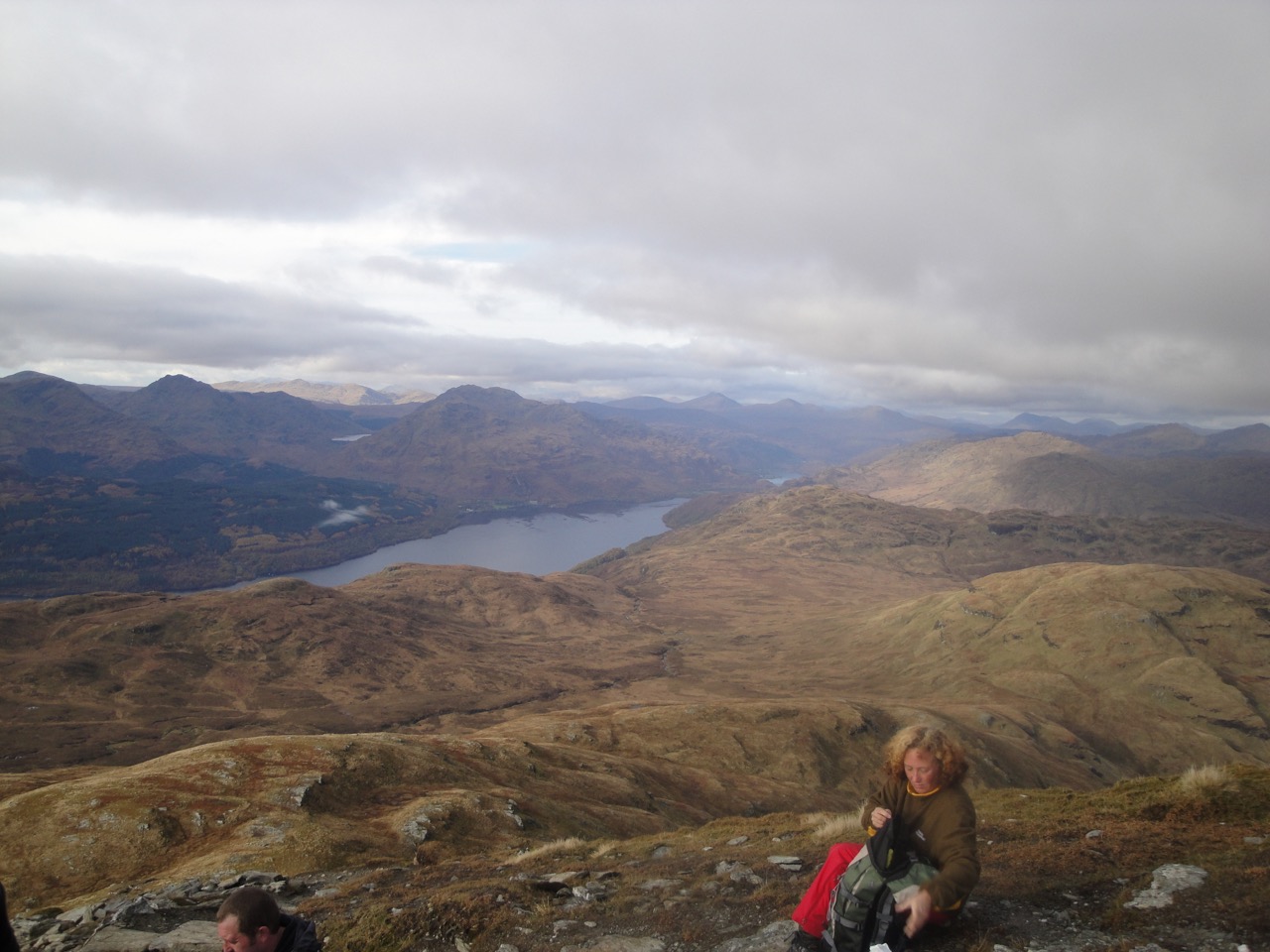
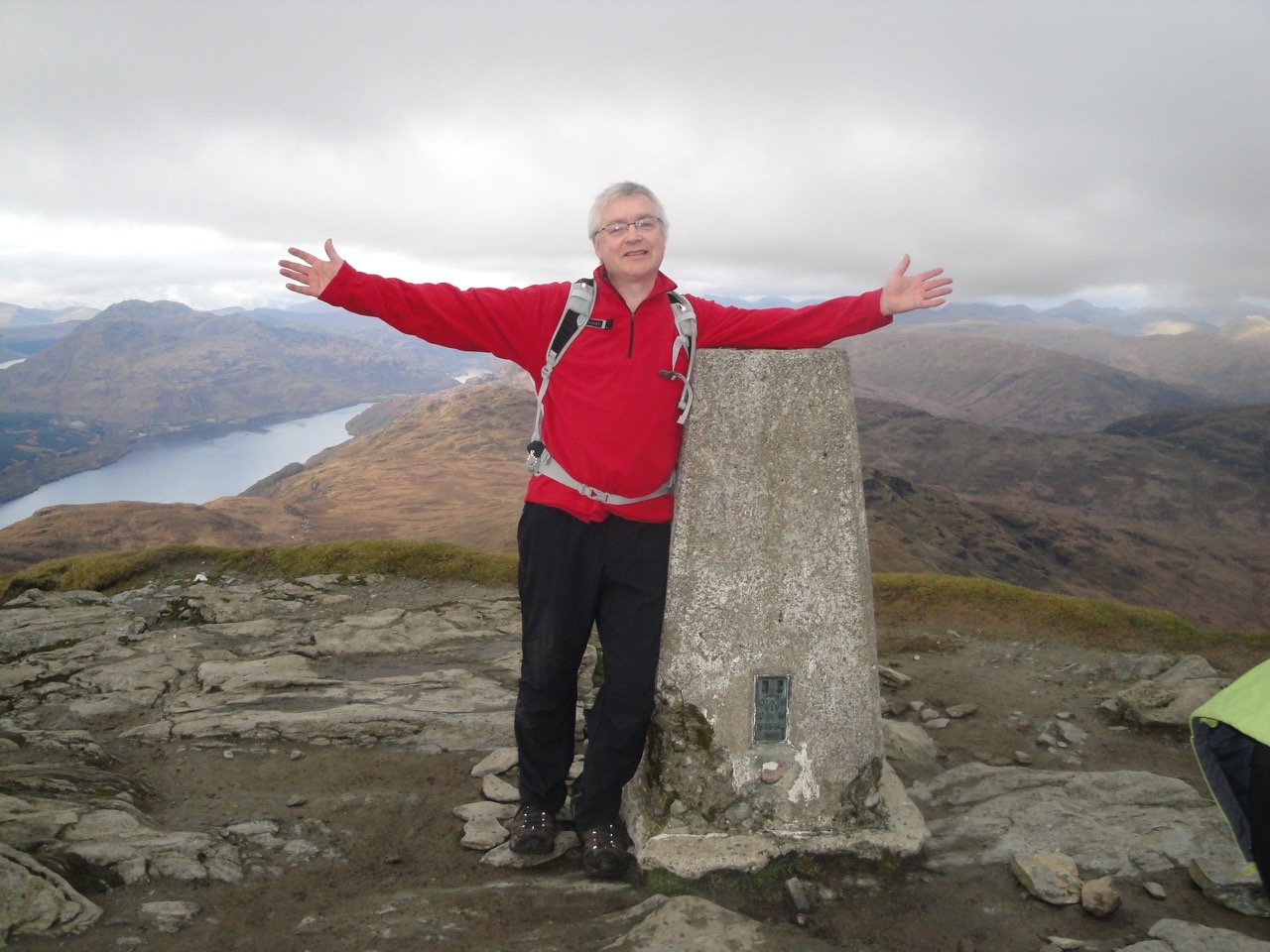
The path from Ptarmigan crosses the Bealach Buidhe (the yellow pass) and leads to some rocky steps and then a short scramble to the summit of Ben Lomond. It was a satisfying achievement and we had some extensive views until the cloud started to darken and spread. The climb had taken us about 3 hours. The packed lunches were welcome by this time and the sandwiches proved to be more manageable (in other words, I was able to eat the whole thing.) It did feel much colder despite adding extra layers and I suspect the weather had begun to turn.
Ben Lomond summit
Heading down, the rain kept threatening, with the odd droplet arriving now and again. Enough to keep the jackets on and cause a little overheating. After the excitement of the climb our downward trek seemed a bit of an anticlimax and did seem to drag on a bit, but perhaps that was tiredness creeping in. We had seen a steam train the day before and this walk was graced by sight of a seaplane taking off from the Loch.
The car was a welcome sight when we got back down. But, alas, the toilets were shut so we were forced to stop at a pub (for coffee and tea).
A great walk. Good choice, David. I’m not sure how we can follow that. Our local walks will seem either a little less exciting or a great deal muddier.
Posted inFar away|TaggedMunros|Comments Off on Ben Lomond and Scotch Mist
The weather on the way up to to Beinglas was dreadful with plenty of standing water on the roads. Each time we drove through one of these monster puddles the windscreen was drenched like a ride on a log flume. Not a good omen for a weekend’s walking.
having arrived at Beinglas Farm we found the road completely under fast flowing water, but intrepid Joanna (4WD off-road experience) got us across. Car #2 was given directions for the back road, an adventure in itself.
After all that we needed rehydration and calories. The food was very good, though the Beinglas belly-buster burger beat both David and myself into submission. No room for sweets.
Excellent rooms, so after a good sleep and full scottish breakfast we were good to go the next morning. The weather had improved. The flooding had receeded but the clouds were still low. David had several alternative walks so we decided to head for the car park at the Cobbler and decide there if it was to be hill or low level walk. Luckily the cloud decided to lift.
Having parked at the top of Loch Long we crossed the road and headed up the path. Zig-zagging up the first hundred metres warmed us up. As we climbed higher and came above the trees the views improved. Ben Lomond was visible above Arrochar and we could see down Loch Long to the Royal Navy munitions depot. Loch Long is gaelic for ship lake, and Arrochar to Tarbet is where the Vikings took their longships overland to raid the shores of Loch Lomond.
I had a minor upset having stopped to doff my fleece and finding I no longer had my camera. Last held 100m back down the hill. I searched my pockets and my bag, but no camera. With a sigh I asked Joanna to mind my rucksack while I walked back down and moved the rucksack off the path. And there was the camera, on the floor under the rucksack.
The path is steep, but once the small dam on the Buttermilk Burn is reached the gradient eases considerably and we got our first good views of the Cobbler. Initially there was a dusting of cloud on the summit lending it a rather brooding appearance but as we climbed further the cloud base lifted and the hill was bathed in sunlight. With the autumn colours of the bracken and sunlit grey of the rocks a camera’s delight.
David forged ahead and was waiting for us at the Nanairn boulders, something to do with the need for privacy. From here we left the main path to cross the burn and head up into the rocks for a spot of scrambling. I find that my mind confuses that word with scrabbling and I feel my rather slow progress up the rocks needs another description. (Straggling?)
I certainly feel achievement after straggling up rocks, even if it is only the mountaineering equivalent of swimming a breadth in the shallow end. The rocky path then led us up to the north peak, and spectacular views of the Arrochar alps, Lochs Long, Lomond, and Ben Lomond. We even had a glimpse of the steam train on the West Highland Railway.
Lunch was on the North peak. The packed lunches from Beinglas were well named. My sandwich was so packed that I couldn’t finish it. My loss, Oscar’s gain.
Time for a choice. Back down, centre peak or Beinn Nanairn? Down we went and then up to the true summit to peer through the eye. That done we decided to head off the hill. The path down the back of the hill was a gentle stroll for the most part, with views of Beinn Ime, the Beinn Nanairn and for the later part Ben Lomond.
As we neared the Nanairn Boulders again Oscar did what all dogs must do. He jumped into a muddy pool, and then ran over to us to shake himself dry.
I hadn’t realised how steep the lower path was until we were going back down, but down is sooo much easier than up. It was a joy to see some youngsters trudging slowly up as we flew down.
After a brief stop at a pottery to admire the salt pigs we headed back to base only to find the A82 closed due to a car accident. This forced us to take refreshment at the Tarbet Hotel until the road opened.
A great walk in unexpectedly good walking weather with the right mix of walking, straggling (scrambling), views and coffee. Good choice David.