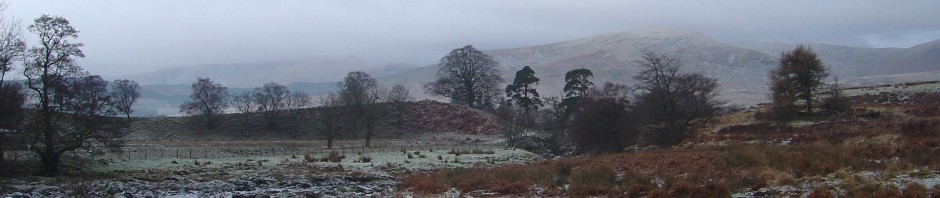
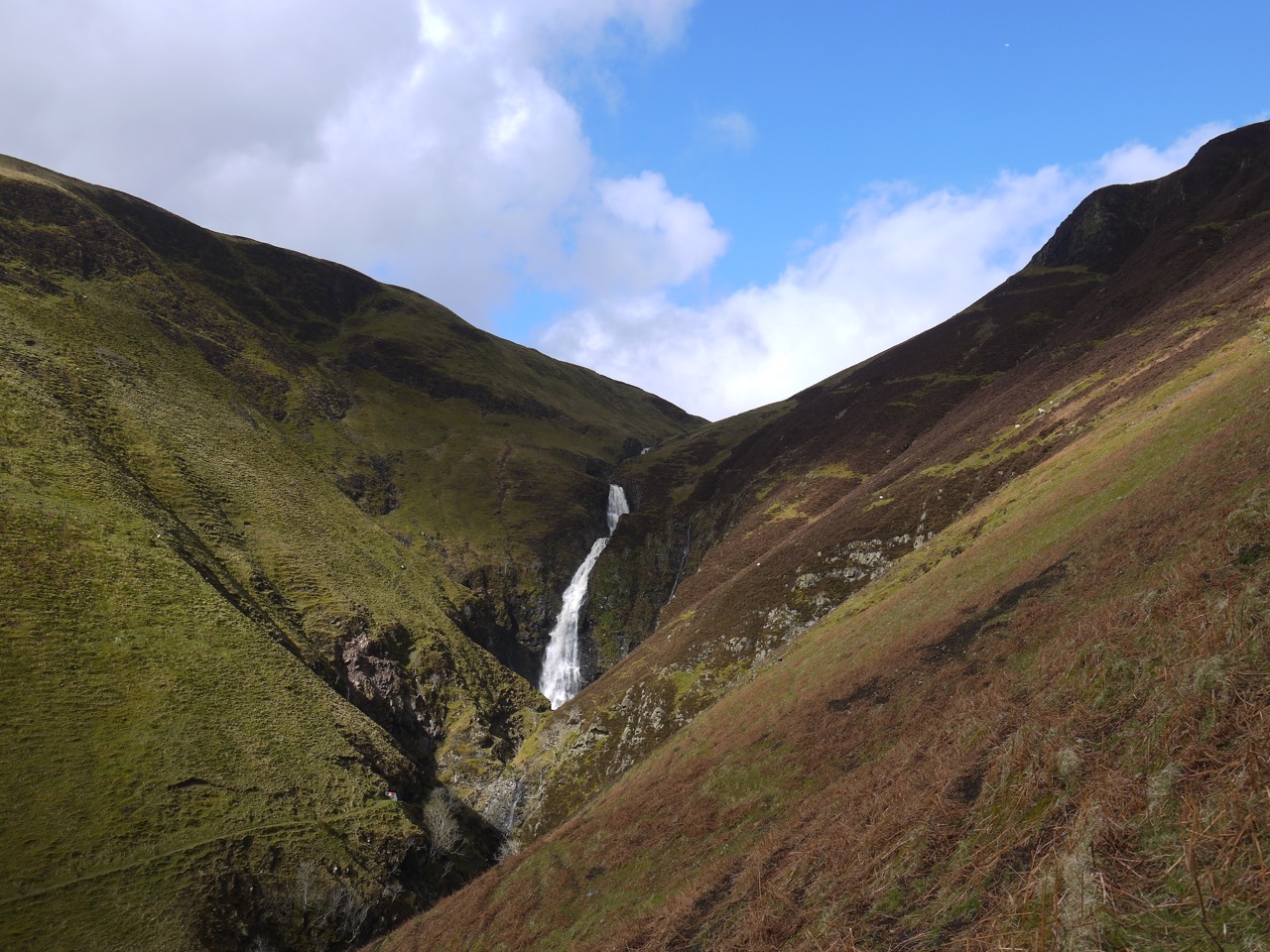
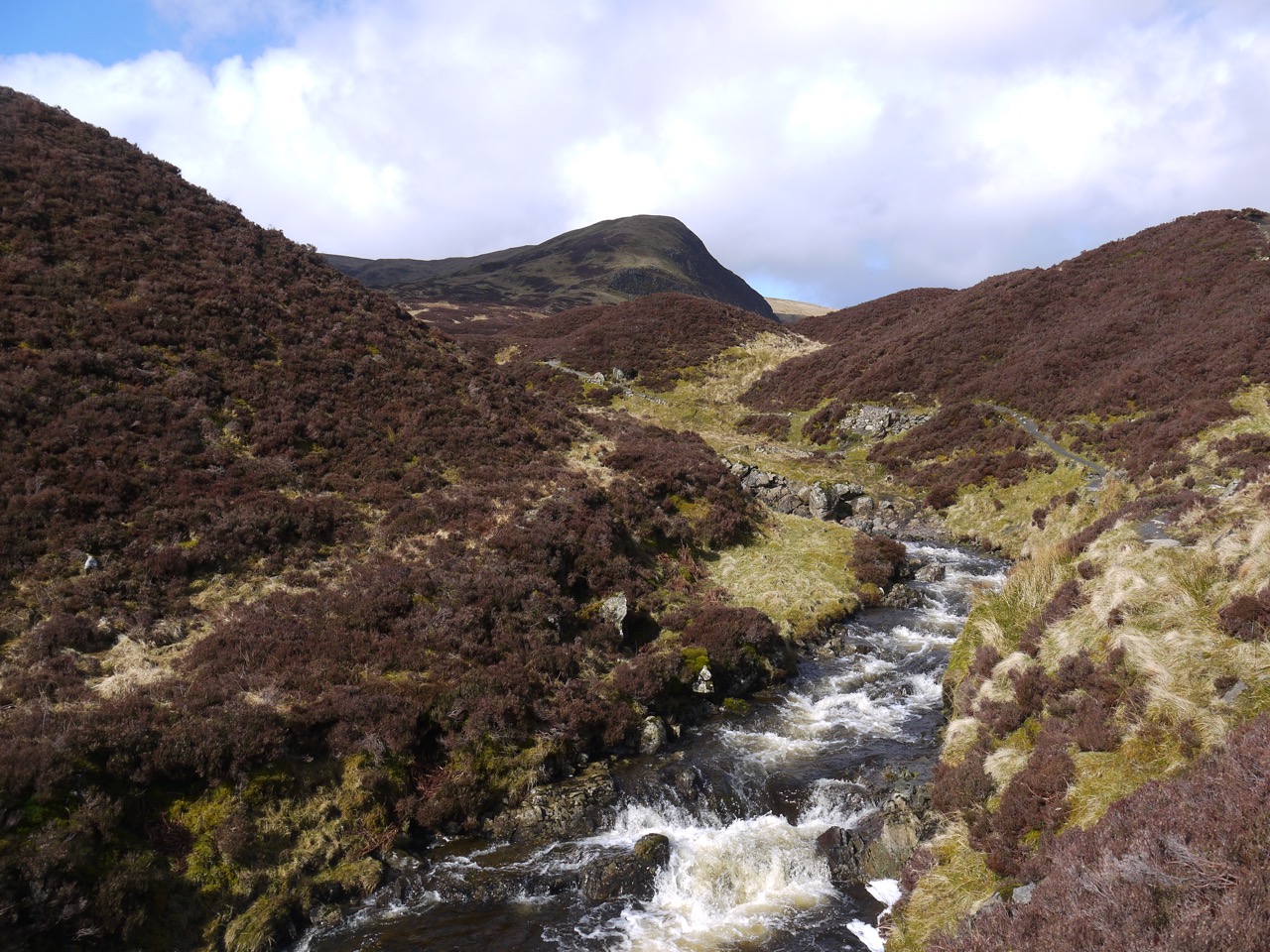
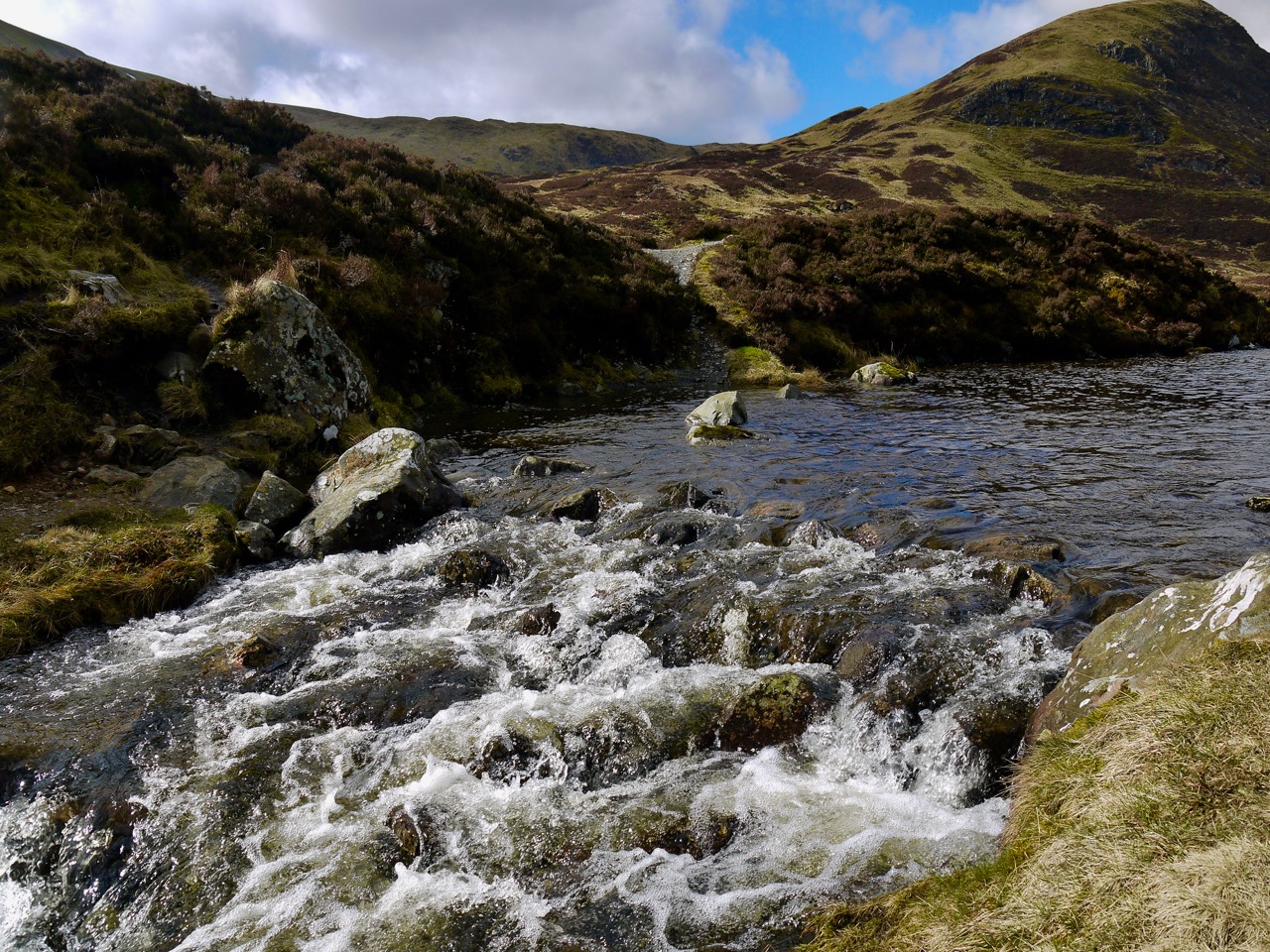
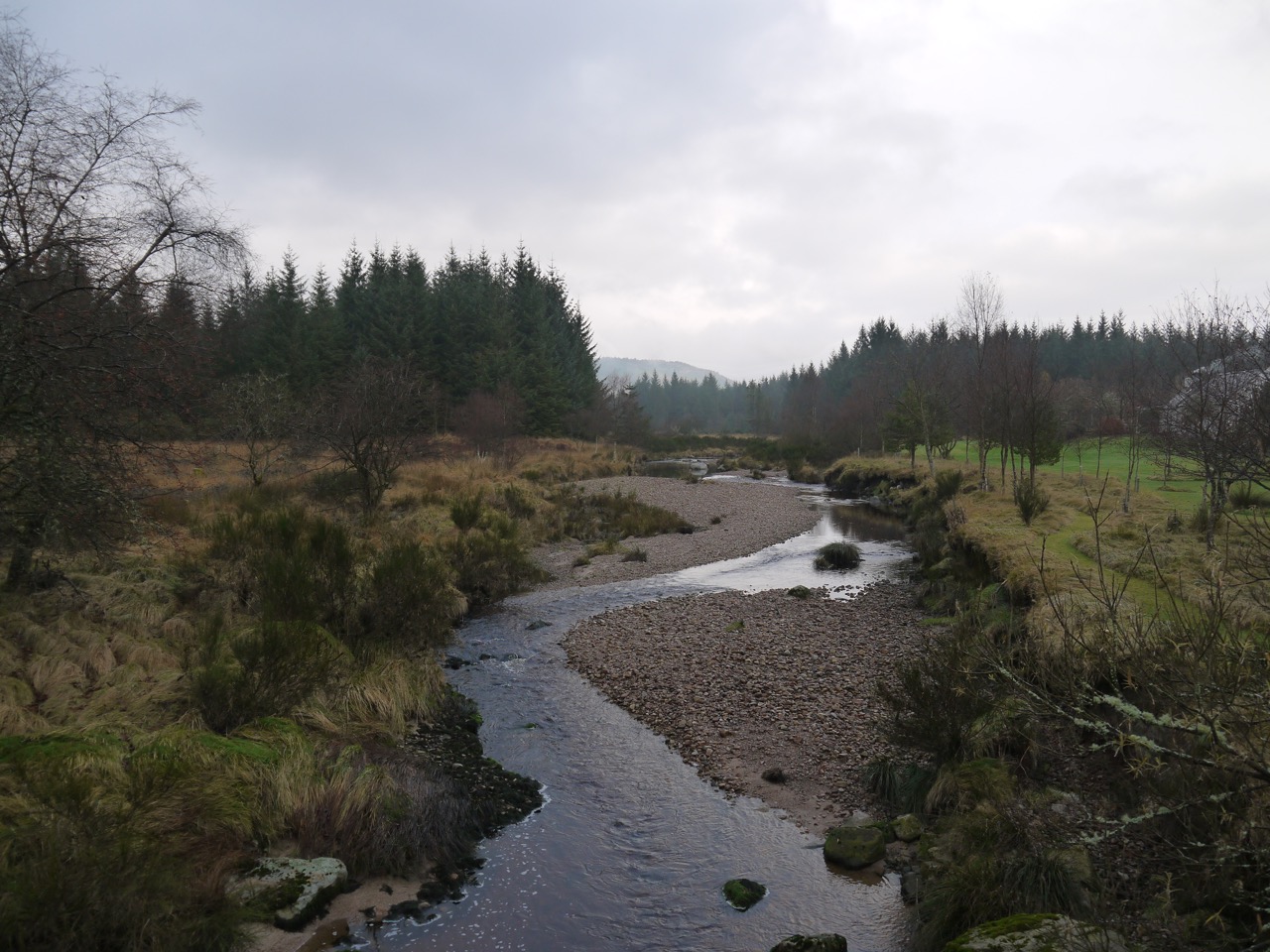
Originally planned as a walk to White Coomb but the Tail Burn was in spate, so we walked a little way along the loch’s eastern bank then went in search of Hogg’s Well, a small lochan, a wee bit above the loch. Then back the way we came.
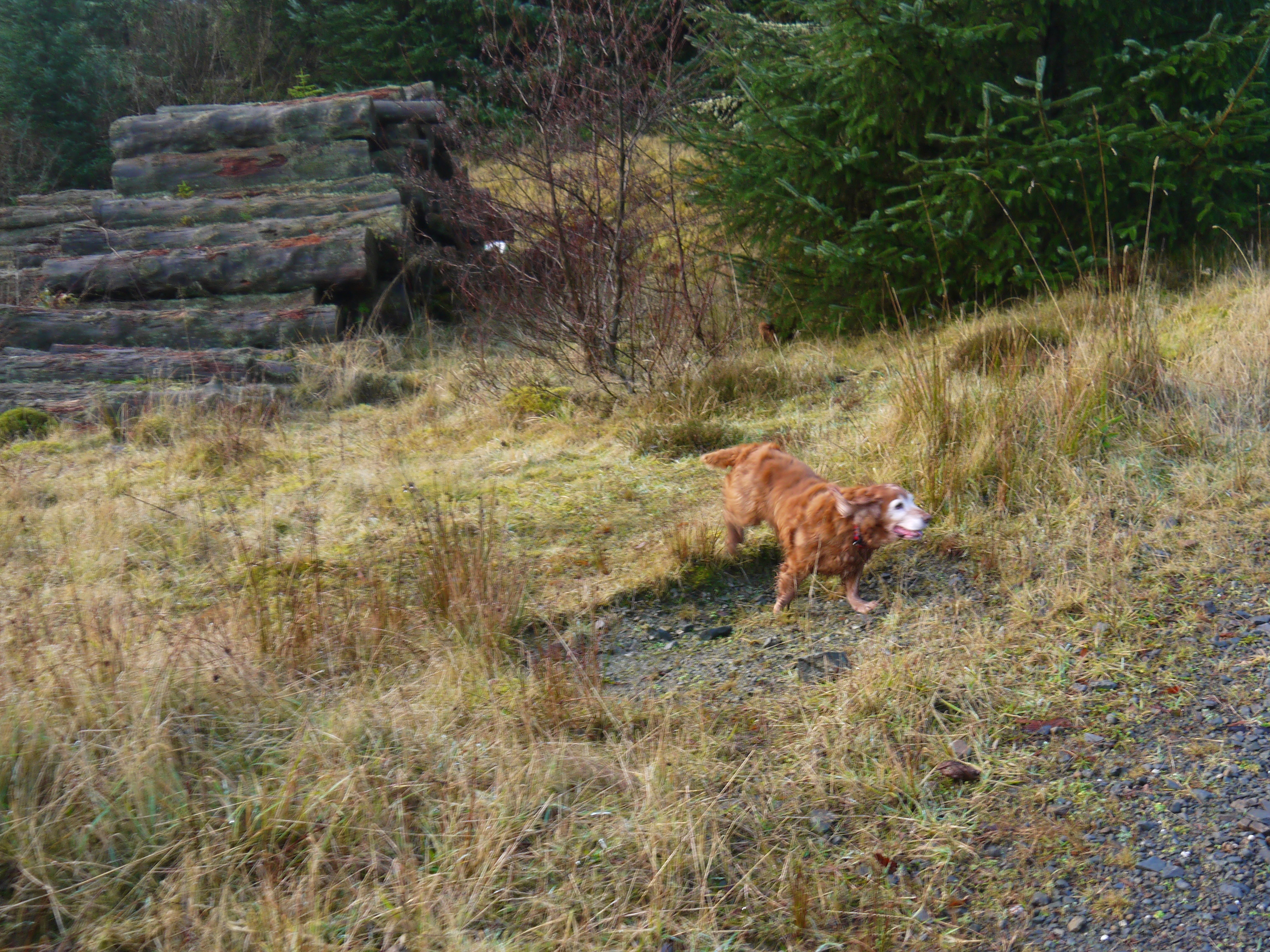
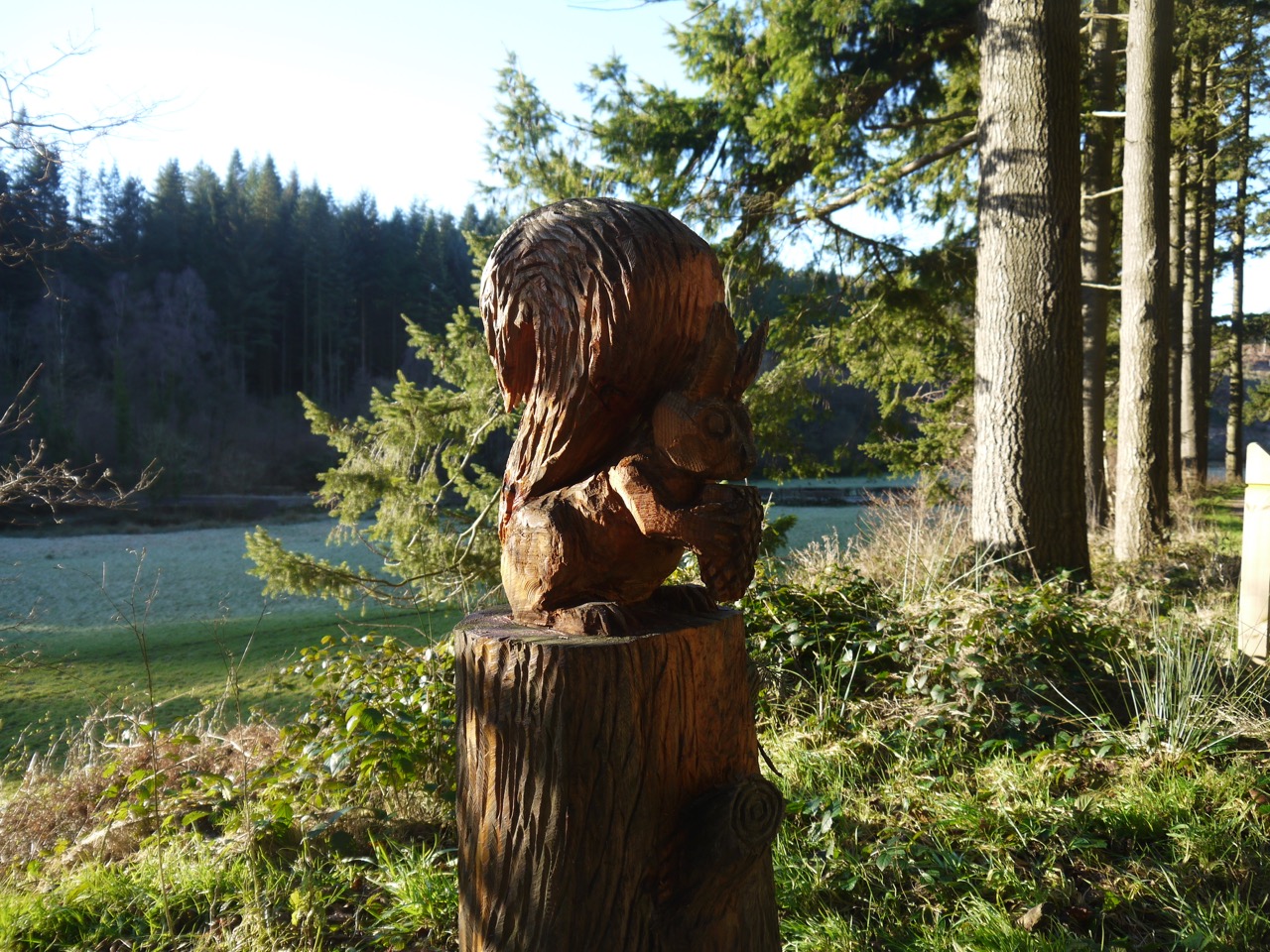
This was a repeat of November’s Snow on Colt Hill walk, but with less snow, less icy wind, more birdsong, an extra dog (Sweep came along as well as Eddie), and a red squirrel on the way home.
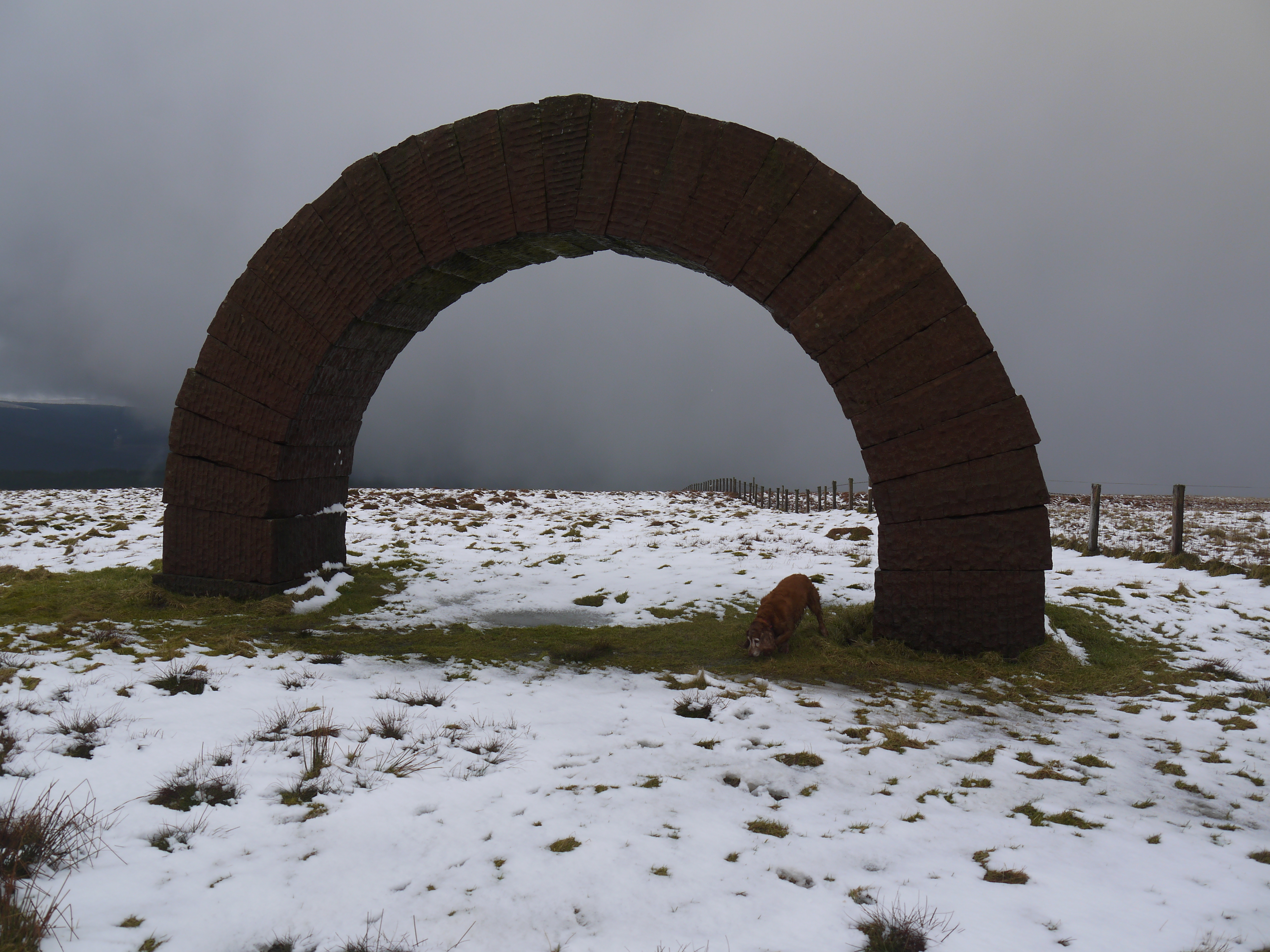
Audrey forgot her hat and gloves and I forgot my sandwiches. I was under the weather and by the col below Colt Hill was flagging a little but, fortified with jelly babies, was able to trudge on up the last few metres into the cloud and walk through the sandstone arch. The descent was a bit slippery but the humans managed to stay upright. Poor Sweep had slipped in the mud but all his sniffling about in the snowy grass had him clean in no time.
After the wildness of Loch Trool we had a country of plenteousness and peace. (The Heather Moon)
Stricken with the flu then cursed with a dodgy knee, I had been out of action for a few weeks so other than short walks with the dogs I had gradually lapsed into unfitness. This outing was to gently ease me back into regular walking.
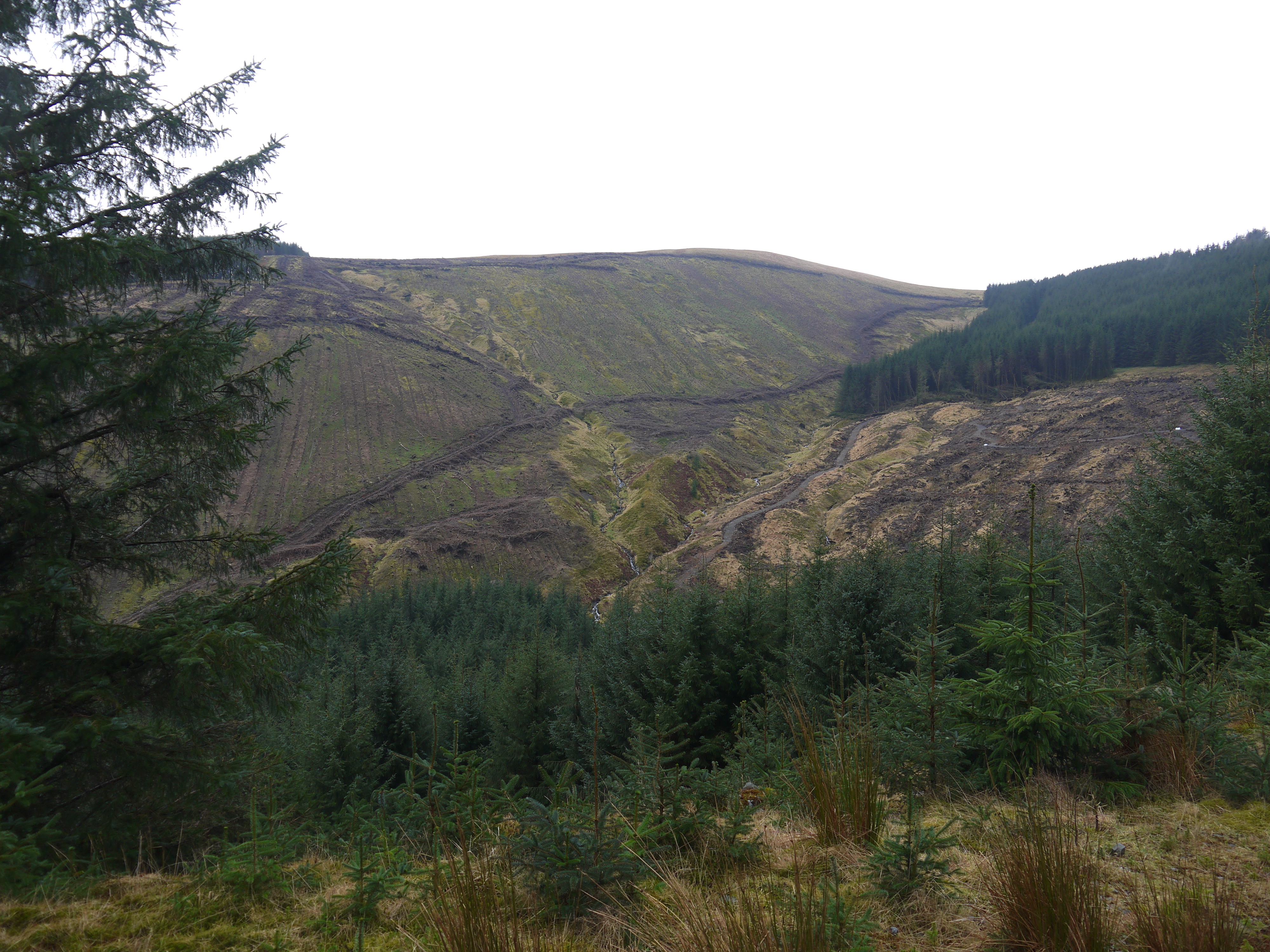
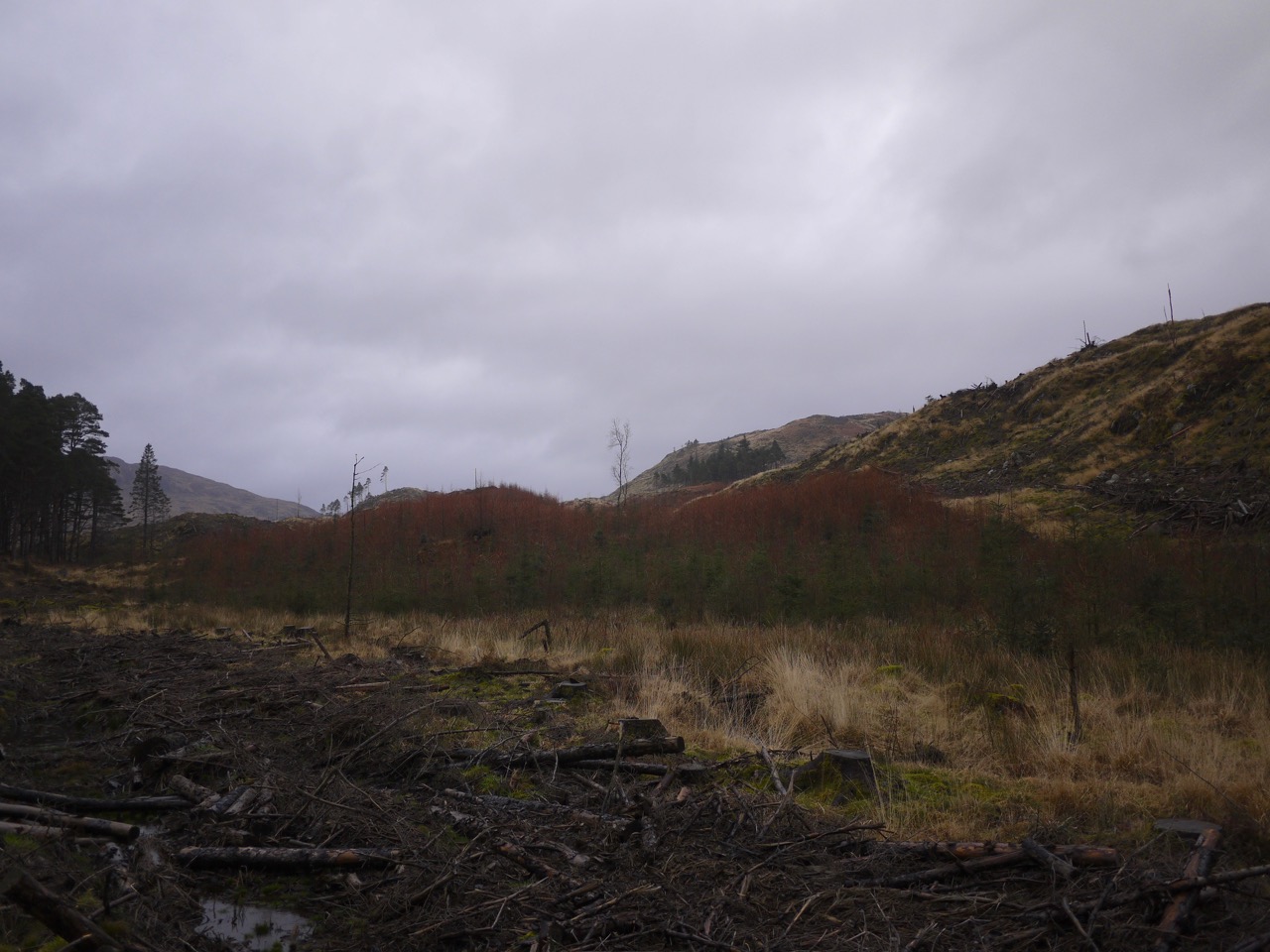
We found a surprising number of cars at the Caldons car park, given it was a weekday, but only saw other walkers a couple of times and then only in the distance. Caldons still has the look of a campsite with its paths and hard stands, albeit without any caravans or tents. Trees still stood over the old campsite but once we had crossed a couple of small footbridges the canopy was gone. Audrey had forewarned me that the forestry had been felling by the loch. She had been turned about and sent away by the loggers the last time she tried to walk here. I was still quite surprised how much it had changed.
Newly felled forest by Loch Trool
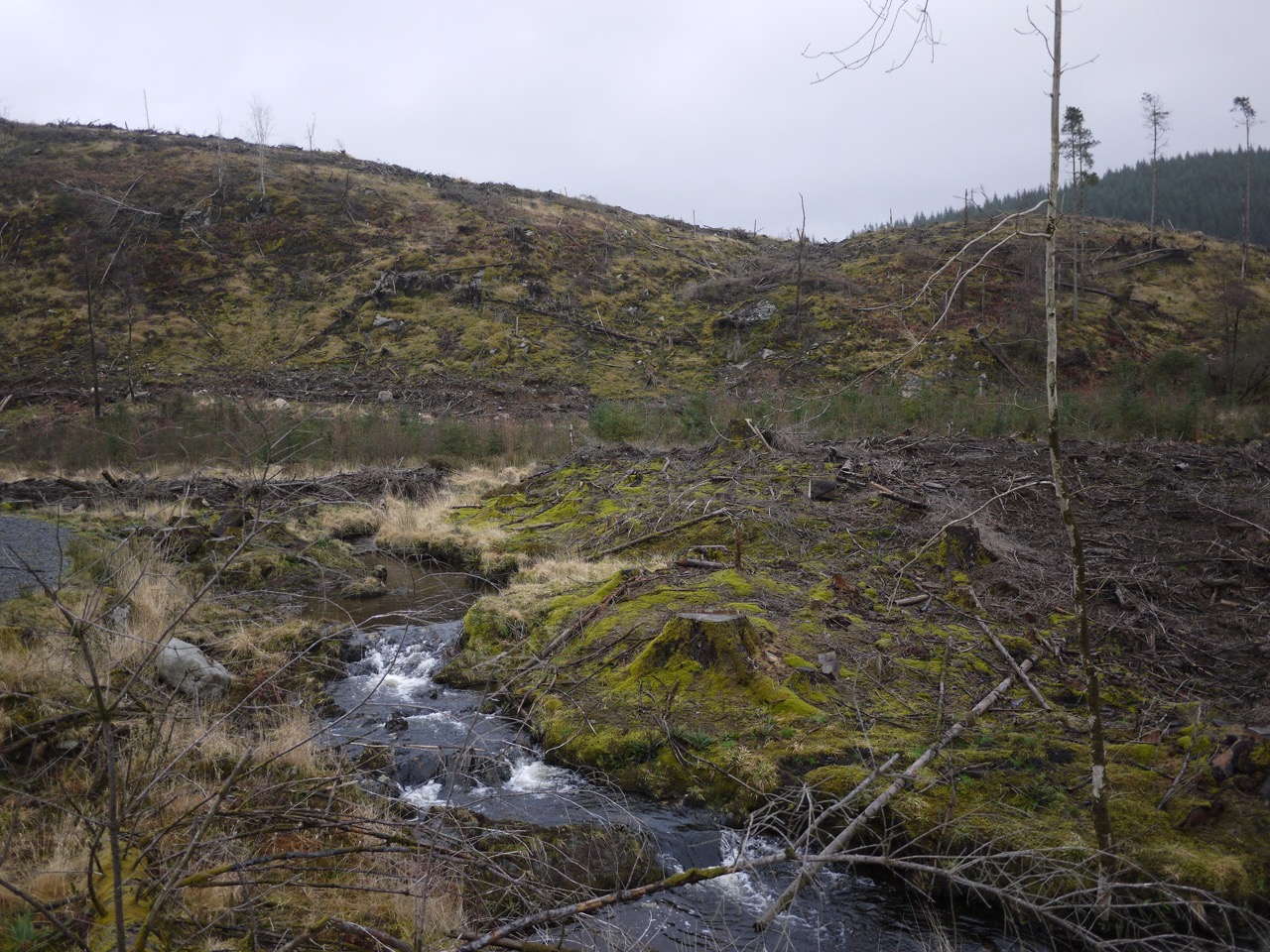
The slopes beside the loch’s southern bank are now open, the trees gone, leaving the usual mess of broken branches and tree stumps. I think the experience of walking in a more open setting is quite different from walking in a forest. Even though one can glimpse more distant features through the trees when walking in forest, I find myself looking at closer features, the moss on tree trunks and the path itself, whereas with the trees gone, my eyes are drawn to the hill-side slopes and the hills.
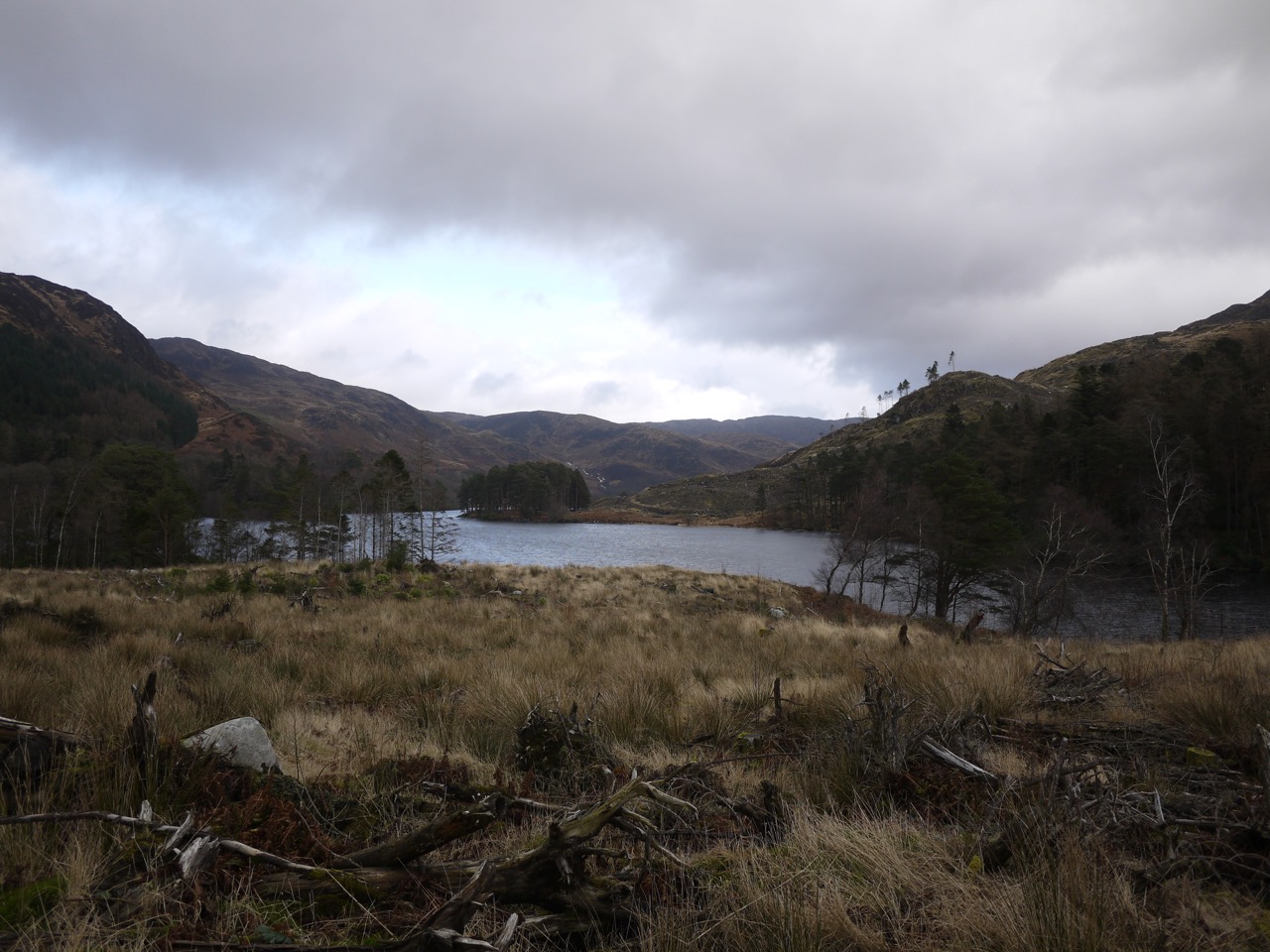
Trool stone circle?
I found myself wondering how long it might be before the ground is re-planted, and if it will be more conifers or perhaps the broadleaved trees that had lent their names to nearby features (Caldons/calltun/Hazel, Ringielawn/leamhan/Elm, and Drumnaminshoch/uinnsean/Ash). I seem to remember reading that the forestry commission work on a sixty year life cycle for pine but longer for broadleaved trees, with a couple of years left between harvesting and replanting. That said, I am sure I have seen plenty of areas which have been left longer without re-planting.
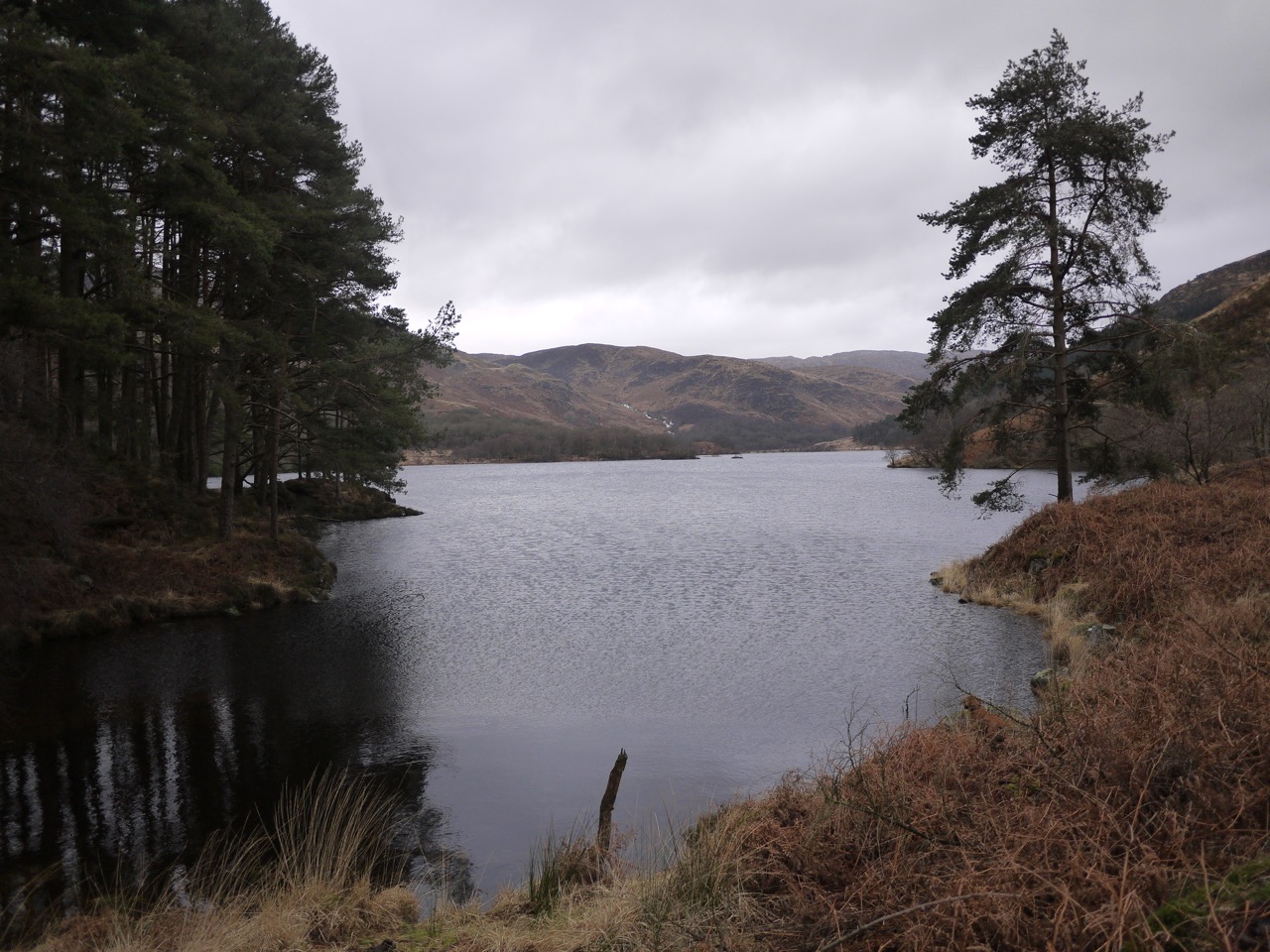
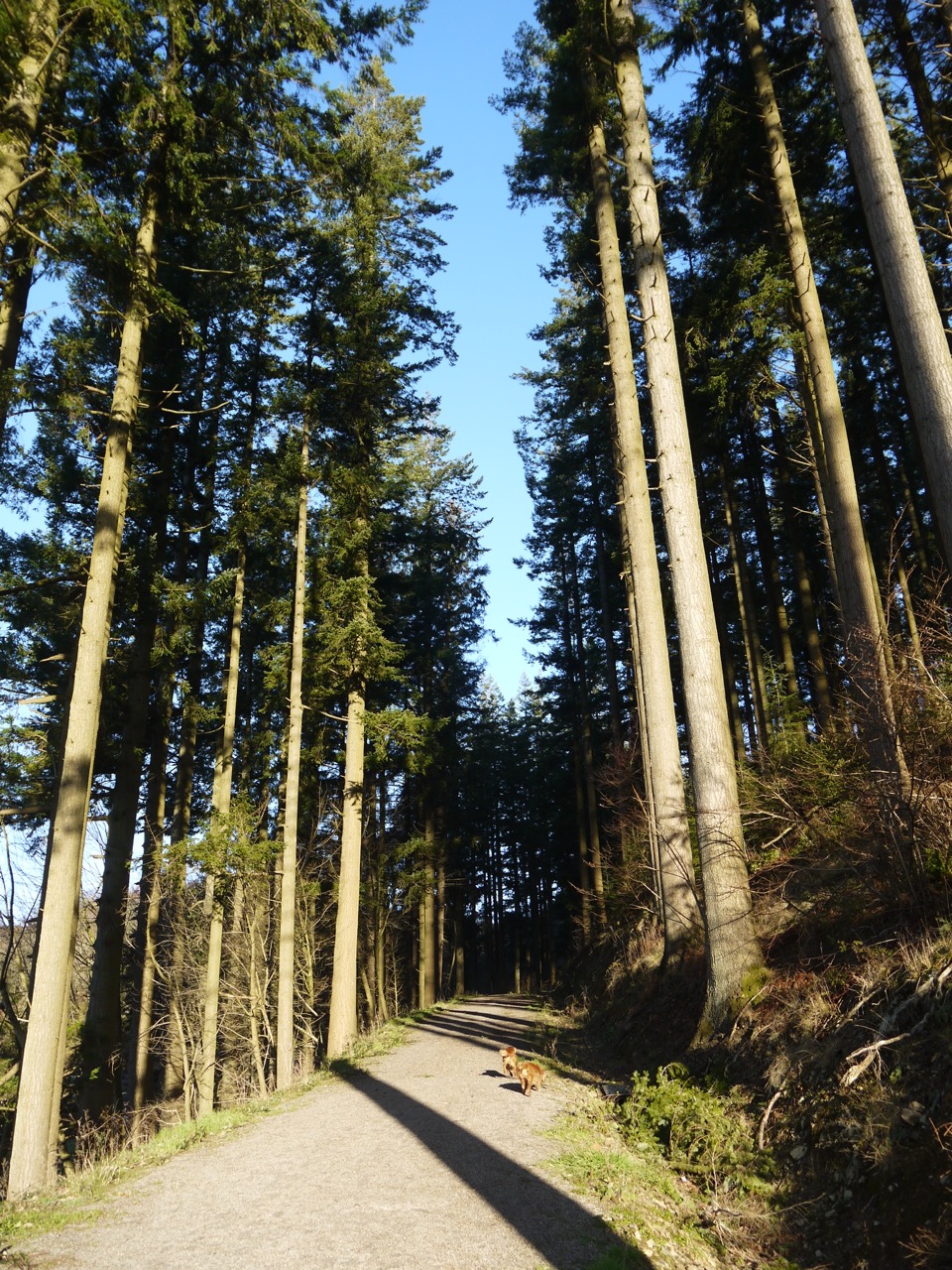
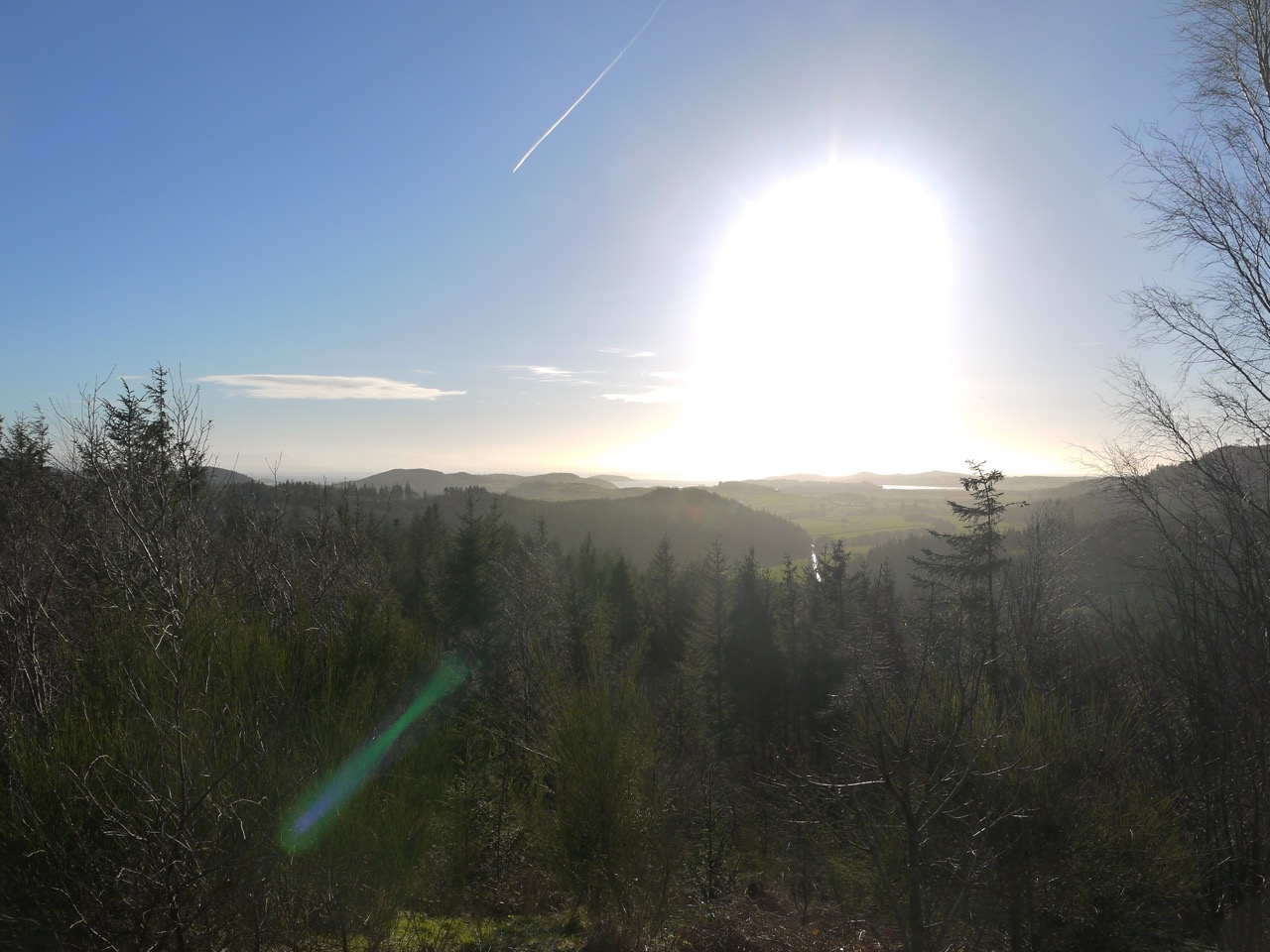
A couple of stands of tall Scot’s Pine have been left beside the loch, the second beside the tiny bay in the photo at the top of the post. I have a feeling as well that the path has been re-layed, but I can’t be sure. The SUW info sign about the Battle of Glen Trool seems to have gone with the trees, but as we reached the eastern end of the loch there we found ourselves back amongst trees.
Young conifers
Spring isn’t yet showing itself except perhaps for some subtle features. A stand of young conifers was a mixture of bright green, spruce I think, and some slightly taller orange trees which might be larch. I don’t think these are as orange in the winter and the more intense colour seems to come as the years new growth starts. Looking across the loch, as seen in the picture above labelled “Trool Stone Circle” there are trees across the glen of the Giarland Burn, and though it is not obvious in the photograph, the upper trees have a purple hue due to new growth.
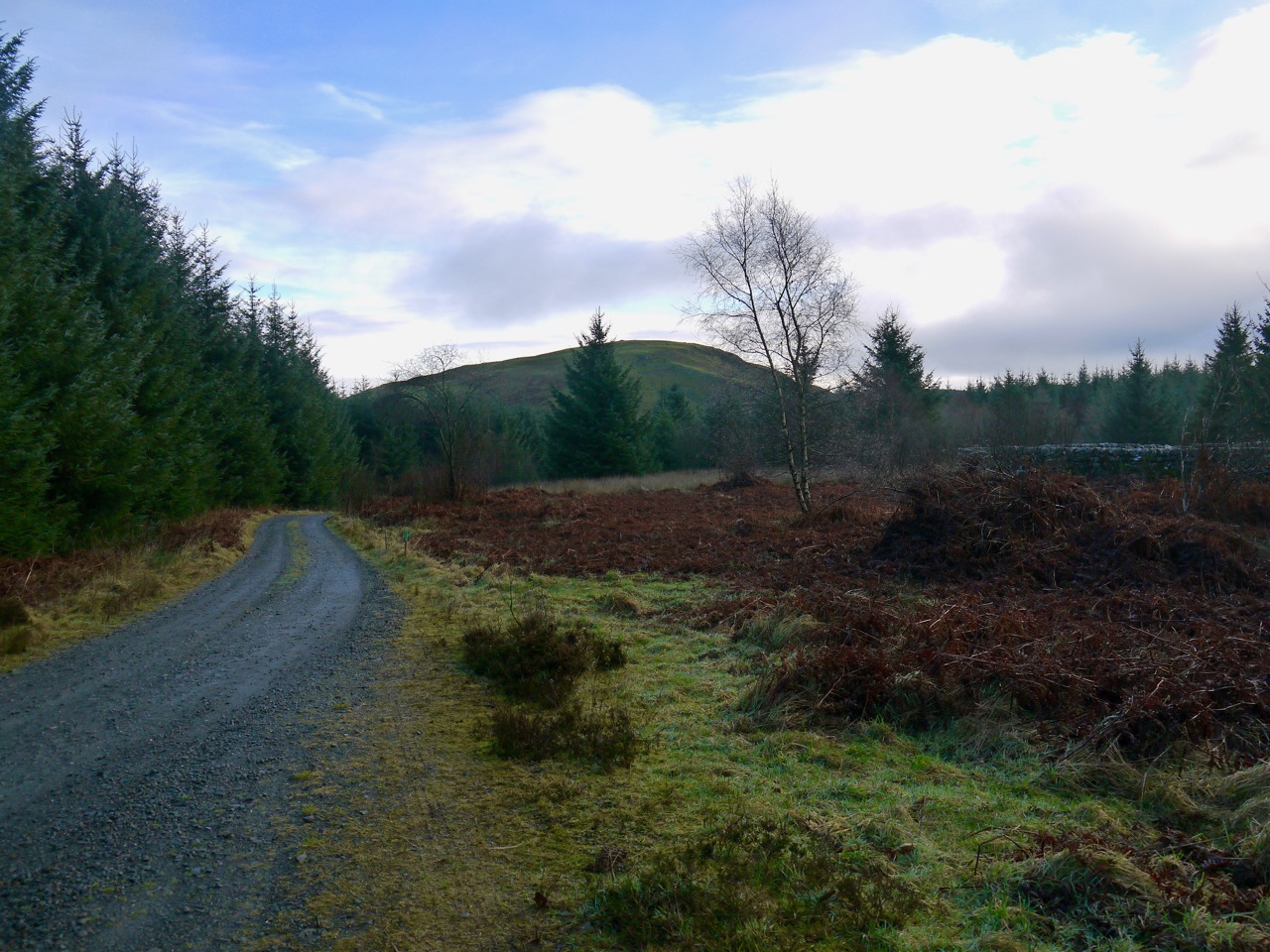
The path winds climbing and falling above the loch often giving great views of the opposite hills with white ribbons of water tumbling down the Buchan and Gairland Burns.
The bog myrtle was beginning to make itself known beside the path, its purplish brown buds standing out against the pale yellow of the grasses. I crushed a bud for its sweet smell and after that I was sure I could smell it on the wind as we walked by more of the plants.
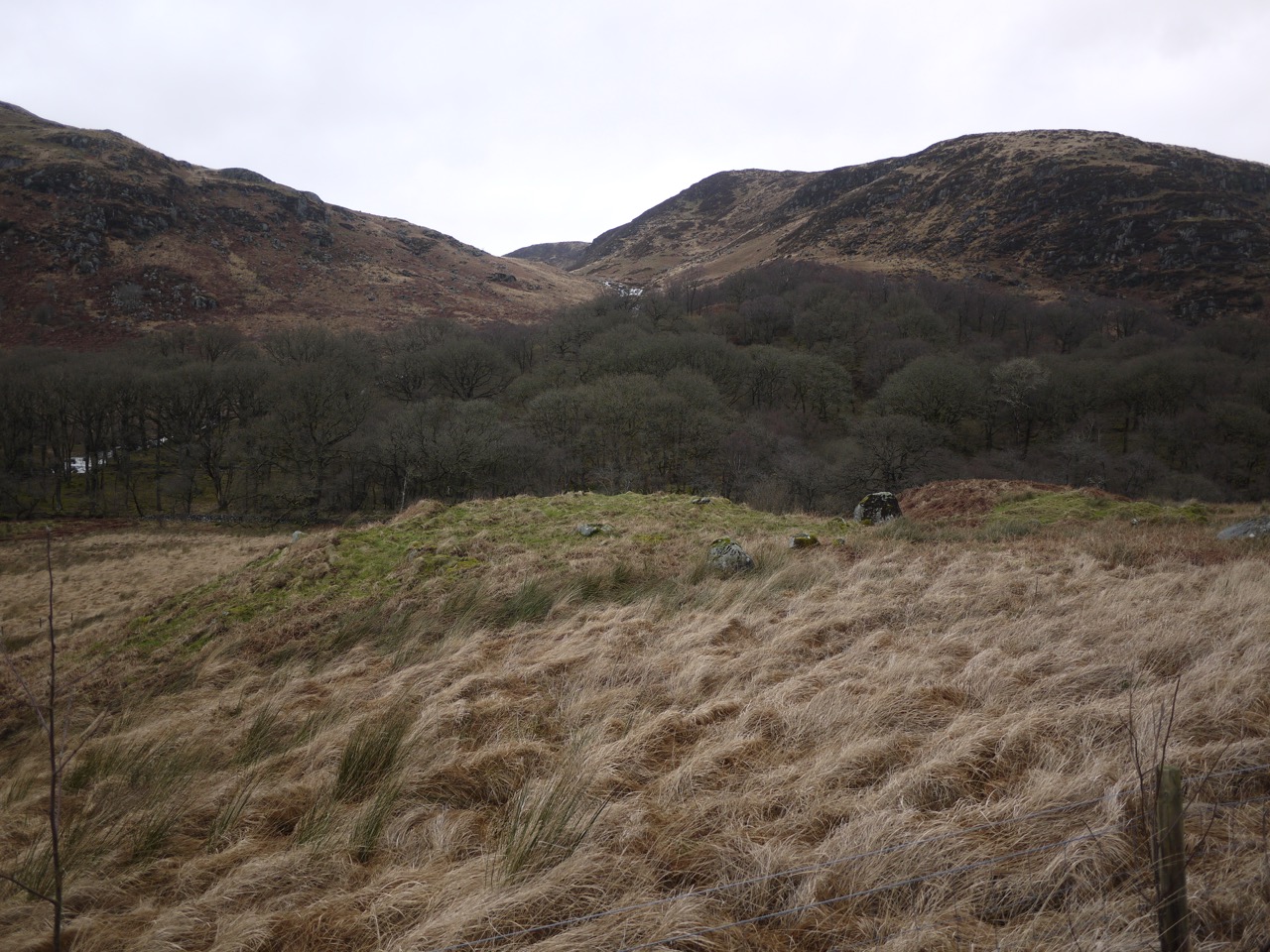
A small knoll close to the eastern end of the loch had what appeared to be a circle of stones, but I cannot find any record of a stone circle here so presumably these are just boulders that happen to look like a circle rather than a man-made artefact. (Edit: It looks as if this might have been the ruins of Ferrachbae, yet another name involving a tree, the trysting place of the birches, bey.)
Missing bridge at Glenhead
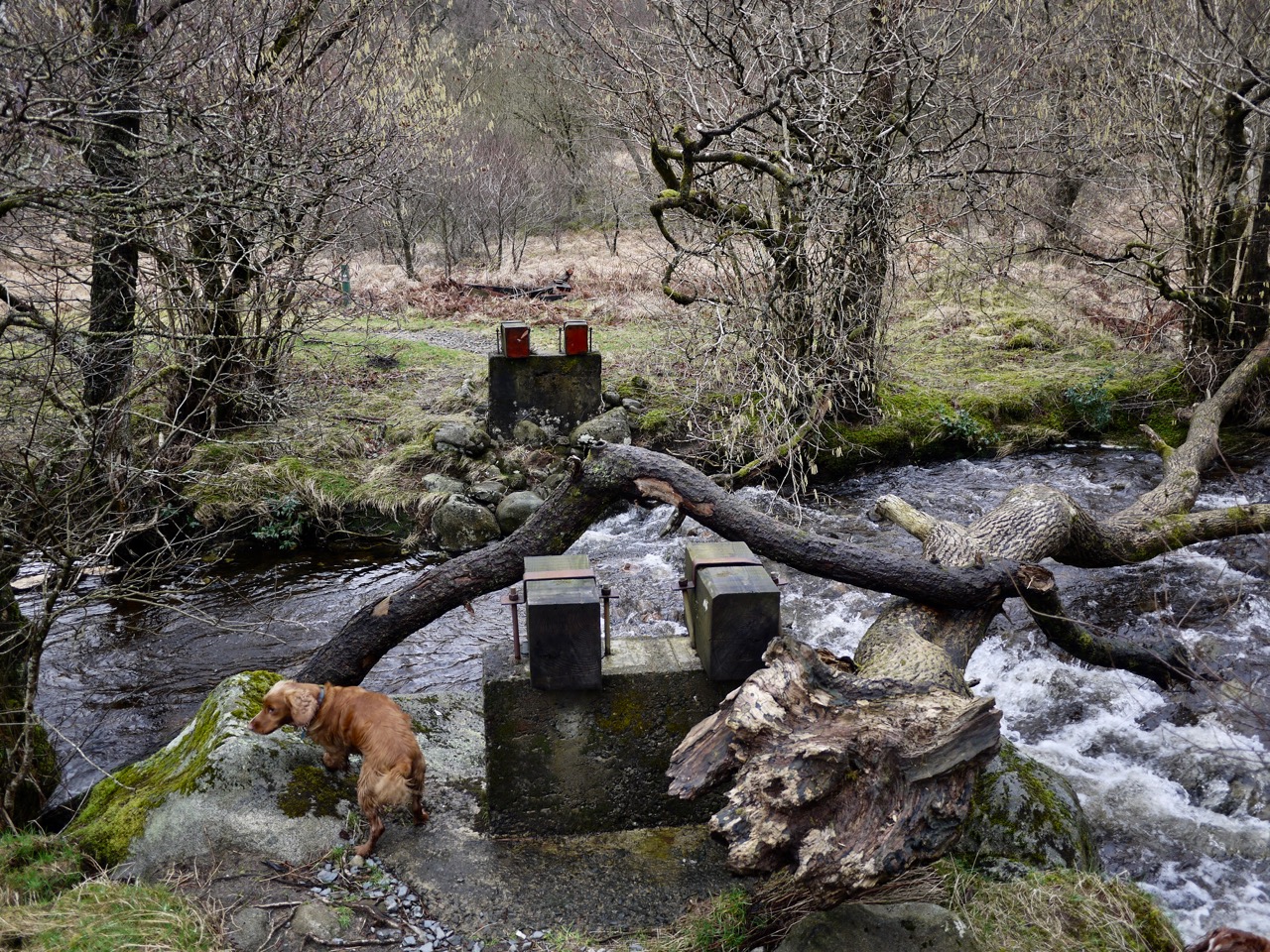
The small footbridge at Glenhead is no longer there, but a twisting tree trunk crosses the water for the more adventurous explorer. I would have used it but what with my dodgy knee I decided to walk the extra hundred yards to the vehicle bridge.
Gairland Burn in spate
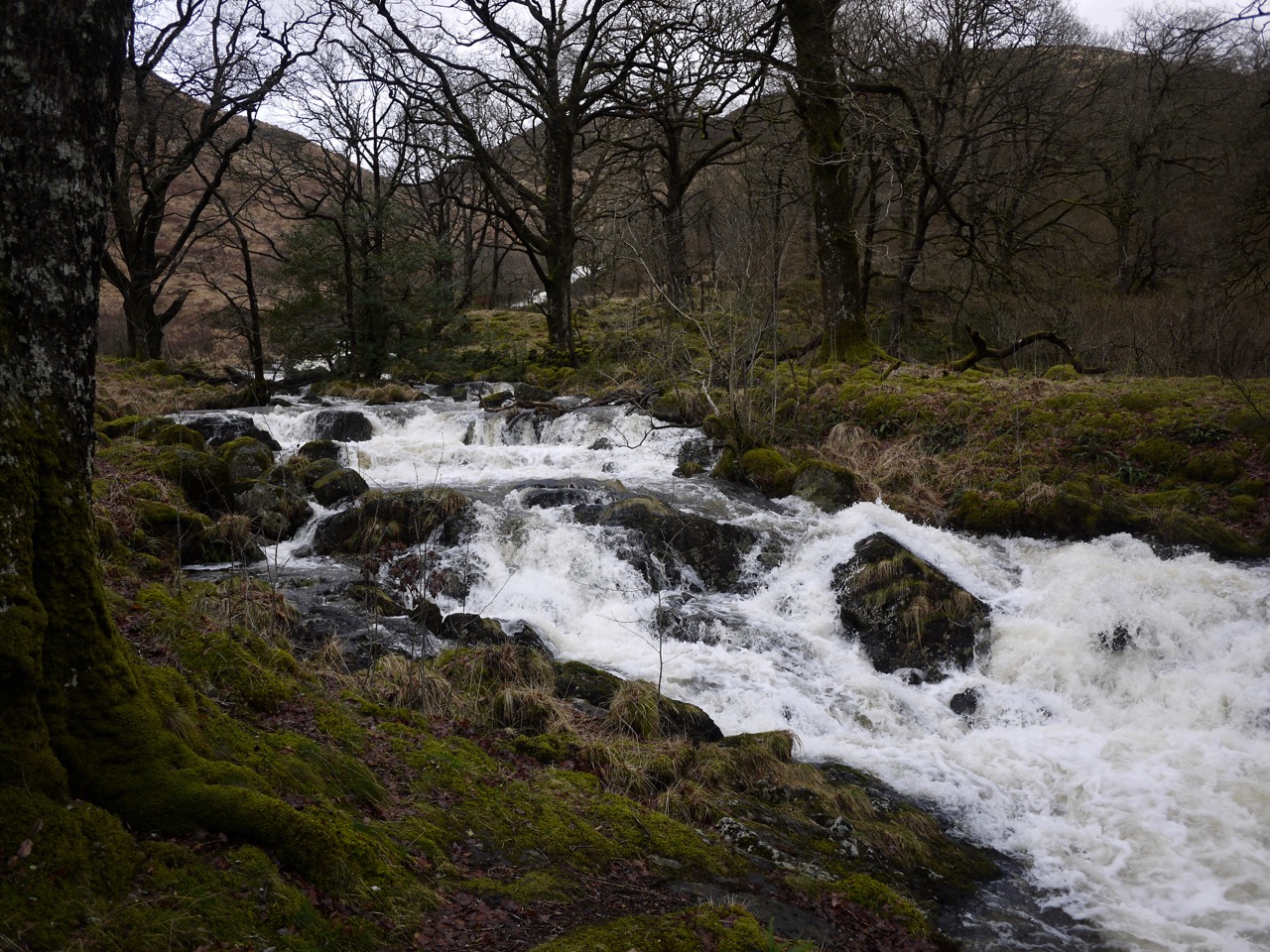
We could see the Gairland Burn in spate from early in the walk, white against the brown of the hills, and once we reached it it was truly roaring.
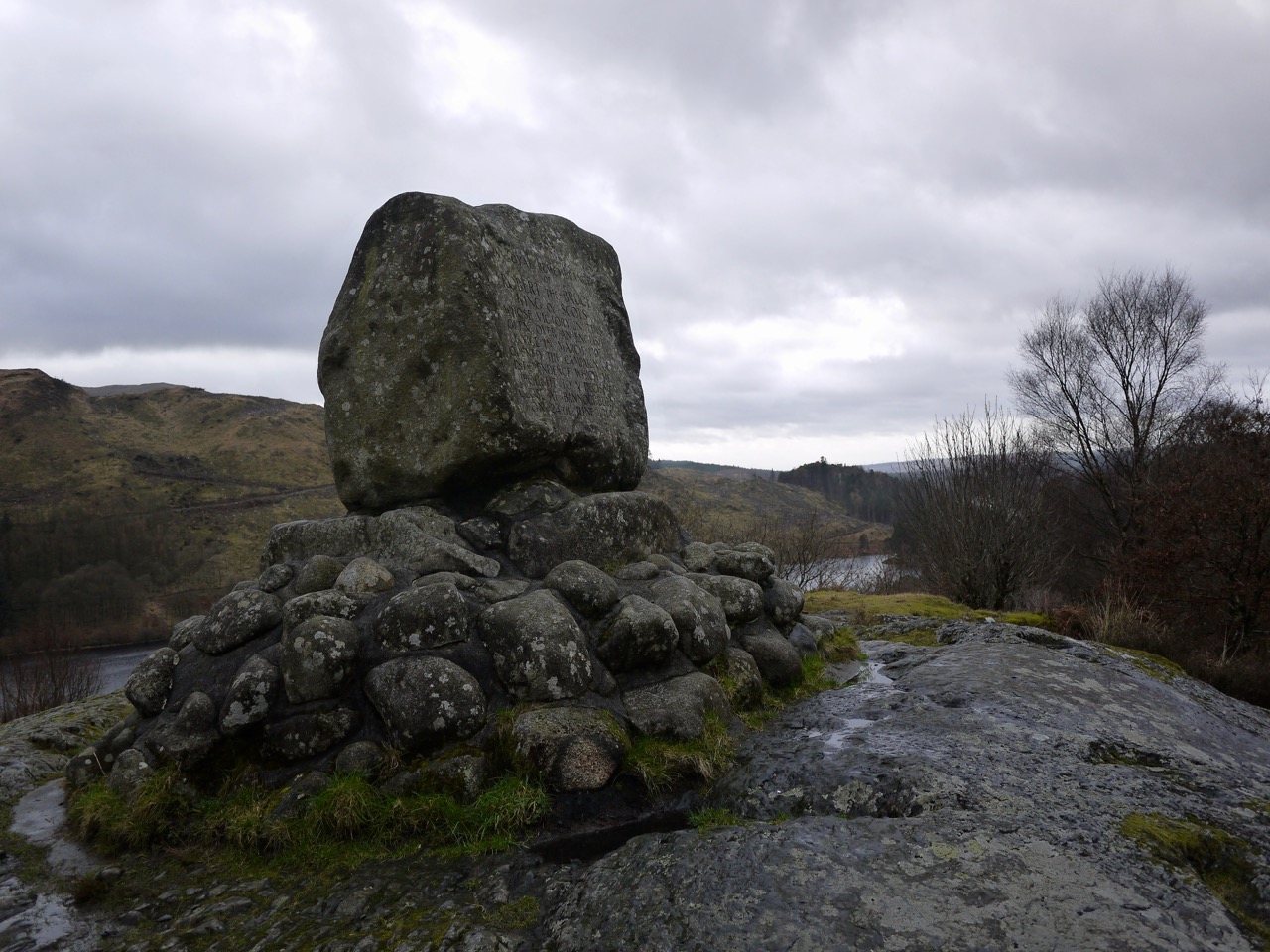
Bruce’s Stone at Loch Trool
And we couldn’t walk by Bruce’s Stone without a visit. The inscription recalls Bruce’s victory in the Battle of Glentrool.
“In loyal remembrance of Robert the Bruce, King of Scots, whose victory in this glen over an English force in March, 1307, opened the campaign of independence which be brought to a decisive close at Bannockburn on 24 June 1314”
Bruce’s Stone at Loch Trool
After the monument we were on road for a little while but were soon back on a footpath down to the western end of the loch. A couple of years ago we sat by the loch here eating our lunch, listening to the loud chattering of swallows as they danced across the water. No swallows in February though. And a bit chilly to stop for sandwiches.
Western end of Loch Trool
A pleasant walk, a little different than my other visits here but my knee held up, until I sat down at home to type this, when it stiffened leaving me hobbling about.
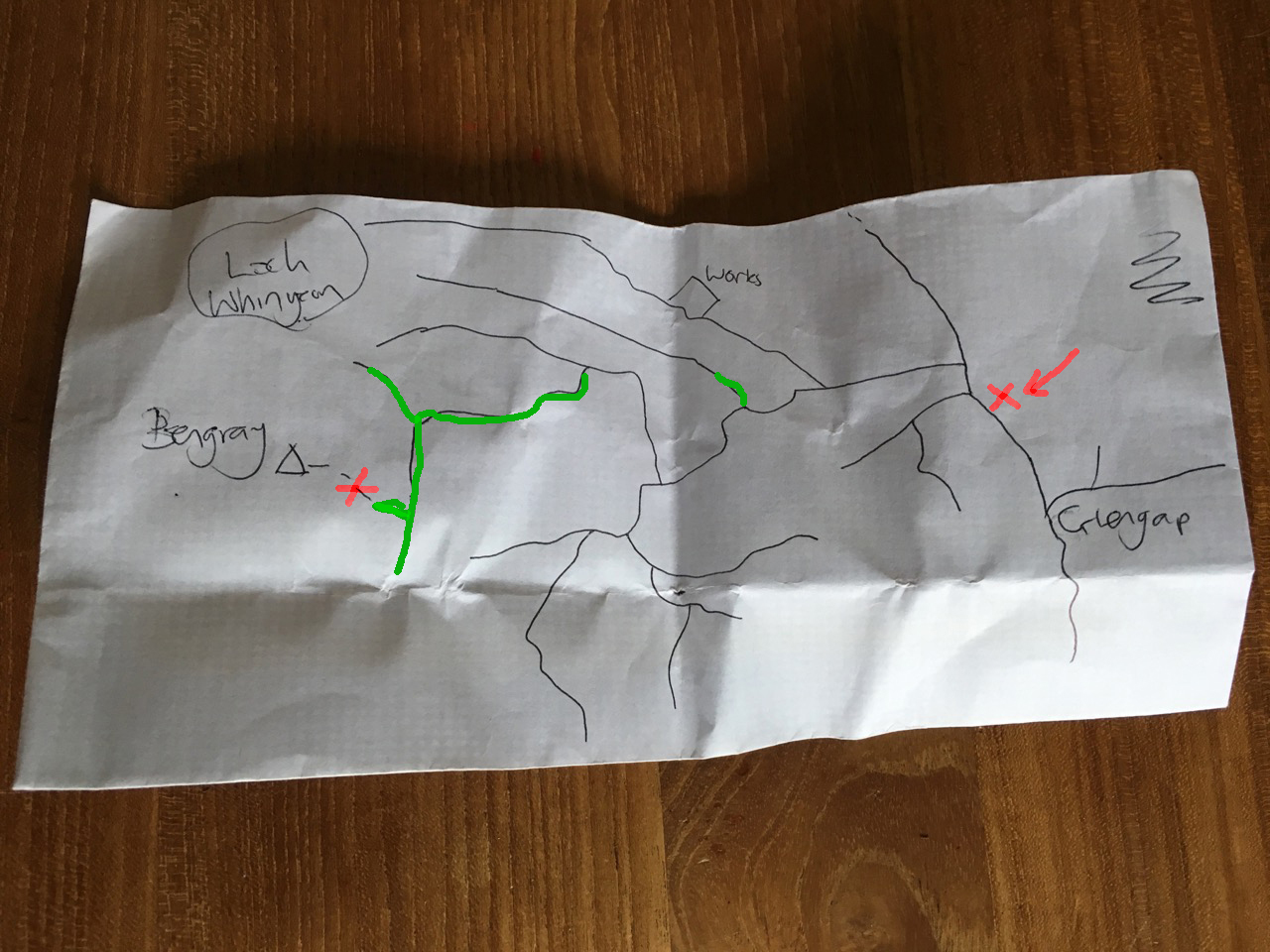
Another wee forest walk, this time in Glengap forest which takes its name from dock leaves. I had drawn out a simplified route on the back of an envelope, using the OS 25k as my source. We started at the X (on the map) near Glengap and set off with the summit of Bengray as our target.
We crossed the Red Nick Burn and followed the forest tracks. The mapped tracks were not always obvious on the ground. We were to take the second left then the third on the right. The second on the left though was difficult to differentiate from a forest break and when we eventually got the the third on the right I was uncertain if it was the third (the forest break having been the second) or actually the second.
The real test was to look out for the track on the left after a left hand turn in the path. On we walked unable to see anything but trees around us wondering if we were on the the correct track of the one running parallel to it. The map wasn’t much help because the parallel paths had the same ups and downs and crossed the same minor streams.
We walked past an opening to our left and I wondered aloud if that was a path but we looked along it and discounted it as a forest break.
A change of plan was needed so we decided to continue along the track we were on, which should have led us to within a couple of hundred metres of Loch Whinyeon no matter which path we were on. We could then decide whether to retrace our steps or head up Bengray from the Loch.
So on we went, for about another 200m before the forest track we were on came to an end with no obvious way on through the forest. This is very different from the appearance on satellite views on google maps, so the old track must have become overgrown. we turned about and headed back the way we had come.
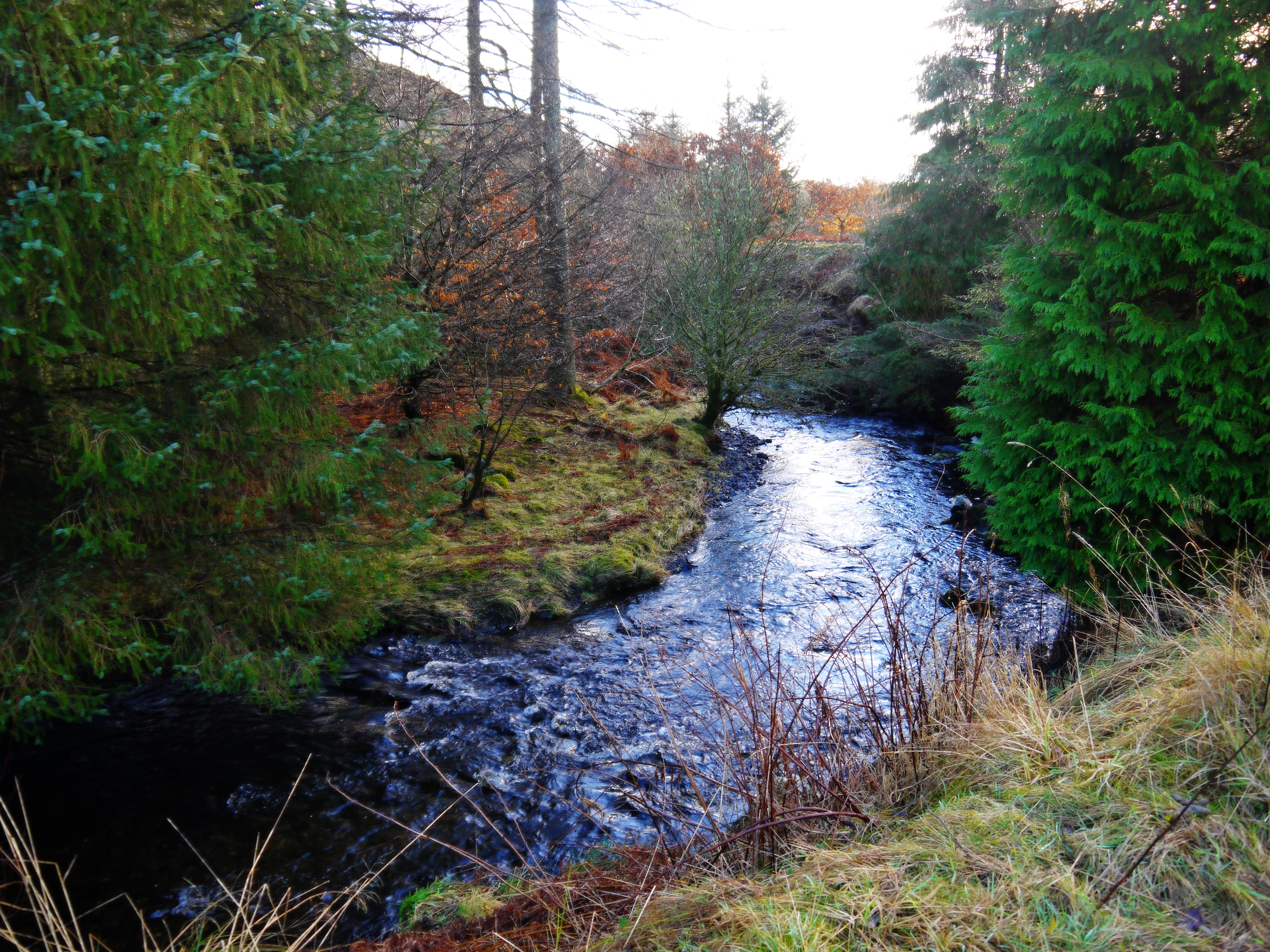
The “forest break” we had passed tempted me and we decided to see how far it went. It soon became clear that this was the path we were looking for but it was now quite overgrown. The photo below is a little further along on a section where the old path could be made out. In other sections you wouldn’t know you were on a path.
The sections highlighted in green on the map at the top are heavily overgrown.
The OS 50k shows a route up to Bengray, but we did not find it. When the overgrown track eventually gave up the ghost, we tramped through boggy ground and then up a steep section through old bracken. We were then in mist and the going became increasingly difficult. Once up the steep slope we found ourselves still quite a way from Bengray’s summit with very uneven rough heather covered ground to cross.
I decided that with my dodgy knee I would turn back and Audrey agreed with the plan. I could have used Sweep, poor old dog, as an excuse but he actually seemed to by managing the heather OK.
[osmap gpx=”http://www.screel.co.uk/walks/wp-content/uploads/2017/01/RK_gpx-_2017-01-07_1016.gpx”]
Big Water of Fleet to Little Water of Fleet along the old railway
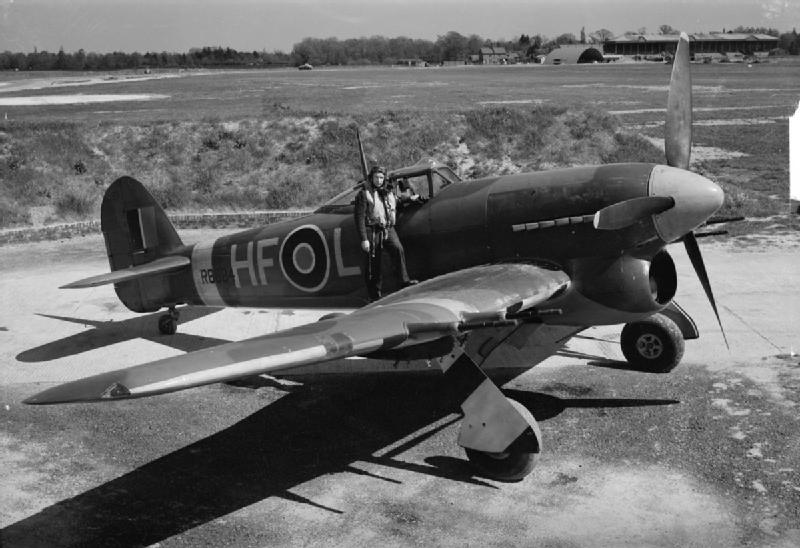
This was a wee walk along the old Paddy line from the viaduct over the Big Water of Fleet to the Little Water of Fleet. I had hoped to find the memorial to a crashed WW2 airplane , a Hawker Typhoon.
On the 18th March 1944 No.440 and No.439 Squadrons of the Royal Canadian Air Force were being moved from RAF Ayr to RAF Hurn, Bournemouth, via RAF Woodvale in Lancashire. Together the two Squadrons were flying a mixture of Typhoons and Hurricanes for offensive operations over France in the run up to the D-Day landings. While on the first leg of the flight to Woodvale P/O Mitchell in Typhoon JR439 lost control of the aircraft which dived into the ground close to the then active Dumfries to Stranraer railway line just to the west of the now demolished Little Water of Fleet viaduct and Loch Skerrow. It was however the following day before the wreck was found and confirmed to be that of the missing Typhoon. (from Peakdistrictaircrashes.co.uk)
Because the Viaduct is closed off, we walked up by the farmhouse at Cullendoch and then joined the old railway line, which is now a stony track. It seemed quite dull on the day but the photos look a lot brighter. There were a few drops of rain, enough to get jackets on and then off again, but that at least the rain brought some rainbows.
Big Water of Fleet
The search for the memorial was unsuccessful. We found a faint track parallel to the railway line and followed it to where I expected the memorial cairn to be, but despite rooting about it was nowhere to be found.
The faint track beside the railway
Rainbow
Posted inDumfries & Galloway|TaggedPaths|Comments Off on Rainbows but no Typhoons on the Paddy Line
I planned this as a walk up past the Striding Arch on Colt Hill and along to Lamgarroch but conditions meant we turned back at Colt Hill.
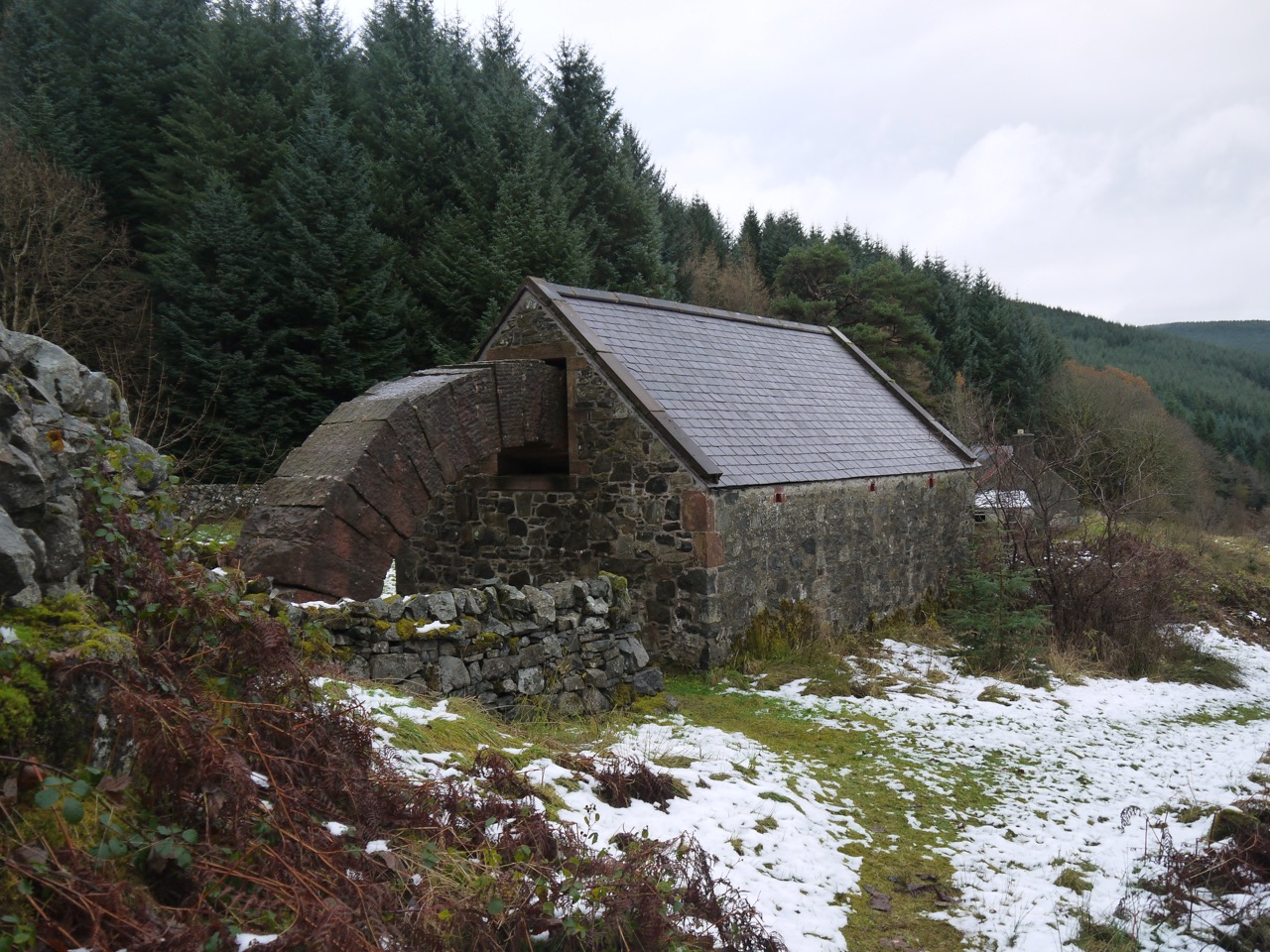
Byre Arch
The walk began at Cairnhead where the road up from Moniaive, which had already become a rutted track, officially becomes a “no unauthorised entry” forestry track, though the gate stood open. We walked up the short track to visit the Byre, with its sandstone arch passing through a space in the wall where one would expect a gate. What does one call such a gap?
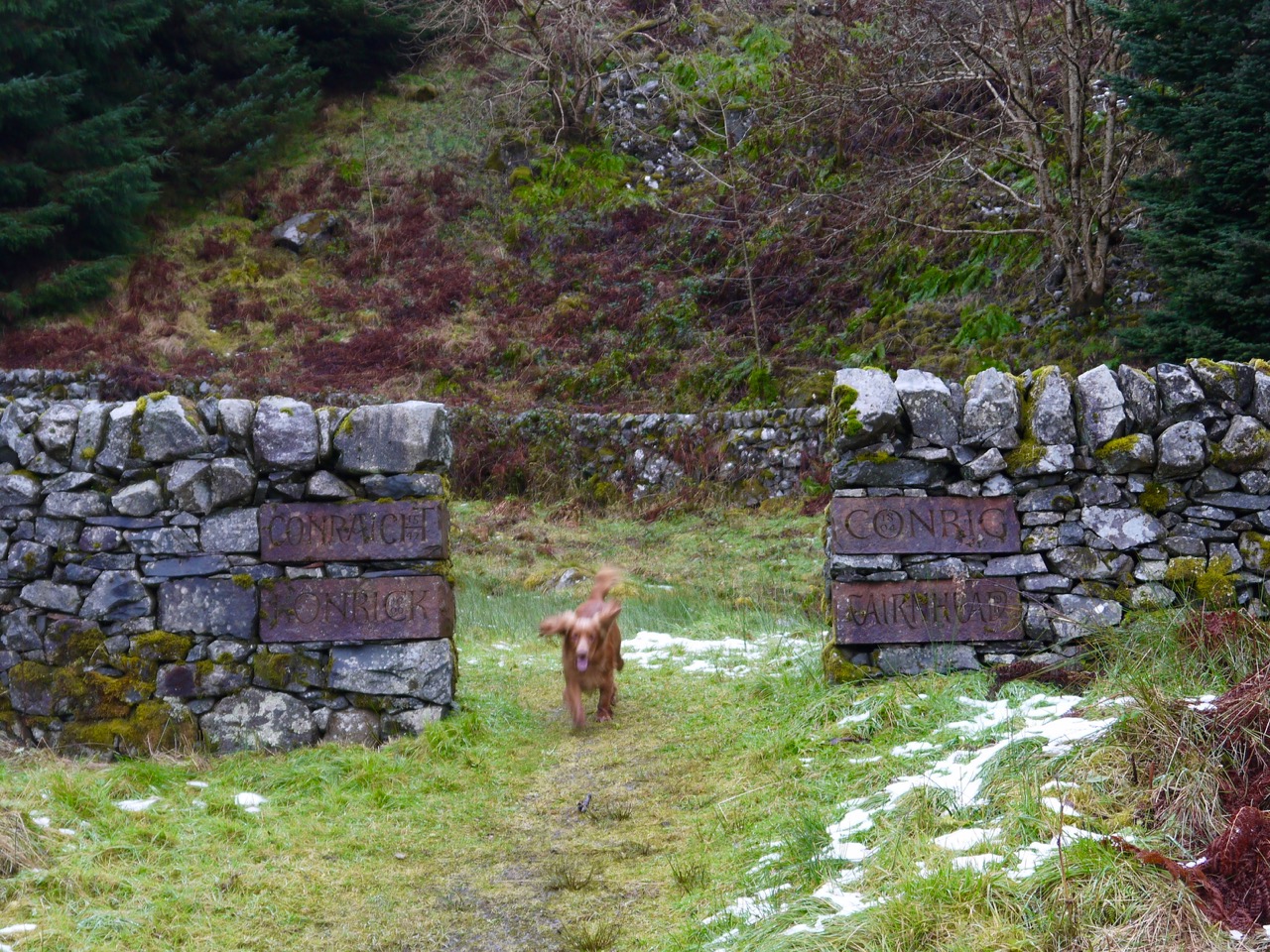
The wall has four sandstone blocks each inscribed with a name and date, presumably the names the place has previously been called: Conraicht 1547, Konrick 1600, Conrig 1804, and Cairnhead 1911.
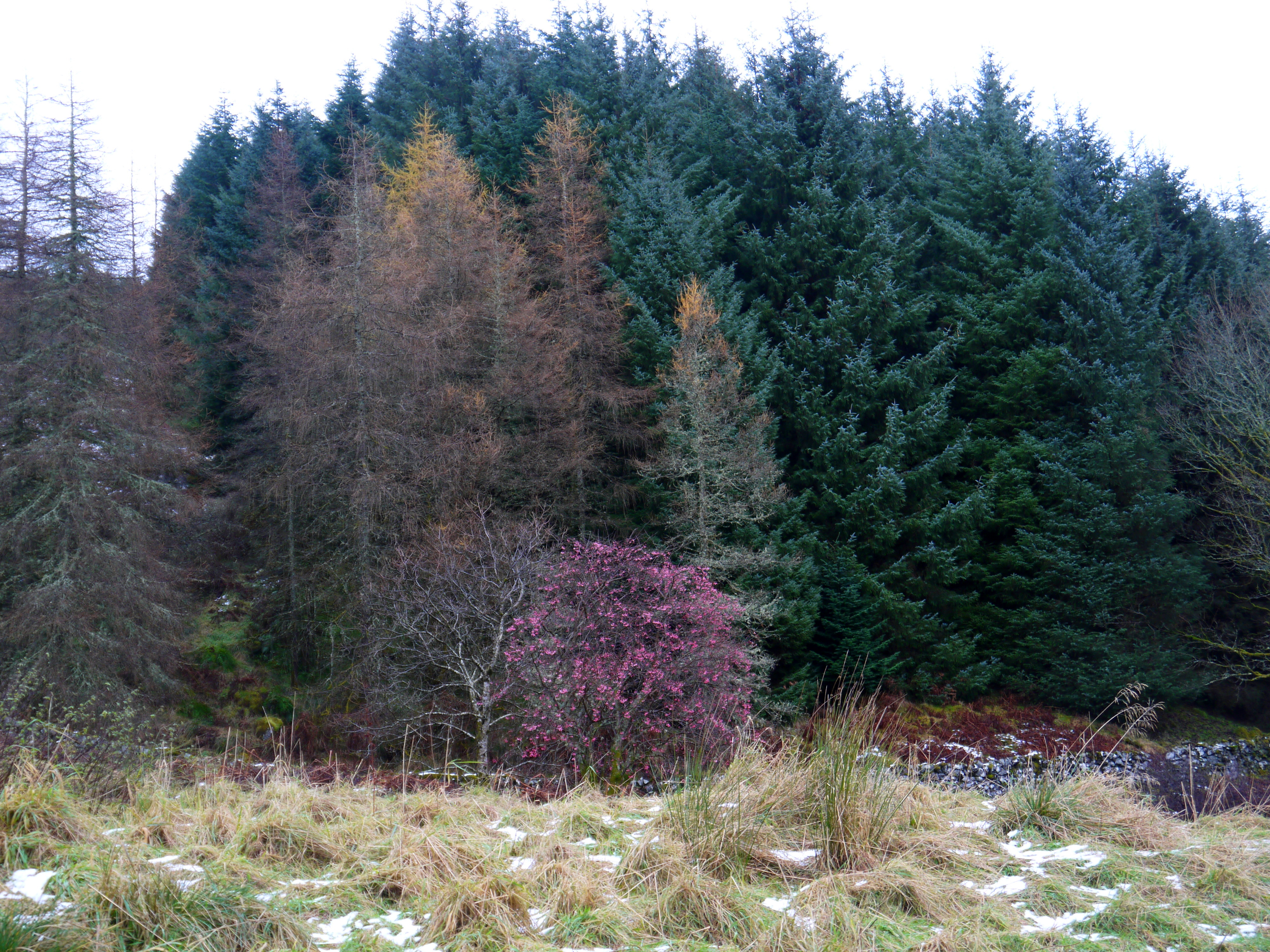
Trees at Cairnhead
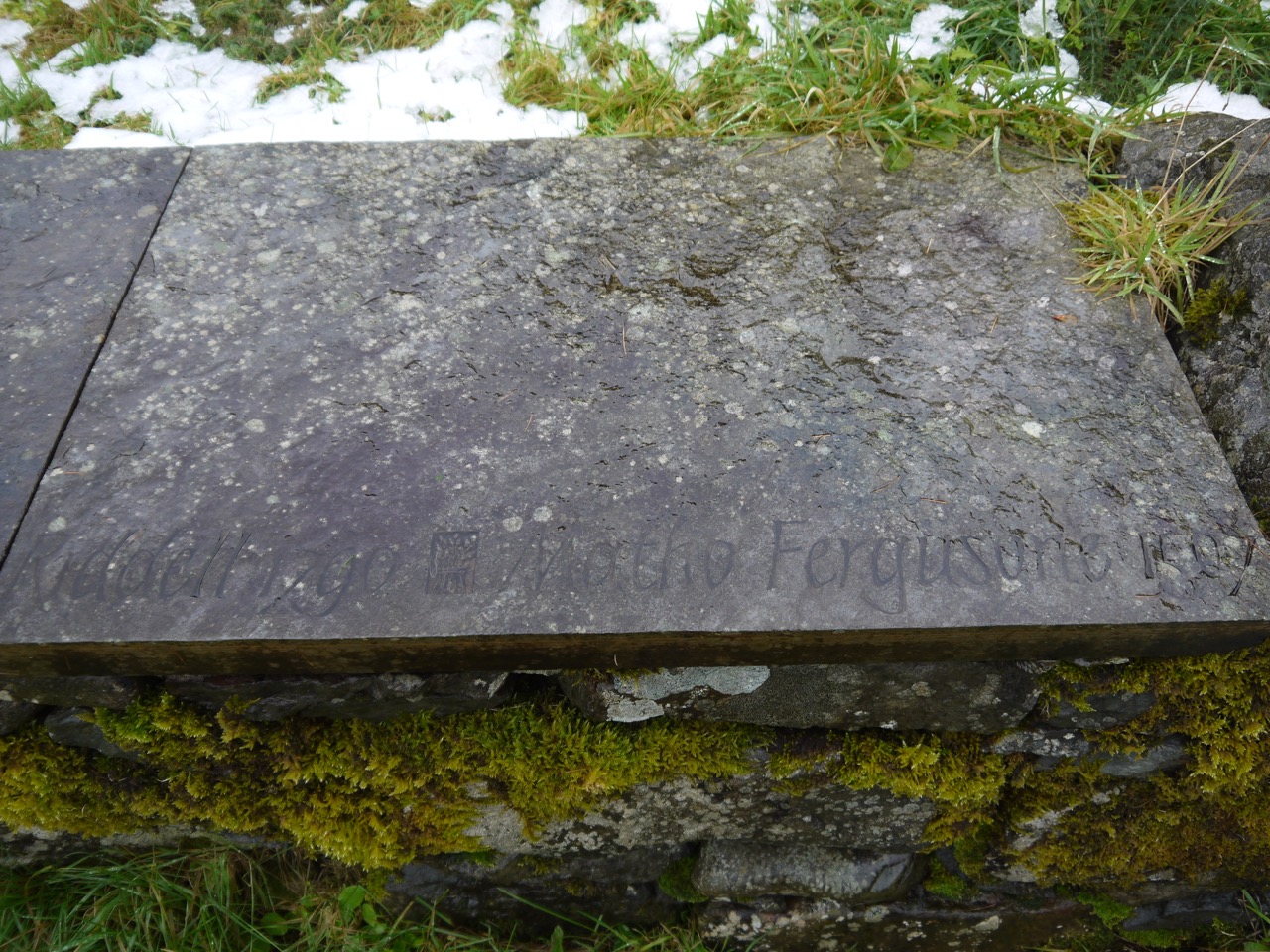
Within the confines of the ungated wall is a raised platform of paving stones, inscribed with eight names: Arthur Bell, shepherd 1891, Samuel McCall 1871, Elizabeth McVittie 1851, John Fergusson 1851, James Barber 1824, Archibald Wallace 1821, William Riddell 1790, Matho Fergusone 1507.
“Matho Fergusone in Conrig of his 2½ mark land thereof” is mentioned as settling of amounts to the Master of Glencairn in a Council document from 6th Dec 1560, so I presume these names are of previous tenants/owners. The 2½ marks he paid was a tiend, a land tax amounting to one tenth of the expected output of the land that was paid to the church. A group of tenants in this area had “contemptuously refused to obey” orders to pay their taxes forcing William Cunynghame, Master of Glencairn, factor for the Kirk of Glencairn to apply to the Scottish Parliament to obtain letters requiring payment of these Church tiends. The Privy Council in Edinburgh made the order for the defaulters to pay in 1560. Matho Ferguson had 5 marks to pay for 2 years of unpaid taxes.
I haven’t been able to find anything about the other people named.
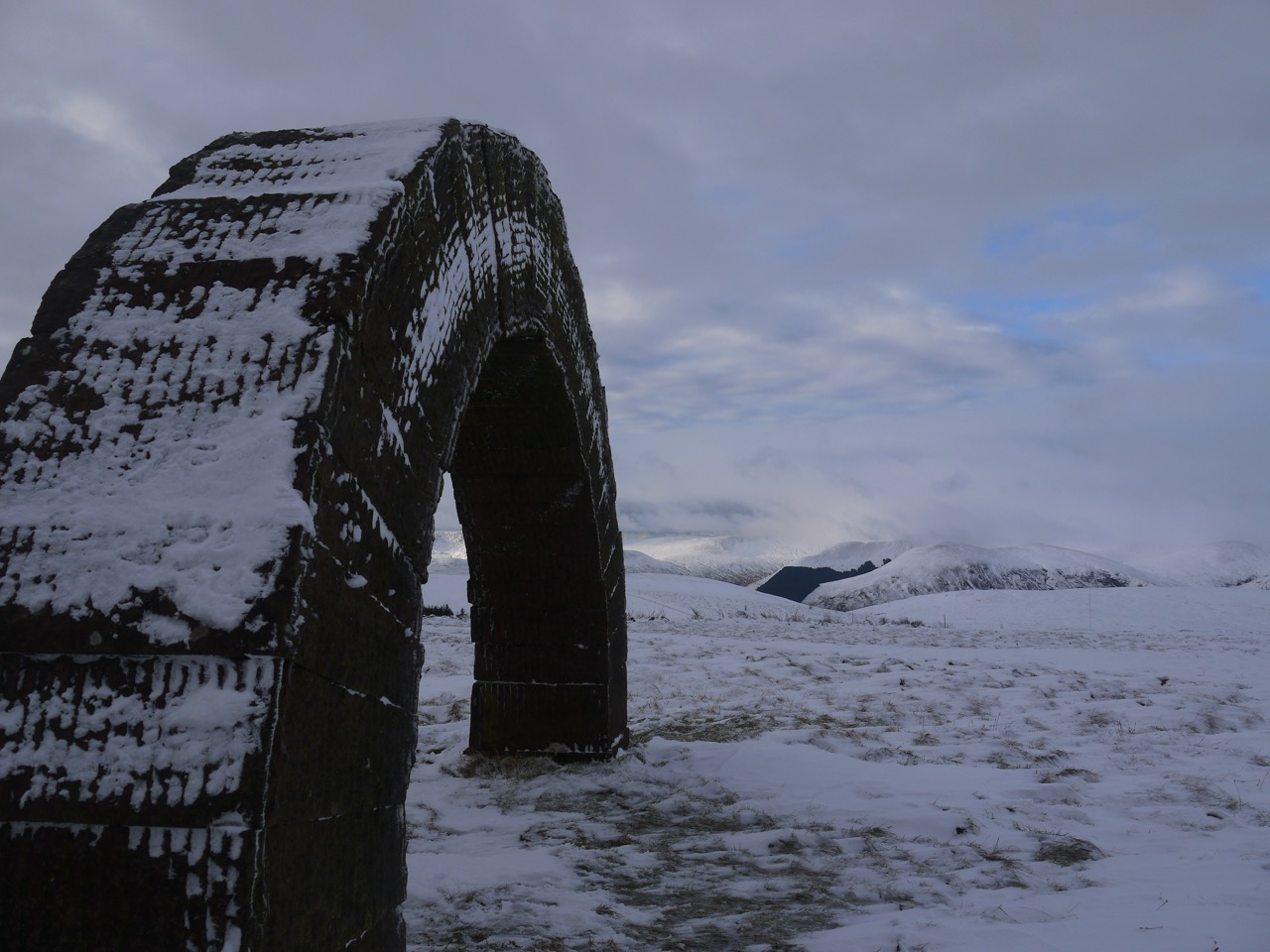
The Byre at Cairnhead has a sandstone arch passing through an upper window. This was the first of Andrew Goldsworthy’s Striding Arches and was built in 2006. Three others stand on the nearby hills, Benbrack, Bail Hill and Colt Hill, and I believe there are others in the USA and NZ. Each arch is a little “under four metres high, with a span of about seven metres, consisting of 31 blocks of hand-dressed red sandstone weighing approximately 27 tons”. So I doubt they will be stolen. The three hilltop arches can be seen from each other, but from the byre arch one can only see the that on Bail Hill.
Despite visiting this spot several times, I hadn’t previously been into the byre itself, only glimpsed the inside through the windows. I’m pretty sure the door has been locked before, but it was open today so we got to see the inner part of the arch. Having looked around at the carvings and sculptures, and confirmed that we could only see the arch on Bail Hill it was time for some walking.
I didn’t expect any sheep to be roaming about given the weather but there was one and I decided to take a short-cut with Eddie to avoid him noticing it. That meant a slightly steep, slippery descent directly from the Byre Arch to the forestry track rather than following the track itself around.
View up the Dalwhat Glen
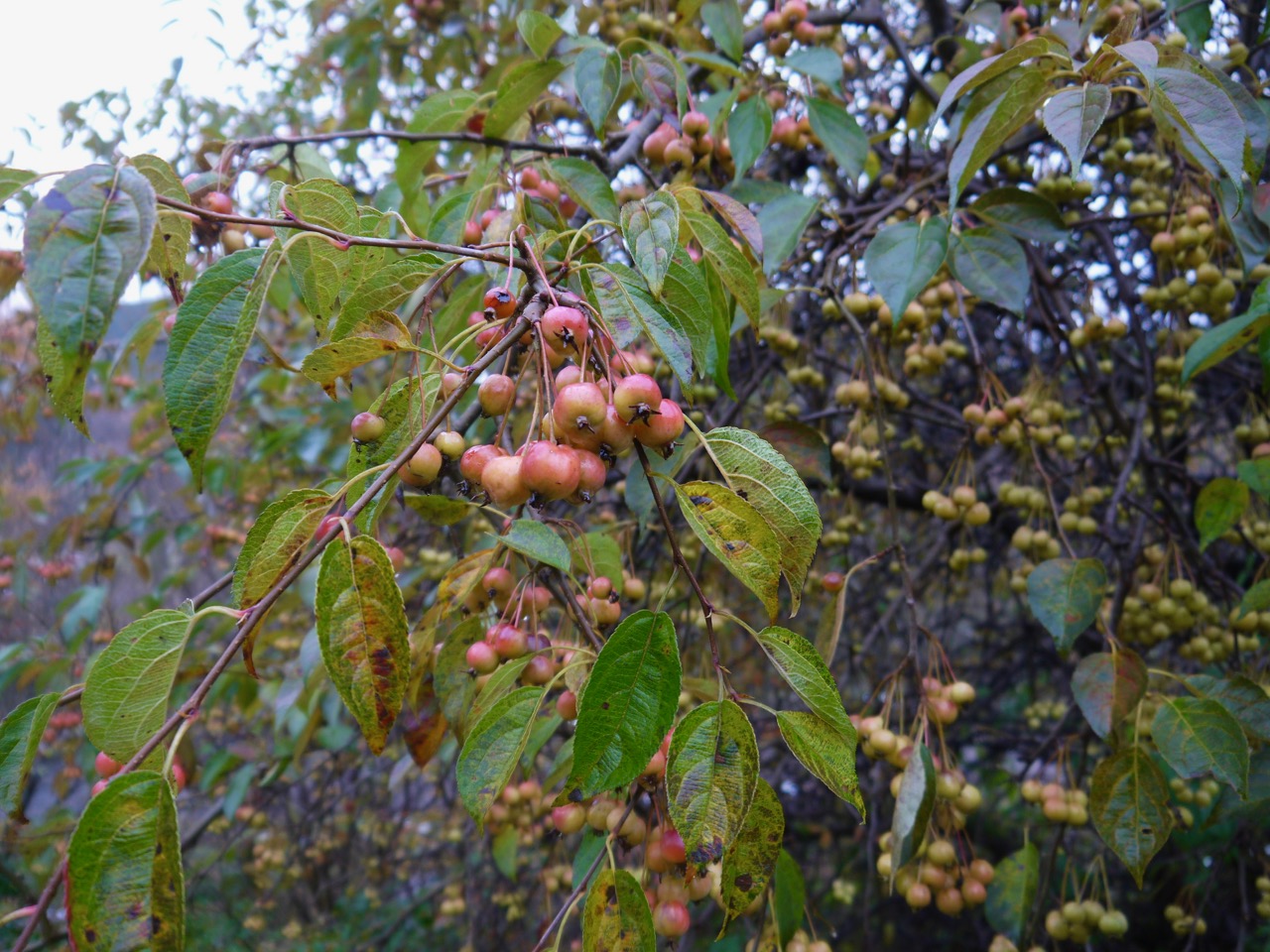
Once back on the muddy track we strode on up the glen. Autumn had turned down the saturation on the greens but some remnants of nature were still shining through. We passed trees laden with crabapples (both common and siberian), the former were intensely bitter and the latter tasteless, though both had the characteristic apple crunch when bitten. Indeed I heard that crunching sound from nearby and turned to see Eddie spitting out the remnants of an apple. Obviously too sharp for his taste.
Crabapples
Surfing the net for the etymology of crabapple I came across the following paragraph several times, and here it is reproduced again: “The crab apple is actually the wild apple, source of all domestic apples grown today. There are two thoughts about the origin of crab in this sense. The first notes that the Scottish form is scrab or scrabbe, seemingly from a Norse source, as there is Swedish skrabba “fruit of the wild apple tree”. This would suggest that crab and crabbe are aphetic forms of a much older word. The other possibility is that it derives from crabbed, which itself means, etymologically, “crooked or wayward gait of a crab” and the several figurative senses that follow from that (disagreeable, contrary, ill-tempered, or crooked). One of those senses might have been applied to the fruit of the crab apple: not right, not pleasant, ill-flavored (because crab apples are very sour and astringent).”
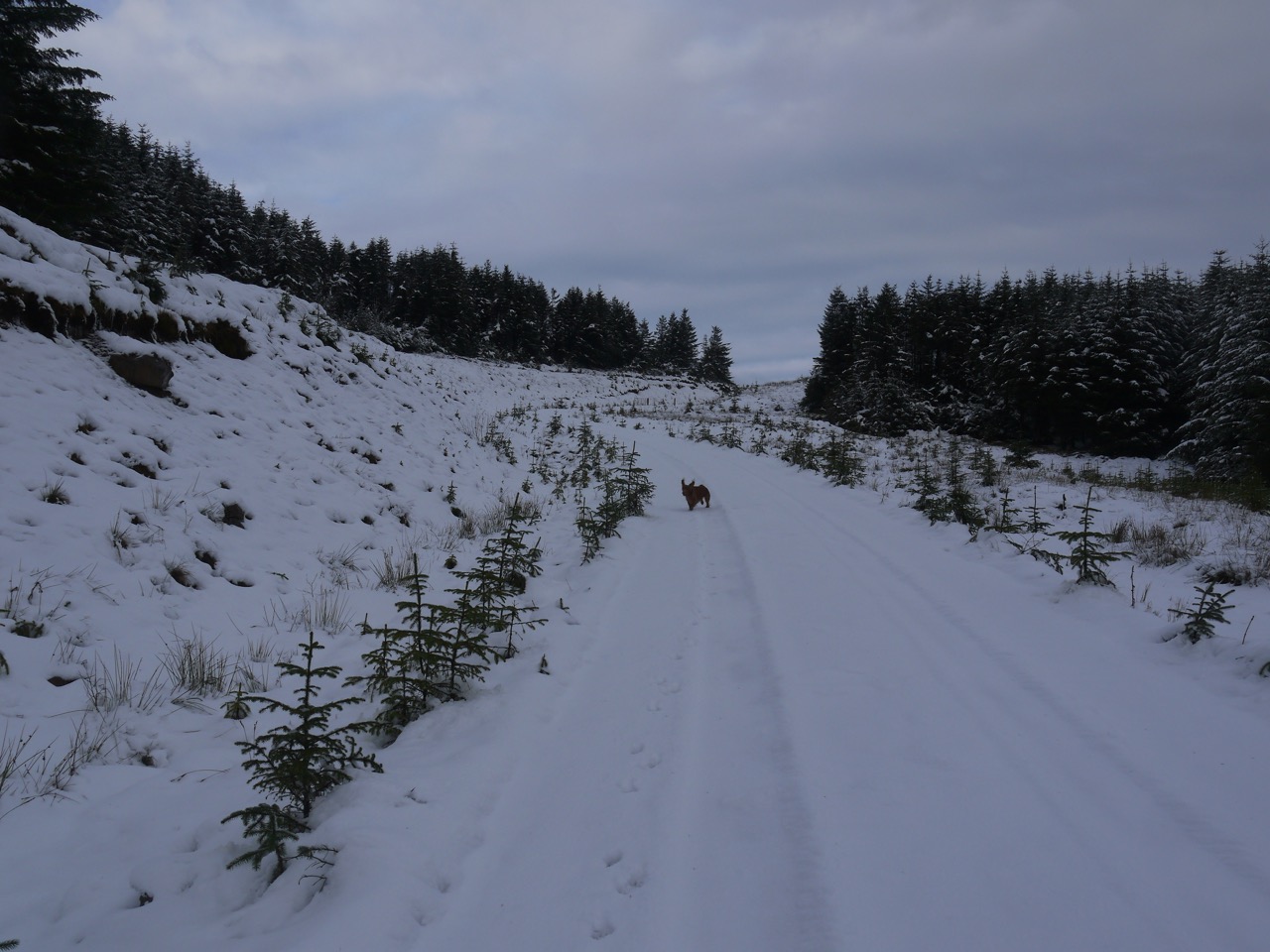
By the time we crossed the Dalwhat Burn the ground beneath our feet had changed from muddy to frozen, and as we walked on we found ourselves walking on frost and eventually snow deep enough to crunch beneath our feet.
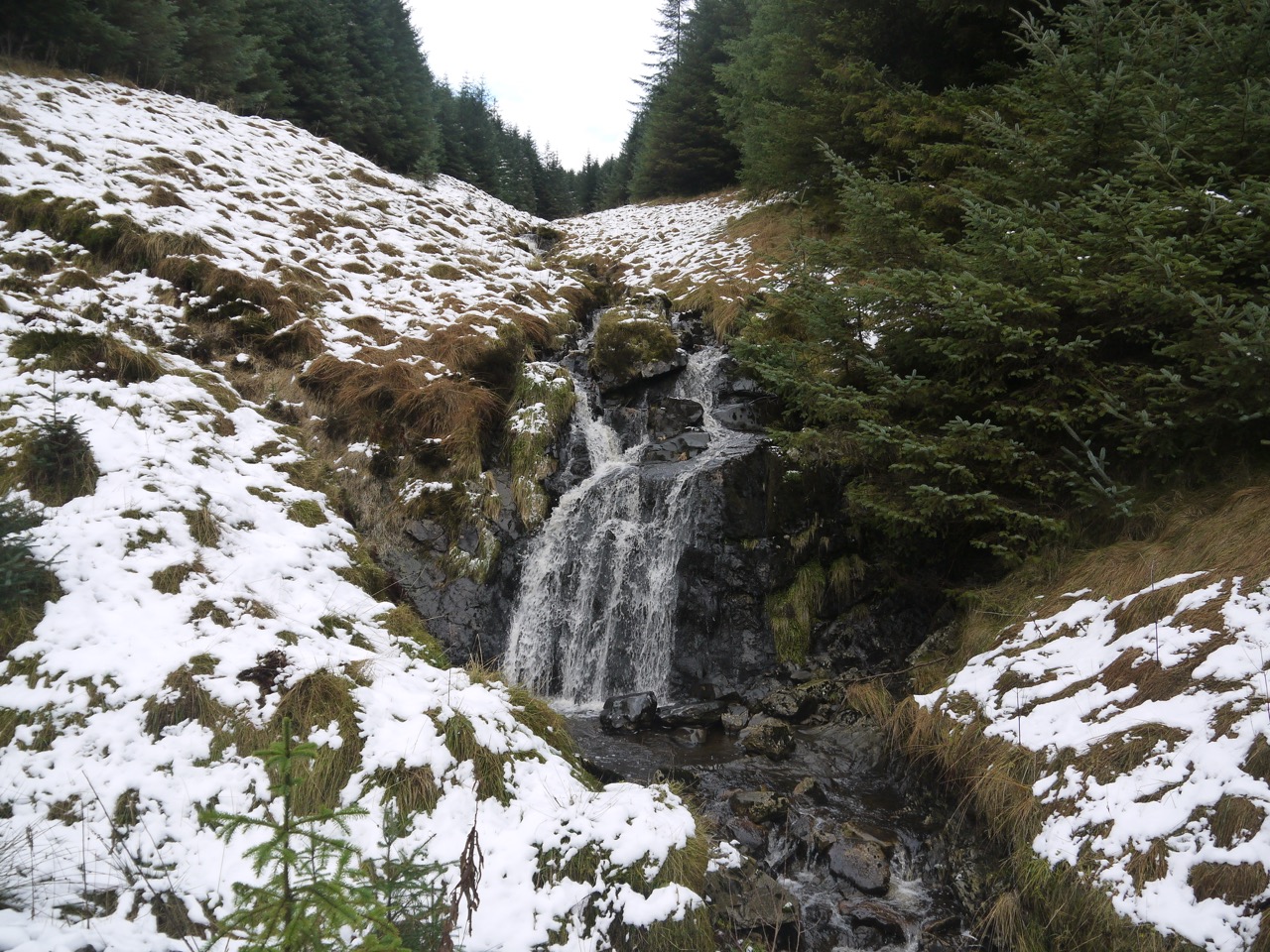
Waterfall on Dalwhat Burn
A bitingly cold wind blew directly in our faces as we walked along the forestry track, only letting up after we turned at the small waterfall and walked into the lee of Black Hill. The snow here was a little deeper but the going much easier now we were sheltered from the wind.
Approaching the col (that’s Eddie)
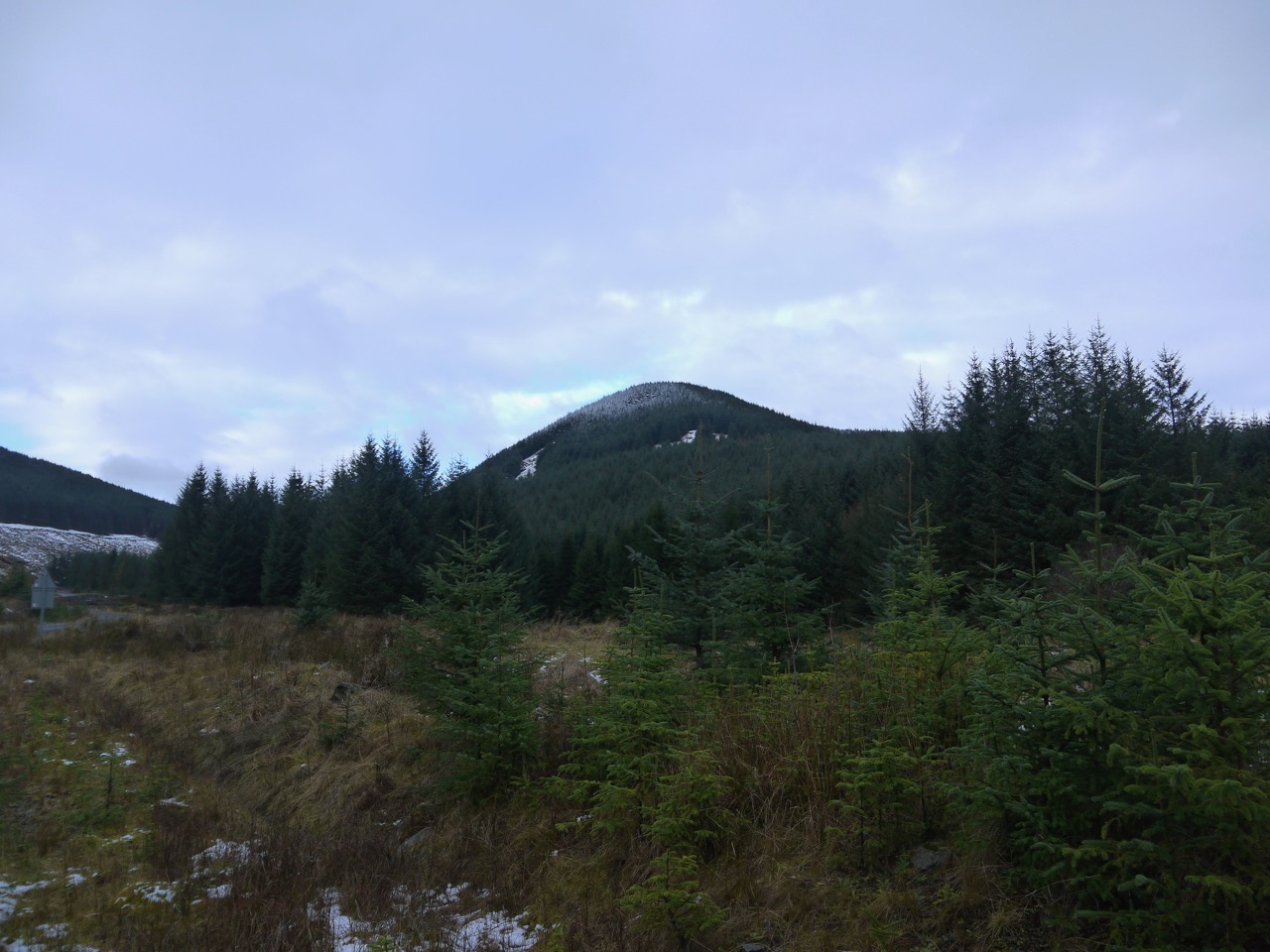
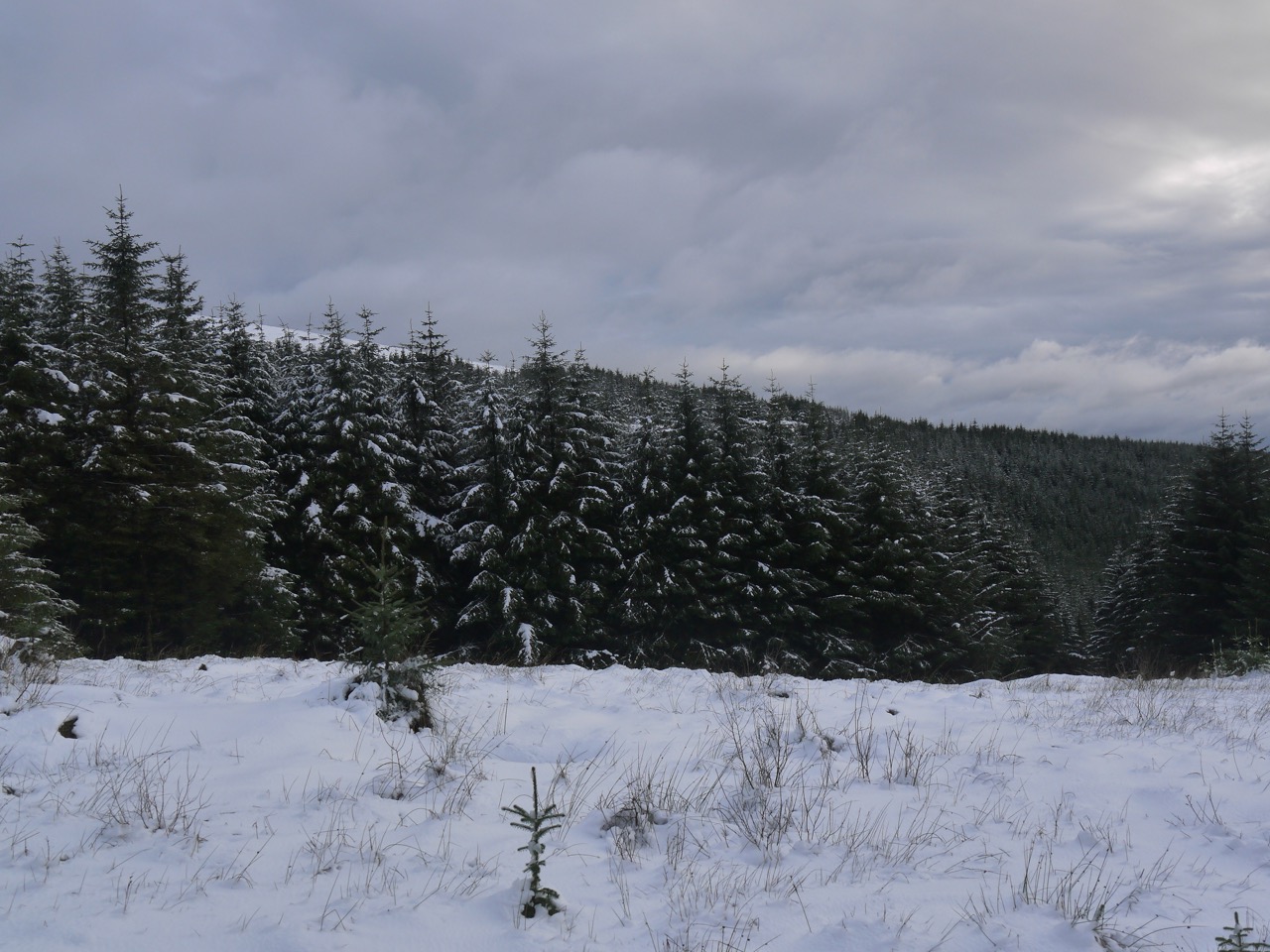
Once we reached the col between Black Hill and Colt Hill we were back in the wind and the temperature, or at least our temperatures dropped quickly. We turned up Colt hill which has been denuded of trees since I was last up here. That allowed us better views but unfortunately it left us directly in the wind throughout the climb.
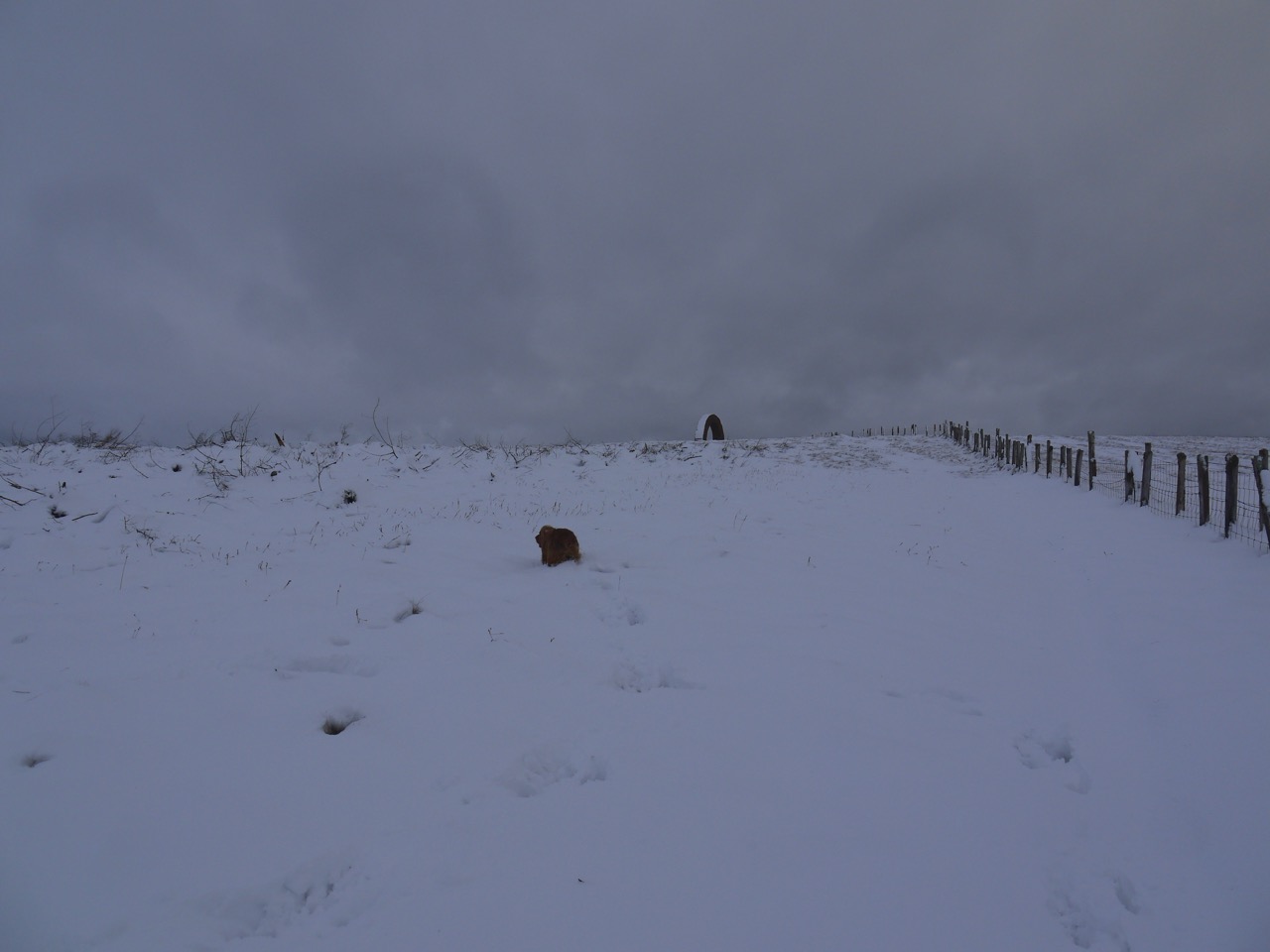
Colt Hill, Eddie in the foreground, the Arch in the distance
The snow here had either drifted or fallen more heavily. Either way we had to climb the last 100m through knee deep snow. It was a little deeper in places where small hollows were hidden by the snow and I saw Eddie disappear into a couple of these as he bounded up the hill. I had my share and judging be the occasional shriek from behind me, Audrey had not avoided all of them.
Colt Hill Arch
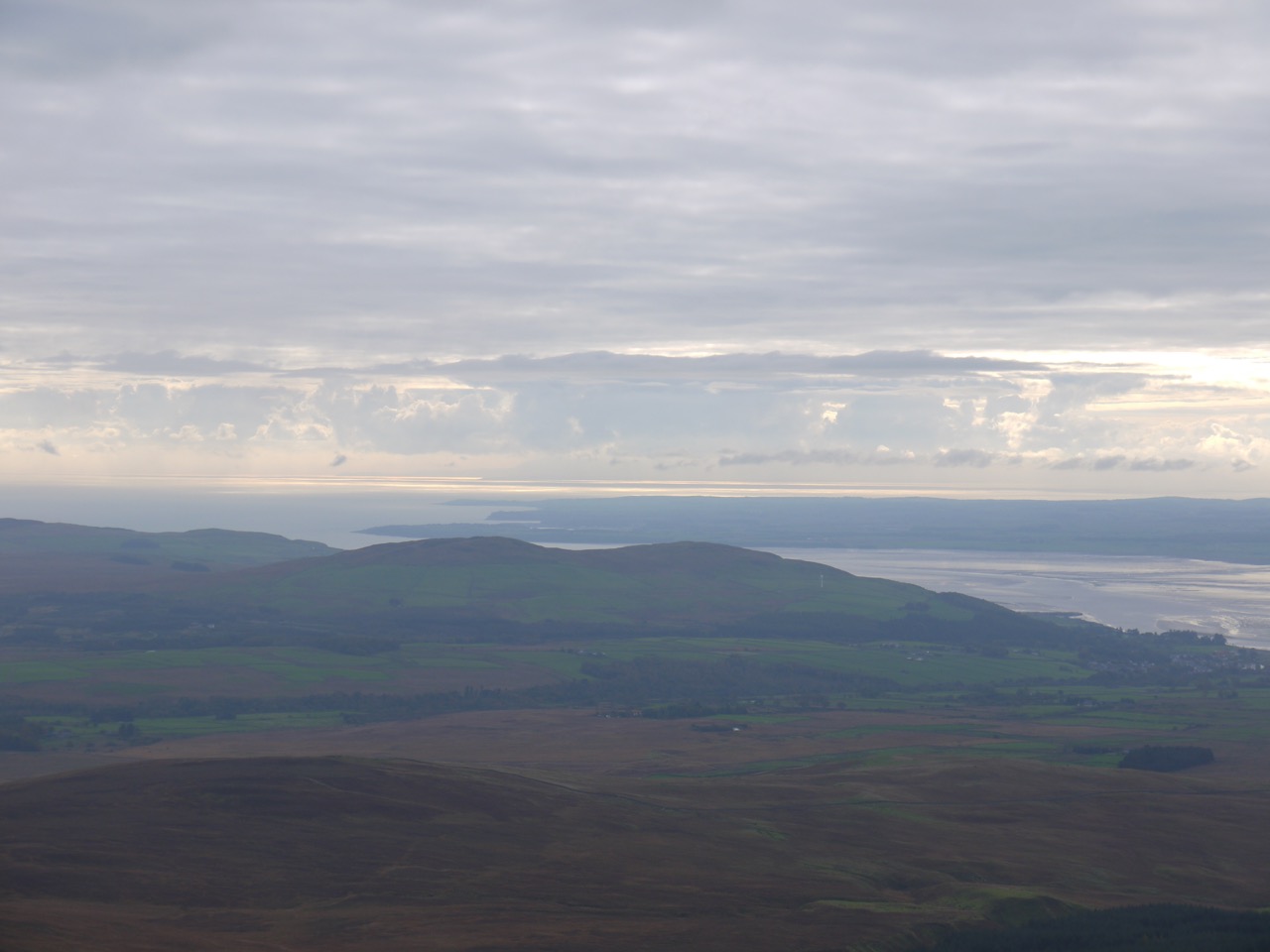
At the summit the snow was shallow except where it had drifted. The wind however was both stronger and colder, a classic north wind. The views were surprising good despite the relatively low cloud. We could see Dodd Hill, Moorbrock Hill and Benninner cloaked in snow but Cairnsmore of Carsphairn was lost in cloud.
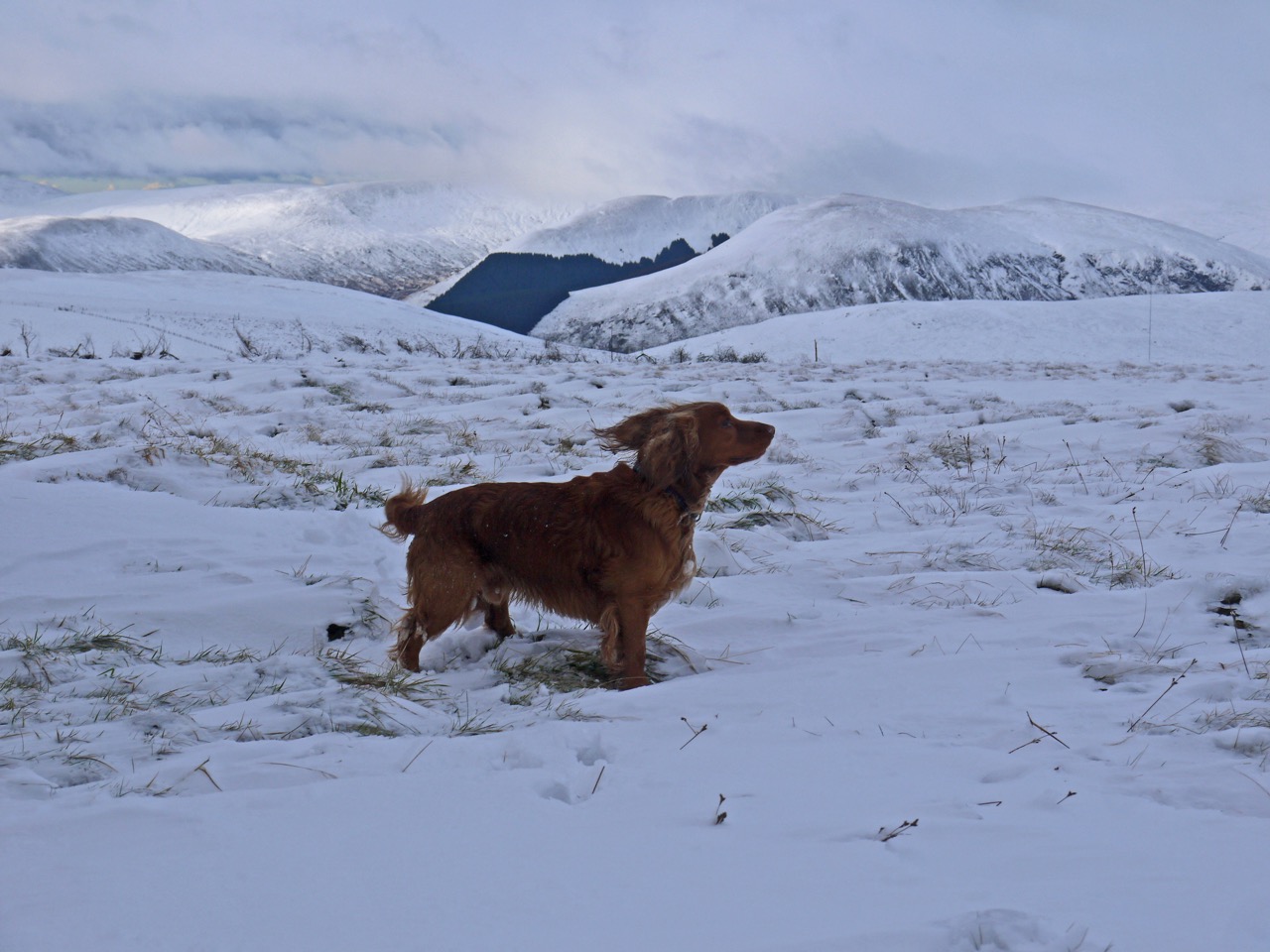
There was too much snow for us to continue on to Lamgarroch, and it was too cold to hang about at the summit so we headed back down. It was much colder on the descent, presumably since we needed to put in less effort. Poor Eddie was collecting balls of snow in his fur and wasn’t very happy about it, so we pressed on quickly to get out of the deeper snow and away from the north wind.
The walk back down was a lot easier and we warmed up once out of the wind and Eddie was soon back to his usual self exploring the trees beside the track. I had worried that we were in for a chilling once we were back out of the shelter of Black Hill, but it seemed to have relented a little for us.
Given the cold, we had our sandwiches once we got back to the car.
It is a few years since I climbed Cairnsmore from the SW, and I am pretty sure there was a car park back then. I recall a couple of old codgers, probably not much older than I am now, had parked their van next to my car and mocked me lightheartedly for walking so slowly. But there is now no place that two cars could park side by side. The parking is beside a small track, helpfully marked with a big “P”.
We set off in sunshine beneath a blue sky, though when driving along the A75 we had seen that the hill was crowned in cloud. There was a mild chill in the air but we were confident that the sun would soon burn off the cloud. Misplaced confidence as it turned out.
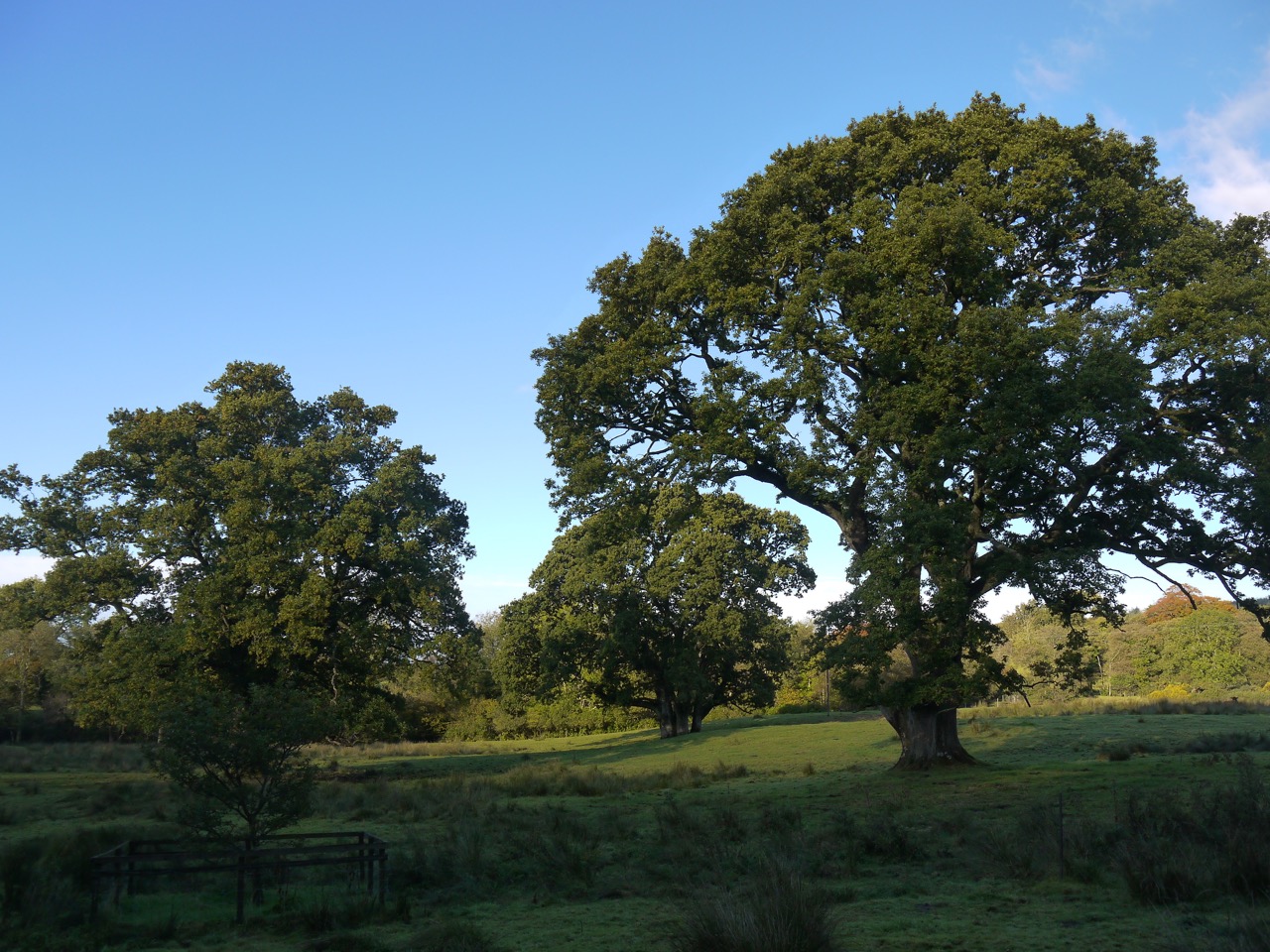
The first kilometre of our walk was along an estate road beside the Cairnsmore Burn. The rhododendrons still had a few flowers but the trees were definitely in autumn livery. The road turned right at an entrance to Cairnsmore House and a little after that a sign invited us to leave the road for a woodland path with more rhododendrons, a few pheasants and some big blue feeders. Eddie was on his lead here but found the undergrowth very interesting, and even more so the fluttering we could hear in the wood.
We were then back on a farm/estate track again, passing Cairnsmore Farm. I suspect my car park from years back had been around here. The outbuildings here looked disused but not dilapidated.
The track ended at a gate with a warning “Caution: cows with calves can be aggressive”. I wouldn’t argue with that. There were some calves but luckily they were at the far side of the field so we were able to walk across and escape back into woodland, passing first a metal gate and then a wooden one. The lower woodland here looks to have been felled and replanted, but we were soon back in mature forestry where Eddie could burn off energy running through the trees.
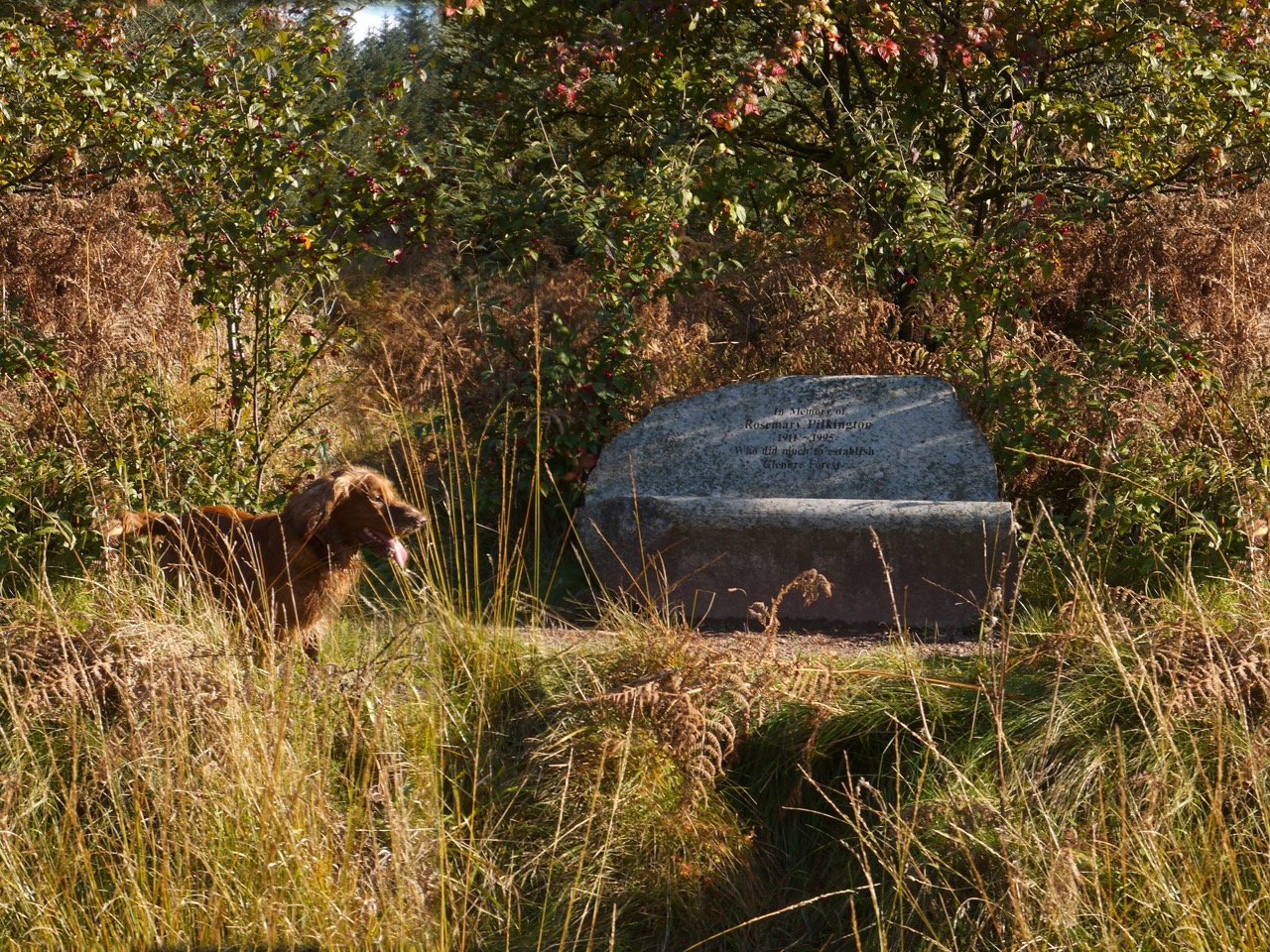
A grassy path climbed gently up a forest break, not especially steeply but enough to chase away the chill and warm me enough to put pack away my fleece. The path crossed a forestry track at about 200m and we found a stone seat dedicated to Rosemary Pilkington. A good place to get one’s breath back and have a drink.
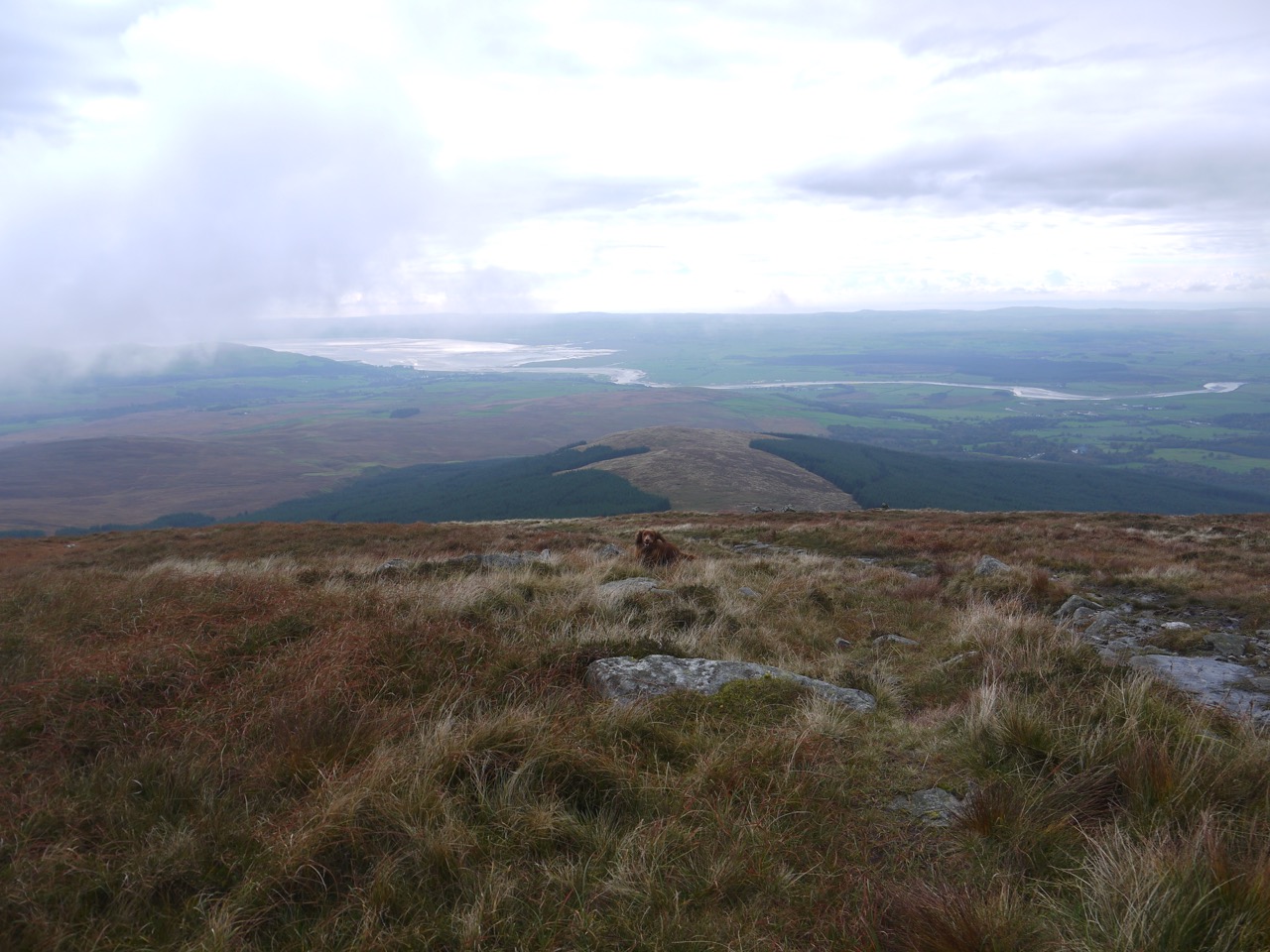
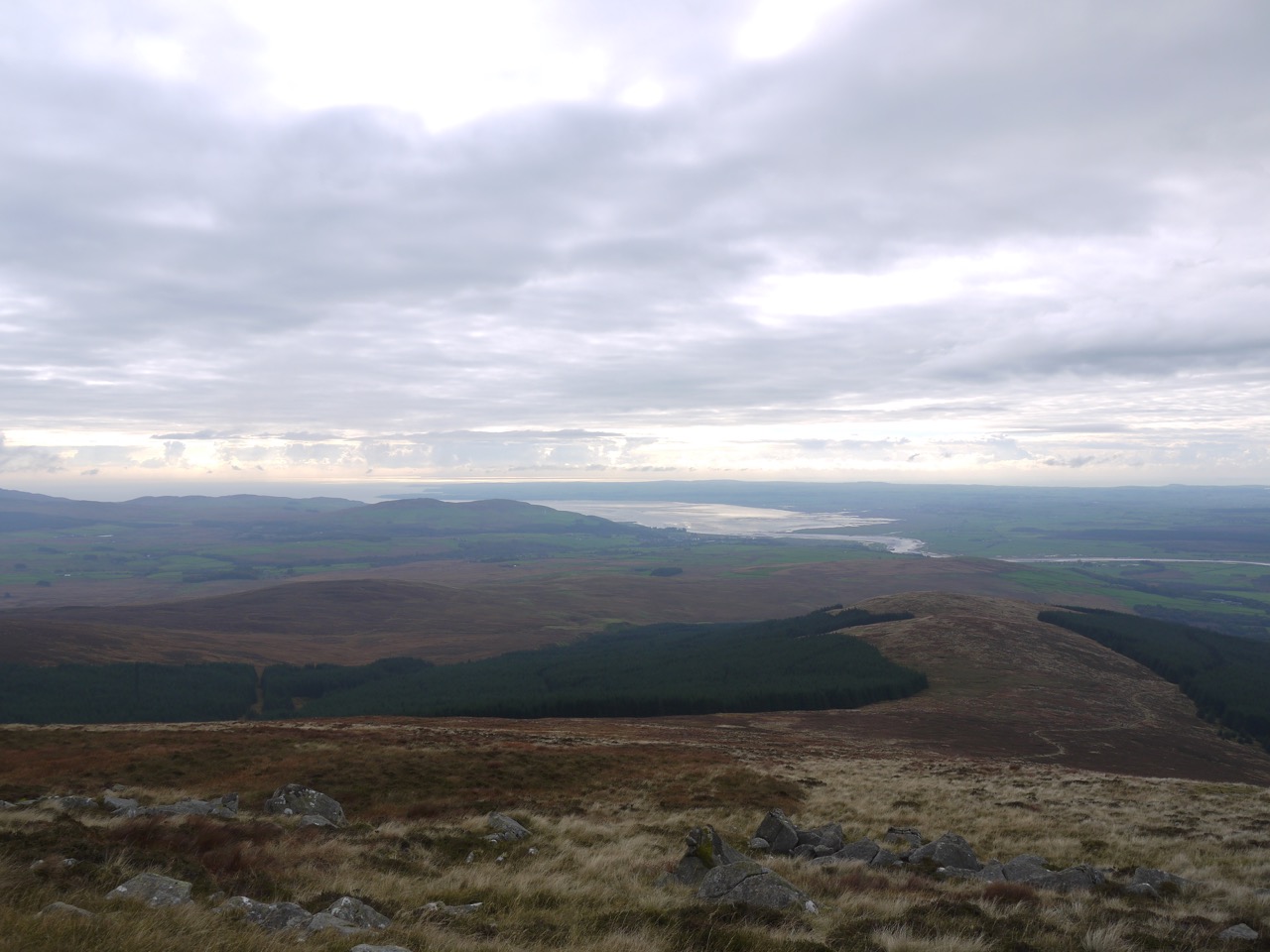
Looking back down the path we could see the plain stretching west and a conical hill standing proud. My book “Twenty walks in Dumfries and Galloway” says this is Craigeach Fell but I disagree. In my opinion it is Knock Fell, one of those twice named hills, cnoc (hill, gaelic), and fjall (hill, norse).
The stone seat bears the inscription: In Memory of Rosemary Pilkington 1911 – 1995, Who did much to establish Glenure Forest. I’m afraid my google-fu has failed me in finding out any more about Rosemary Pilkington.
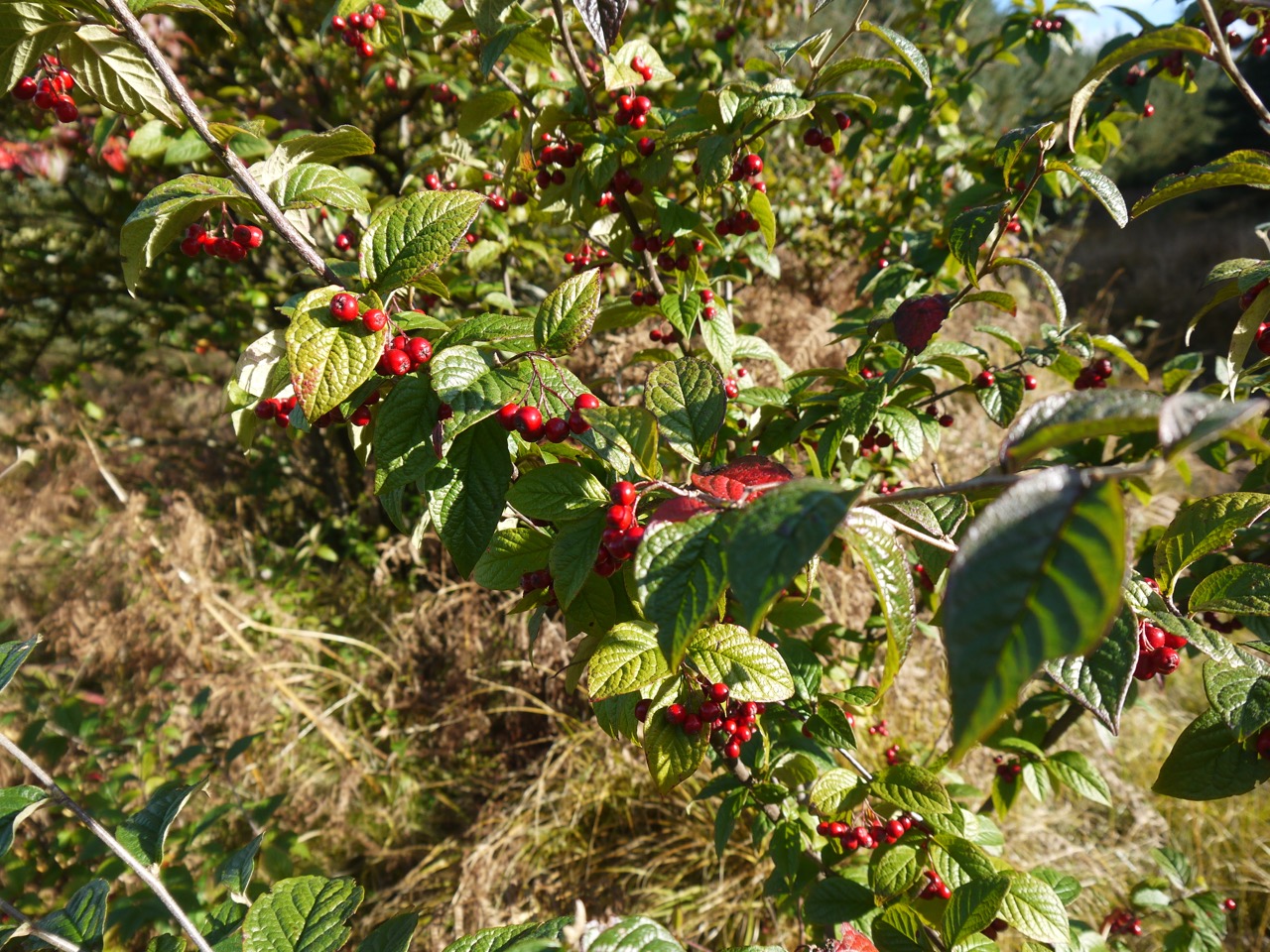
A small tree with red berries stands behind the seat, but neither of us could identify it at the time. Audrey has since found it to be Cornubia Cotoneaster. The berries didn’t taste particularly pleasant, having quite a dry texture.
The path steepened a little after this but after bearing left the climb became more gentle. We left the trees to cross the moorland of Crammery Hill with the path ahead of us zig-zagging up the hill. A fence, with a metal gate, crosses the path at about 400m and was a good place to pause for a slug of coffee before the steeper section ahead of us.
Eddie is not one for stopping and made his impatience known with whining and barking. The sun had by now hidden behind clouds so at least he didn’t have shadows to worry.
Cairnsmore of Fleet, Crammery Hill behind Eddie
On we trudged, climbing gently until the remains of a stone dyke and a little more steeply thereafter. As we walked, and gained height, wisps of mist began to blow by us and eventually formed more complete cloud. Photographs tend to make the view look clearer than reality and visibility had dropped significantly by the time we reached the summit plateau.
As we climbed, the cold east wind strengthened and the temperature dropped. I put my fleece back on and seriously considered adding hat and gloves. The path became less well defined but we were kept right by following a series of cairns. We heard a distant whooping at one point, which could have been human or avian, and soon enough three people walked out of the mist re-calibrating my distance assessments. I had seen an irregularity in the horizon where the path looked to pass through a deep dyke, but when the walkers appeared, looking like giants, it was obvious that the horizon was in fact very much closer. The deeper ground either side of the path was in fact just grass no more than a few inches tall.
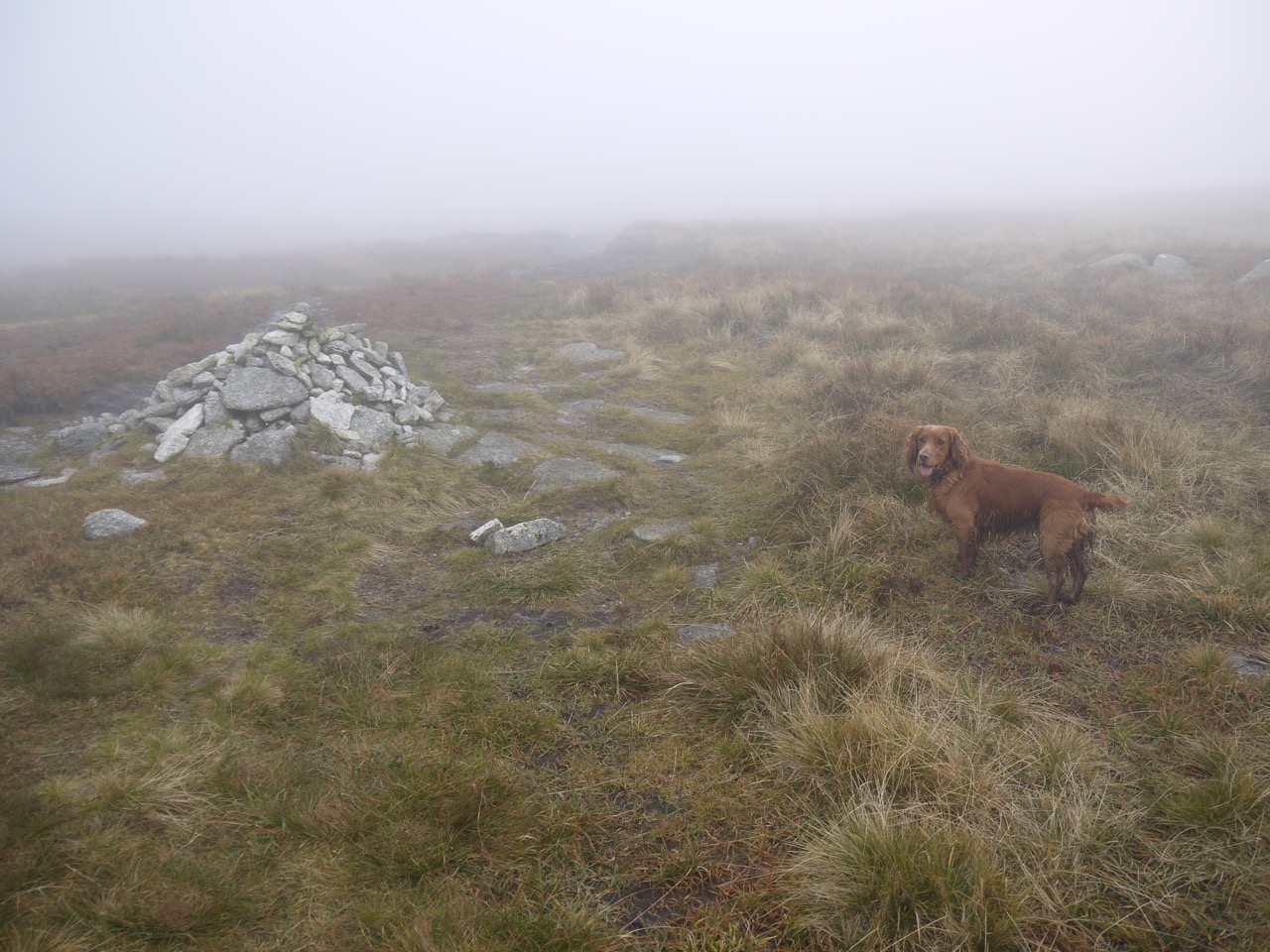
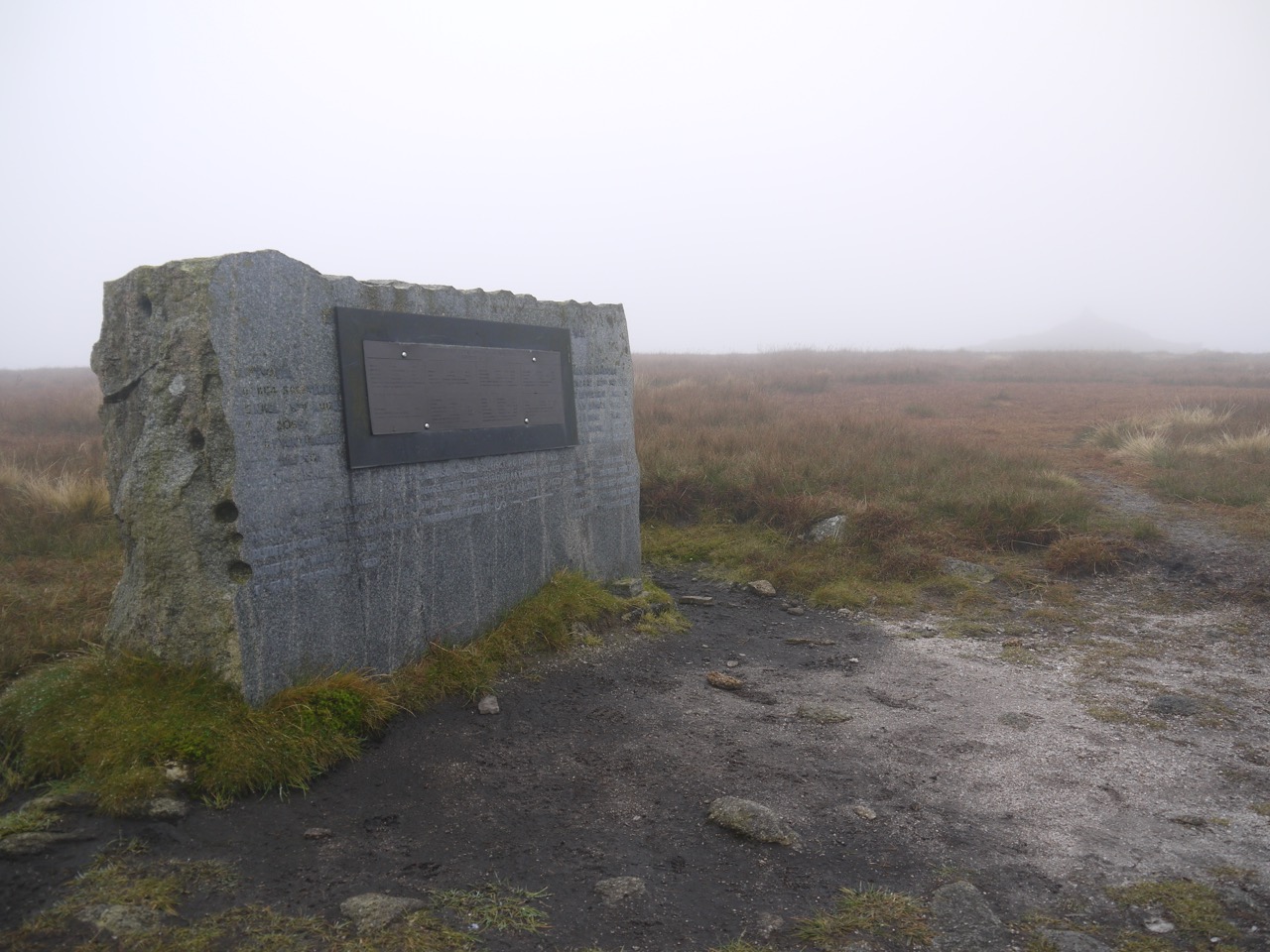
As we walked on we could make out an indistinct shadow which was the large cairn about 150m west of the true summit. I wasn’t sure at the time if it was the actual summit cairn and was considering leaving our cairn-led route when the Aircraft Monument came into view directly ahead.
Cairnsmore of Fleet Aircraft Monument, summit cairn in the distance
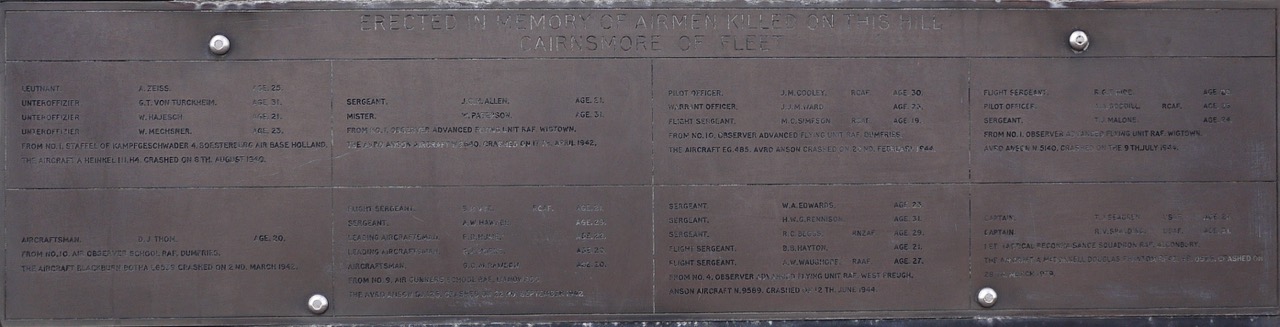
The monument gives details of the airmen who have been killed in eight crashes between 1940 and 1979 and is inscribed:
Memorial to Airmen killed on Cairnsmore
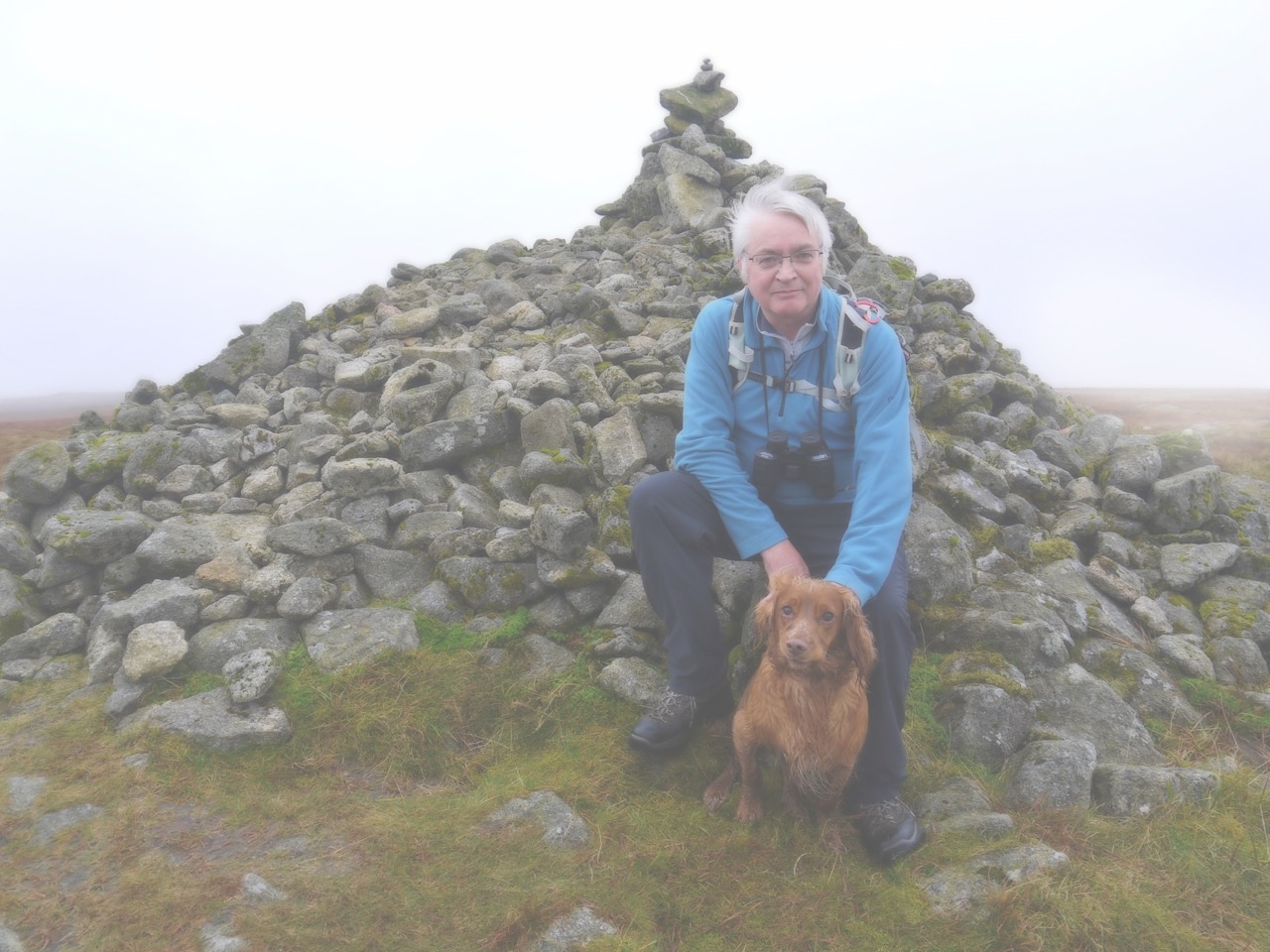
Once at the monument we could just make out the summit cairn which, because of the mist, looked much larger than it actually was. My plan had been to admire the views from the summit, but that wasn’t going to happen on a day like this. So we decided to hunker down for lunch in in the climber’s shelter near the trig pillar.
Cairnsmore of Fleet summit cairn
This didn’t work out as I might have hoped. I climbed into the shelter, chose a nice stone to sit on and hunkered down. As soon as I dropped below the level of the wall the wind lost some of its bite, but unfortunately it was still unpleasantly cold since it was blowing directly through the gap in the wall.
So we stood up in the wind and headed back the way we had come. We had expected the descent to be a bit tricky, with wet stones on the steep path, but it was easier than expected. Eddie did fall over once, but I stayed upright on the descent (having fallen over after stepping in a hidden hole on the ascent).
Having been robbed of our views at the top we had to make the most of the scenery on the descent. We could see Largs Hill, Lamachan Hill, Curleywee, the Isle of Man, Wigton Bay, and the River Cree. There were quite a few folk on their ascent as we headed down, including a couple pushing mountain bikes up the hill.
We kept an eye out for a place to have our sandwiches but didn’t find anywhere sheltered enough with adequate seating and decided we would use the stone seat once we reached that.
Unfortunately that seat was taken, and despite scowling at the couple who were occupying it they stayed put. The sandwiches had to wait until we were back at the car.
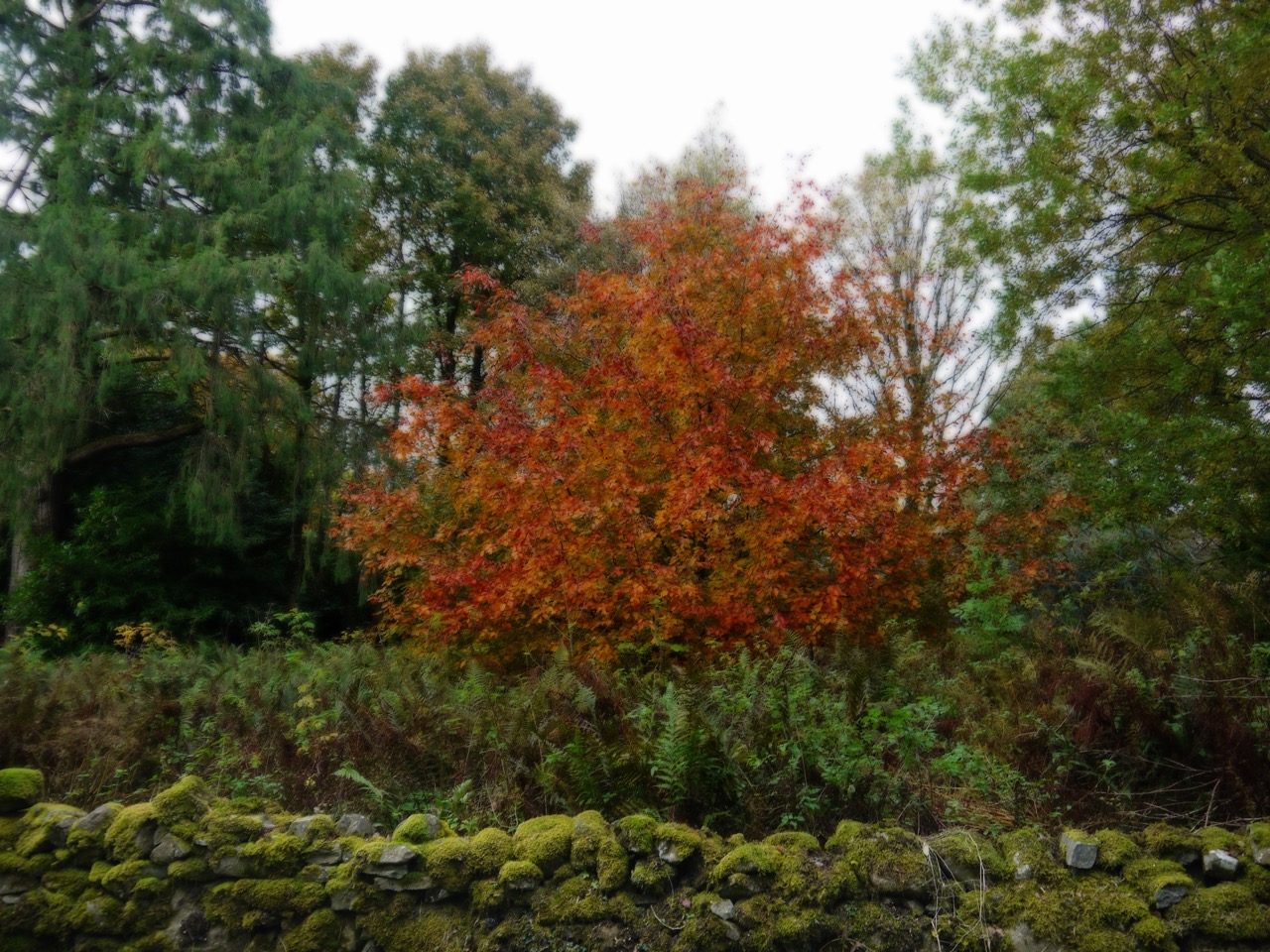
Autumn beech at Cairnsmore estate
Though autumn was well underway there were a few hardy flowers hanging on: buttercups, tormentil, scabious, creeping thistle, prickly sow thistle, and red campion.