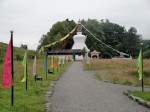
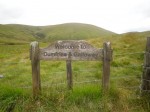
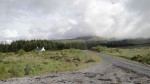
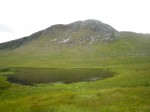
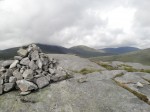
A straightforward walk. I parked at the Barstobrick visitor centre where I had hoped to get some information on routes for walking. Various signs suggested that maps for walks would be available but I could not find any.
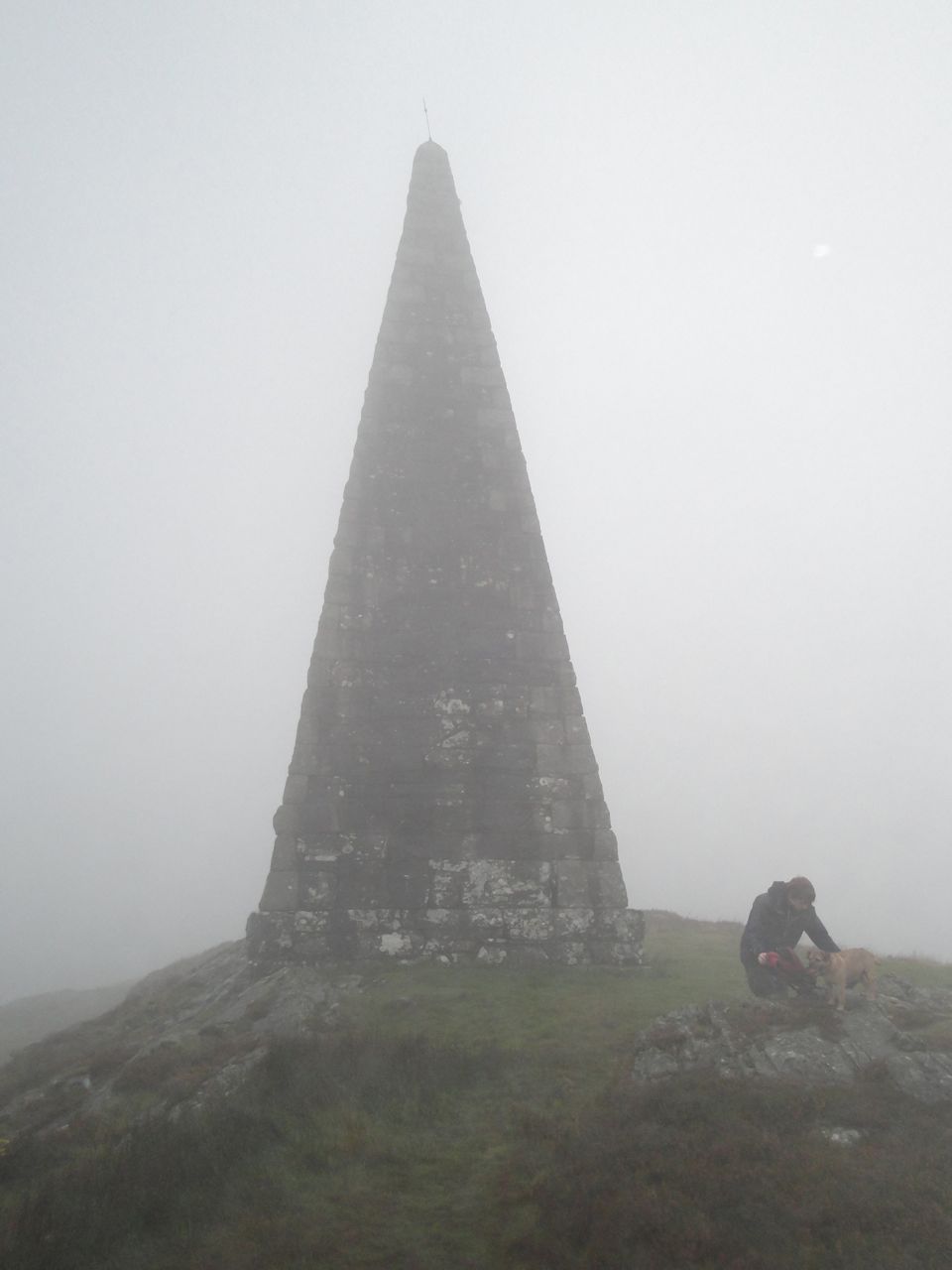
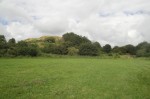
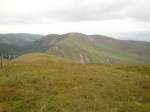
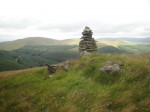
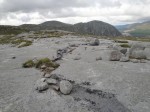
As you can see from the picture, we were not blessed with good weather. Barstobrick hill is usually visible from the A75, but not today. It was visible from where I parked though.
We followed a meandering path along some ponds that would I am sure be pretty in better weather and then struck off on a faint, but clear path heading up towards the obelisk. This proved to be an easy climb and looks to be well trodden. Unfortunately there were no panoramic views today.
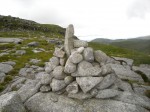
The 10.6m monument atop Barstobrick Hill commemorates James Neilson (1792-1865) who invented the hot blast process for iron smelting, apparently improving efficiency significantly. It is set on the site of an ancient fort, the Giant’s Dike, but it was difficult to see anything of the fort.
The Neilson Monument is inscribed on one side
NEILSON
HOT BLAST
1828
and on the other side
MDCCCLXXXIII
W M N
FECIT
My schoolboy Latin had Fecit as “he did” which I presumed meant “built”, but for some reason part of my brain kept recalling Father Jack of Craggy Island.
There was a much fainter track, really just slightly flattened undergrowth, heading NNE from the monument and it seemed more interesting than simply retracing our steps. As you can guess it soon deteriorated and had us snagging clothes on brambles, wading through sodden undergrowth and slipping on grass and mud. Not for long though.
Once off the hill we made our way through ankle deep farm slurry before reaching terra firma. From the bottom of the hill I could see a path down its eastern side, which would be an easier route down if there is a next time.
I managed to coax Sweep into a pond in the hope that it would remove at least some of the mud/cows**t that he had been jumping through but both he and Leo still needed hosing down on arrival home.
In better weather I think it would be reasonable to extend this walk to include the Towers of Kirkconnell.
Craigencallie, Loch Dee, White Laggan and the Glentrool Giant Axe Head
I have both driven and walked the road from Clatteringshaws past Craigencallie, but have never actually spotted Craigencallie House, where I planned to park. It was the same today. I must have driven past it again and therefore cheated a bit by driving almost a mile past Craigencallie and parking when I found a wide enough section of road.
The Southern Upland Way was to be my route but I spotted only one SUW sign and that was at the beginning where a locked gate prevents cars heading up towards Loch Dee. Within 5 minutes of setting off, the heavens opened so I packed the electronics away and deployed waterproofs. For some reason this seemed to set off Sweep barking, and he really put effort, and endurance, into it. Needless to say, the downpour was short-lived but I thought taking off the waterproofs would be tempting fate. They helped when the buffeting wind arrived.
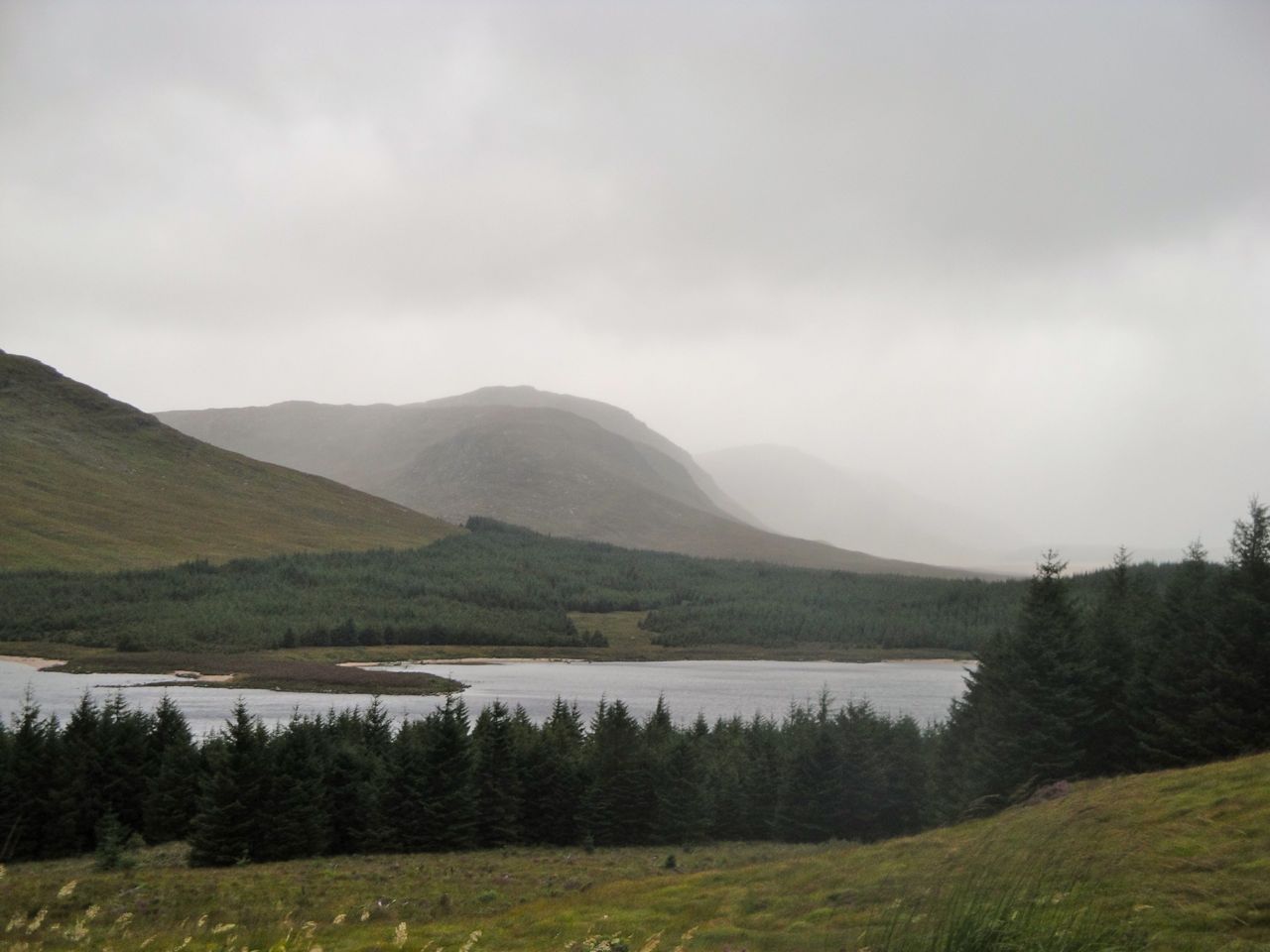
This walk is relatively flat and the first half mile or so has trees either side of the road but after that the view opens up, or would do if it was less misty. Black Water of Dee can be seen winding across flat ground that I presume will be marshland. The Dungeon Hills, Craignaw and Dungeon Hill itself, occasionally appeared from the mist, while Craiglee was always visible. Ahead of us were Curleywee and Lamachan with Mulldonach peeping through the mist at times. I had hoped that the Silver Floe would be visible but it is hidden behind Ellergower Knowe.
Loch Dee with its peninsulae comes into sight as the track rises and is an accompaniment throughout the walk. Malcolm Harper in Rambles in Galloway (1892) wrote:
Loch Dee is a lonely mountain lake, in a treeless waste, about five miles north-east of Loch Trool, and is only approachable by the pedestrian, or by very rough bridle roads. Heath and moss, rocks and stones without end, and jagged hills, with here and there bright verdant patches on their rugged sides, form the chief features of the landscape.
Agriculture is nowhere to be seen, and the traveller might in a day’s walk not alight on a human habitation. The whole region being one vast sheep farm, only here and there a solitary shepherd’s sheiling is to be found in low sheltered places. The district is not opened up by roads, and its interesting character is but little known — its solitudes being seldom trodden save by the shepherd, the sportsman, and the student of nature.
Nothing can be greater than the contrast betwixt Loch Trool and Loch Dee. The former, surrounded by sylvan woods and bright verdure, merits the appellation of the southern Trossachs, while the latter, in the vicinity of Buchan’s gloomy dungeon, is a “Ruder and more savage scene, Like that which frowns round dark Loch Skene. “
Dungeon Hills in Mist
A liitle past a track heading south is an anglers’ lodge with a sign reminding anglers that there is a two two fish limit, and that water bailiffs patrol the area. I didn’t see any, but perhaps they keep a low profile. “Lodge” might give the wrong impression about this building, it actually looks more like a large garden shed. Nearby and facing the Loch is a wooden bench dedicated to Dr Robert Donnan Borthwick. The bench is well placed for views, though today the Rhinns of Kells were lost in mist and the Dungeon hills were only just visible. I’ll have to come back when the sun is shining.
Cycleway sign at Loch Dee
The path turns away from the Loch to a bridge over the White Laggan Burn, and the White Laggan bothy can be seen sitting up on the lower slopes of Curleywee. The bothy had a saltire on its wall. Black Laggan was less easily spotted since it is a ruin about 100m off the path. I think in better weather I would walk up to have a closer look at each of these. A laggan is a hollow and this hollow lies between Curleywee (the hill of the wind) and Millfore (the cold hill). Why there is a Black and White Laggan, I don’t know.
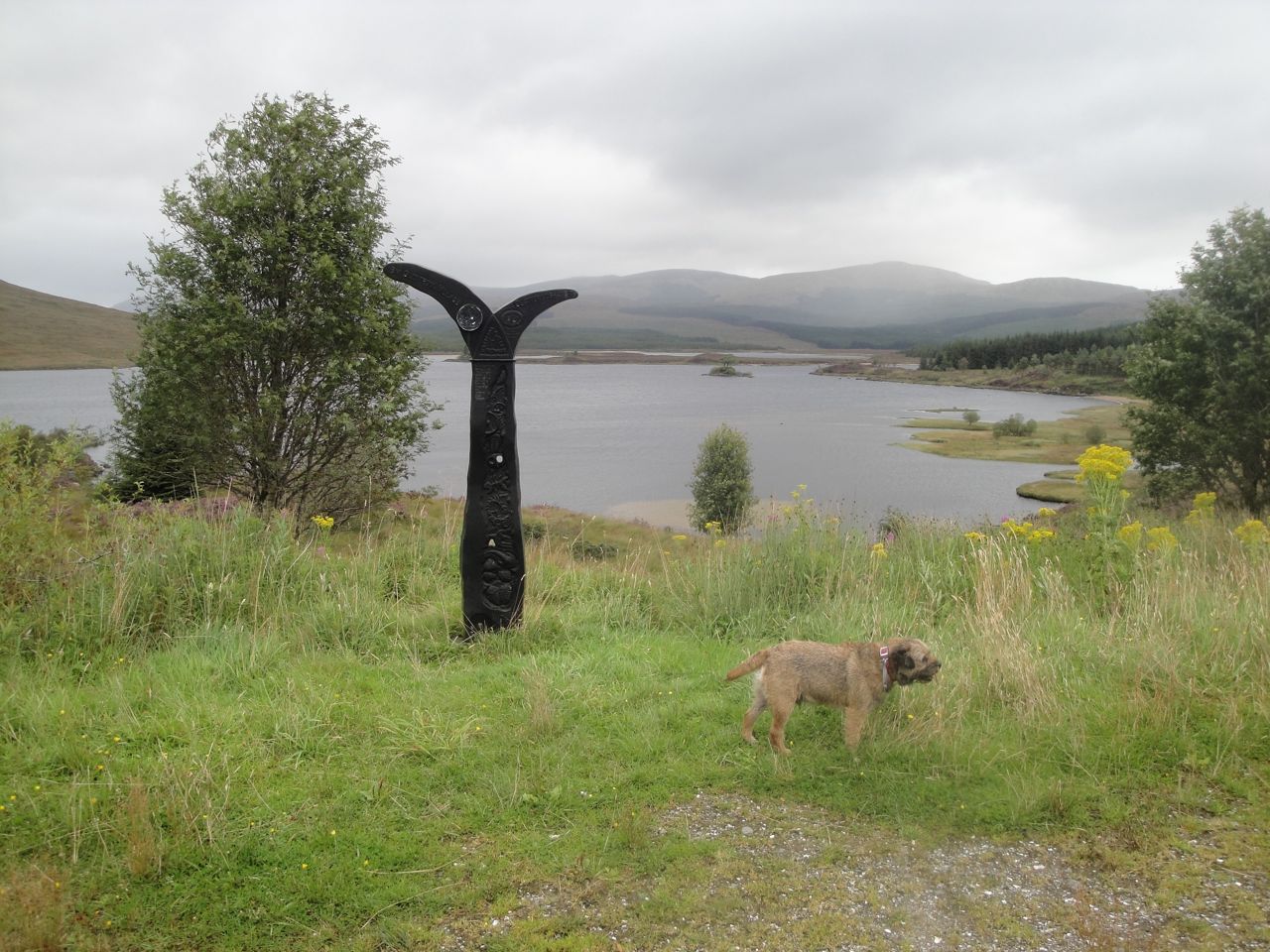
Overlooking Loch Dee near its western end is one of the national cycleway signs. The hills you see behind it are the southernmost of the Rhinns of Kells, Meikle and Little Millyea and Darrou.
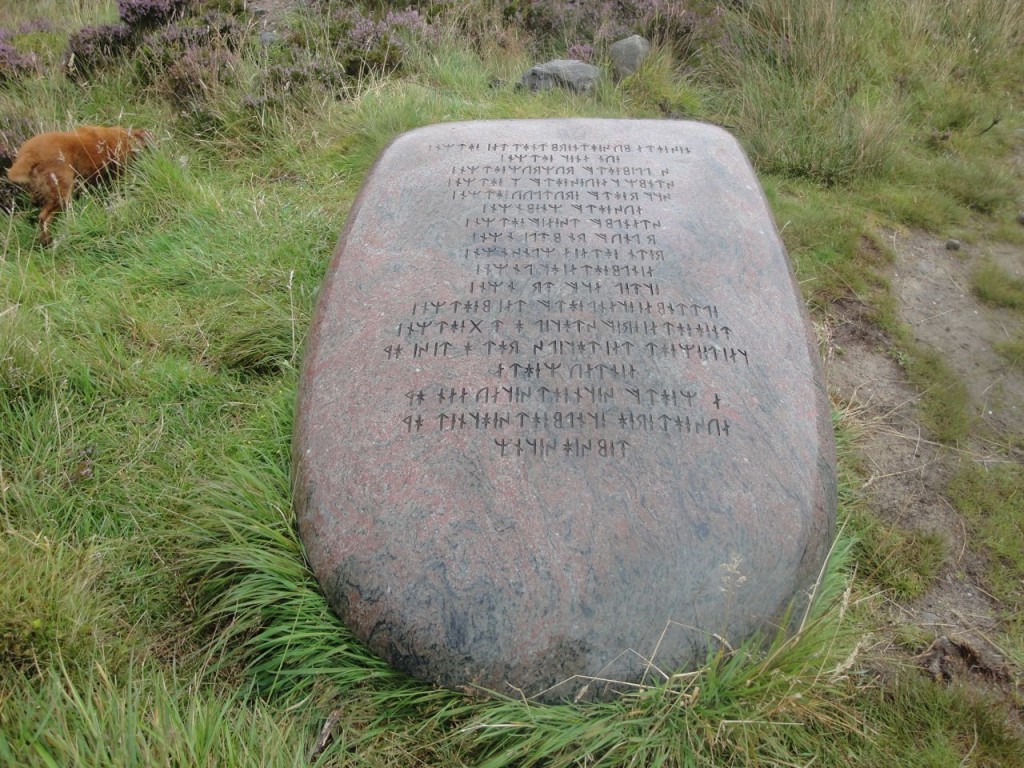
The path then climbs around the lower slopes of Curleywee’s northern end, White Hill. This is one of the ways onto Curleywee but certainly looks steep. The 7 Stanes Giant Axe Head is about a mile past the cycleway sign. This has runic text carved on its surface. I believe this is supposed to be an ancient Irish Poem by Amergin. It is called The Mystery.
I am the wind which breathes upon the sea,
I am the wave of the ocean,
I am the murmur of the billows,
I am the ox of the seven combats,
I am the vulture upon the rocks,
I am a beam of the sun,
I am the fairest of plants,
I am a wild boar in valor,
I am a salmon in the water,
I am a lake in the plain,
I am a word of science,
I am the point of the lance of battle,
I am the God who created in the head the fire.
Who is it who throws light into the meeting on the mountain?
Who announces the ages of the moon?
Who teaches the place where couches the sun?
(If not I)
Unfortunately the light was poor and with the mist and rain the whole area certainly seemed a rude and savage scene. It was not conducive to photographs, or to sitting and eating sandwiches, so I turned about and headed back. It was on the way back that I managed to spot Black Laggan’s ruins, which I had not noticed on the way up.
I decided to walk down to the Loch side, so followed a branch path down to a small promontory that looks to have had a large campfire on it. At the end, the water looked quite deep. As I stood wishing the surrounding hills would appear from the mist, Sweep decided to jump in and then found he couldn’t jump high enough to get out. I thought I might have to get into the water to get him out but managed to grab him by the scruff of the neck and hike him out.
A nice easy walk, starting at the 7-stanes Trailhead car park about a mile and half east of Newcastleton.
My schoolboy error was to take a monochrome copy of the Newcastleton cycle trails, rendering the numerous coloured trail markers somewhat less useful than they might have been. But by hand-railing I got us where we needed to be. The dogs had to be kept on leads because there were sheep wandering across the track near the car park (and because Leo tends to do a runner if he catches the scent of deer). God knows what he would do if he found himself facing a deer five times his size.
Linns Trail
The basic route is purple on the trail map, and is I think called the Linns Route. Certainly that was what was on many of the way-markers. Rather than follow this completely we took a single track path along the dry stone wall just after the cattle grid where the Caddrouns trail heads off east. This took us down to Hillhouse wood where the path was a little muddy until we rejoined the Linns trail. There was the first of several picnic tables here but sadly we hadn’t brought sandwiches.
Border Stane, English side
This route took us down and across the Tweeden Burn then slowly climbed, parallel to the burn, until we reached the Border Stane, which is about a mile from the actual border. The side facing England is inscribed with Blake’s Jerusalem, whereas the Scottish side has Burns’ Auld Lang Syne. We would have “pood the gowans fyn” but there were none thereabouts. I would of course be careful to pick but not uproot any wildflowers (illegal, I believe). Those daisy chain makers should all be banged up if they uproot the plants, shouldn’t they?
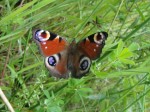
Peacock Butterfly
Other than the section in Hillhouse Wood the paths were well maintained and would be good in any weather. There were plenty of thistles about and we came across a peacock butterfly that let me close enough for a photo.
We nipped into Newcastleton after the walk for some sustenance then headed back to D&G. On the way home, just after crossing back into D&G we drove through Rowanburn, an old mining village which has a couple of interesting artefacts by the roadside.
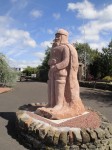
Lang Sandy, Rowanburn
There is a stone statue of Lang Sandy. This replaced a wooden statue that had been there for many years but was apparently beginning to deteriorate and was moved to a museum in Langholm. Lang Sandy Armstrong was a powerful Reiver who was executed with eleven of his sons in 1603 in the ‘pacification’ of these parts. Across the road from Sandy is a pit-head wheel, a memorial to Samuel Lindsay, killed in a mine accident in 1922, just a few months before the last mine closed.
This was a brief stroll through Dalbeattie Forest in pleasant weather. We had previously walked the Dalbeattie to Colvend path (once in rain, once in sunshine) but this time started at the 7 Stanes car park.
The first ten minutes were the most challenging to navigate since there were quite a number of MTB routes. We choose to follow the trail markings for “main routes” which took us on a minor meander but got us to the right place. We were soon on forestry tracks wide enough to allow bikes past us easily and were able to follow the trail markers. I must be getting middle-aged eyes, because the tracks on the 1:25k map were merging into the contours. My compass has a small magnifying area and I would have needed it if the light had been bad. I realise I have now reached a certain age (at which I can grumble that printing is too small).
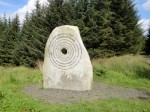
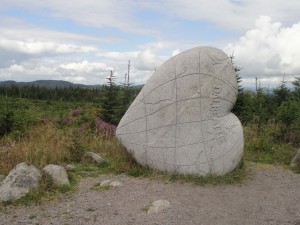
Unfortunately there wasn’t much in the way of a view at first but there were trees, butterflies, wild flowers and the blackest water to see. The MTB trail-markers were helpful in pointing out to us that we were ascending. Having said that, there wasn’t much ascent. We reached the highest point of our walk (119m) after 2.5 miles, at the Heart Cleft Stane. This is one of the 7 Stanes, made from local granite, carved in the shape of a heart (lover’s rather than anatomical) with a map of the world carved into it. It stands on Moyle Hill in an area cleared of trees, or perhaps never afforested, so it was the first chance to see the surrounding wee hills such as Screel and Maidenpap.
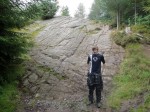
The Slab
The MTB track headed up over Moyle Hill but we backtracked the 25m to the forestry track and continued on. This was a path much less trodden which reminded me of the disused railway to Skerrow Halt, though perhaps not yet as wild as that. There was even heather growing on the path. We rejoined the MTB track after a furlong. That sounds better than an eighth of a mile doesn’t it? A narrow path took us down to the bottom of the Slab, a 15m steep granite slab which attracts mountain-bikers. The photos don’t do it justice. There is plenty of evidence of its use on YouTube.
Once back on the forestry tracks we headed down to briefly join the “brown” way-marked path that goes from Dalbeattie to Colvend. I had a vague memory of seeing the path down from here to the A710 and hoped I would be able to find it. Luckily it was very obvious and clearly signed. There isn’t a path marked on the OS map from the A710 into Kippford forest but there is a well maintained path on the ground. This wound around between two minor hills in Kippford forest and took us to the foot of The Mote of Mark.
Mote of Mark
The Mote of Mark, is a small hillock, standing 45m above the sea-shore. It was once the site of a fort or settlement dating back to the 5th century and was clearly quite a cosmopolitan place since excavations have found evidence of metal working on site and various imported goods: iron from the Lakes; jet from York; pottery from Bordeaux and Rhineland glass.
I can see why this prominence would be used as a fort since it gives excellent views over the Rough Firth. Screel and Bengairn are seen to the north, Barcloy hill to the south, and across the firth, the Almorness peninsula (which defeated us on a previous walk) and the two islands, Hestan and Rough. Both can be reached on causeways at low tide but we reached Rockcliffe not long after high tide.
The weather was not the thundery heavy rain forecast, just a persistent drizzle (smirr). The route took us from the main car-park along a track that looked to have been renovated recently, past fields of sheep (to the right) and cattle (to the left), separated from the road by large rocks. This took us to the overflow car park which is marked on the OS map.
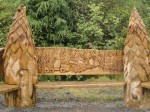
I had planned to walk anti-clockwise but missed the turn uphill so switched to clockwise, which turned out I think to be the better direction. Had we gone the way planned we would have missed the carved wooden seats near the car park. These have several carvings, some of which I only noticed when looking at my photos. I like the fact that they have carved JCBs and log lorries as well as the usual animals and plants.
Wooden seat at Ae
We took the forest track that follows the Water of Ae northwards. This track steadily climbed and drifted away from the river before dropping back down the hill close to the Craigshiels Outdoor Centre.
After the bridge we rejoined the red cycle route and the path began to climb slightly more steeply. Our first 4.5 miles was all uphill, except for a brief dip down to Craigshiels, so despite waterproofs protecting me from external moisture I was damp from the inside.
Wee Queensberry with its two summits was visible ahead of us as we walked up from Craigshiels, but Queensberry itself was hidden in cloud. Twenty minutes later the cloud had risen a little and Queensberry was revealed except for its summit. There were wisps of cloud across the valley, below us, but luckily our route escaped any cloud.
Once up on the higher paths we saw some other folk braving the weather, a couple of horse-riders and some mountain bikers. I presume it will be much busier in good weather. (Insert your own insult regarding fair weather walkers/riders/etc.).
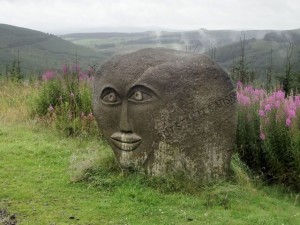
Eventually we reached the Talking Head Stane, one of the 7Stanes. I had seen a photograph of this before but had been unsure if we were looking for a small rock or massive boulder. It fact it is about the height of a man. I’ve read that it is 6ft 4in x 4ft 6in, but suspect this isn’t accurate. The 7stanes website says it weighs 1.5 tons and is sculpted from a glacial granite boulder. The stone has a rather forbidding face looking eastwards and these words, from Deep in the Forest, by Hans Børli, inscribed around the sides and back.
But still it satisfies my soul to hear the spruce and wind. They speak together like sister and brother, and use such beautiful wind-wild words deep in the forest, deep in the forest.
From the talking head stane the views could I think be good but today were limited by cloud and poor visibility. I wonder, as well if the stone might look less sinister when not wet. A reason to come again in dry weather, perhaps?
From here the way back was downhill, initially on a wide bridleway and then down the orange cycle route, The Shredder. This has an uphill-push path for MTBs and we used this to get back down. We did not see any any riders on this section. It is steep enough that I wouldn’t relish pushing a bike up it.
If the MTB routes were busy it would be possible to avoid the Shredder with only a slightly longer walk.
Though we didn’t climb any hills on this walk, it was a higher climb than Screel had been, and felt like it.
The Ettrick Horseshoe: Bodesbeck Law, White Shank, Smidhope Hill, Capel Fell, Wind Fell, Hopetoun Craig, Ettrick Pen.
Plan B (version 3). The original plan was the Awful Hand Ridge as a linear walk with two cars. The forecast, however, suggested we would be parking our cars in cloud and walking in rain. Fair-weather walkers I hear you say, but that would be unfair. I’ve walked in my share of drow ‘n’ smirr. As it was, the second driver ended up having to work so I headed east where the low cloud wouldn’t arrive until later in the day.
Samye Ling
Potburn, where the walk starts is not that far away, just 25 miles as the crow flies, but 50 miles by road and much of that on pot-holed, single track, chicane which tends to limit speed somewhat. Mind you there are certainly some nice houses out there. I was surprised, however, to see some brightly coloured things up ahead which I at first thought was a childrens’ playground. As I was musing on what a stupid place this was for such an undertaking, it came into better view and I realised it was the Samye Ling monastery.
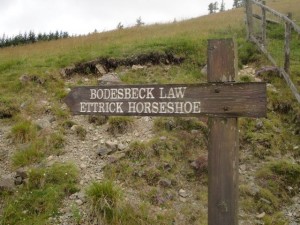
There is a small area to park cars just before Potburn Farm, and closed gates to dissuade further access. The sign (above) pointed the way onto a forest track that climbs steadily winding around Bushie Law. I had intended to do the lesser horseshoe leaving Bodesbeck Law for another day (version B.1). This entailed leaving the track on a smaller track which strikes off to the left and leads to the col between Bodesbeck Law and Fauldside Hill.
Well… there was a junction of sorts, with a signpost, the top of which had broken off and the signage was nowhere to be found. This path lead down and across a small bridge which looked in pretty good nick (relatively new, I imagine). The path was overgrown and didn’t look much used and it was also sooner than I had expected, so the map was consulted and misread. I blame this on the wind blowing it in my hands. I presumed the real path to be a little further along.
Forest track up to Bodesbeck Law
I was feeling happy. The path I was walking was firm and dry, climbing steadily but not uncomfortably. There were wildflowers aplenty, butterflies and many small white tailed birds. The sky was blue in places and it was tee-shirt temperature. On the down side the views were limited since there was dense forest either side of the path.
So it was that it gradually dawned on me that I had missed the path I had intended to take and was only 100m short of Bodesbeck Law’s summit. It seemed pointless to walk back down so Bodesbeck Law was included in the hike (now version B.2).
The track actually climbs a little further than the OS map would have you believe and the terrain was firm with short grass. Once at the summit there is a much wider vista to take in, of the hills lining either side of the A708. The two deep valleys of the Carrifran and Blackhope Burns can be looked into from Bodesbeck Law. The cloud base was just hiding the summits of the nearby Corbetts.
Looking south I had my first view of the route I was to take over to Capel Fell and round to Ettrick Pen, which looked quite distant. This walk follows the boundary between Dumfries and Galloway and the Borders and is marked by a fence (and sometimes a dyke) making navigation simple. There are three minor hills between Bodesbeck Law and Capel Fell but all feel like shoulders of Capel Fell. The going was mostly good except for a few boggy areas where Bodesbeck Burn rises. This is where version one of the walk would have joined the boundary fence.
Cat’s Shoulder, Croft Head
At Capel Fell the wind had picked up enough to need a fleece and and I got the dreaded low battery warning from my camera, so photos were limited. There was a good view of the trefoil shaped Croft Head with the zig-zag path coming down Cat’s Shoulder. It looks like a hill worth visiting (in good visibility).
Between Capel Fell and Wind Fell there is a steep dip down to Ettrick Head. The descent was giving my knees some gyp, so I gave jogging a go, but that was worse. As I looked down there was a wide stile to carry the SUW walkers across the county boundary, and it looked as if it could double as a picnic table for my lunch. Sadly, on closer inspection there was considerable guano, and though this was only on the part which would be the seat, I had my banana while leaning on the fence rather than sitting.
Sign on the SUW
The fence headed directly up Wind Fell and looked steep, though in actual fact it probably looked worse than it really was. There was however a quad bike track heading up from just 200m away and it looked less steep, crossing the contours at more of an angle. So I took in 200m of Southern Upland Way then picked my across some boggy grass to follow the tracks. The wind was blowing colder now which was no bad thing with the added exertion.
Wind Fell’s summit was anything but sexy. There was no obvious top among the flat expanse of grass, but one area looked like a likely summit and had piece of broken fence post planted in it looking like a broken cross from a cemetery in an old western film. This small totem was encircled by peat bogs and hags, so there was at least some sense of achievement in reaching it without getting covered in mud.
Cairn on Hopetoun Craig
Hopetoun Craig, the next hill, has a small, campfire-size cairn at its summit and a couple of more substantial fellows nearby. One of these looks like a cross from afar but up close is a well constructed cairn about the height of a man. I trudged over to see if there was a plaque on it, but found nothing.
Ahead of me now was the stroll up Ettrick Pen. The hill which had seemed so far away earlier in the day was now within reach. There were a couple of short steep sections but with firm ground underfoot the going was easy. By now however, the clouds were closing in from the west and every now and then a raindrop would fall. At the summit I met the only other walker I had seen all day. I told him he had spoiled my record of seeing no-one but he trumped my record since I was the first person he had seen in eight days of walking. He was doing a route similar to mine but clockwise, so I asked how the walk up from Potburn was. It was because of his answer that my walk became version B.3.
I had intended heading north, with the fence, for 100m then heading west to find a forest track. He said that the route up was no problem, “just follow the fence”.
Ettrick pen has a considerable cairn, but also a wide scattering of stones suggesting that it may once have been larger. It was certainly large enough to act as a windbreak while I had my lunch. It had taken three and a half hours to get here, which I thought was good going. Surely I would be back at the car in no time. No problem, “just follow the fence”.
The shape of these hills is such that you cannot see what is at the bottom of a slope until you start down it. I followed the fence. The ground fell away nicely. This terrain could have been unpleasant if wet, with long grass and spongy moss, but it was dry.
My first problem came when the fence split, one arm going precipitously downhill, the other just steeply. I choose the latter and knew that I could always cross back to the other fence if necessary. This fence ended at a dense forest plantation so I made my way across and down to the other fence, where I found a stone wall and what looked like a trodden path.
It soon became clear that this was not a well trodden path. The give away was the interlocking branches that could only be passed by breaking them. No-one had walked this way in a long time. Then the difficult path was blocked by several fallen trees. Attempts to get round these led to me discovering a whole line of fallen trees, presumably a domino effect, so eventually I had to backtrack to the wall and climb over it. I had already crossed this a couple of times falling for the “it looks easier on the other side” fallacy, but this time is was easier.
Once at the bottom of the slope I breathed a sigh of relief. Then realised that there was Ettrick Water between me and the car. Luckily the stream’s water was relatively low leaving many rocks to help my crossing. The only problem was that the banks were high and finding a way down onto the rocks took some searching. By now the rain had started to fall.
I wouldn’t recommend this route off Ettrick Pen, but overall this was an easy walk since there is the boundary fence to follow around most of it. I would definitely include Bodesbeck Law in the horseshoe since the route up is relatively easy being on good forest track most of the way.
This is a repeat of the northern section of the Black Loch and the Eye walk, but this time in sunshine rather than rain.
We went up the track from the Queen’s Way to the eastern end of Black Loch then walked along the Old Edinburgh Road, with its rather unexpected covering of seashells, as far as the sheep pens at the Grey Mare’s tail burn, with a brief detour to the Eye.
Unlike most of my Galloway outings, we were not alone. A family were exploring the same parts as us and a young lad passed nearby on a motorcycle.
The dogs enjoyed exploring, though they were tethered when near to children. Sweep always likes to jump into water and had a swim in the Black Loch close to the Eye, but needed help getting out. Leo was less aquaphilic and just paddled in the shallows of the Loch and later the Burn. Sweep did his usual bouncing about in the undergrowth, so I’ll no doubt be removing ticks later on.
The Eye
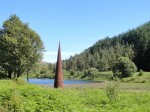
The Eye is a 7m conical terracotta-covered structure by Colin Rose, commissioned in 1997 to mark the 50th anniversary of Galloway Forest Park. There is a hollow section running through it but I don’t know if this is part of the “art” of the piece or something more mundane such as the means by which it was held prior to being placed here. I tried looking through in case it showed some important feature in the distance but couldn’t see much.
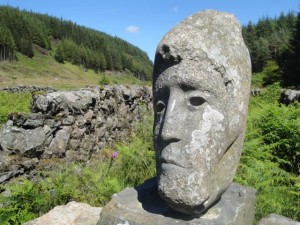
At the sheep pens further along are a collection of stone faces called Quorum, by Matt Baker, who also did the Devorgilla piece in Dumfries.
After our stroll we called in at the Clatteringshaws visitor centre for some cream of Galloway ice cream and to admire the loch and surrounding hills. The loch was a beautiful deep blue, the best I have ever seen it, or perhaps the ice cream was giving me rose tinted spectacles. Coming back to the car though Sweep, wet from from his swim, had managed to climb across and sit on my seat leaving it damp.
We finished of our brief outing with a visit to the Catstrand gallery in New Galloway.
Backhill of Bush, the Silver Flowe, Nick of the Dungeon, Dungeon Hill, the Devil’s Bowling Green and Craignaw.
The forecast was for rain and low cloud but as I drove towards my low level walk it became clear that the higher summits were cloudless and the sun was beating down. So I reverted to my good weather plan, the Dungeon Hills from Backhill of Bush.
As I drove along the Queen’s way in Galloway there was a rainbow over Clatteringshaws so I presume it had been raining. But now it was sunshine. I took the single track road along the western side of Clatteringshaws Loch that we had walked, in the opposite direction, a couple of years ago. The original plan was to stop at Craigencallie and head up Darnaw. Had the forest track beyond Craigencallie been blocked I would have had no choice, but the gates were open so on I went.
My navigation skills on forest tracks leave something to be desired and I will admit that I had to stop a couple of times to use a GPS to find where I was. Trees all look the same to me and I did go down a wrong turning south, towards Millfore, for quite a while which required a multi-point turn. I realised something was wrong when I saw the bluffs of the Buckdas of Cairnbaber. My heart then sank when I came to a locked gate but that turned out to be the SUW to Loch Dee, a walk for another day. It seemed to take an eternity to get to Backhill of Bush Bothy but approaching it I had wonderful views of the Dungeon Hills and the Rhinns of Kells.
Backhill of Bush Bothy
There was a white van on the path past the bothy and I was worried it would be forestry chaps who might tell me to retrace my steps. Later on in the walk I wondered if I might come back to find the car nicked. That would have been a bind since phones don’t work down there. This wasn’t helped by me being unable to see the car once up on the hills. I saw where I thought it should be, but was wrong.
But back to the walk. I set off across a bridge over Downies Burn near the bothy and headed along a poor quality track looking for a way onto the Silver Flowe. I passed some trees and once I got to a tree-free area I headed into the wild. Two minutes later while negotiating large tussocks and reed like grasses taller than me I slipped into a water filled ditch. Both legs went under water, the left as far as the thigh, and my left arm as far as the shoulder.
To say the least, this somewhat sapped my good humour. The terrain was the same as far as I could see. I decided that this was too much, too soon, pulled my self out of the mire and headed back for the car. But as I looked into the trees on my right, it looked as if it would be possible to walk in the forest and so by-pass the horrible wet area.
The forest floor was initially almost firm but deteriorated into muddy areas, and then became blocked by fallen trees. I decided to head for the edge of the trees but was then back in the waterlogged tussocks and reeds. Then I spotted vehicle tracks not far off. These were very waterlogged and muddy, but at least I could see the ground and would be less likely to have another unexpected ducking. And my legs and feet were already wet so the mud didn’t matter so much.
Eventually, I was past the trees and all that stood between me and the Silver Flowe was the Saugh Burn. The Dungeon Hills looked quite close by now. Unfortunately the burn was deep and too wide to jump. I followed the burn for a short while then found a section where the river bed was visible and not very deep. I took a run and managed to land one foot (already wet) in the burn and the next step took me to the far bank. I looked around for a landmark so I could find the same section again on the return leg. There was a concrete post with some rusting barbed wire so I stored that in memory.
The far side of the burn was large tussocks and water-filled hidden holes into which my feet would occasionally slip. I grew to dread the sudden fall of a foot with the accompanying “thunk” sound as my boot entered the water and sank. The thunk was the sound you hear when a large stone is dropped into water but without the splash. Perhaps that’s a plop? I had considered changing socks following the initial dunking but was pleased I hadn’t. In retrospect though I should have taken off the gaiters, which by now were probably holding water in rather than out.
Craignaw above the Long Loch of the Dungeon
In time though the tussocks gave way to shorter vegetation as I came on to the Silver Flowe proper. There were a great many small flowers and butterflies and although the ground was wet it was safe to walk on. The Silver Flowe has many sections of standing water and I had to find a way around these or accept that I would need to head through the water providing I could see something to stand on. About half way across I came upon a track, possibly an animal track, and followed it to the Dungeon Lochs.
The Long Loch of the Dungeon came into view and later the Round loch. These lochs are joined by a burn (or should that be a Lane?) and I hoped it was not too wide. Otherwise I might have to head north to find a way across on the far side of the Round Loch. I was looking forward to getting onto firmer ground.
Difficult terrain in the Nick of the Dungeon
As it turned out I found a place to step across the burn without too much difficulty but was back in tussock country. The climb up the Nick of the Dungeon was steeper than it looked. There were more hidden holes to step into, numerous water channels hidden beneath grass and boulders scattered about blocking my way. This section needed care to avoid injury. My boots continued to squelch but my shirt and trousers were now drying out. It took me an hour to climb the mile, and 1100ft, from the Dungeon Lochs to the summit of Dungeon Hill and I don’t know if that is an achievement or a cause for shame.
Dungeon Hill required a short section of steep climbing but I was able to use the tussocks as stairs. Once on the hill I was rewarded by great views, a sandwich and a text message from Lynn. The phone must have briefly got connection out there in the middle of nowhere.
Awful Hand from Dungeon Hill summit
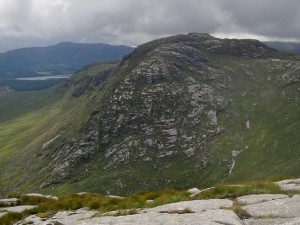
The views were very good indeed. Despite the forecast the Dungeon Hills were cloud free, though clouds were settling on Merrick and the Rhinns of Kells which are perhaps 150-200m higher. The ridge of Brishie looked quite sharp and pointed to Loch Doon where some rain was falling. The Silver Flowe was glistening in the sunlight. Craignaw, my next call sat brooding across the Nick of the Dungeon and I wondered now if my planned route down Craignaw, by the Dungeon Burn, might be a little too steep, but gradient would not be the difficulty as it turned out. You can probably see the Dungeon Burn on the photo at the beginning of this post.
The OS map gives the impression that a ridge curves round from Dungeon Hill to Craignaw, but once up there it is clear that it involves quite a lot of ascent and descent. I decided to head directly down toward the cairn in the col between Craignairny and Craignaw’s NW ridge which would spare me some climbing and scrambling.
Excited Cairn on the col below Craignaw
In retrospect I wonder if the extra climb would have been easier than the terrain I chose. I did though come across another track which allowed me to see where I was walking. It too was waterlogged but my boots could not get any more wet by this time. I have often wondered if there is a name for the apparent tracks that are always waterlogged and sometimes have actual running water. As I tramped along one of these, I realised that there is a name where I come from…a stream. There is a strange cairn in the col. One wonders if it was built like that on purpose or by chance.
Getting from the col to Craignaw was straightforward but tiring, needing a couple of short scrambles and several short steep climbs. The Devil’s Bowling Green was on the way. This is the flattest of many granite terraces and scattered with boulders large and small. There is quite a way still to go from the Devil’s Bowling Green to Craignaw’s summit and the routes up all looked pretty steep. I chose the most likely candidate and headed up. This was the usual tussocks, hidden holes and scattered boulders which with the added gradient meant I made slow work of it.
Mullwharchar and Dungeon Hill from the Devil's Bowling Green
There are several Lochans on Craignaw, and on another day I might have considered dipping my feet in one of those with well placed rocks to sit on. But my feet were already wet and I couldn’t really be bothered. Then at last, there was the summit cairn ahead of me.
I stopped to recharge myself with water and a banana and took a few photos of the views. I must have been sweating with the heat and exertion because I had finished my two litres of water in just the three hours it had taken to get here. While soaking in the views, the temperature suddenly dropped and I could see the clouds rolling down the slopes of Merrick as well as rain coming in from the north. I decided to curtail my rest stop and get to lower ground before the cloud and rain reached me. It never did.
I had thought the descent of Craignaw, especially the steep section above the bowling green would be difficult but the ground was firm. I crossed the Dungeon Burn then stayed to the north of it. It was only once I got to the Nick of the Dungeon that the ground became dangerous again. Climbing this section had been tiring but I must have chosen a slightly different route down which was especially treacherous and had to be taken slowly testing every step. Yet still my feet plunged into holes. Slow progress but 20 minutes faster than the ascent.
Once back over the Dungeon Lochs I was looking forward to an easy stroll back over the Silver Flowe. I hoped to pick up the track I had found but managed to take a different one that led me into a large area of standing water that took some effort to cross. I did have a target on the far side, a stand of three trees one of which was dead, so once the trees were visible I left the track and made a beeline for them.
Of course I then re-entered tussock land and made my way back to the Saugh Burn. The concrete fence post with barbed wired was there but the burn’s water was now black and deep. No sign of the six inch deep section anymore. There was only one thing for it. And my feet were wet anyway.
After some clambering over fallen branches and watercourses I then found my way back to the sodden vehicle track and followed it back, this time not going into the forest. This took me back to the place I had had my first dunking. I stood looking at the water channel deciding how best to get across but then the ground I was standing on gave way and I was in the water again. At least this time I fell with my arms on dry land so only went in up to my knees.
Five minutes later I was back at the car, stripping off the wet gear and putting on dry clothes. Despite the water mishaps I had managed to do a couple of things that I had had in mind for a while. I had walked on the Silver Flowe and visited the Devil’s Bowling Green. I would have liked to visit the air-crash memorials on Craignaw but will have to leave that for another day since I had scarpered when the clouds looked like closing in.
I had wondered why most routes described to these hills start at Loch Trool even though it is a much longer walk, involves burn crossings and tramping along the muddy Gairland Glen. Now I know.
(PS next day: I have aching muscles as if I’d done a twenty miler. This walk really was hard going).