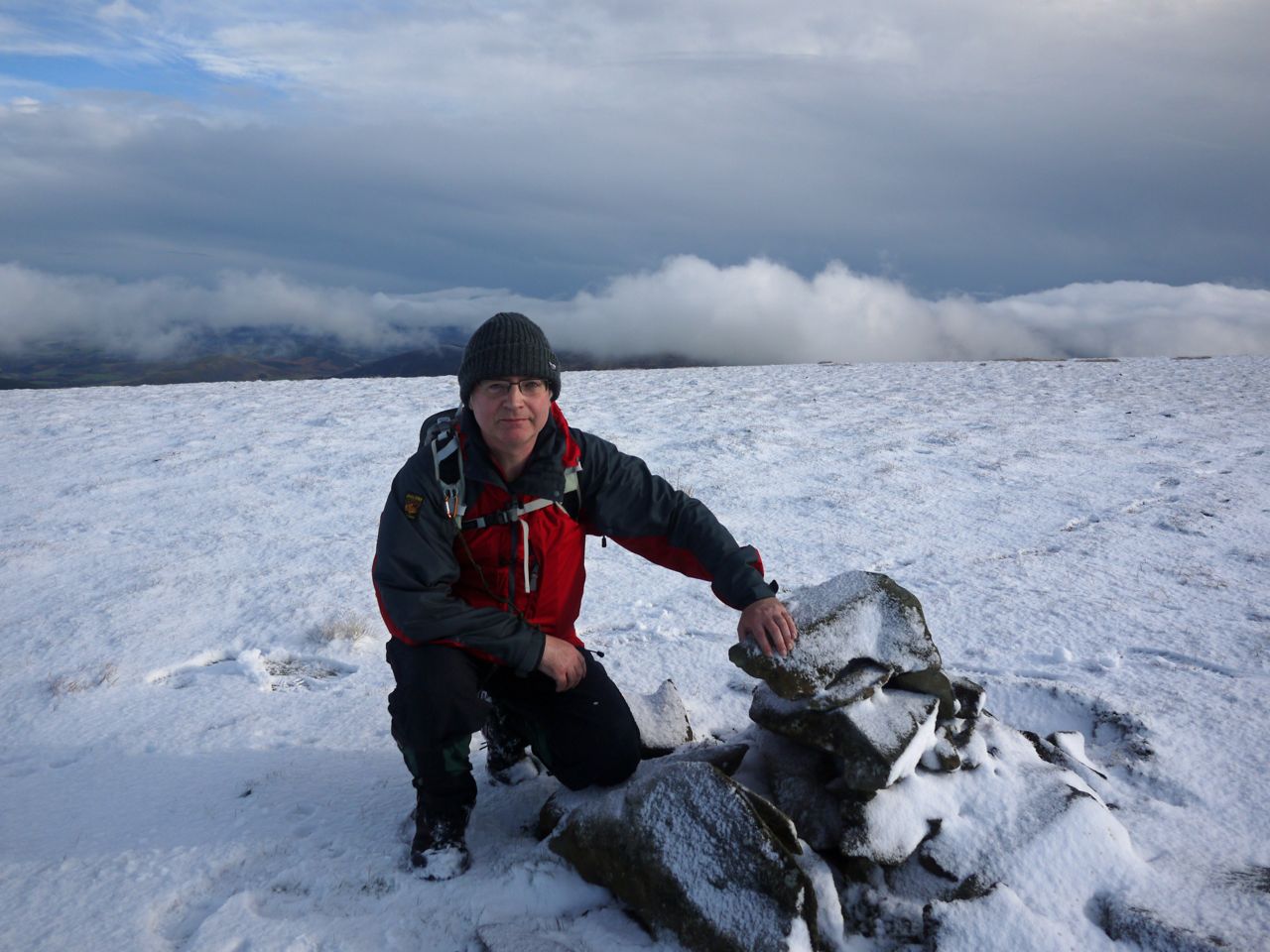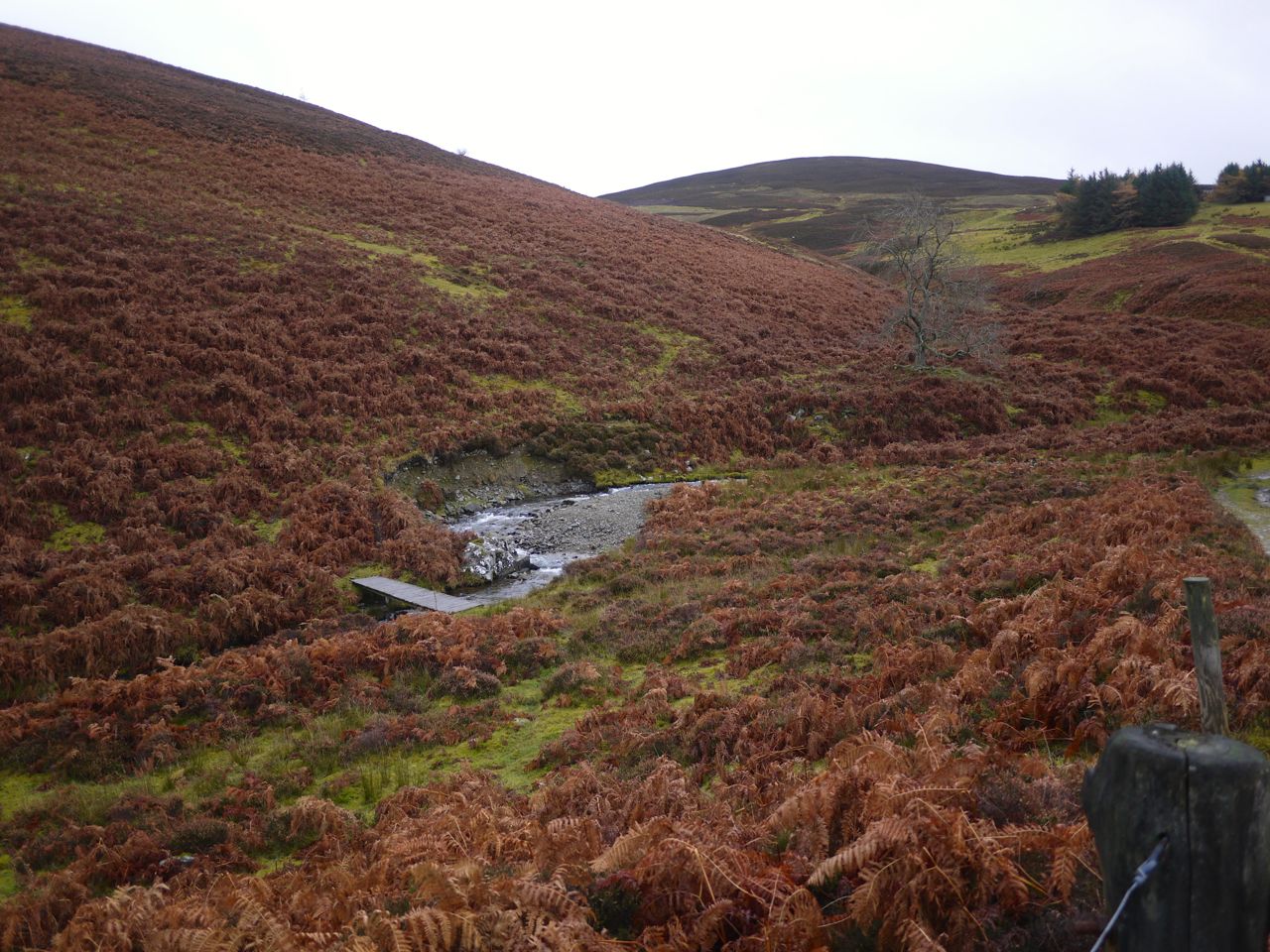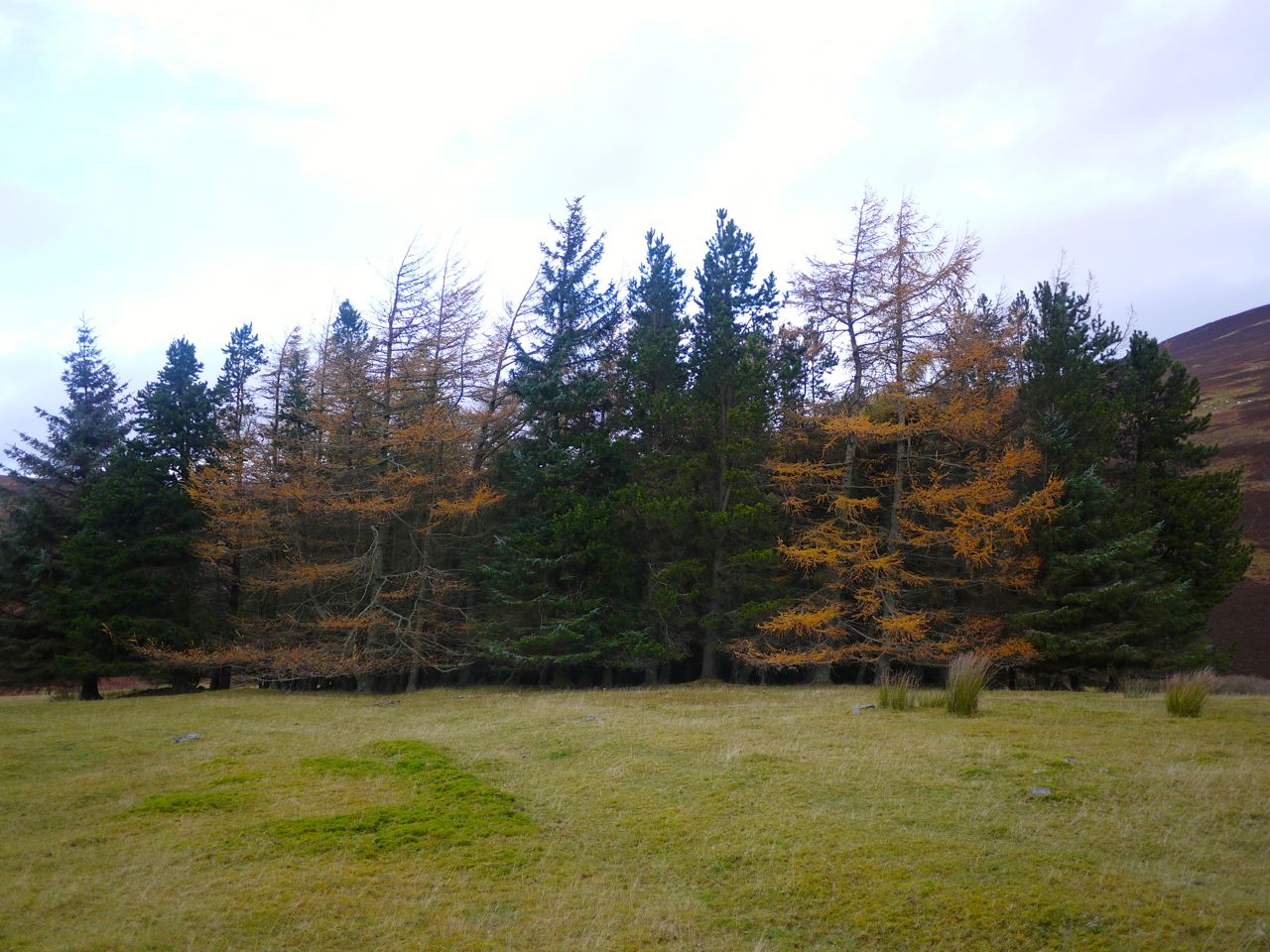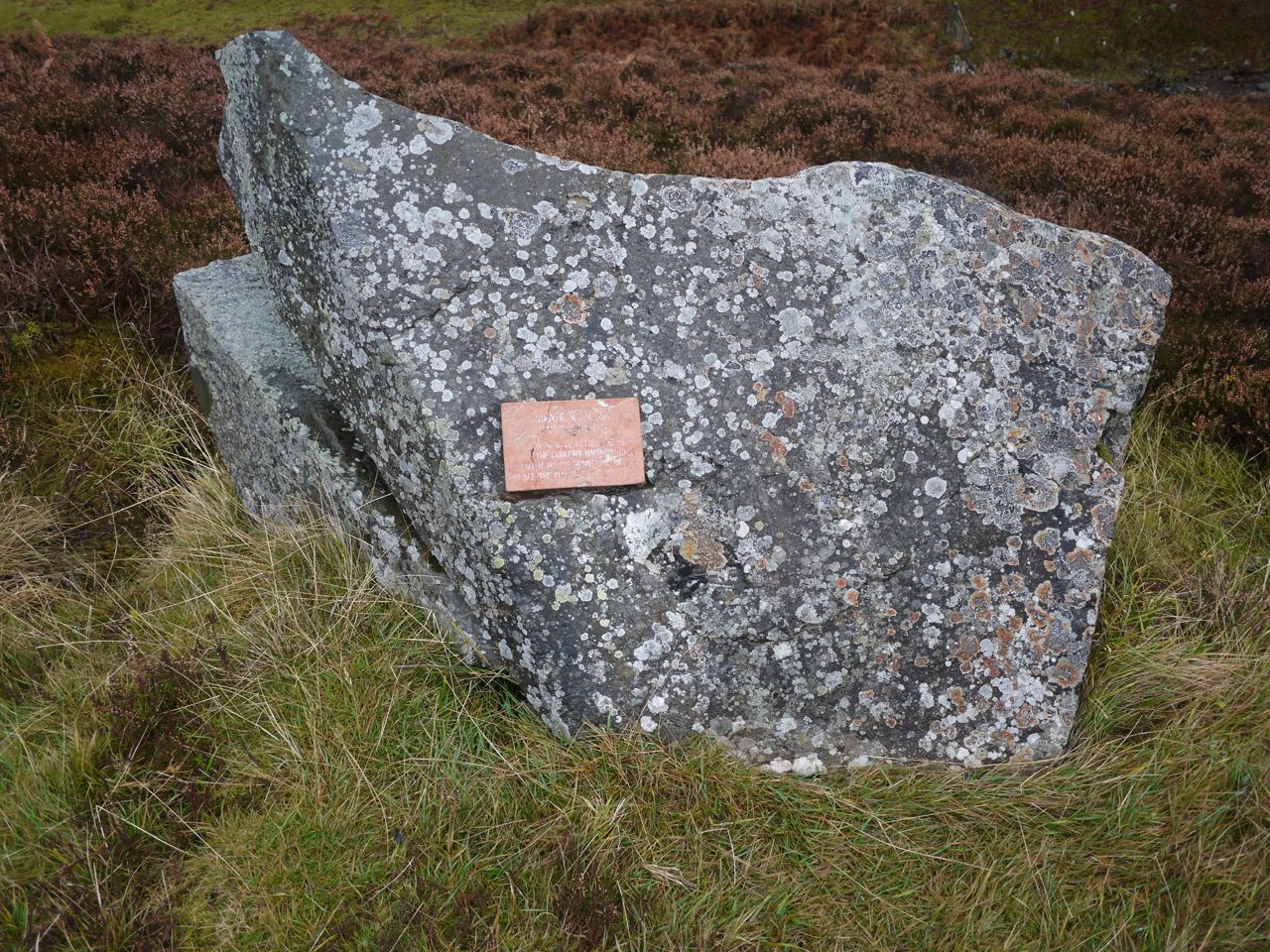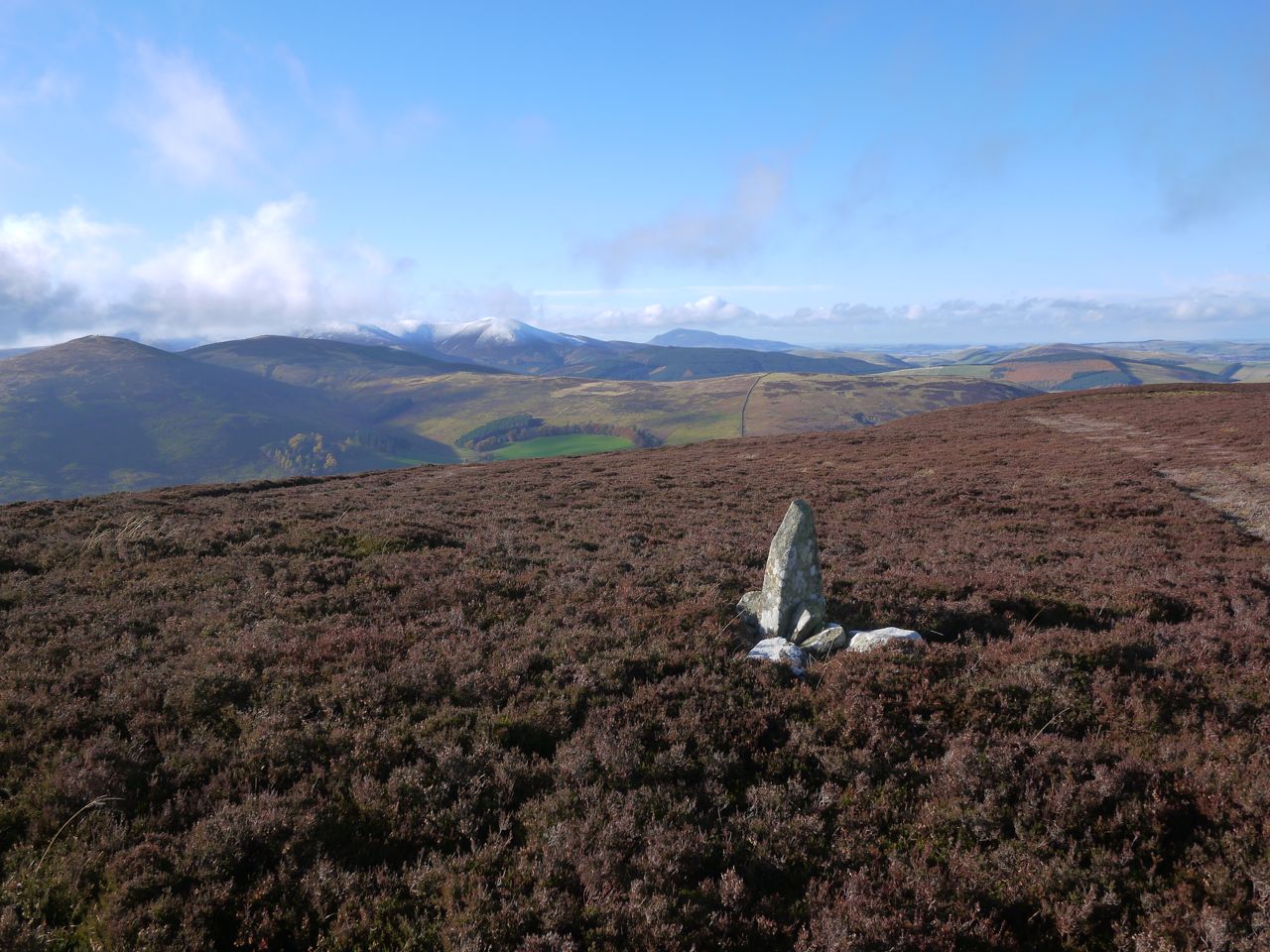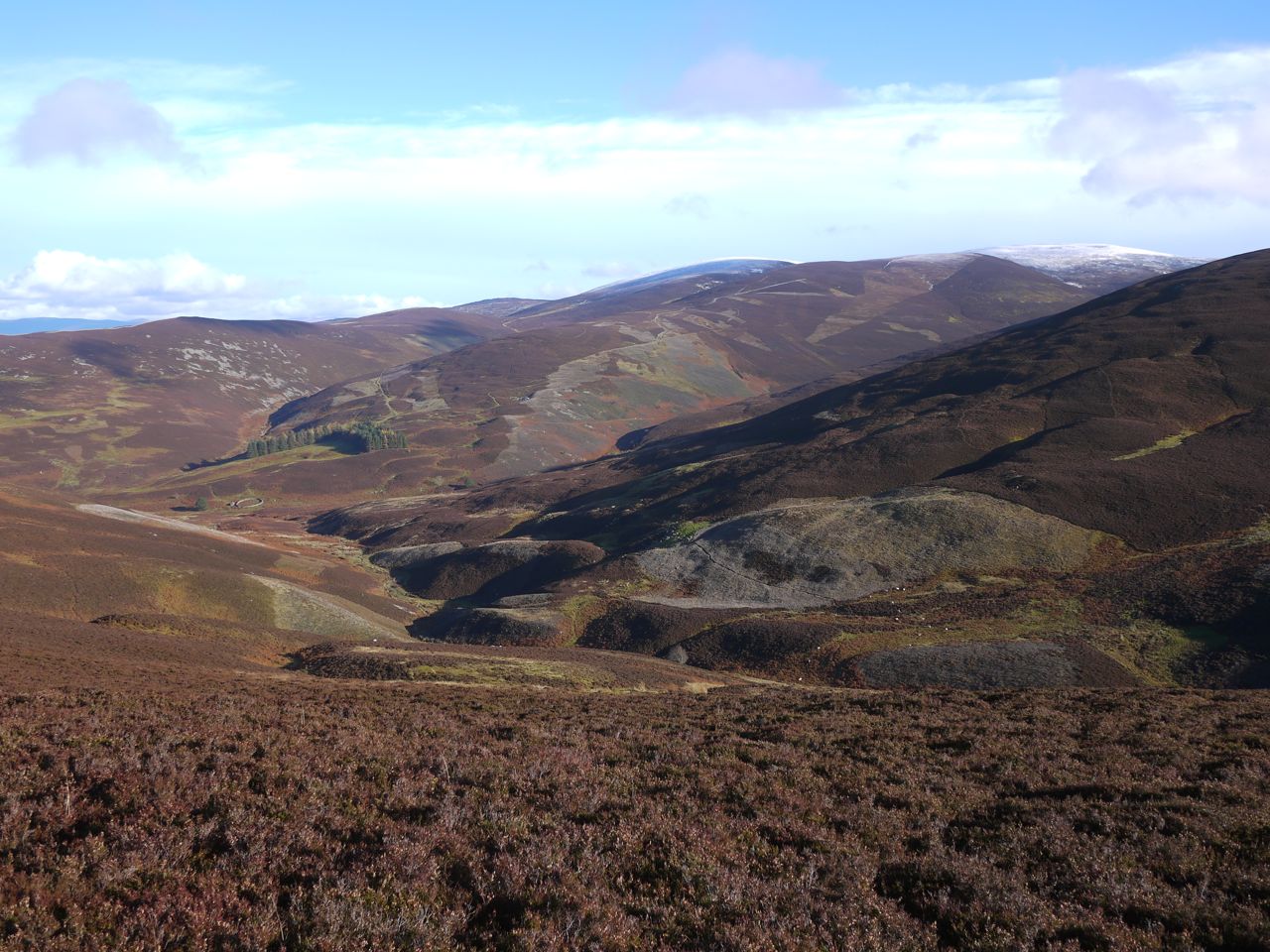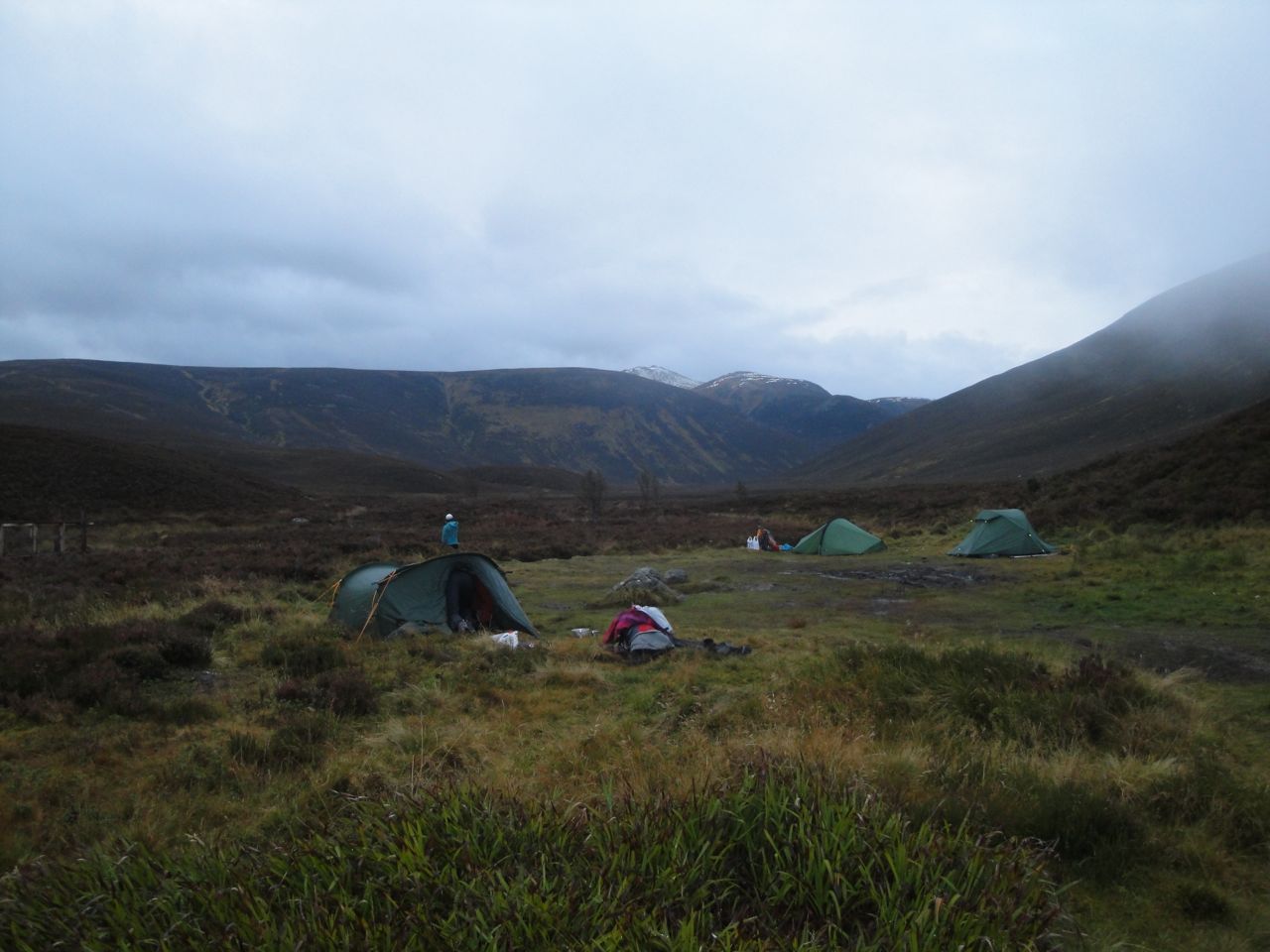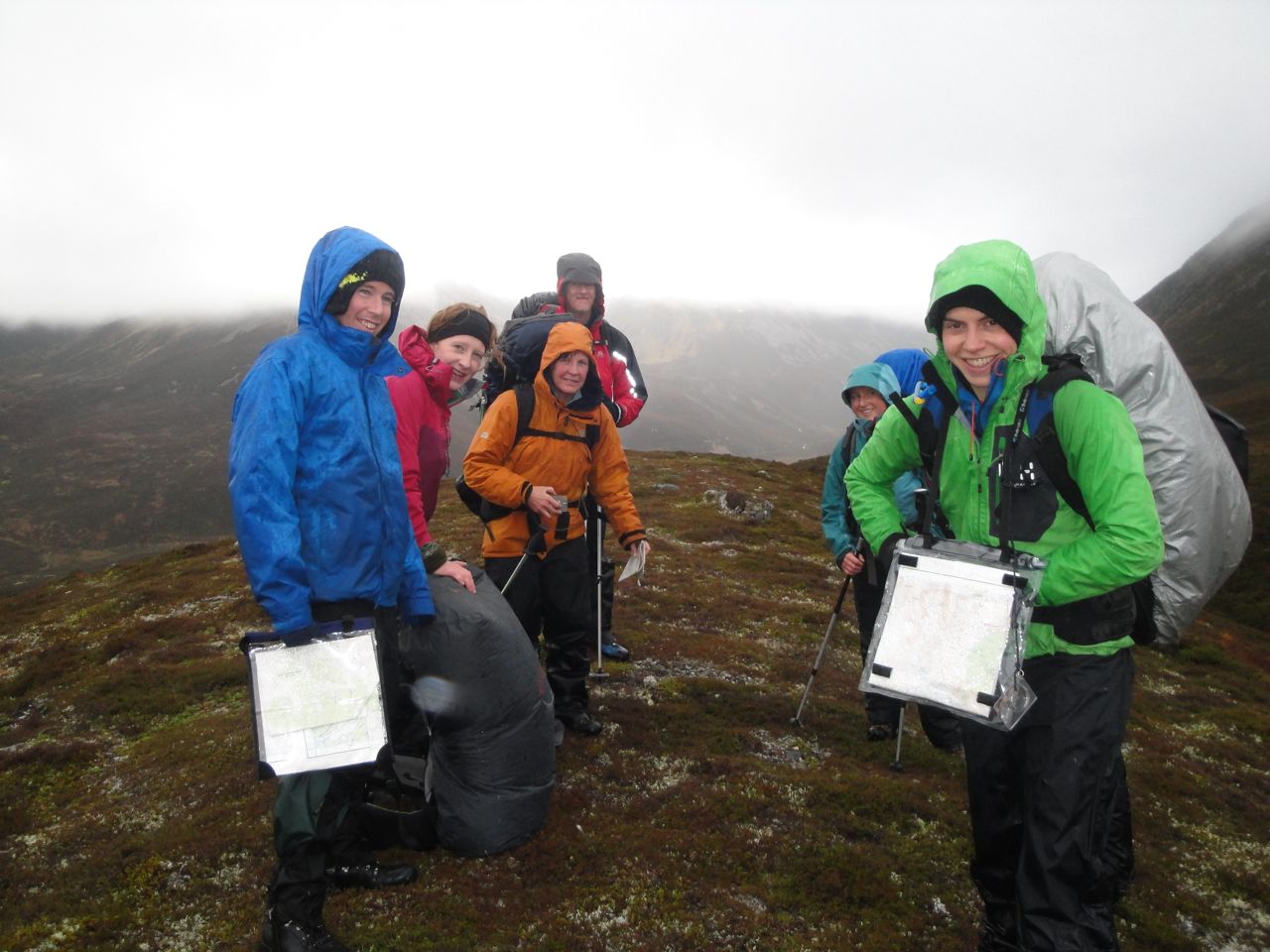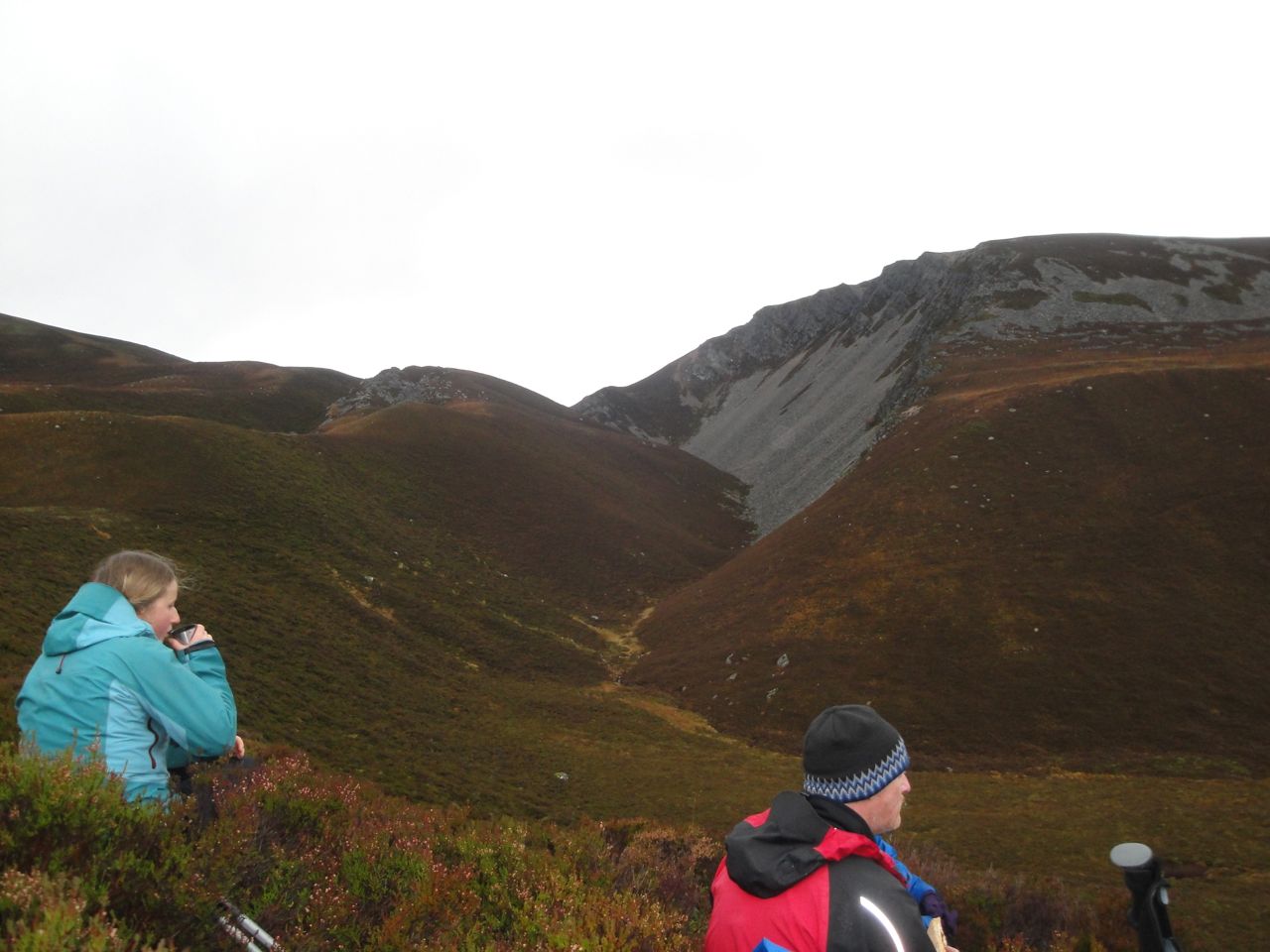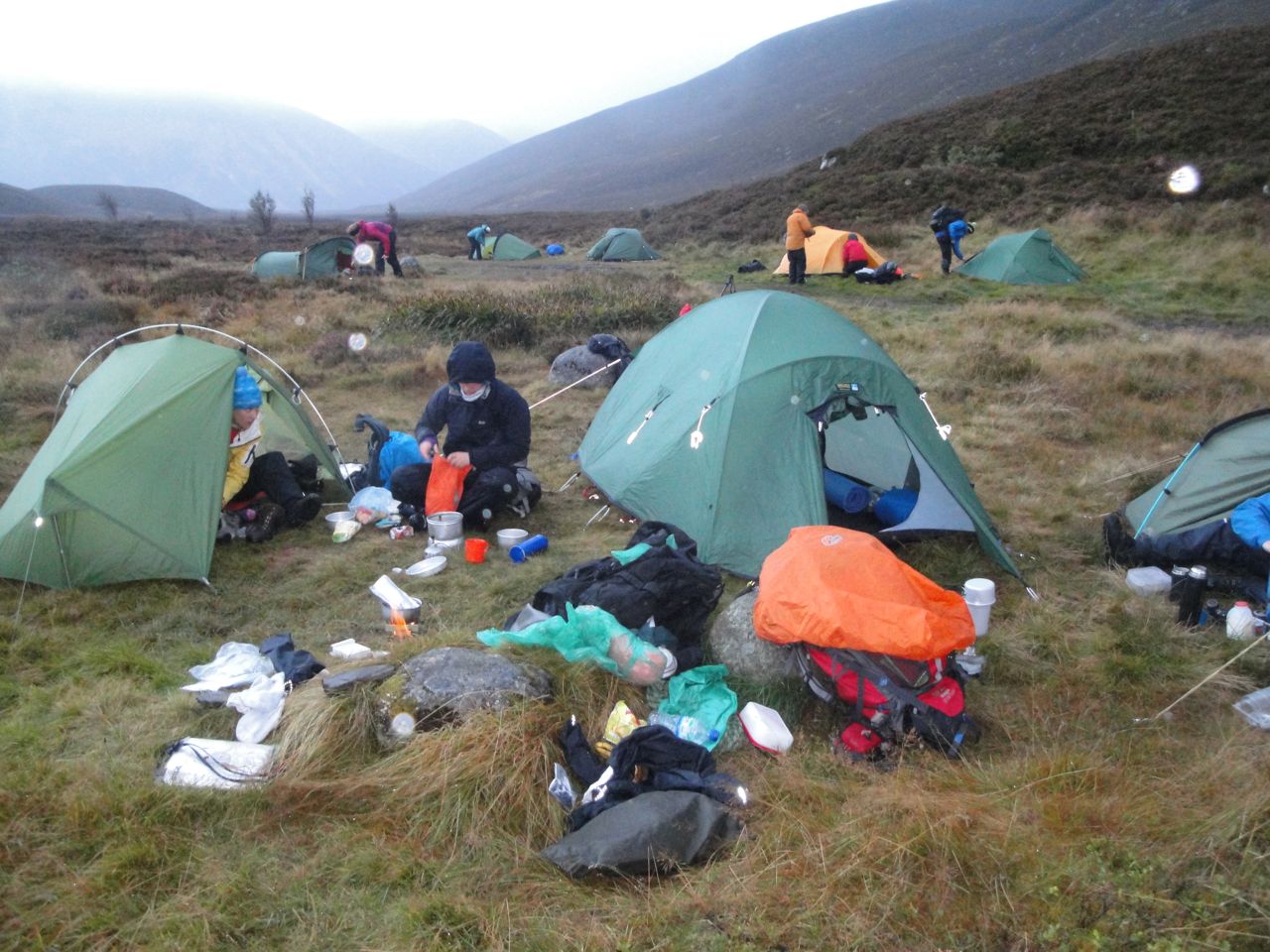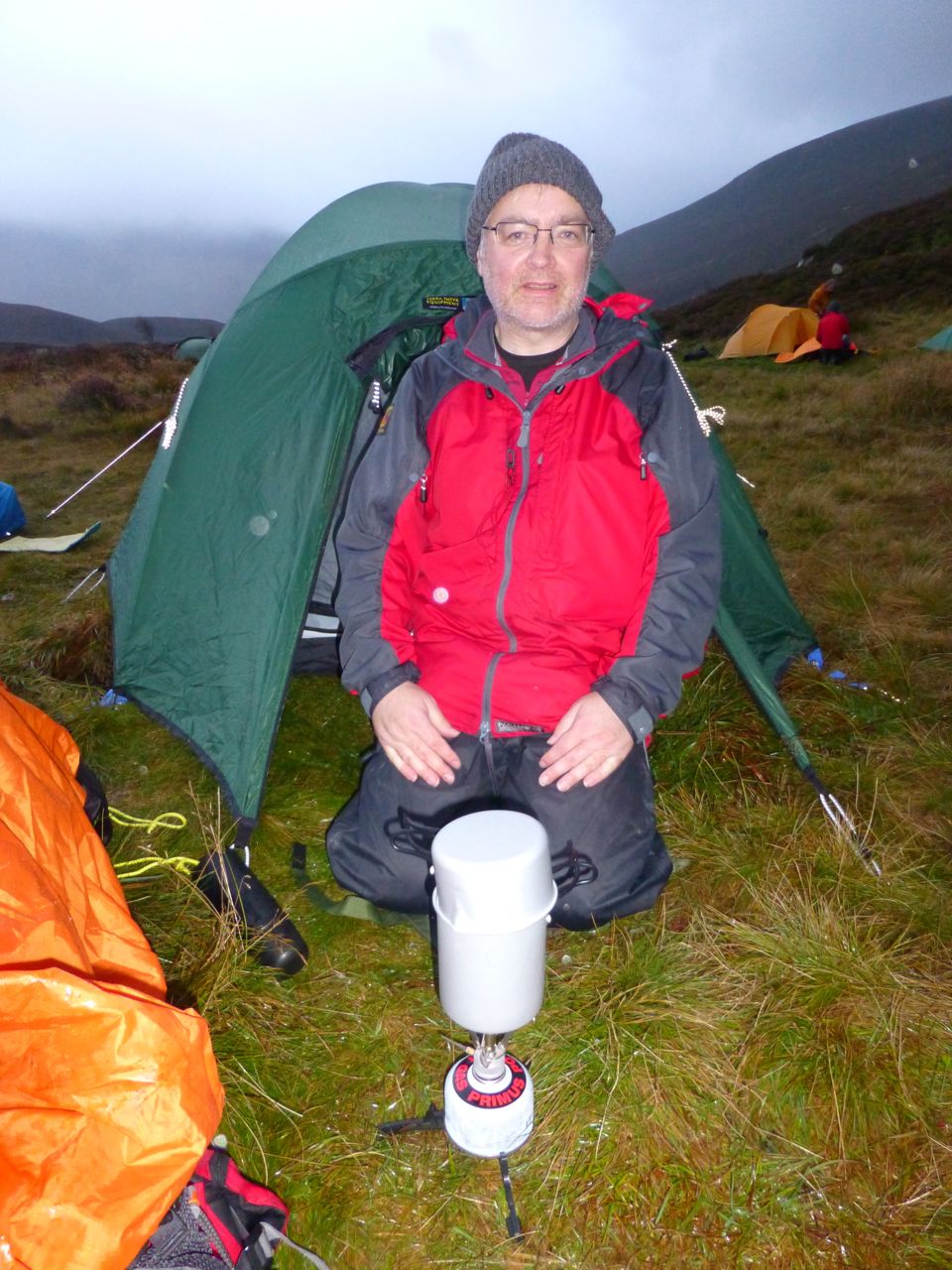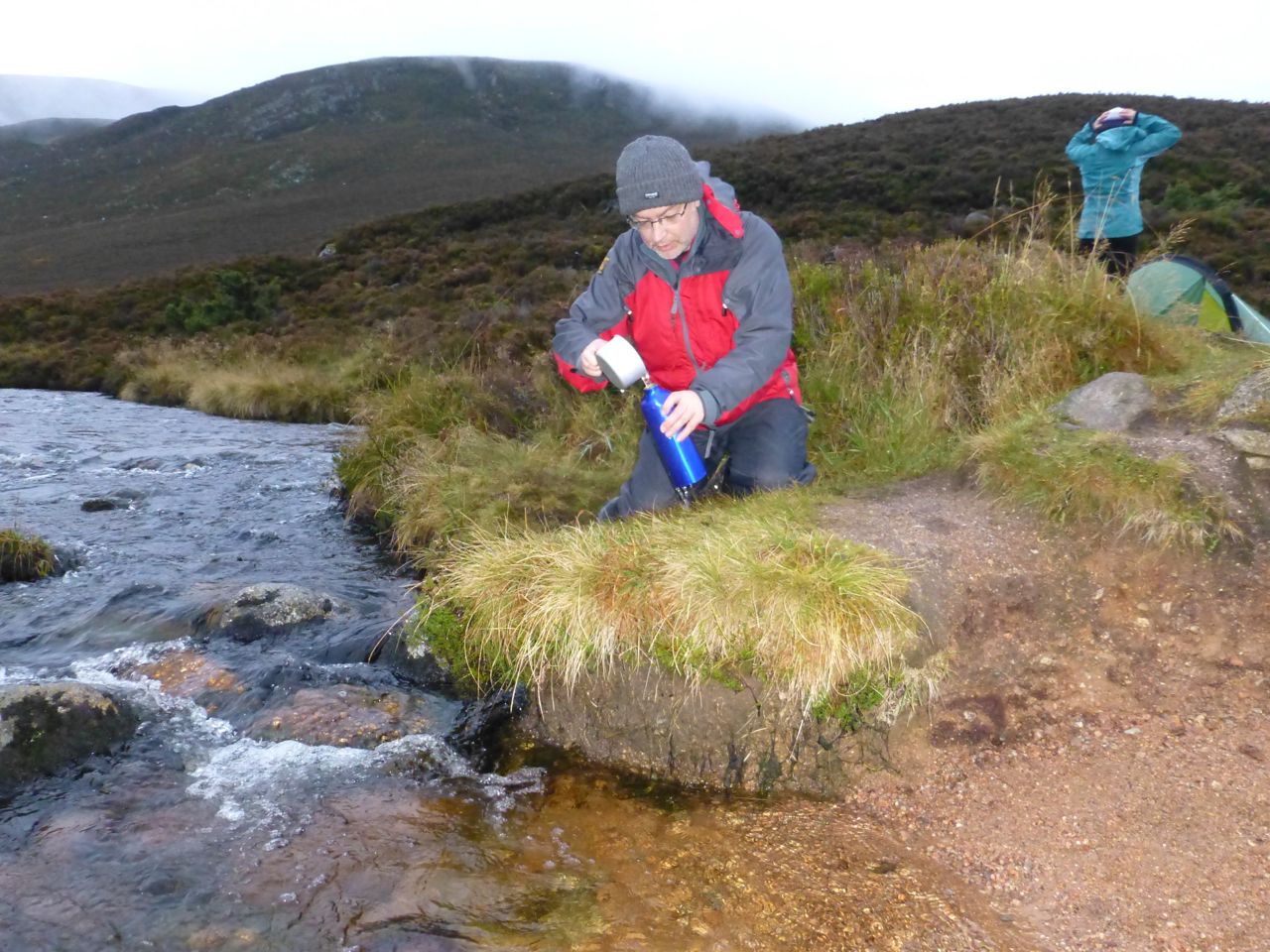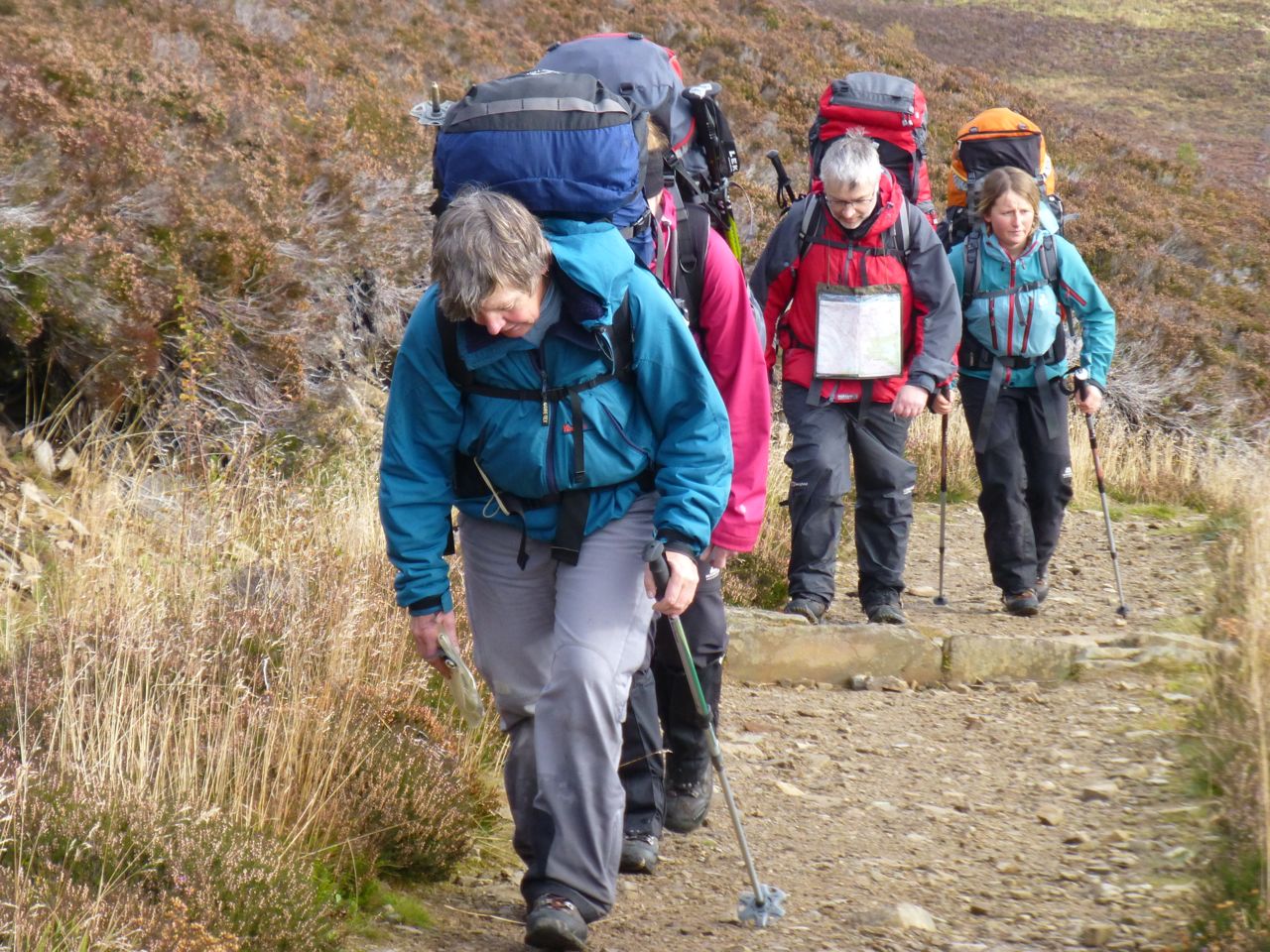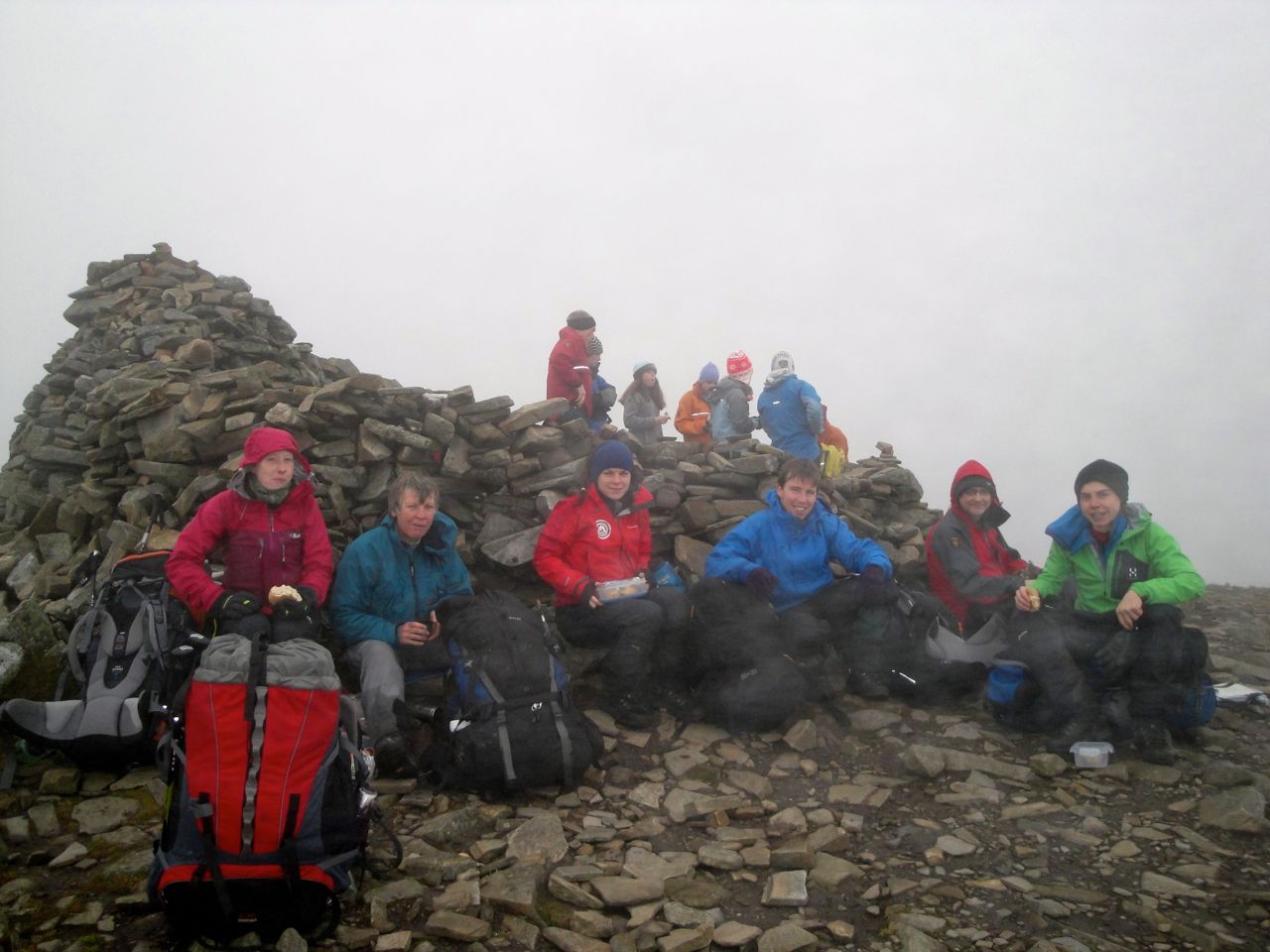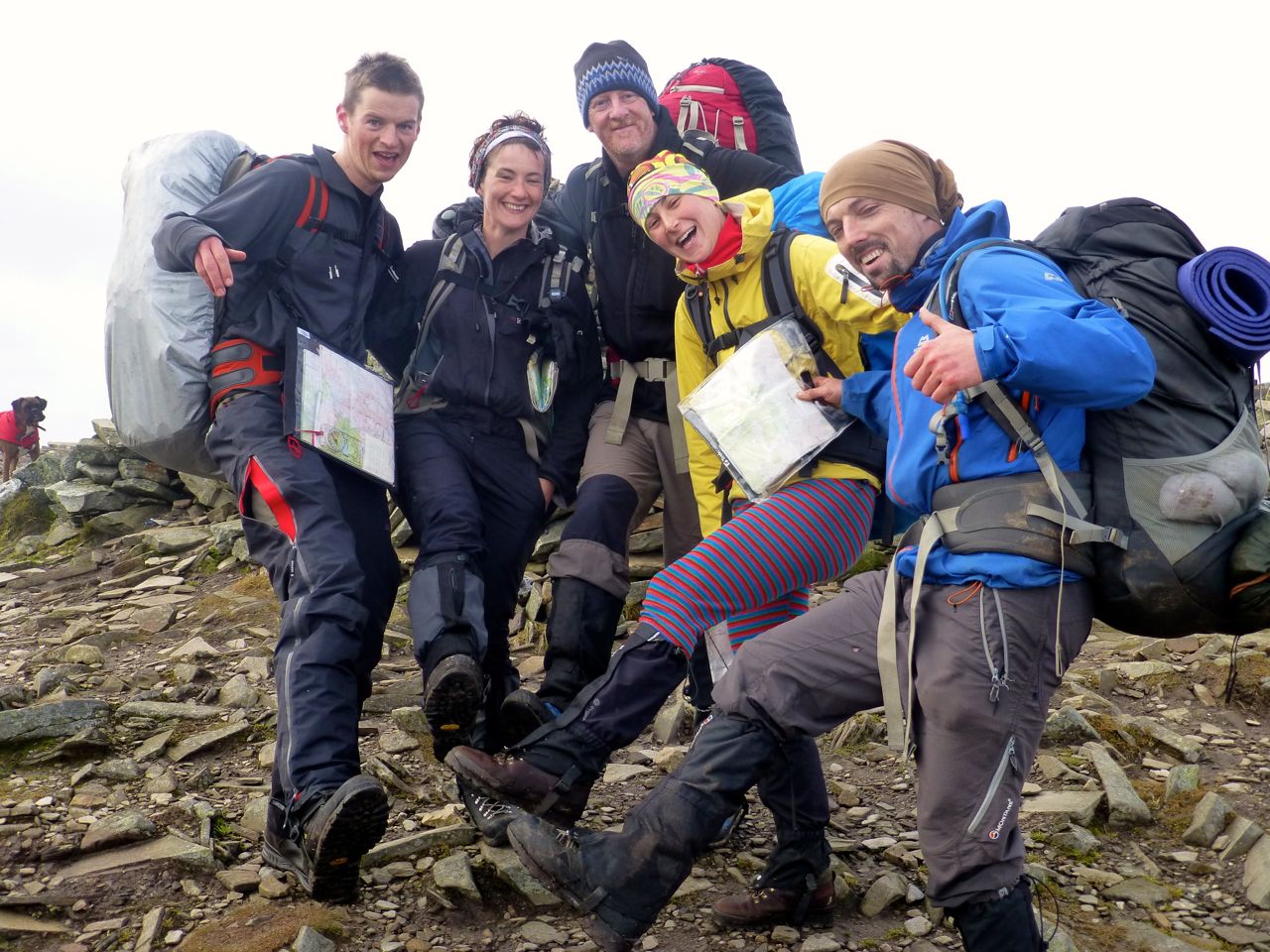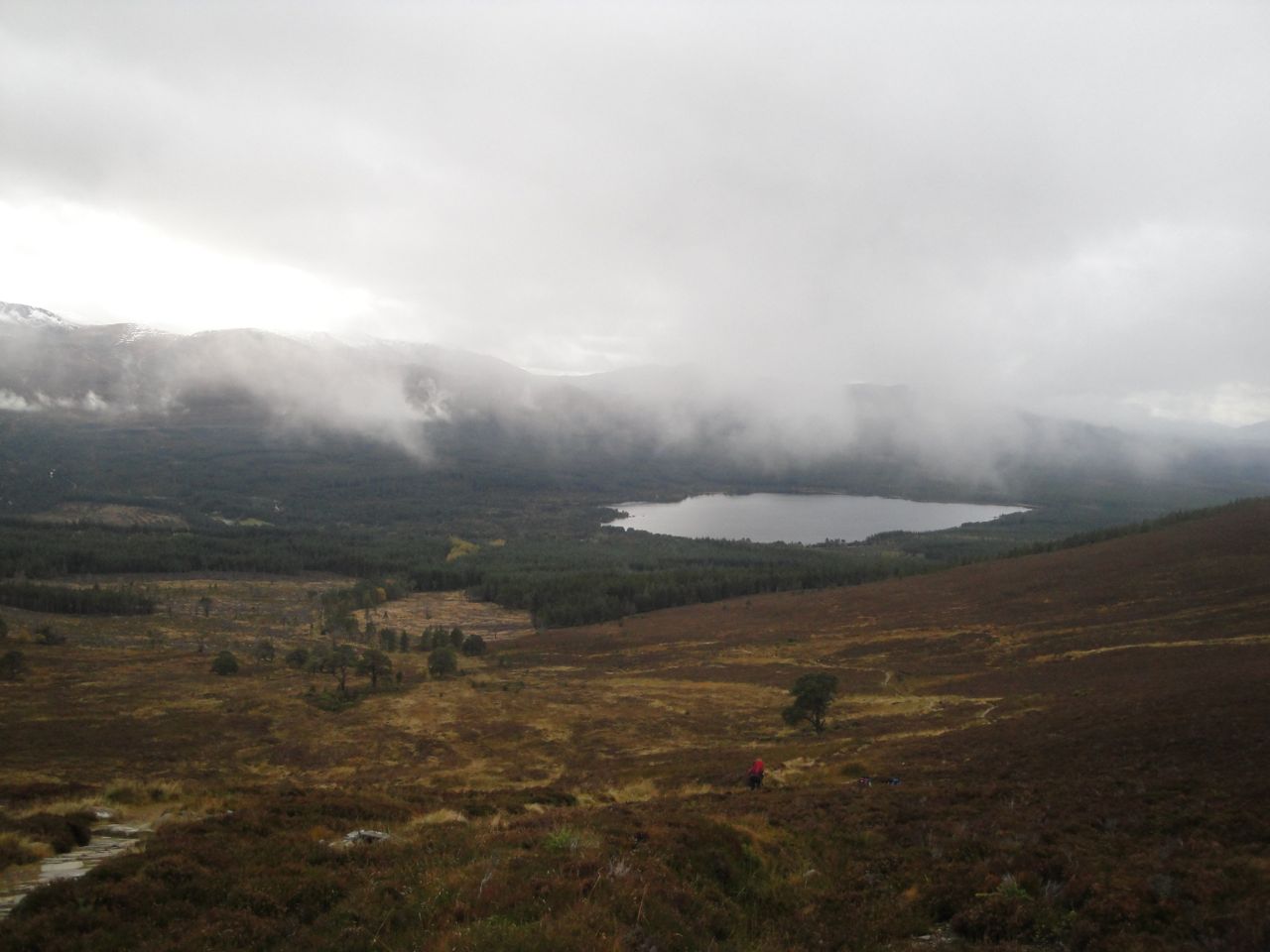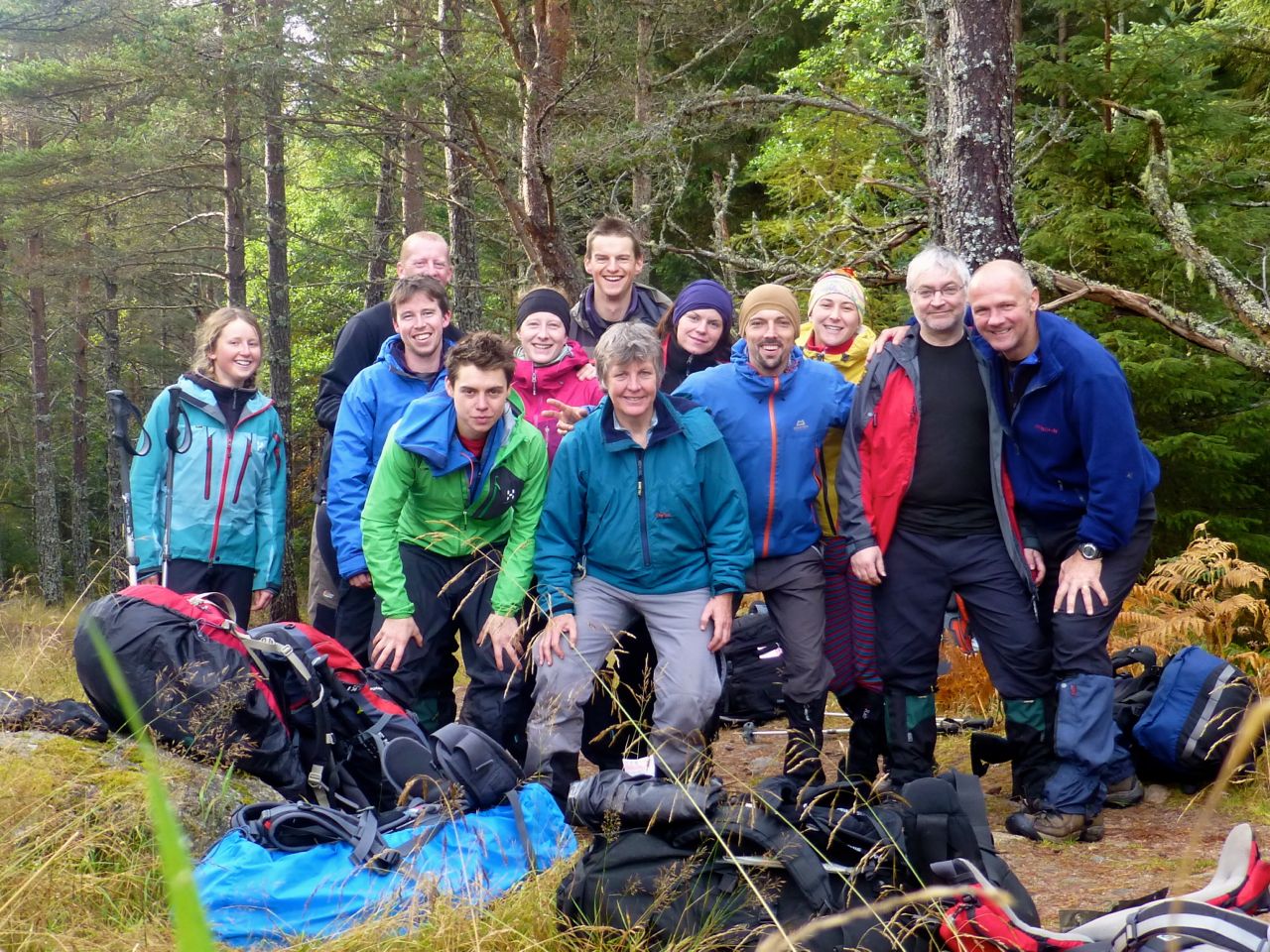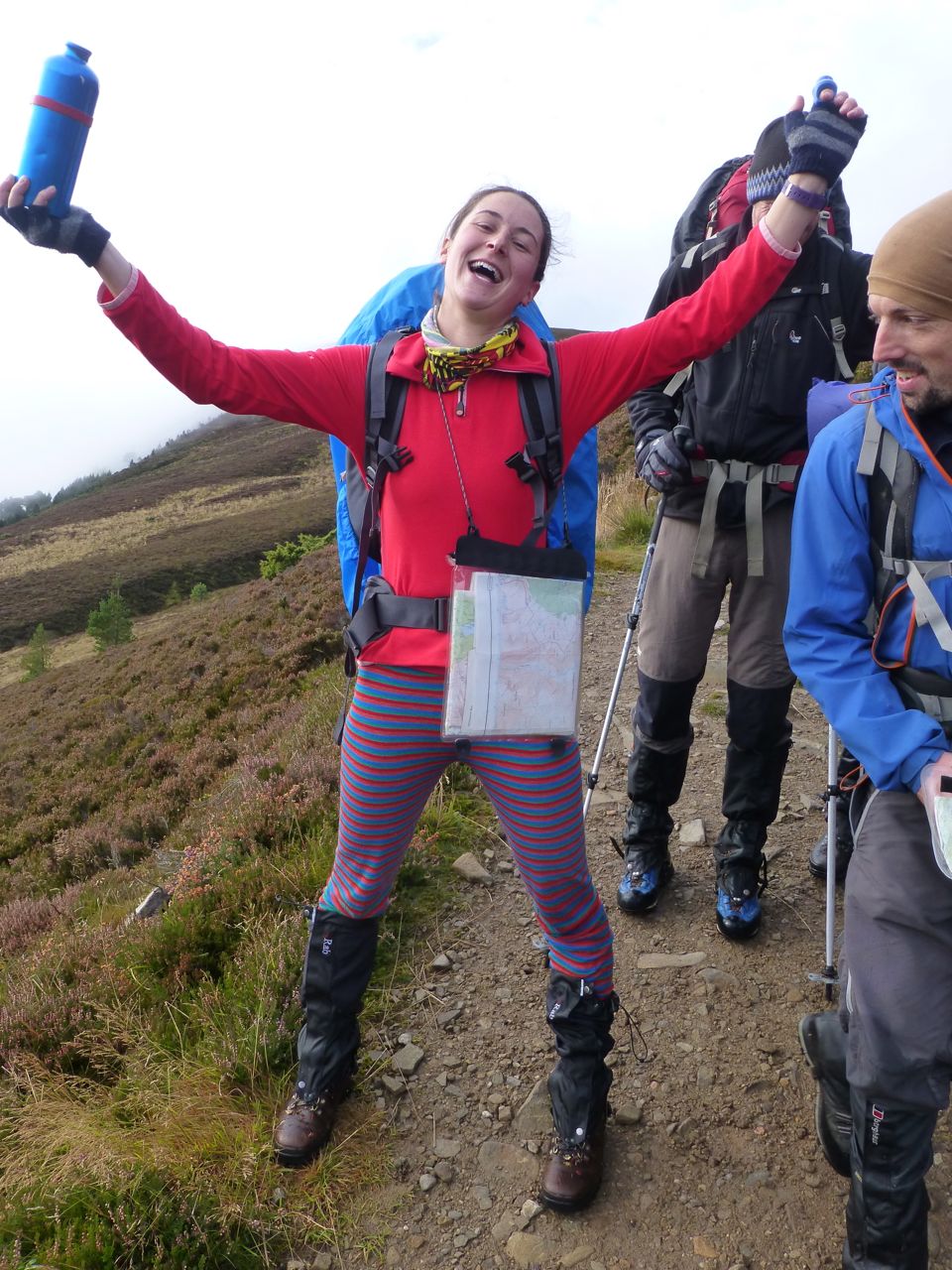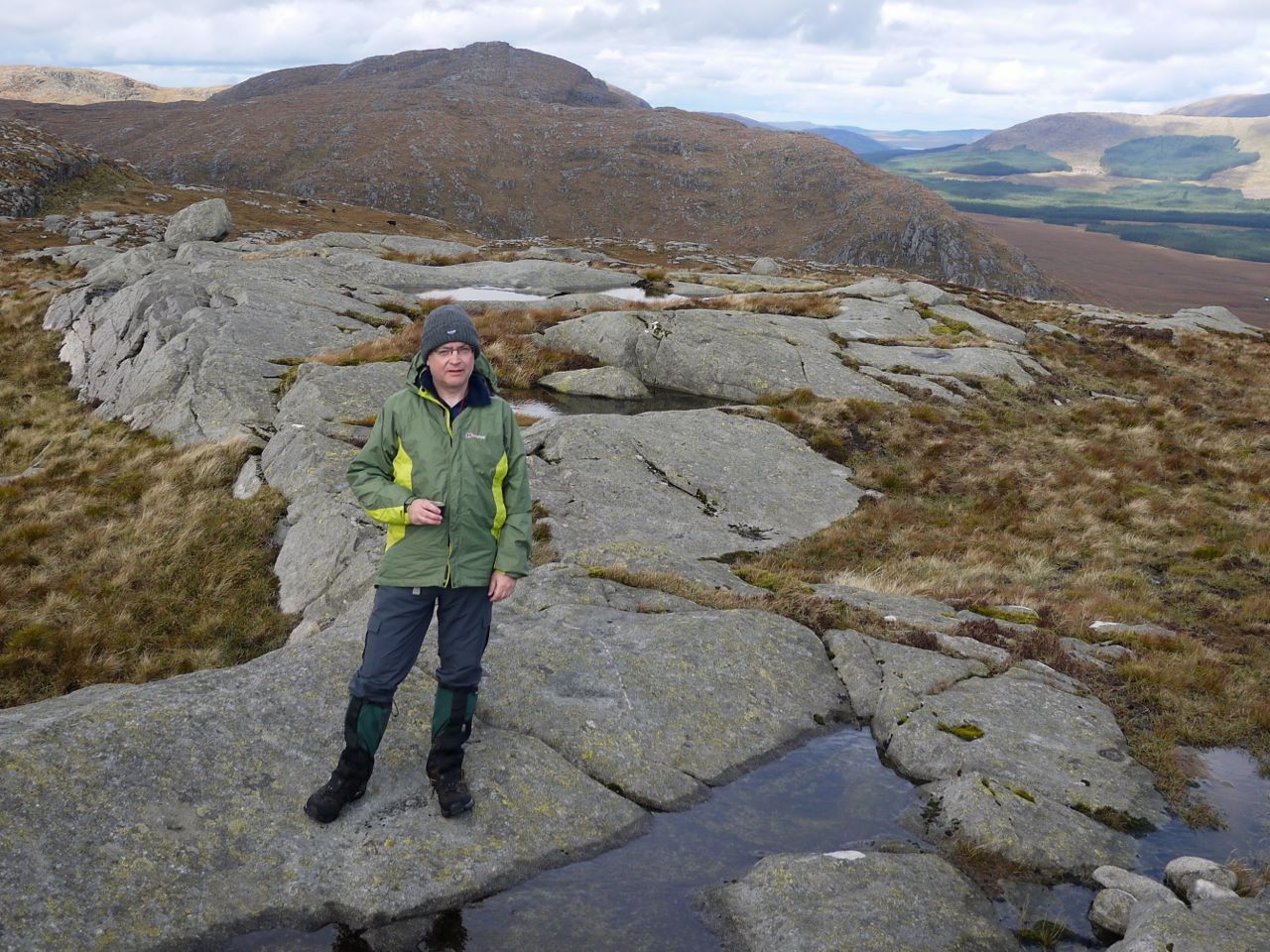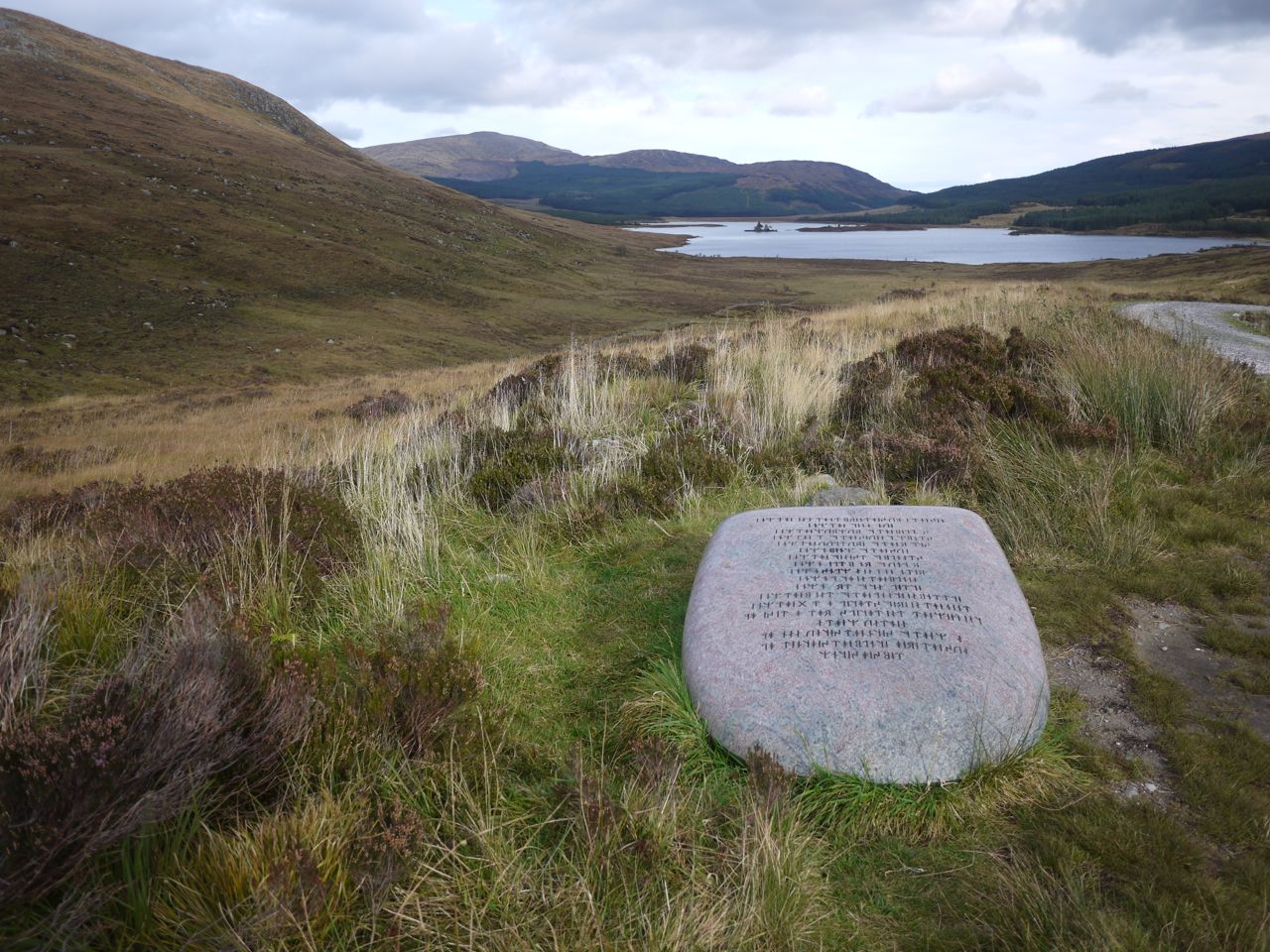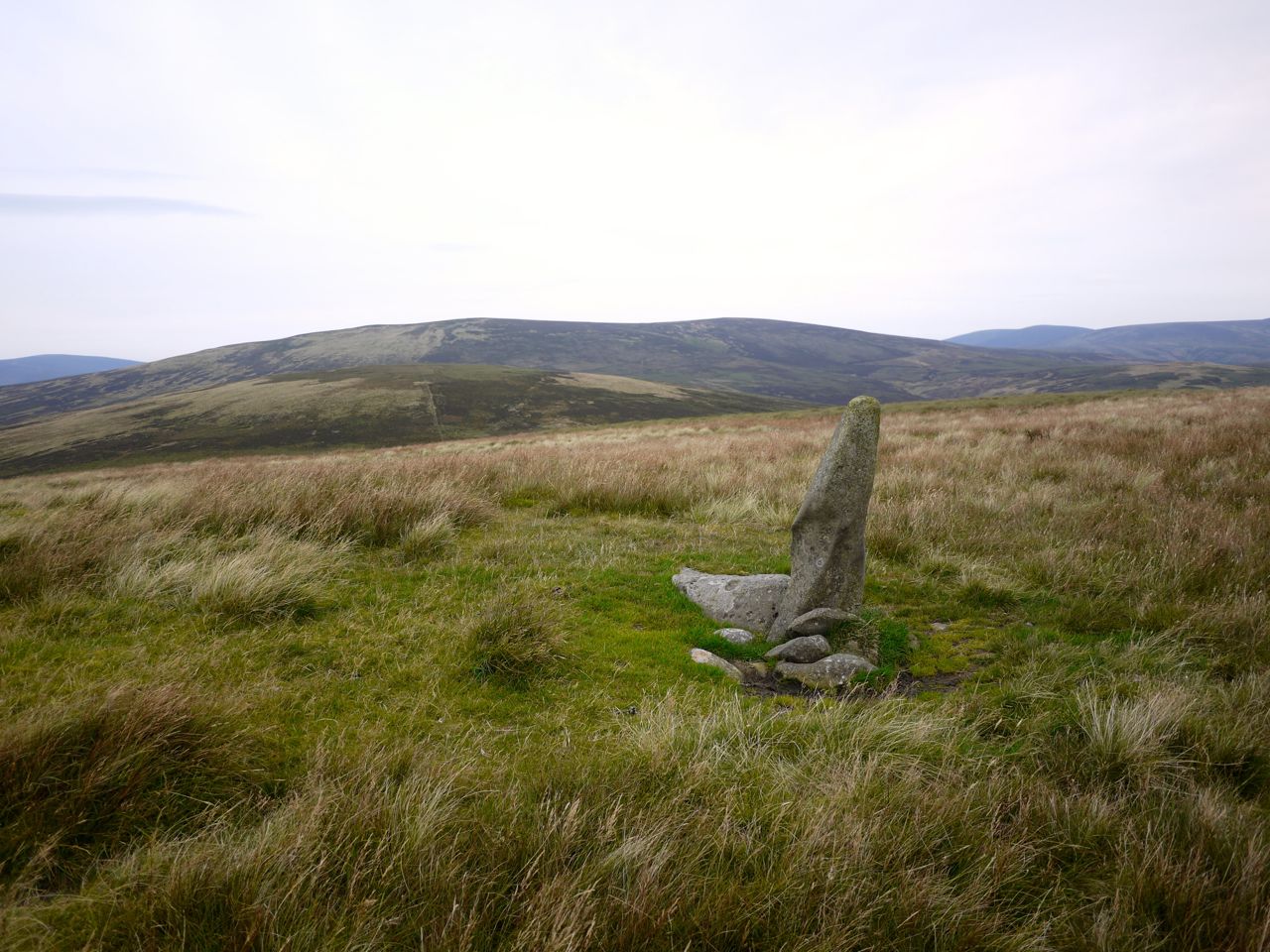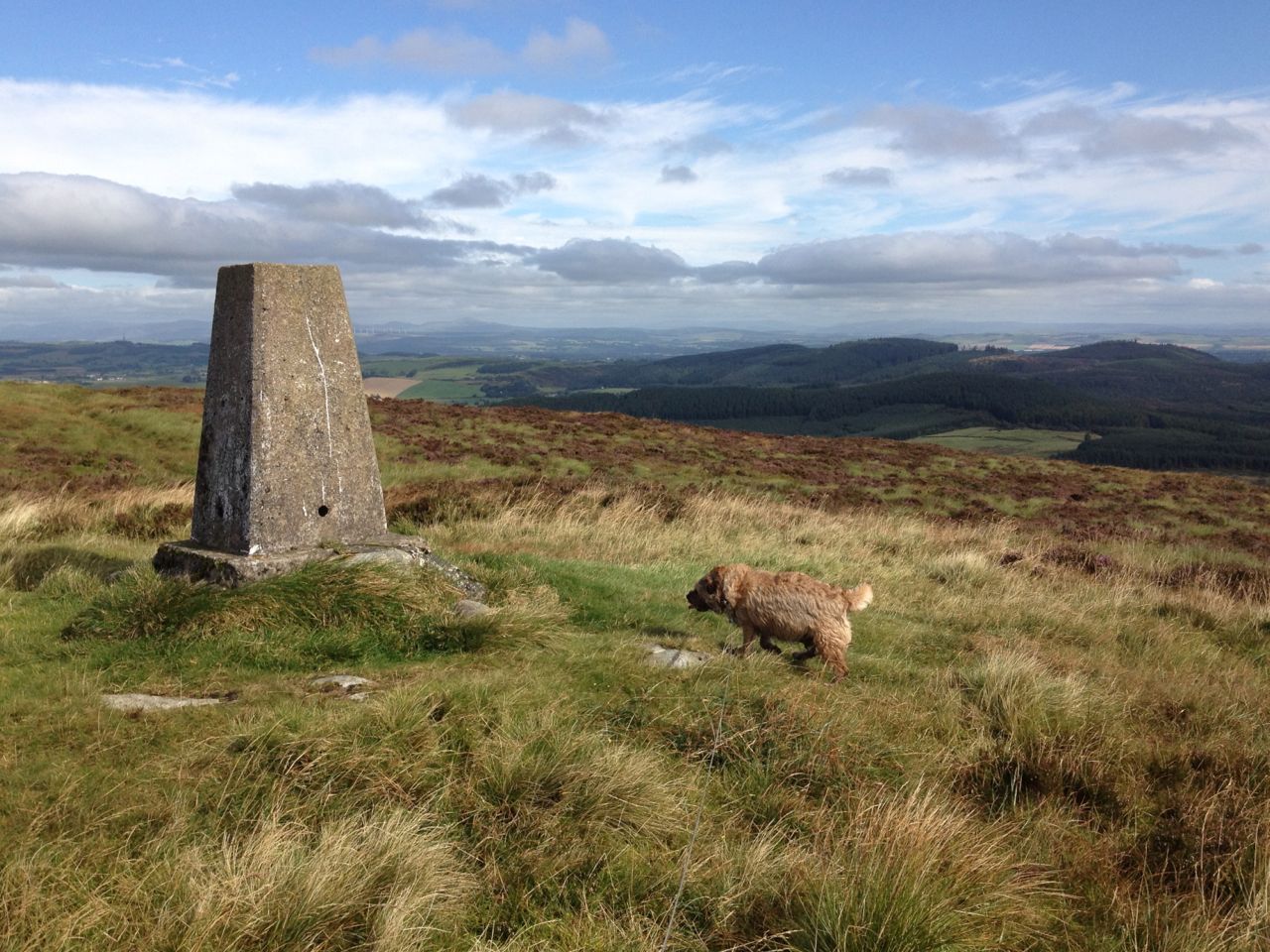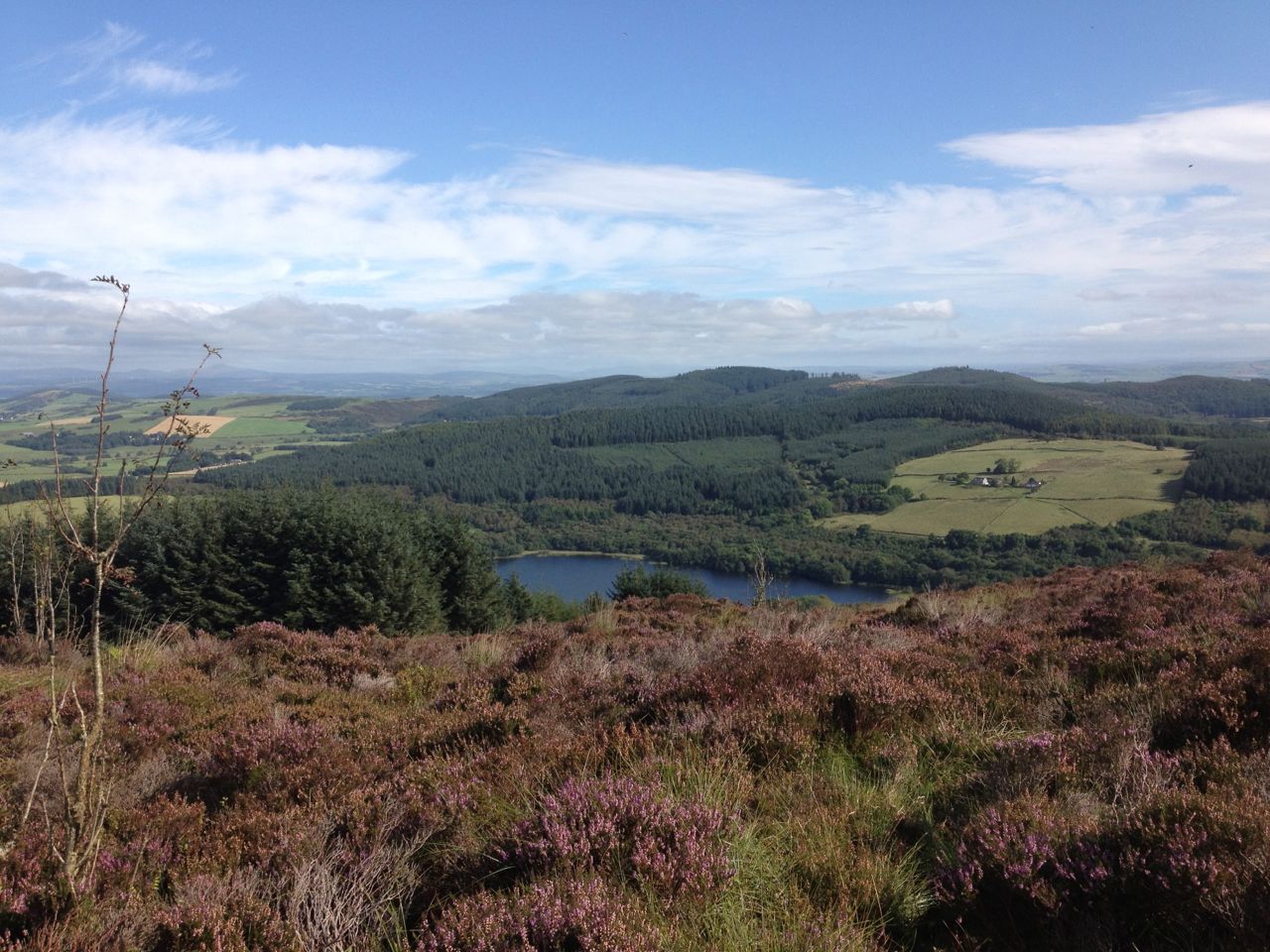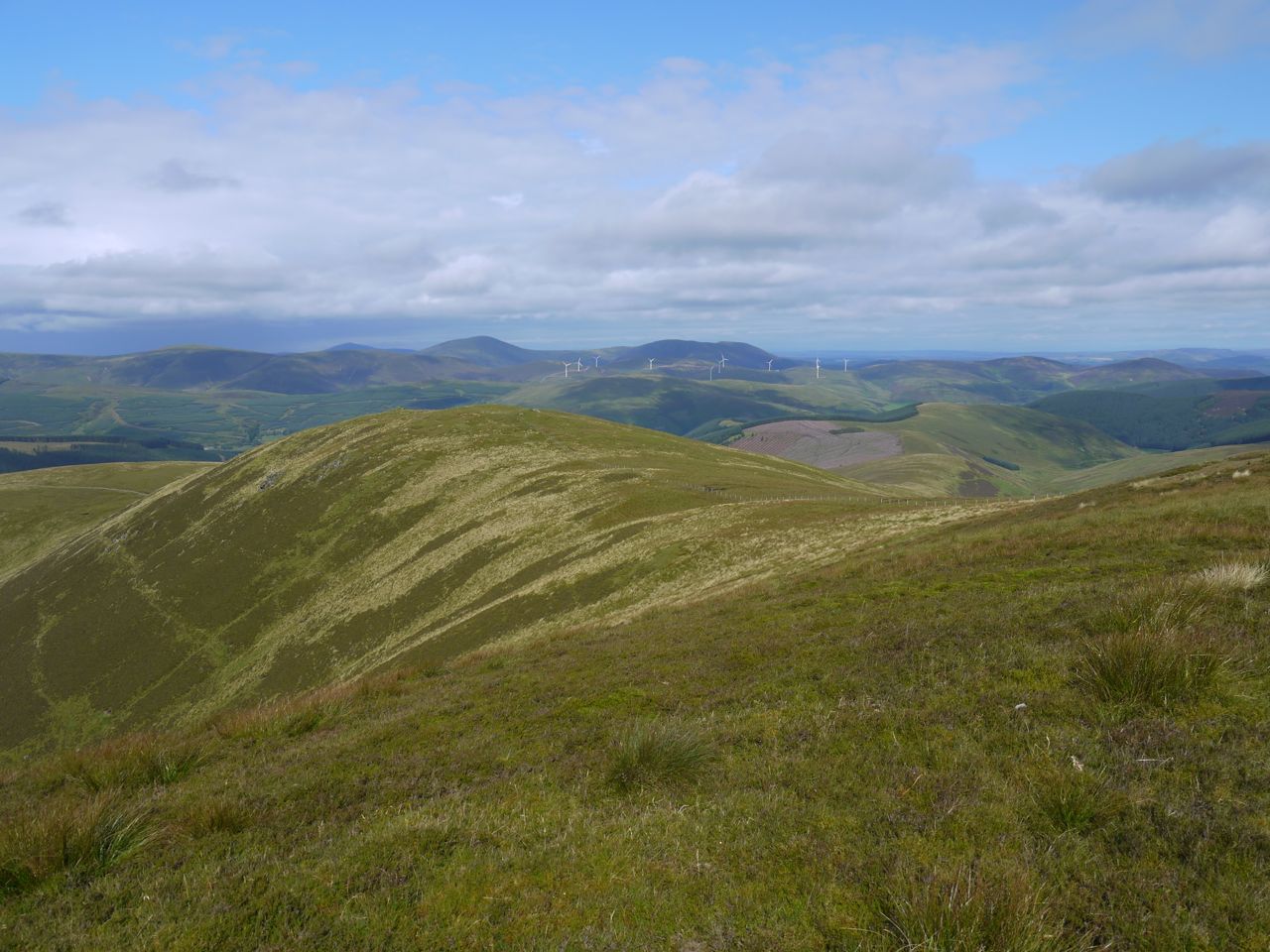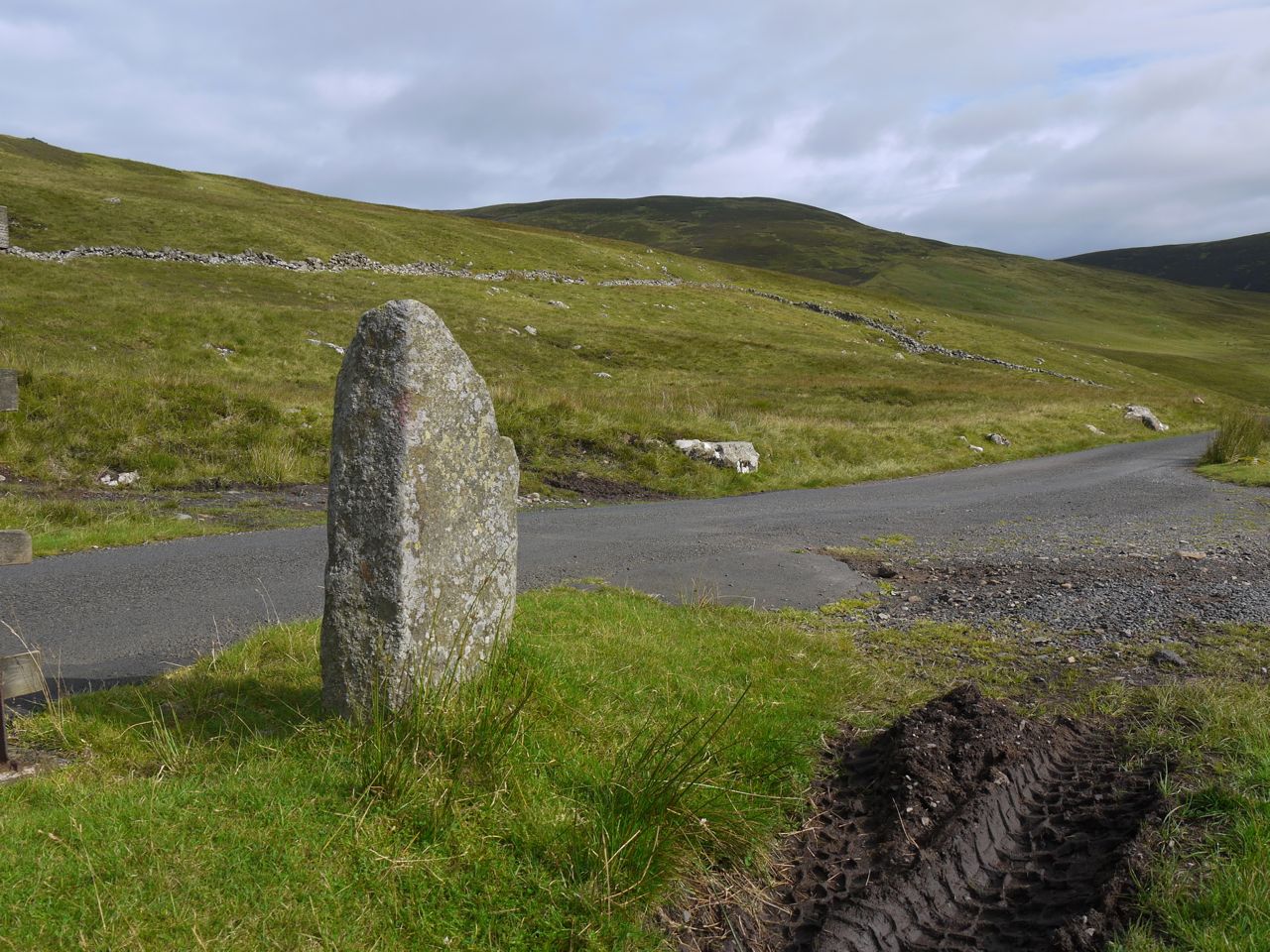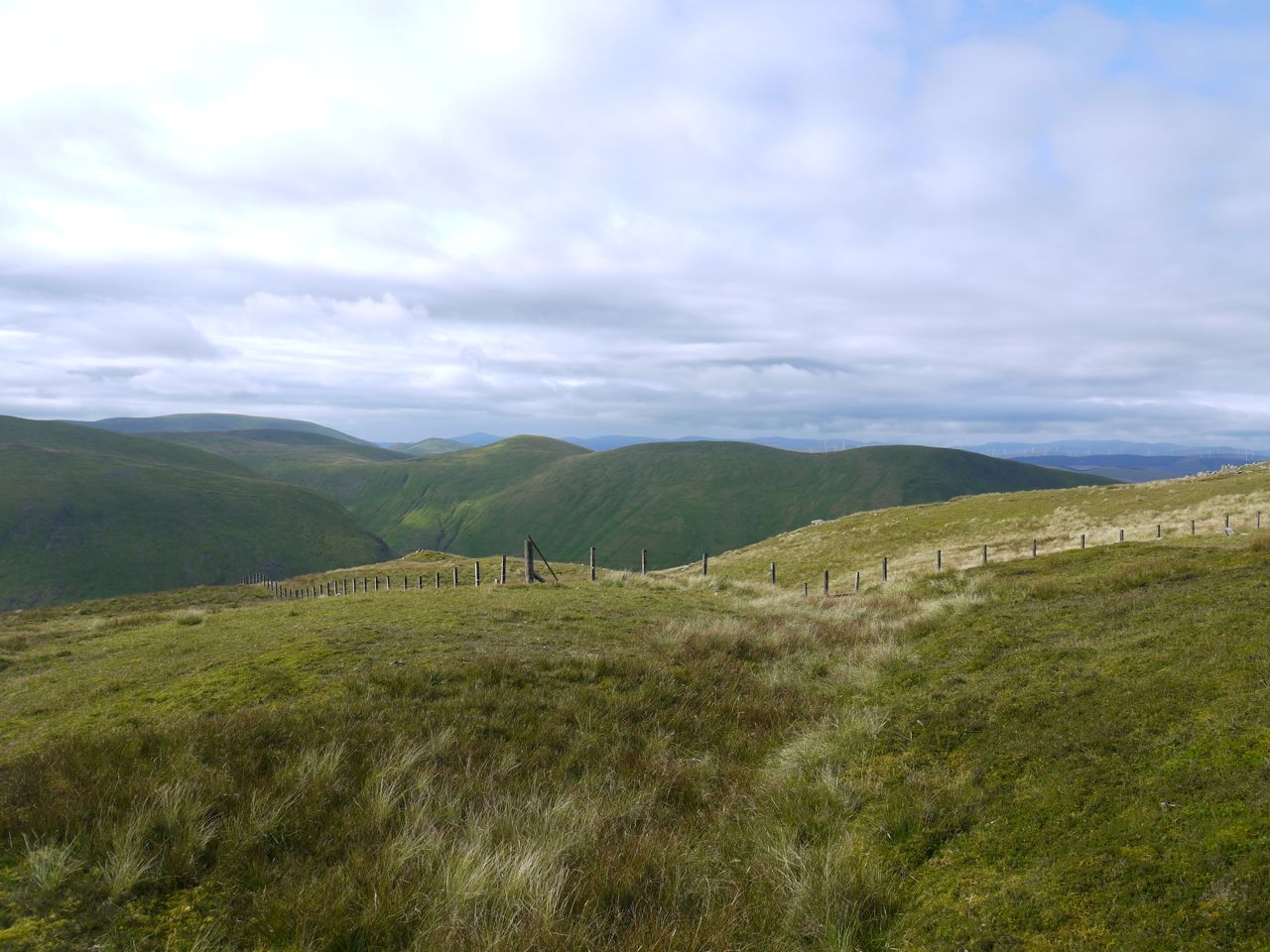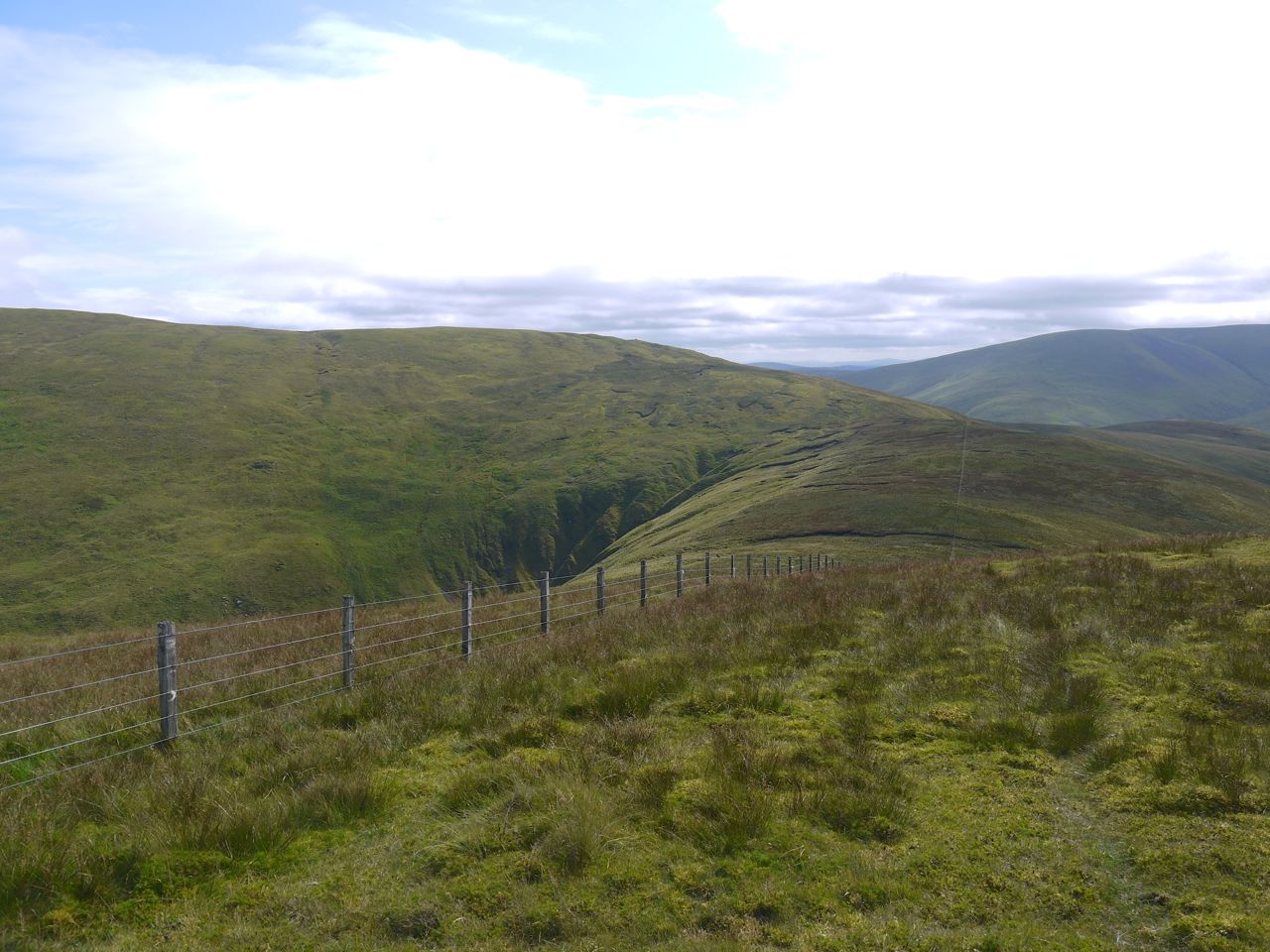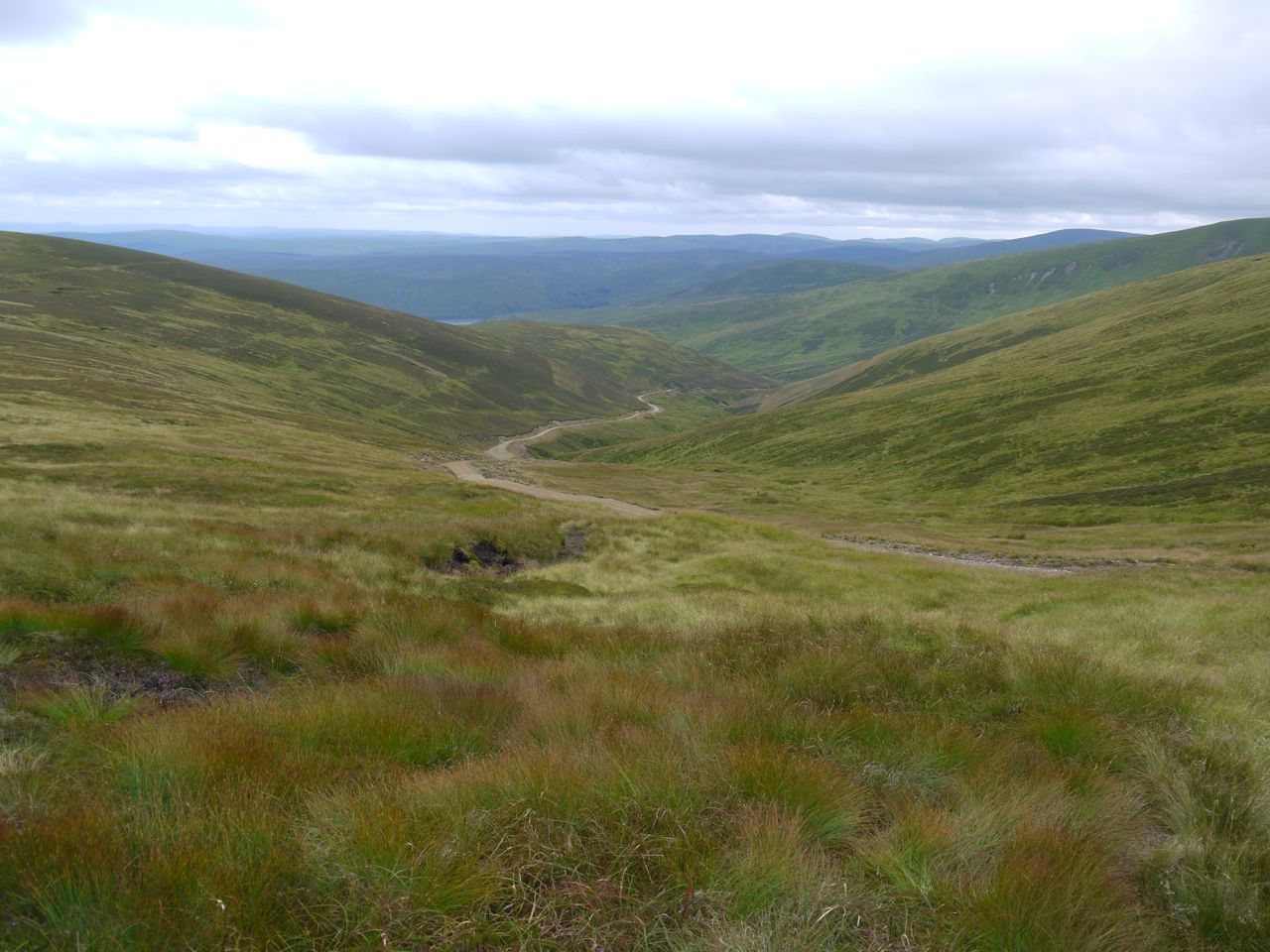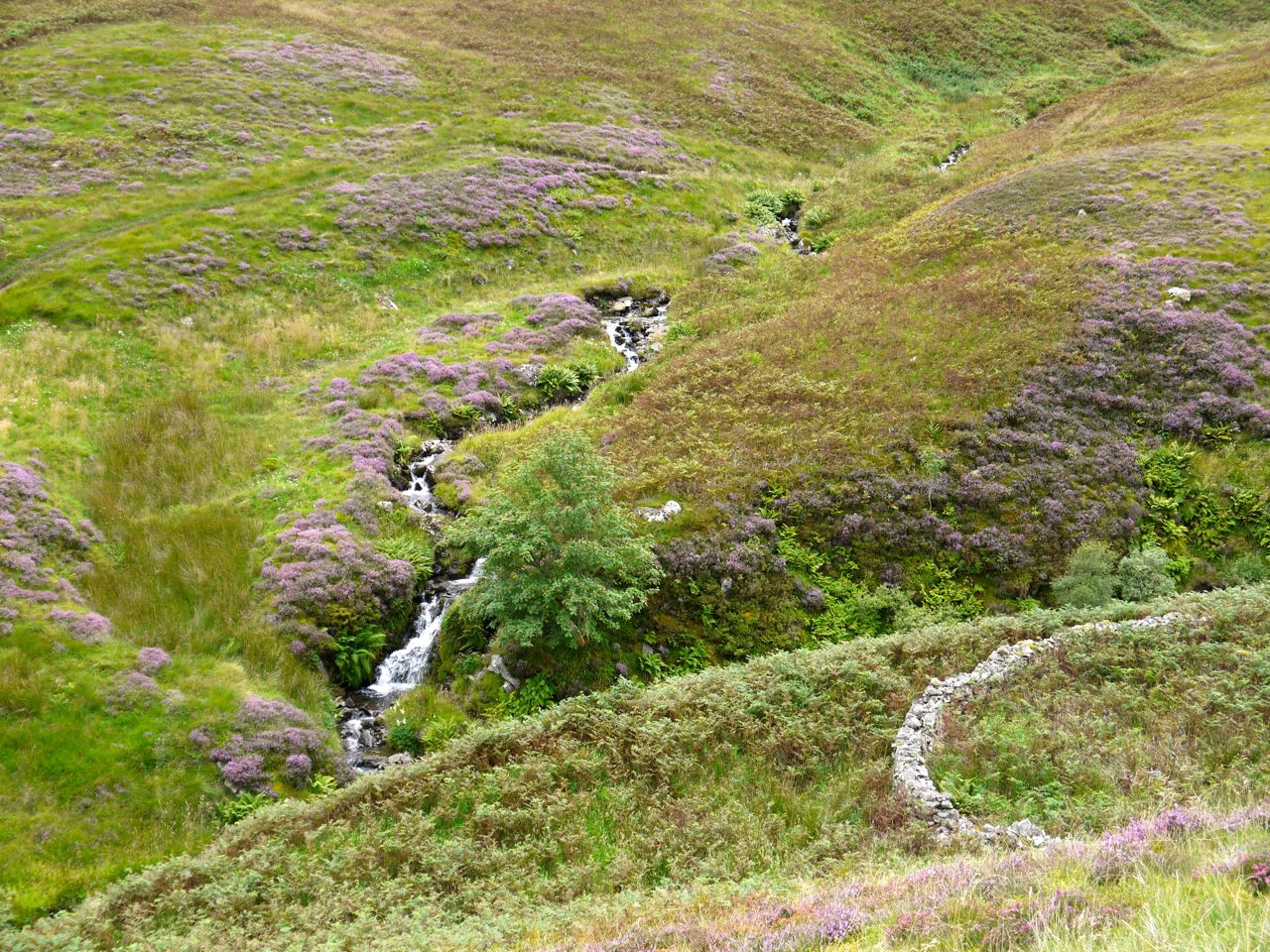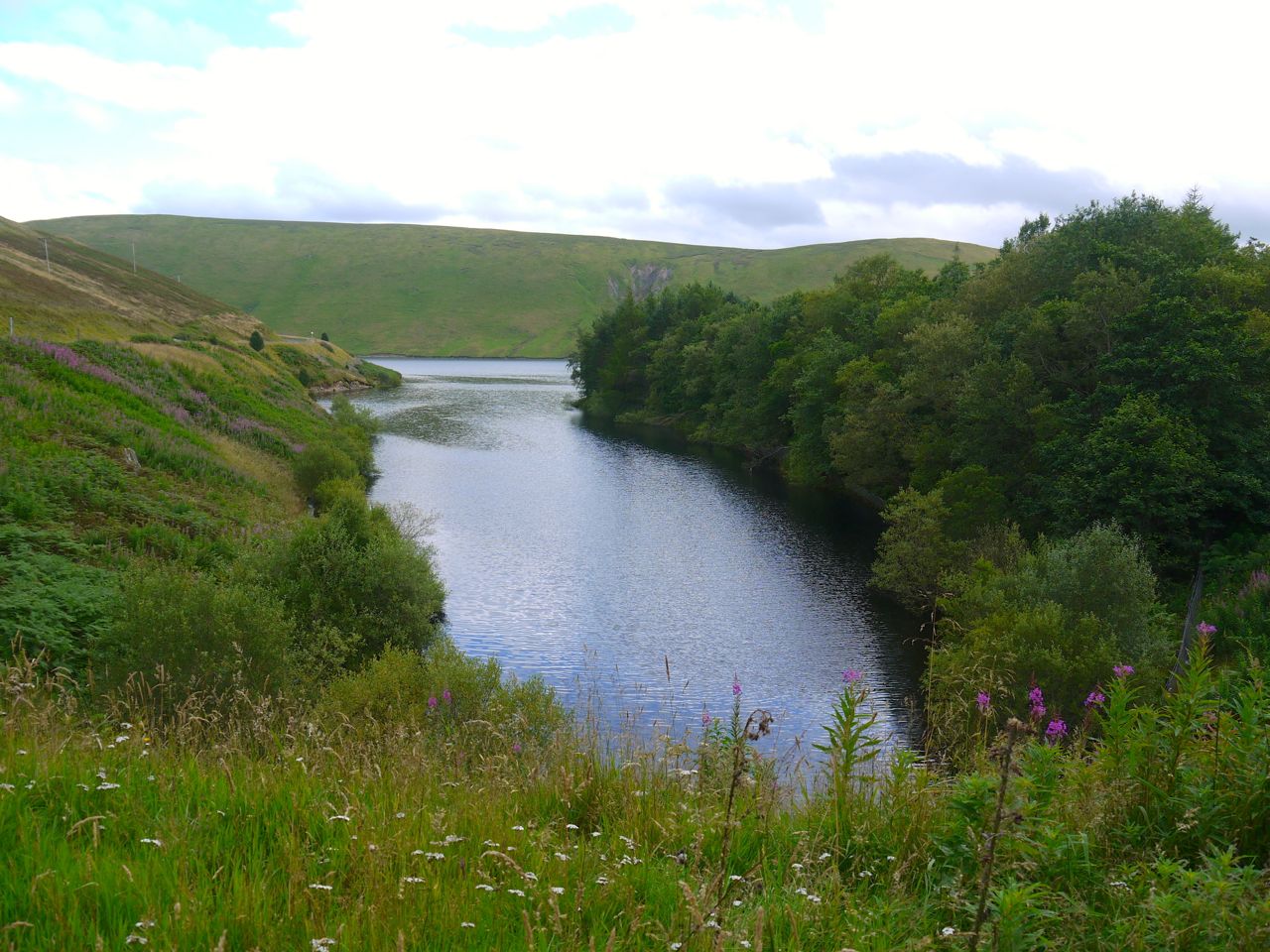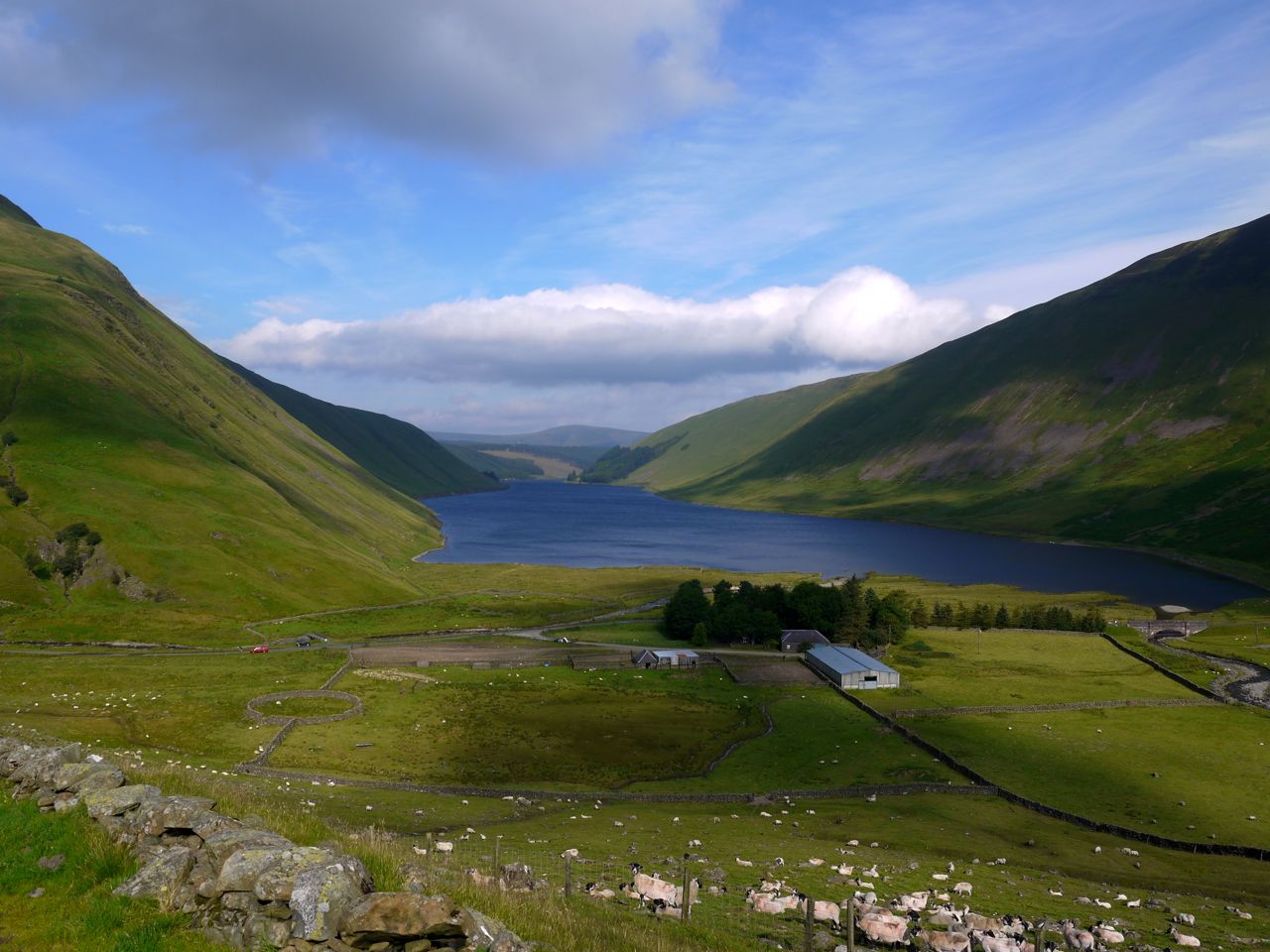
Loch Trool-Gairland Glen-Rig of the Jarkness-Craiglee-Glenhead
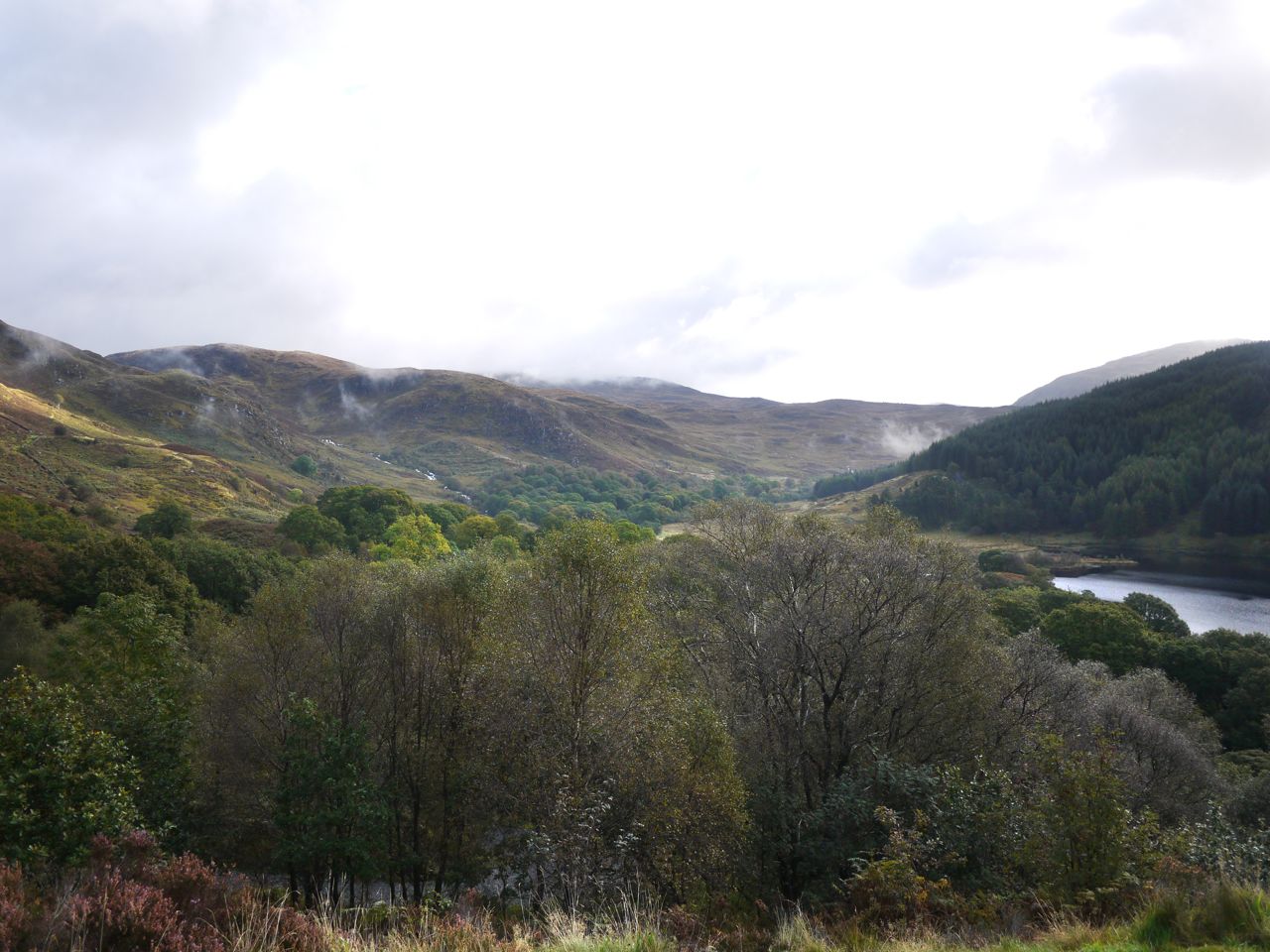
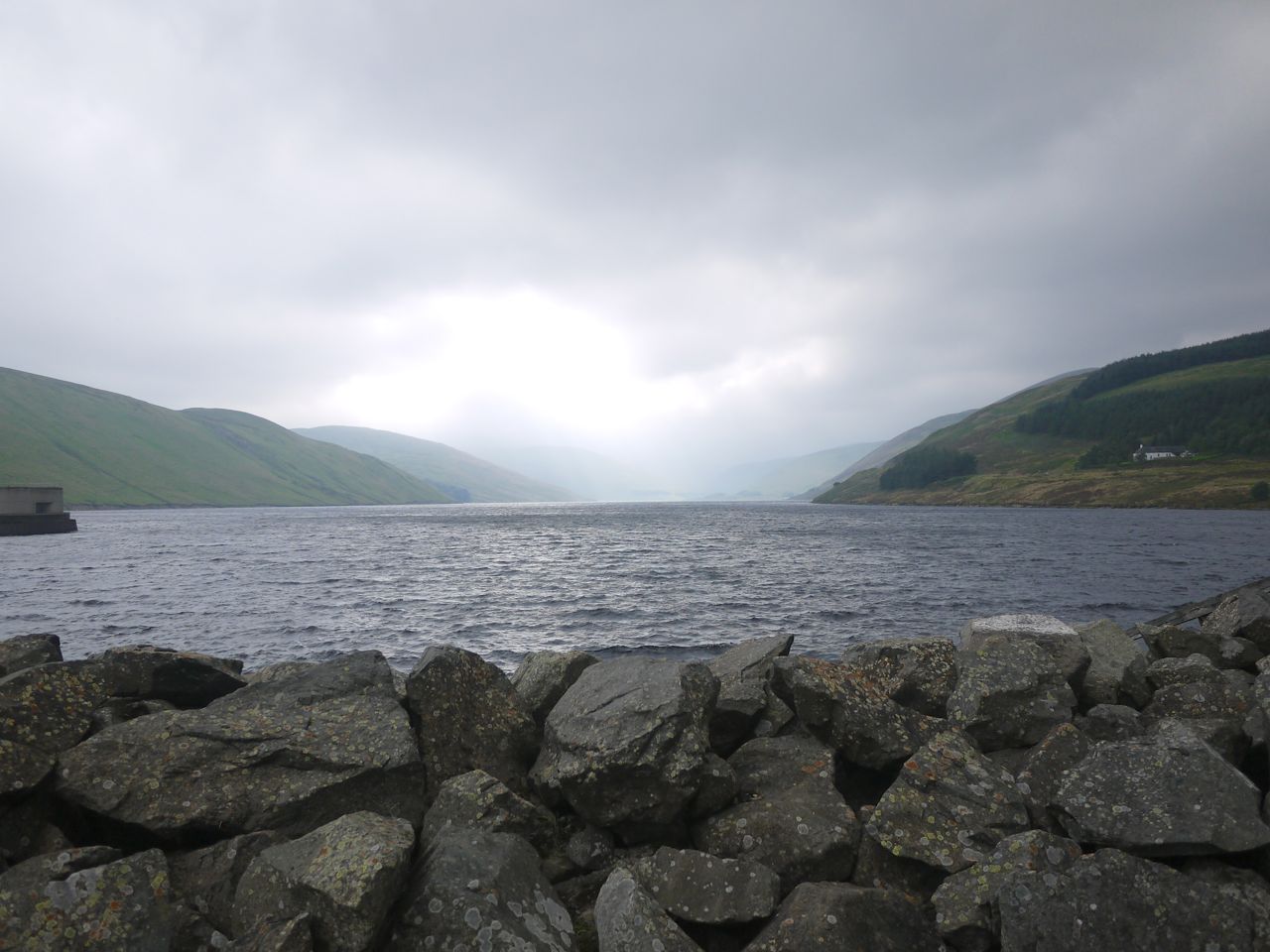
Best done during a hose-pipe ban. I started with a stroll up to Bruce’s Stone overlooking the loch. From there I could see the white water of the Gairland Burn which worried me since my route would entail its crossing but the weather looked great with sunshine and some wisps of morning mist, and autumn’s colours filled the glen.
Gairland burn in the distance
My first section would take me up the side of Buchan hill to the Gairland Burn and when I set off it was with the enthusiasm of the seven dwarves singing on their way to work (hi ho, hi ho, etc). Once I left the road however, the mud required all my attention, silencing my inner voice. This section hadn’t been this muddy the last time I was here, and the higher sections even then had been a quagmire. What lay ahead?
Anyway, I picked my way along the muddy track congratulating myself on the decision to wear gaiters when one muddy section proved surprisingly deep, my leg sinking to well above boot top. Beware here, there is a temptation to step to the side of the boggy path, but the whole section is terraced, though hidden below undergrowth, so it is easy to take a tumble. Perhaps I should have unstrapped the trekking pole, but that would have impeded my sudden arm waving when trying to maintain balance.
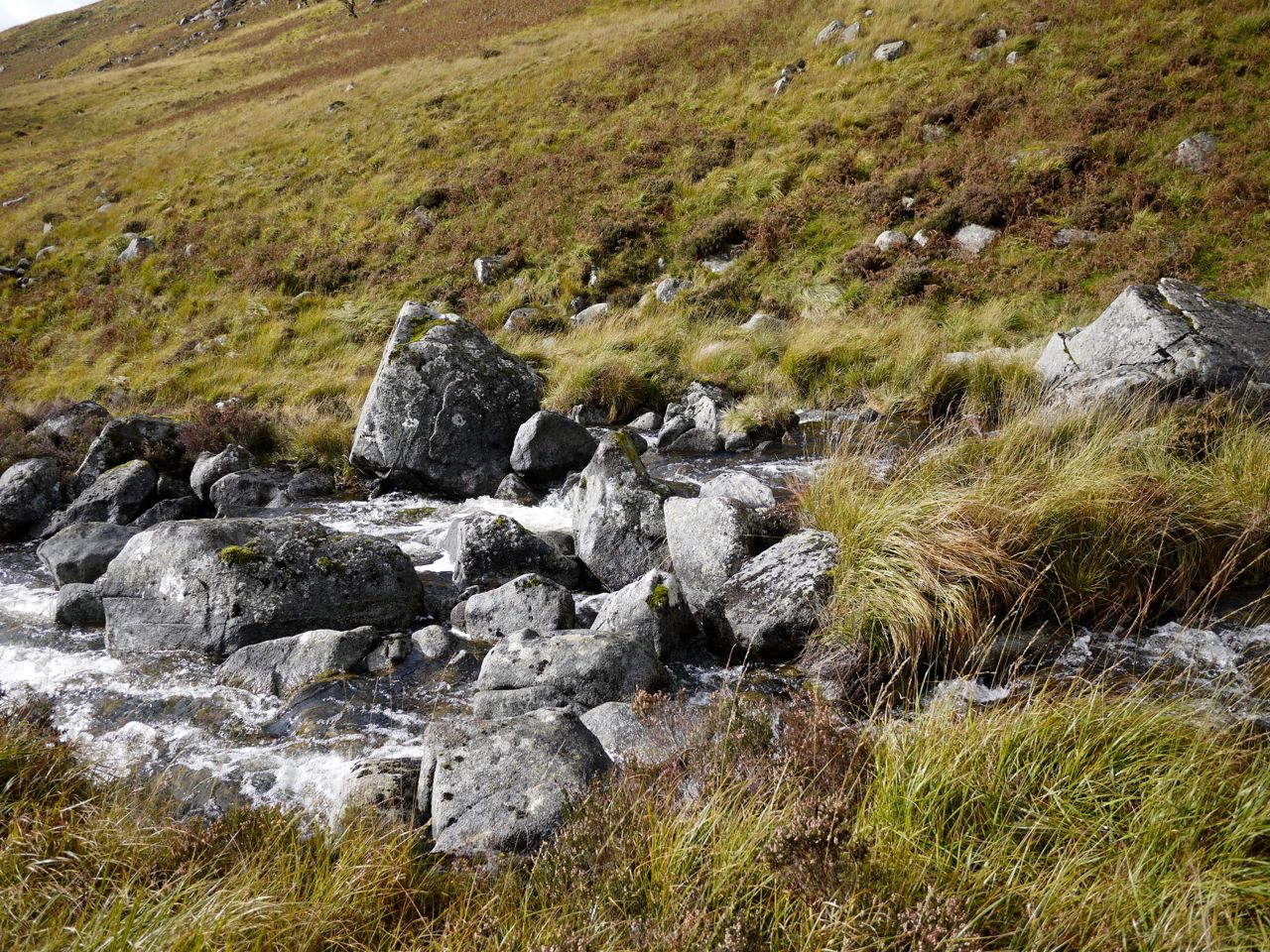
The plan was to cross the Gairland Burn at the section marked “ford” on the OS map, but I can only presume the ford has been washed away. The burn was not in spate, however, but neither was it in drought. There is a section where the burn splits forming a small island but the water either side was rather intimidating so I chose a spot immediately downstream of the island where there is a large boulder midstream.
Gairland Burn crossing
The rocks were wet and slippery and crossing did require the use of some submerged rocks, but at least that washed the mud off my boots. I had hoped for best but planned for the worst, putting all my possessions into waterproof bags before the crossing, but made it across in one piece. Amongst the things I packed away was my watch, which was to have an effect later in the walk.
Once across the burn there was a flat area of boggy tussock grass which looked as though it should be easy walking but wasn’t, and then the climb up to the Rig of the Jarkness, which in places required the use of hands. I hesitate to call it scrambling when it is on vegetation.
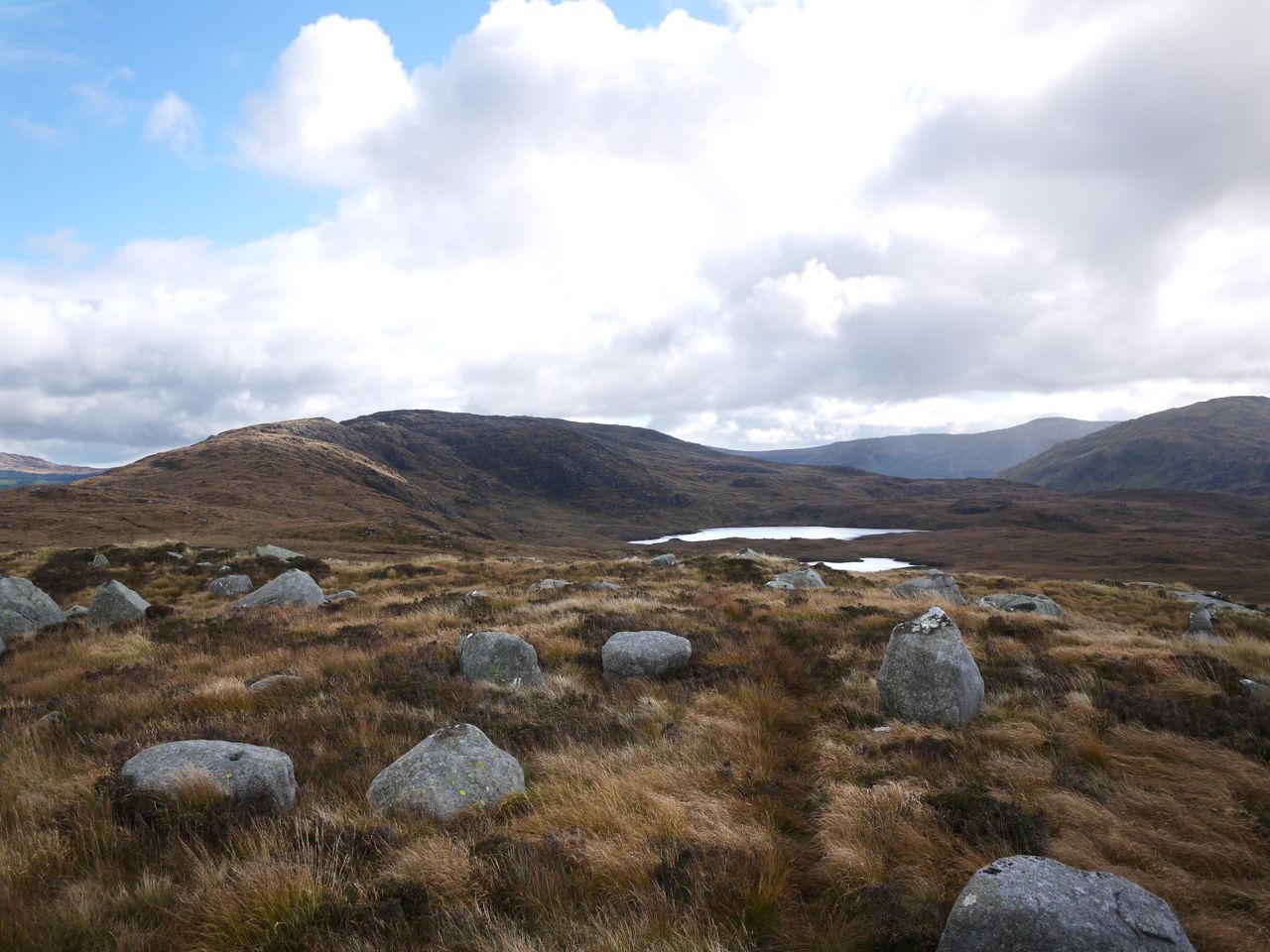
Once up on the Rig the views were fantastic. I slowed to a snail’s pace looking around at the Dungeon Hills, Merrick and Curleywee. The terrain here is granite blocks embedded in boggy grass with numerous scattered erratics. Looking southwards, in the direction of the sun, the ground sparkled with reflected sunlight, as if someone had sprinkled glitter over the entire hill. I found myself just stopping to take in the view and listening to the silence. In fact it wasn’t silent. Just at the limits of hearing I could hear a waterfall. Wonderful.
Merrick from the Rig of the Jarkness
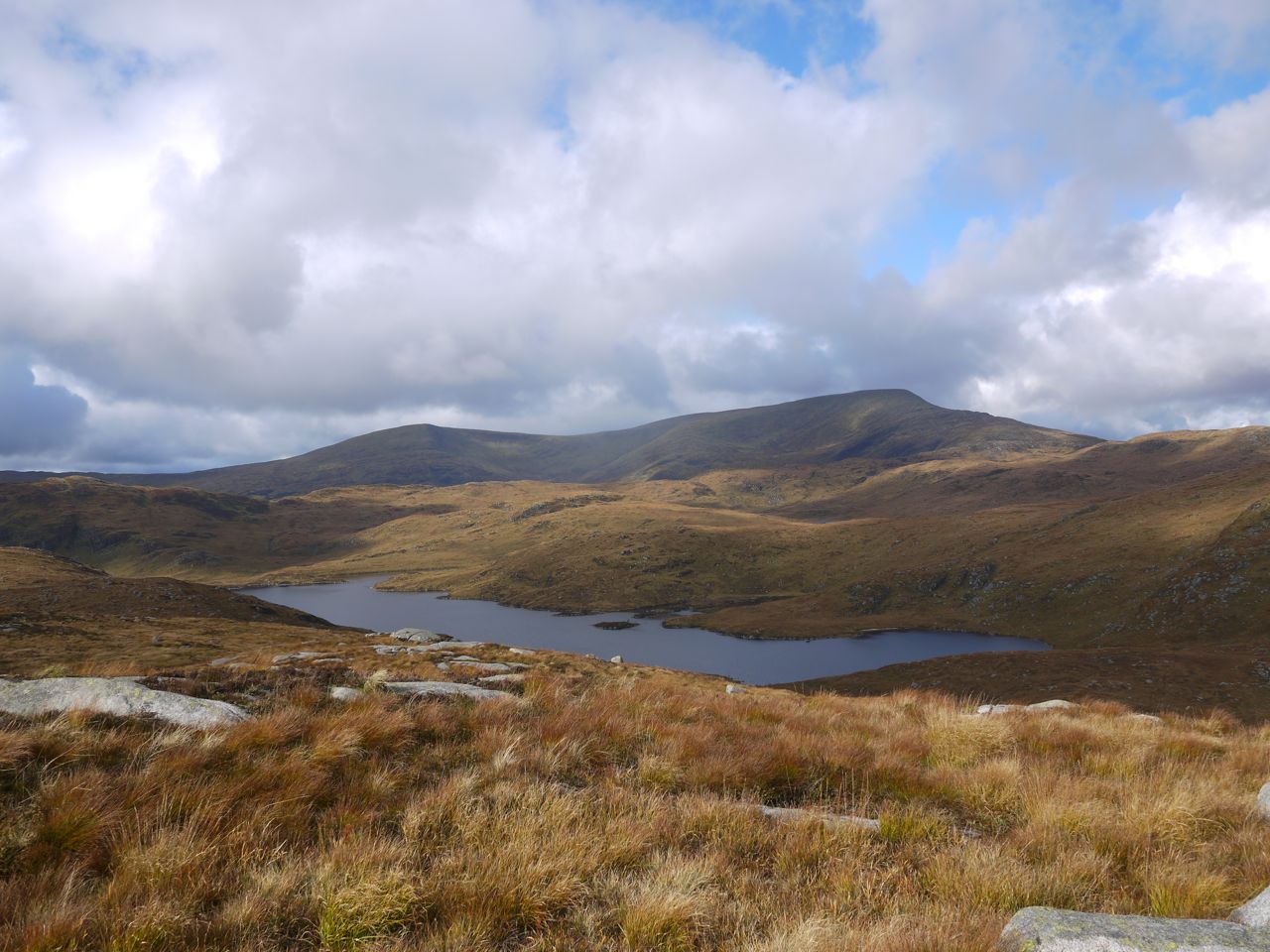
I had read that ten lochs can be seen on this walk so I was keeping a count. The most I could see at any one time was six, but throughout the walk, ten it was (Lochs Trool, Dee, Clatteringshaws, Long Loch of Glenhead, Round Loch of Glenhead, Dow, Narroch, Valley, Neldricken and Enoch).
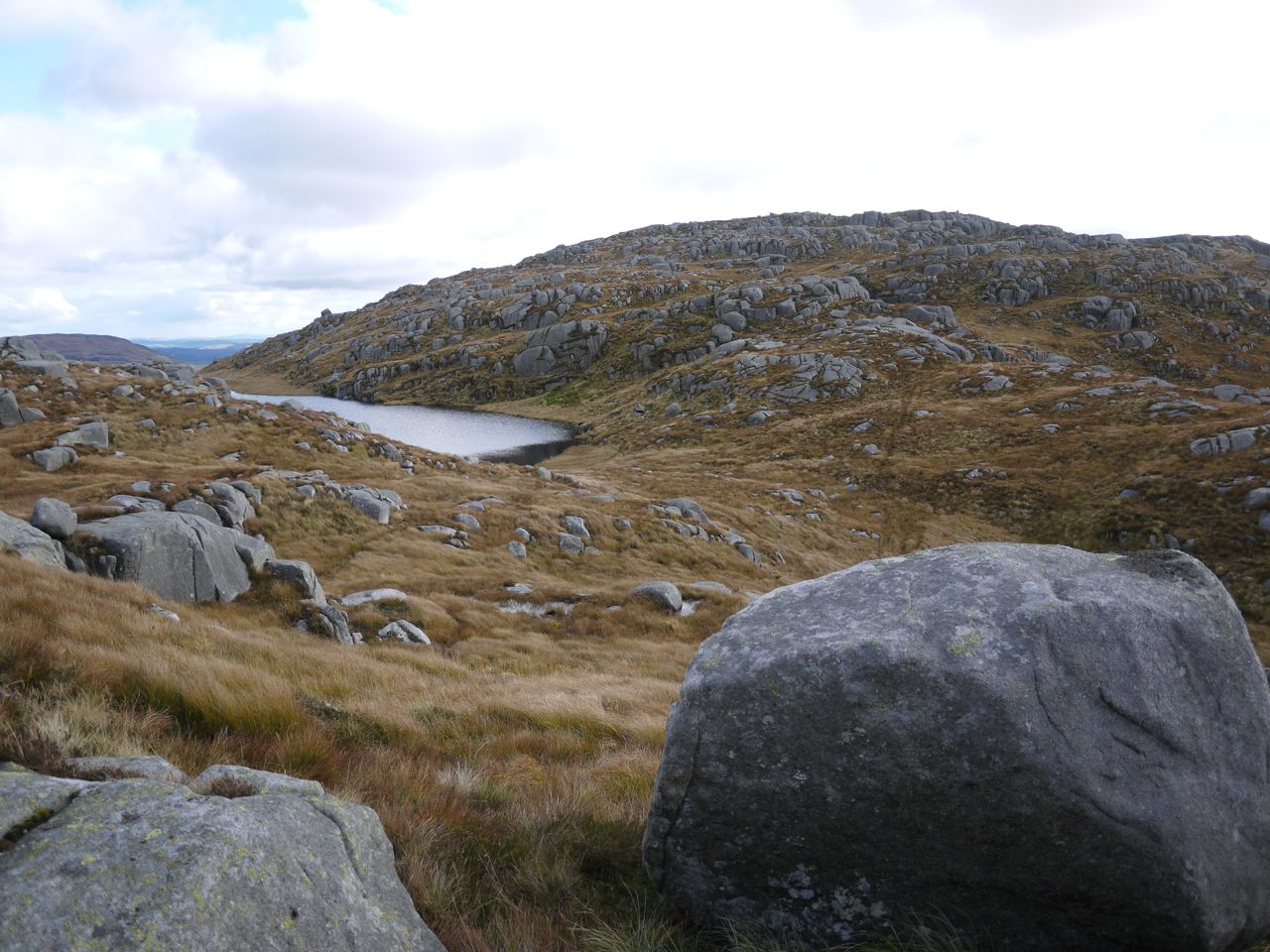
Wandering along the Rig of the Jarkness I would sometimes come upon a track but none that persisted. The ridge undulated and required some care in picking a route around water and over rocky knolls. The Clints of the Buss are a shoulder of Craiglee and mark a change from the relatively flat Jarkness to a rocky climb with a significant worsening in the bogginess. This is particularly bad around the Dow Loch and the small lochans nearby. Some of this mud is deeply churned and had deep round prints reminiscent of the mud near farm gates and much to my surprise I spotted four cows grazing at about 500m.
Dow Loch
Once at the Dow Loch I was beginning to feel a little weak and decided to stop early for lunch. The original lunch spot was to be Craiglee’s summit, still over a kilometre away. As I was getting the sandwich out however, the rain started so I took out my jacket instead and carried on in the hope that the rain would soon stop.
Craiglee and the Glenhead Lochs
The final half mile to the summit involved crossing several rocky ridges. These were a little like false summits except having reached the top of one of these ridges I had to climb down before climbing the next, and all this on an empty tank.
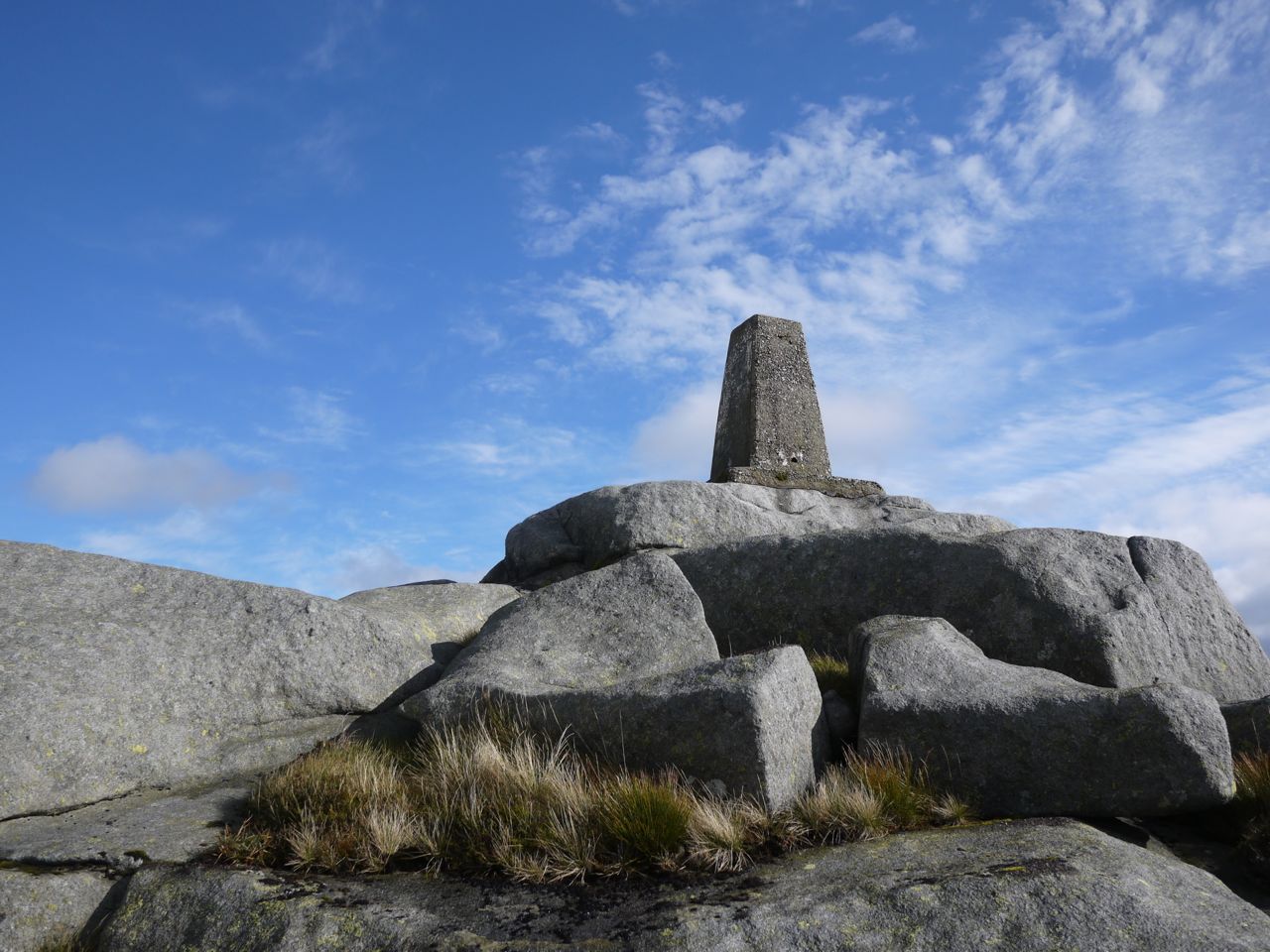
At the summit I dug out my watch and realised I had been walking for 3h 45m without a break other than my pauses on the rig. No wonder I felt washed out. Lunch certainly revived me. Craiglee’s trig point sits on a pile of boulders and has excellent views. I could even see the Silver Flowe glittering, living up to its name.
Coffee on Craiglee
From the summit I intended to head directly down to where the SUW crosses Dargall Lane near the Giant’s Axehead. I took a bearing and found that I could use the the burn coming off Curleywee as my target.
Unfortunately I could not find a safe way off Craiglee in that direction and had to backtrack a good 250m to avoid the bluffs. The rest of the descent was mostly boggy tussock and hidden watercourses. I came across several deep holes with water cascading down them and even more areas where I could hear them but not see them. I presume one of these might be the Buck’s hole marked on the map. I would worry about this route in poor visibility. It was certainly a relief to reach the firm track of the SUW.
Giant’s Axe Head and Loch Dee
Despite weary legs I detoured to the Seven Stanes’ Axehead and used it as an excuse for a quick break. from there I just followed the SUW back to Glenhead (downhill) then the road back to the car (uphill).
The Rig of the Jarkness is a beautiful place, a secluded wilderness with wonderful views. The routes to it are not difficult but do exact a price in effort, but that probably contributed to the effect of the rig.
PS I’m annoyed that I can’t find a convincing meaning for the Rig of the Jarkness. It is suggested to mean the ridge of the turbulent waterfall, but the absence of a turbulent waterfall is a little odd if that were true. The best I have come across is [rig (angl.), “ridge, back”+dearg (gael.), (a specific shade of)”red”+ness, (norse/danish) “nose,promontory”].
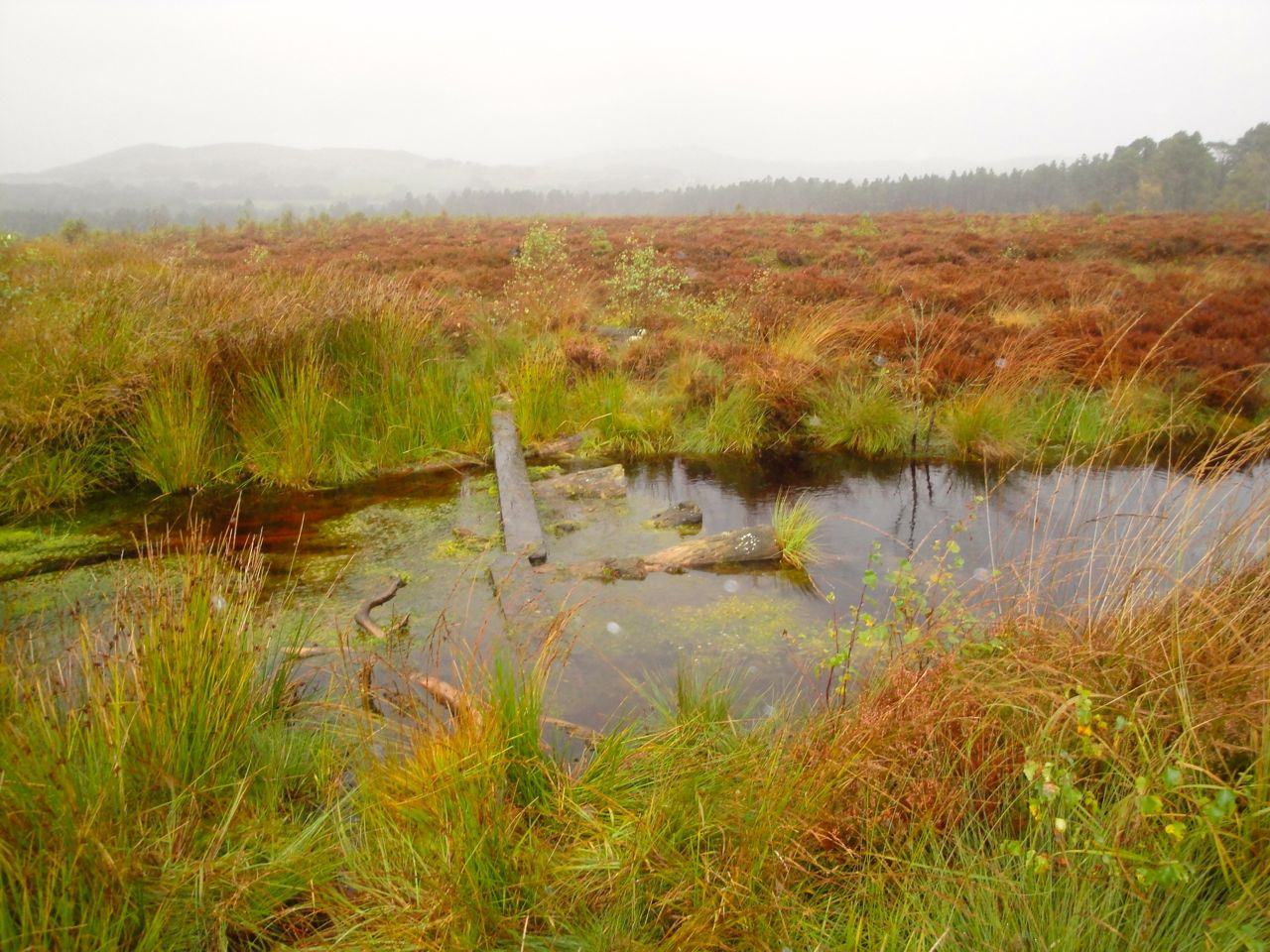
Today there was a important conjunction of environmental and personal events, heavy rain and laziness, which led me to choose an easier walk in place of that originally planned. (Shakes head) Had I learned nothing from the Almorness misadventure?
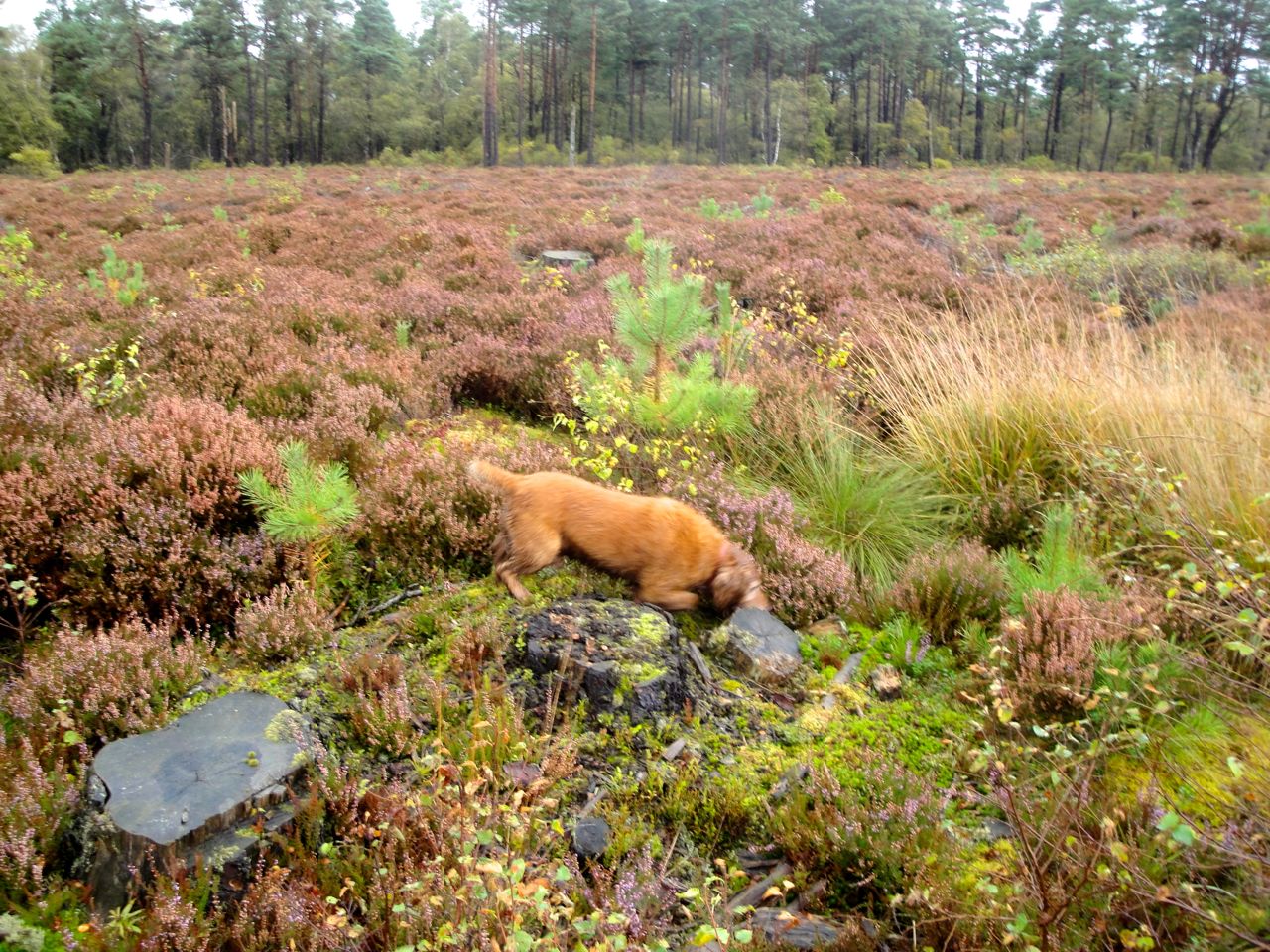
Rather than climbing hills I decided take the dogs for a slightly longer walk than usual. Though obviously not too far since they’re getting a bit grey in the muzzle. I thought a stroll around the nature reserve at Kirkonnell Flow would be reasonable. I even thought I could call the report “Kirkconnel Flow: first recce”. Well it didn’t go to plan. Poor Sweep is limping around the house and Leo is in hibernation.
The Scottish NNR say of it:
Restored from its formerly damaged state, this site represents one of the most threatened habitats in the world. The sodden surface of the bog is a palette of green, purple and red shades of Sphagnum mosses and wet-loving plants, giving a sense of a remote wilderness among the busy surrounding fields. Colourful butterflies flit over the moss, whilst adders and lizards bask in the sunlight.
Who could resist that? This raised bog has a floating pathway around its edges, which allows access for nature lovers such as me.
The car park was empty. The rain was heavy and the wind was strong. Both dogs were shivering. The information board was empty. All of this contributed to the atmosphere of wilderness.
Having said that, a well constructed path of wood bark leads from the car park. The visibility, firmness and dryness of this path follows the inverse square law, whereby its quality deteriorates rapidly as one walks from the car park. But that is probably appropriate in order to maintain the feeling of wilderness.
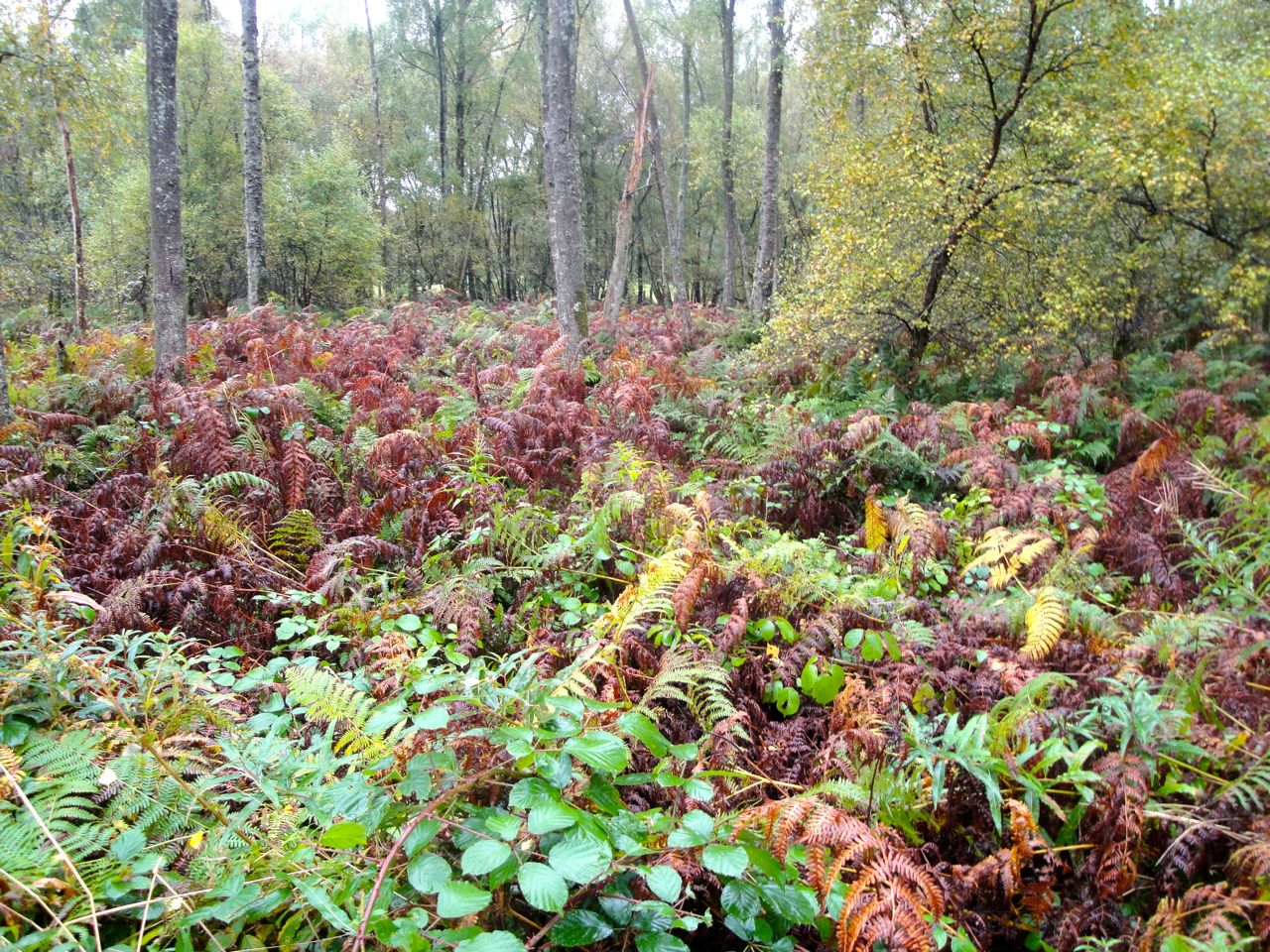
I am sure that I would have appreciated the flora better were it not for the heavy rain. There were certainly a great variety of plants in their autumnal colours.
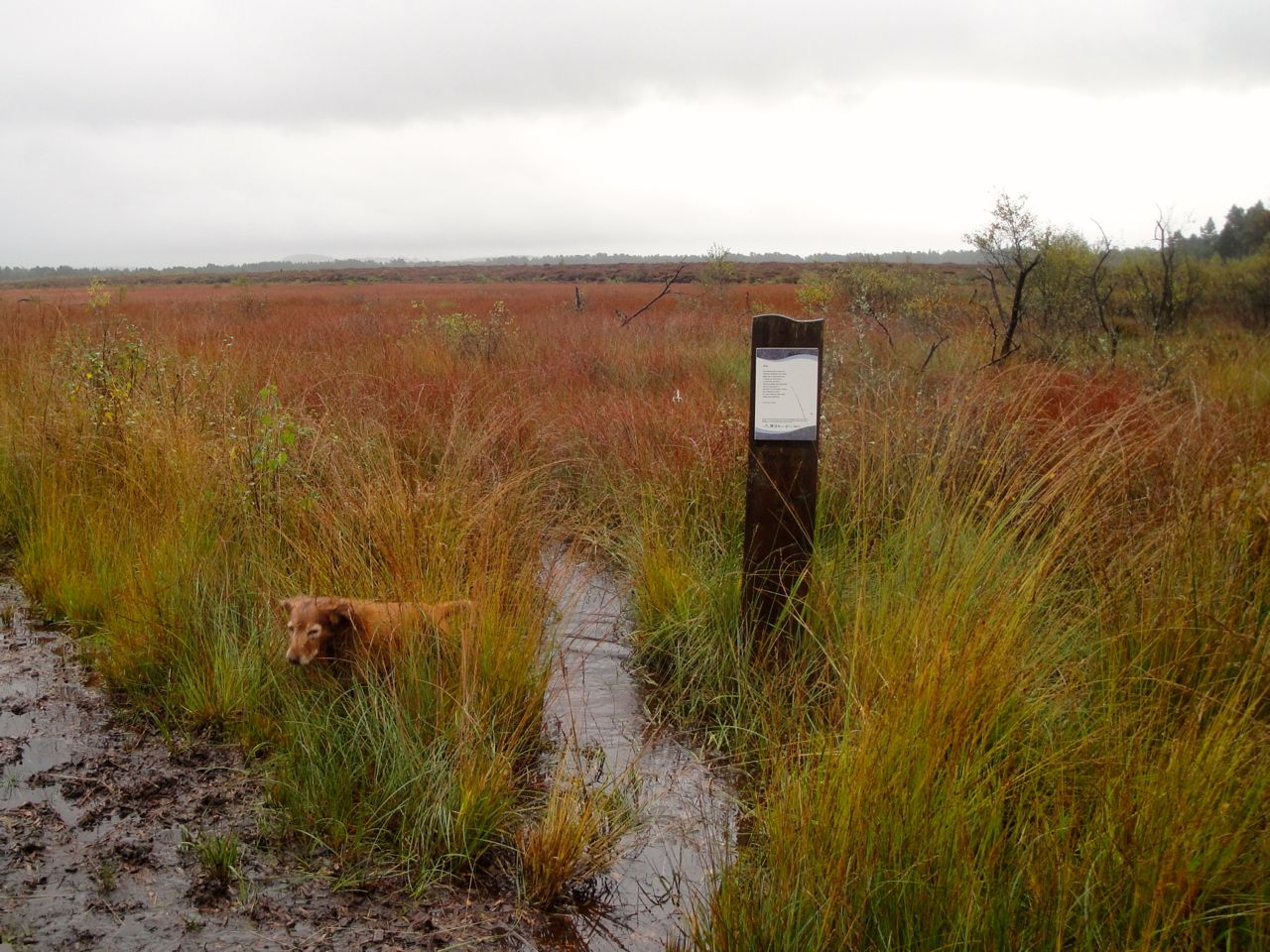
The bark path gradually became waterlogged so that its consistency was like porridge, the dogs’ legs, and my boots, sinking significantly. I thought it best not to stand still. Then the bark ended. It was possible to follow a faint track which at times had posts nearby, which are presumably way-markers but unmarked.
My passage through this section was aided by knowledge from a detective novel I am reading at present. In this a murder victim is thought to have had some safety training since when walking along a tunnel in the London underground he had avoided stepping on the sleepers. These are apparently slippery and those who slip may come into contact with live tracks. The track in this section has numerous rotting logs across it, which were indeed extremely slippery so I did my best to step elsewhere. I was also careful to stow my camera before moving off. I’m not sure if the entire place is full of logs or if these are part of the path. I suspect the former.
There were large areas of standing water, but I suppose one can expect that in the middle of a bog during heavy rain. Sweep bounded from pool to pool while Leo and I edged around as best we could.
We then came upon a stretch of water with a couple of moss covered planks thrown across it. Sweep swam across and Leo, on an extendible lead, took the planks but had to swim part of the way. I edged carefully over but Leo decided to cross back as I did so upsetting my equilibrium. The final metre of planking disappeared below the surface so I leapt.
The thrice crossed water, from the far side
Imagine my surprise to find that the extendible lead in my hand suddenly became taut. Leo had walked around a bush and snagged the lead. I managed to make the far bank but the lead was well and truly stuck so I was forced to cross back, un-snag the lead, cajole Leo across in front of me and cross yet again.
The far side was more boggy but it was easy enough to find a way through and though it was now difficult to discern a path or track we did come to a gate in a fence which made me think I was still on track. Eventually we came to the end of the open ground and another gate.
Once in the trees there was a bark covered path but as before this gradually petered out. The path again became less distinct and eventually I could see no sign of it. On google earth the track is obvious but on the ground it must have been lost beneath the ferns.
So we carried on where I supposed the path would be, presuming that we would come upon it again. In the woods however I was straying further from the path and the undergrowth became increasingly difficult with dense undergrowth. I saw a break in the trees to my left and made for it, the undergrowth becoming even thicker and difficult for the dogs to get through.
Then ahead the trees ended, separated by a barbed wire fence from a lake. My heart sank as I contemplated backtracking through the woods. On closer inspection, however, the lake was merely a flooded field and it looked as if we could get across. There were no holes in the fence for the dogs so I had to manhandle squirming sodden dogs over the fence then get over myself.
The field proved easy enough except one section of water and mud which needed a just-go-for-it approach. Then we were on a road, near a junction. But what road? I hadn’t thought a map would be needed so finding the name of a farm on a sign wasn’t helpful. I did at least have a compass so was able to choose which road seemed to be going in the best direction and followed that back to the car park.
Sweep didn’t seem to like us stopping and took to barking at me whenever I stopped to think and consult the compass.
There is a very short section in trees after the fence and gate but after that I should have remained out of the the woods. I know now.
Though a relatively short walk this one needed three maps. To be honest it was an out-right Donald bagging expedition, but also an opportunity to try out my new piece of equipment: a fold up mat to spare my backside the from wet grass. I splashed out on this one paying the extra £1.50 for the deluxe version.
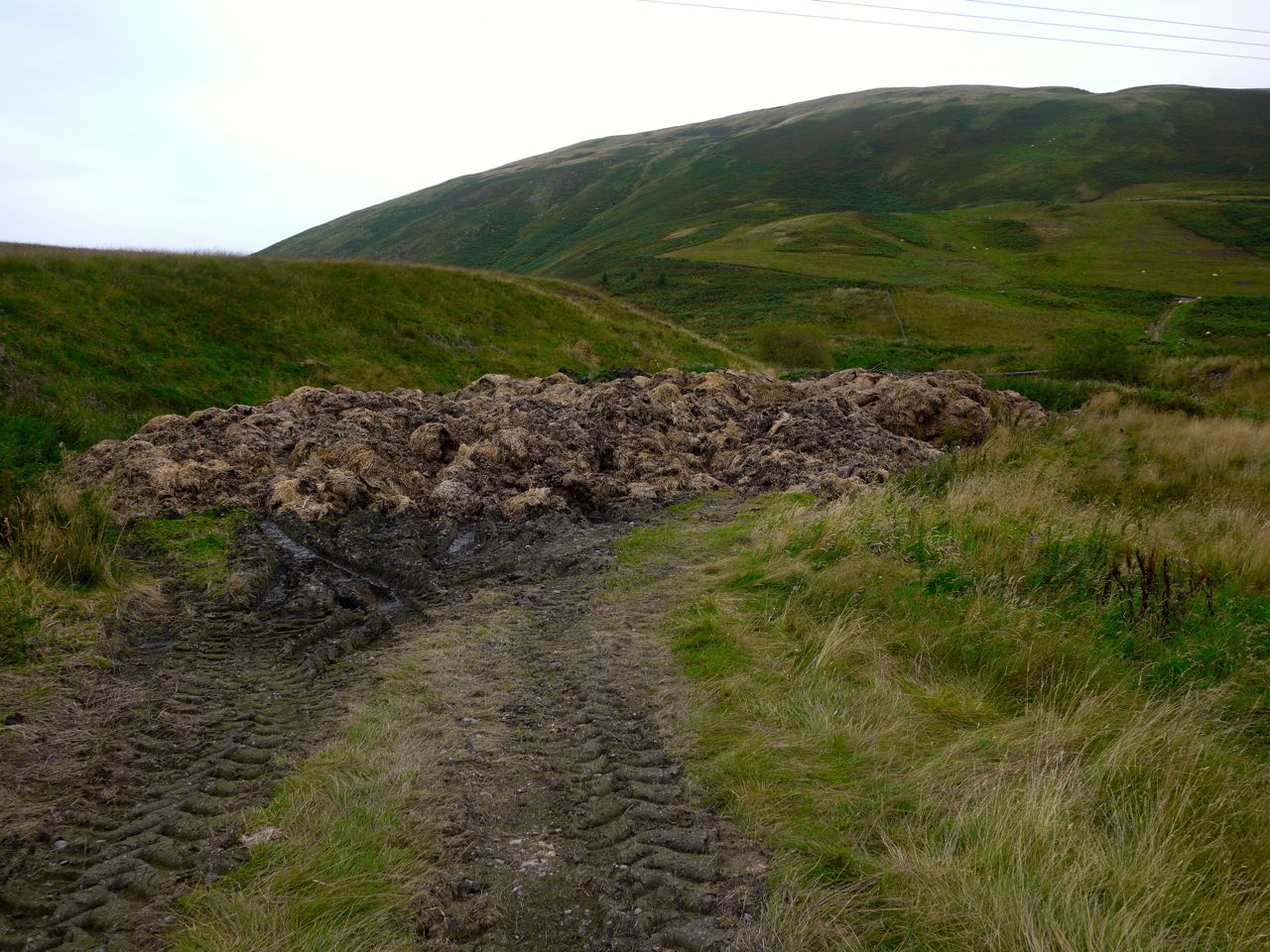
I parked at the Megget Dam and after standing for a while, amazed by the sheep grazing on its grassy slope, I set off downhill to Glengaber. There is a farm track just before the farmhouse which is completely blocked by a massive pile of manure, but luckily this isn’t the path to follow. The track around Broomy Law was visible from the road and easily reached by crossing a field at a gate a few metres past the house. The field here was neither boggy nor muddy and must have been magically transported from some distant paradise.
Pile of Manure
The stony track slowly climbs up Glengaber Glen, hugging the base of Broomy Law, with the burn burbling below amidst heather and ferns. A sheep pen near Boar Cleuch was succumbing to nature and filled with ferns. Presumably there must have been many more sheep up here in the past, and perhaps even boar?
The rocky track crosses a couple of small streams and then ends with a ford over Cons Cleuch at a collection of sheep pens. From here I climbed up onto Deer Law, initially following a faint track but eventually toiling across pathless grass and heather, the ground growing boggier the higher I climbed. This was a typical convex hill where the horizon was always just a few metres away and the top only seen when you have almost reached it. The combination of the going underfoot and uncertainty about how far was left to climb proved quite tiring and I had several stops to admire the view back down the glen.
Deer Law
Deer Law is a good 180m shorter than its namesake, Hart Fell, but does have its own cairn (well a few rocks anyway) and one of these is flat enough to serve as a seat amidst the soggy grass. From here the rest of the route was visible for the first time. I followed the fence over Conscleuch Head then up to Black Law.
Now I am quite used to the cols being boggy, but Conscleuch Head seems to have forgotten that it is a hill and gone native with the cols. There is bog, hidden muddy holes, black peat mush and supersaturated sphagnum moss, all requiring care when picking a route. I could see the change in colour half way up Black Law that marked less boggy ground and looked forward to reaching it. Despite care in placing my feet, I fell foul of a mud filled hole but most of it had been wiped off within a minutes.
Black Law’s summit is a 600m plateau with a small rise at each end, that to the east being 2m higher. There are deep furrows running along the summit which are too large to have been made by a vehicle other than a tank. They must be natural however since they degenerate into a network of channels when they reach collections of peat hags, whereas a vehicle would have cut across the peat.
I had my lunch on Black Law, protected from the damp, cold and irregularity of the ground by my new seat/mat. I was however denied comfort since the weather chose just this time to crank up the wind to blustery.
The map suggests that it should be all downhill as far as Foulbrig but heading down to Redsike Head definitely has some uphill sections. Luckily there were more opportunities to practice coping with bogginess. I found myself crossing the fence several times when faced with uncrossable sections on my own side. The fence had seen better days and many posts were rotten. There were a great many pieces of fencing wire lying about and these were difficult to spot looking quite like grass. I tripped over these several times with much cursing and stumbling.
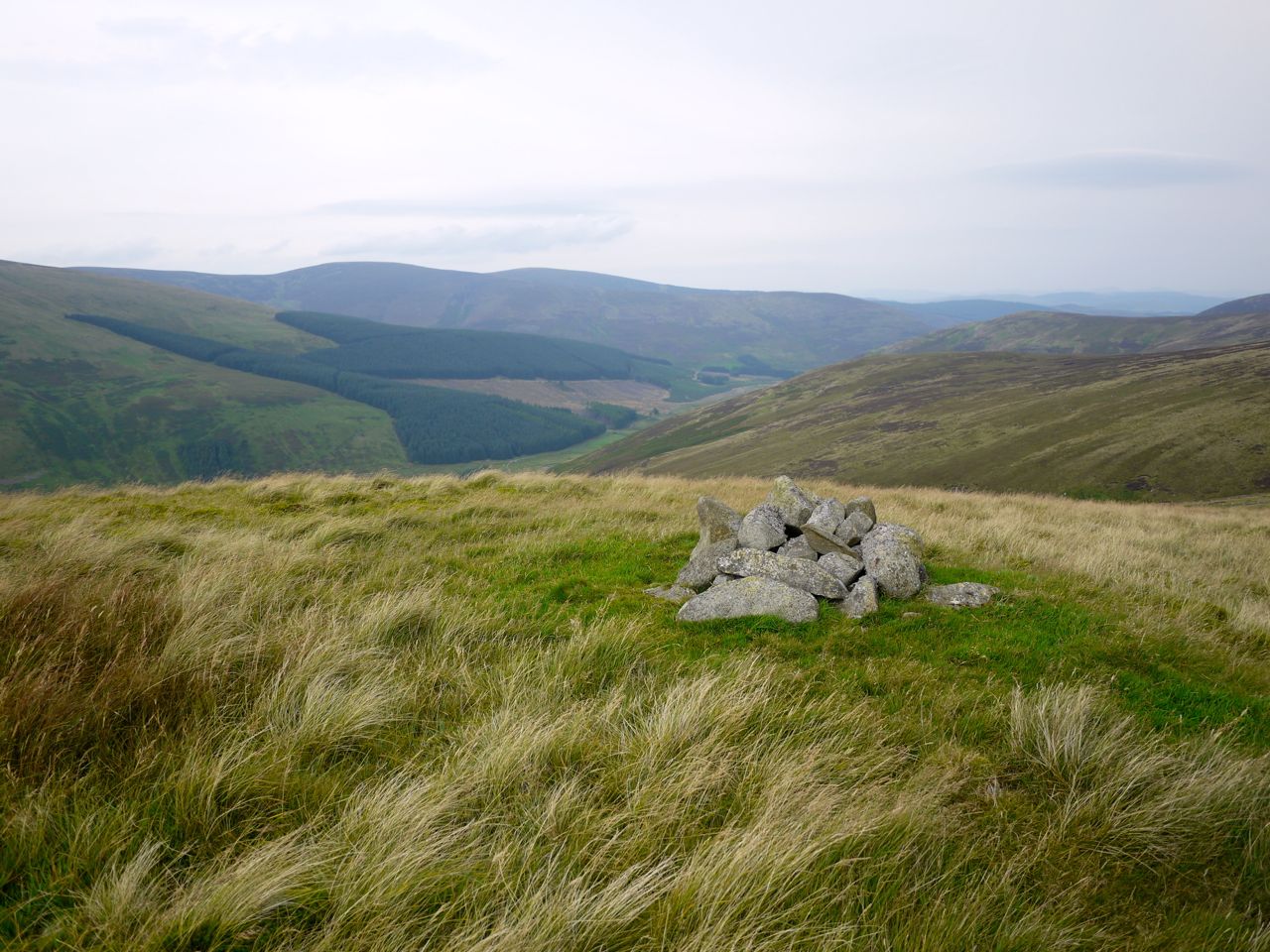
Cairn on Redsike Head
At 570m the fence takes a sharp left hand turn and goes down to Foulbrig. I followed the fence but looking back it would be better to continue in the direction of the original fence and join the path above Bitch Cleuch. I had been uncertain if the single broken line on the OS map would be an actual path or a mere ghost, so followed the fence down to the aptly named Foulbrig, a flat area of marshy land that I would not want to cross after heavy rain. Standing by the fence contemplating which way to walk across this section I looked down at the fence post. It’s centre had rotted away and two dead newts lay within it. That’s not something you often see.
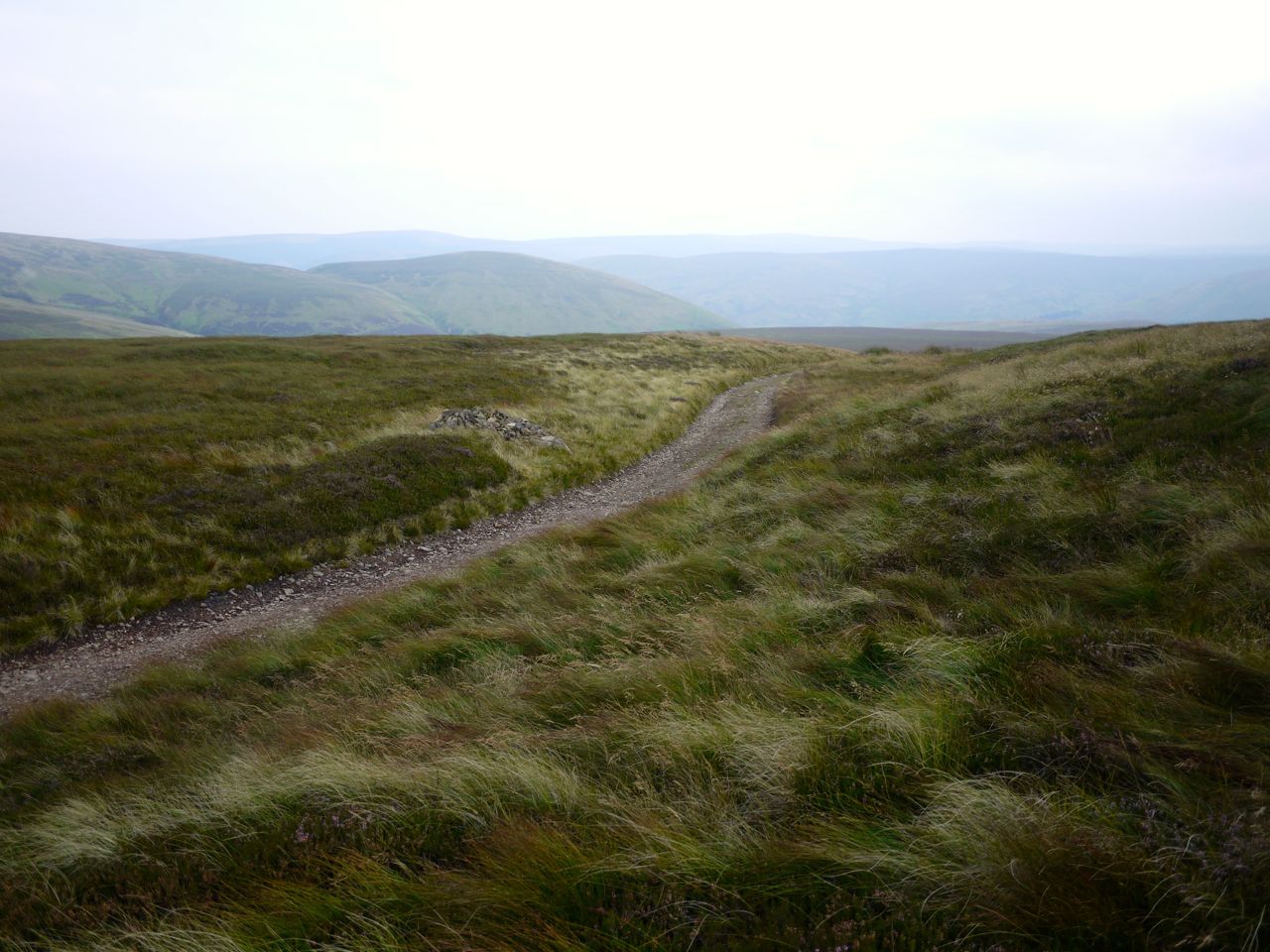
Manor-Megget Path
The right of way from Manor Glen to Megget is actually a substantial and well maintained track and I chose to follow this for 50m of easy ascent, rather than follow the fence line directly up Greenside Law. There is a small cairn beside the track where it reaches its highest point close to the 567m spot height on the OS map. I had hoped there would be a track leading up to the summit from here, but did not see one so headed up through the heather. There were at times faint tracks that I took to be animal tracks. The final 60 metres to the summit were across uneven ground with the similar terrain to the rest of this walk. My heart lifted briefly when I saw a cairn on the horizon ahead, but once there it was clear it was not the summit. I couldn’t really tell I was at the summit until I could see over the far side.
From the summit my plan had been to head for the pile of stones marked on the map and then towards a sheepfold where I would join the path back to the Megget Road. Unfortunately given the shape of the hill, I could not see the pile of stones and since the actual summit is unclear it was difficult to use a bearing, so I headed off perpendicular to the fence. The pile of stones was nowhere to be seen, though in retrospect (inspecting my GPS track) these were the cairn I had passed on the way up. I eventually came upon a vehicle track that I followed all the way back to the Manor-Megget path, close to the sheepfold.
From here I was able to walk the last mile or so back to the car, via Craigierig, on firm dry land.
Posted inBorders|TaggedDonalds|Comments Off on Raikin the Foulbrig
A nice short walk, but best done during a drought. There was a deer standing in the car park when I arrived, as there was the last time I parked there.
I had set off from home intending to walk the dogs along the forestry track at Kissock, but Lotus Hill was too tempting. About half a mile from the car park the forestry track divides and I turned right up a gentle slope. The first mile is on firm tracks but then degenerates into a boggy path that climbs to the bog that covers most of the summit.
I was picking my way across the marshy area with Sweep running along as point man when he disappeared in the tall grass ahead of me with a loud plop. The sound of a dog entering deep water. I was therefore forewarned to alter course.
View from Lotus Hill, Loch Arthur
From the summit we headed down through the heather then into a forest break. The first few metres of this break were muddy, and I mean muddy. Sweep ran into the mire and sank to his wedding tackle. A short burst of scrabbling and he was out the other side. Leo and I picked our way around the edge.
There are a couple of forest breaks that lead from this one to the lower track and I had decided to take the first one. Less muddy from memory. I came across a way marker and presumed it marked the first break.
I shouldn’t presume. The break was impassable with fallen tress so I went a few metres further and took that break mumbling to myself that the waymarker was badly placed. The way I took showed signs of others using the same route but eventually joined the more substantial path of the forest break I should have been on.
13.5 miles ascent 929m 5h 42min (add 2.3 miles and 160m if you don’t get a lift)
Talla Cleuch Head-Broad Law-Cramalt Craig-Dollar Law
This walk starts near the Megget Stone. I managed to park 100m to the Megget side of the stone, with the car reversed up a slight incline, the effects of which were to impact on me several hours later. I began by looking across to Nickies Knowe, which Conor and I had climbed a couple of weeks earlier. The hill has a group of mini-drumlins (presumably there is a correct name for these protuberances) at its base. We had made our way across these so no wonder we found it tiring.
My photo of the Megget Stone that day was taken into the sun, so I got a better picture today, then set off up to Fans Law guided by the fence. Unfortunately this section, despite being steep, was still boggy. Not I-wish-I-had-yetis boggy, but the more cunning stealth bogginess, with hidden pools beneath dry-ground grass.
The Megget Stone
The climb to Fans Law lent itself to a number of stops to take in the gradually improving views, especially since I could look across to the route we had walked a couple of weeks earlier (and catch my breath). I was definitely surprised by how steep our descent from Garelet Hill had been.
The plan was to follow the fence up to the Shepherd’s Cairn then across to Talla Cleuch Head, but the gods of hillwalking had marked me out to be tested. This walk didn’t fit on one OS map. Most is on on 336 but the first 1.5 miles is on 330. I had practiced ninja origami on 336 and put it in the map holder for easy access and stuck 330 in the rucksack because I’m a conscientious walker. All I had to remember was to follow the fence to the junction with the fence from Talla Cleuch Head then follow that.
There is a dog-leg in the fence a little way before the fence junction. That I had failed to remember. As I approached the left hand bend of the dog leg, the aerial atop Broad Law came into view and captured my attention. There was a very faint trail continuing up the hill towards the aerial, clearly cutting across a a dog-leg in the fence so I continued along it. Unbeknown to me the fence to Talla Cleuch Head was attached to the dog-leg and hidden behind a slight rise.
As I walked on, blissfully ignorant of my mistake, I eventually climbed high enough to see the fence again. I could see it climbing up ahead but with no sign of a fence joining it. Then the penny dropped. I got 330 out and realised my mistake. Luckily I had only overshot by 200m. I regained the fence around where the 717m spot height is on the OS map.
Looking from Cairn Hill along Gameshope glen
I decided to cut across a wee bit rather than follow the fence back down, and the terrain was alright for descent but would have been a bind to climb. I got back to the Talla Cleuch Head fence at a bend near a small rocky knoll on Codleteth Hill, then followed it across the boggy col to Talla Cleuch Head. Once on TCH there were great views of the the Talla hills and Culter hills. It’s a shame that there is such a deep valley between TCH and Broad Law because the only way back was the way I had come. I decided to follow the fence this time all the way back to Shepherd’s cairn and once there could see St Mary’s Loch and the Eildon Hills. Looking from the same place, along the line of Gameshope Glen I could see a dual peak which I thought was Saddle Yoke. For some reason I was impressed that the twin peaks of both the Eildons and Saddle Yoke were visible. Later, once I had engaged my brain and looked at the map (from rucksack), I realised that the twin peaks were Whitehope Knowe and Heights, being as they were on the opposite side of Hart Fell to the Saddle peaks.
Col from TCH to Cairn Law
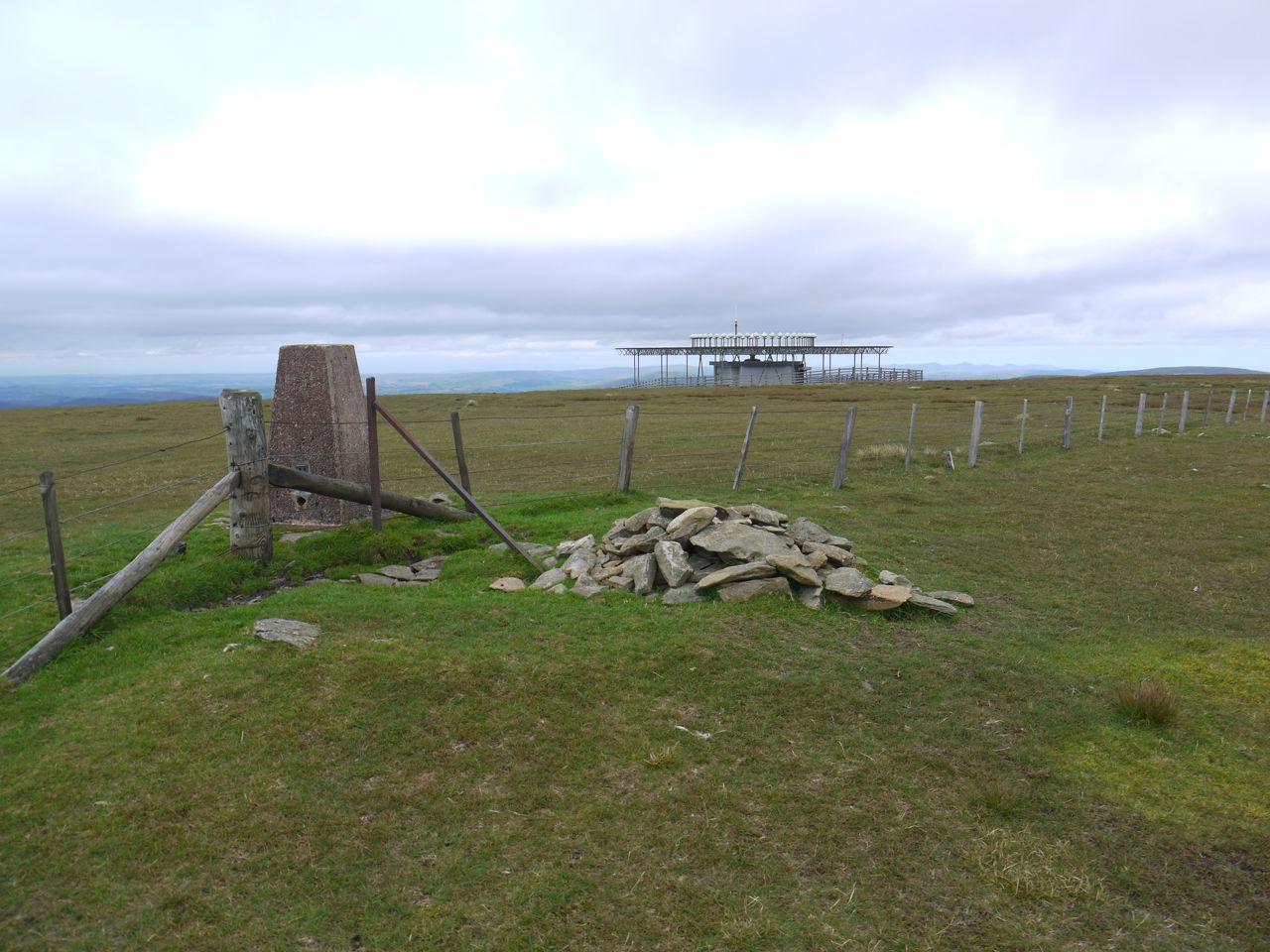
From the Shepherd’s Cairn, it is a relatively easy mile and a half up to Broad Law’s summit. I had not intended having much of a break on Broad Law, but did stop to get a photo of myself with the air traffic control bandstand in the background.
Have you ever noticed that trig pillars have a hole in the middle? I presume I must have seen these holes before but, to tell you the truth, I don’t think I had stored that information in my long-term memory. I now know because I somehow managed to drop my camera’s mini-tripod into the hole. These holes are just too small to admit a hand and just too deep to allow a tripod to be easily reached.
Broad Law summit, with hungry trig pillar
After several unsuccessful attempts including efforts to lasso it with the string from my compass or grasp it with two sticks, I was able to retrieve it. This involved deforming my hand by painfully flexing the coronal plane of my metacarpophalangeal joints to increase the distance of insertion and manipulating the tripod legs between my fingers, now rendered inflexible but with finger nails and slightly sticky finger pulps, assisted with a small stick. Hundreds of thousands of years evolving larger brains have not been in vain. And having petite hands helped. Well it was five minutes rest for my legs.
The col between Broad Law and Cramalt Craig has a descent steep enough to make me consider breaking into a run, though obviously I dismissed the idea. Sadly the enjoyment was spoiled by bogginess. Most of this section was squelchy but some areas were very wet. Near the col’s lowest point is a watercourse, bog rather than burn, but presumably a very young Polmood Burn. This was too wet to walk across and too wide to jump, so I walked upstream and it grew narrower. The gods of hillwalking smiled down in anticipation.
I leapt across but the far side was deep sphagnum moss masquerading as a bank. My boot sank deeply into its sodden embrace converting linear to angular momentum and dumping me flat on face. I can laugh about it now, but the incident itself took place in a laugh free zone.
Cramalt Craig, Culter Fell in the background
By the time I had reached the summit of Cramalt Craig the wind had blown my trousers dry so I let it have a go at my socks as well while I had lunch. Perhaps I should have explained to the walkers who arrived a few minutes later, and sat in the lee of the summit cairn, that I was sat on the windward side on purpose. One chap did make a bit of a show of dropping a piece of grass to gauge the wind before choosing where to sit. I presume he was trying to teach me some common-sense.
From Cramalt Craig the route ahead is visible all the way to Dollar Law. This is an easy enough walk across short grass, albeit somewhat squelchy in places. There is in fact an obvious track heading from Cramalt Craig that looks to have had substantial vehicles on it. This eventually turns off to the right whereas my route followed the fence over Dun Law and Fifescar Knowe to Dollar Law. The ridge and Dollar Law itself have great views of the adjacent hills.
Dollar Law, Broad Law with an aerial in the distance
There were two walkers having a break on Dollar Law and I wished them well as I left, which as things turned out may have been a pleasantry well spent.
There were two ways back, either retracing my route, but without Talla Cleuch Head, or heading down to Cramalt and along the road to the Megget stone. Pre-walk measurement had suggested the latter was an extra half mile with about the same ascent, but without the boggy cols. I chose to head down to Cramalt.
I walked down by the fence to the col below Fifescar Knowe, then followed the Thief’s Road. This is quite a wide track and must once have seen regular use, but is now reverting to nature. It has become overgrown and impassable in places with deep puddles. I didn’t intend taking this track over Notman Hill but would cut down to the track by Cramalt Crook when the Thief’s Road crossed the fence.
At the fence was a gate; not in the sense that it could possibly have been opened without an axe, but that it would have been manufactured as a gate. Climbing the gate was out of the question since I would have needed wellingtons to approach it, so I climbed the fence instead.
Cramalt Glen
In planning this walk I had imagined I would stand at this point and would need to decide which path to take. I should take the right hand fork, the one heading south. Unfortunately there was no fork, only one path. The dotted line on the OS map was merely a virtual path but I wasn’t put off and set off south across the rough ground but soon spotted a major track that looked to be coming down from between Dun Law and Fifescar Knowe. The track up from Cramalt has clearly been extended and it is easy enough to distinguish the newer track which is a slightly different colour. I hope this isn’t a prelude to building on these hills.
The soundtrack of this path is the sound of the Cramalt burn growing gradually louder as the burn grows in size. The colours are the purple and green of the heather and grass contrasted at times with the bright red of solitary rowan trees. The upper sections of the path are quite steep for a road and the stone covered surface gave my ankles a good workout. The hills to my right were those whose summits I had walked across just a few hours earlier.
Wolf Cleuch
One particularly pretty area is at a sheepfold where waterfalls of Wolf Cleuch burn join Cramalt burn. The sheepfold nestles amid tall grass, a single tree overlooks the burn, the hillside’s many shades of green are mixed with patches of purple heather, and there is the sound of the waterfall.
Half a mile later I was at Cramalt looking over the still waters of Megget Reservoir. The sun had now come out and I was warming up, so it was time to disrobe to the tee-shirt layer. I emptied my spare water bottle to save myself carrying the extra kilogram since I knew I had only 3.5 miles along the road (but uphill) back to the car. I hoped there would be something to make these last few miles more than just trudging along a road. The views across the reservoir were pleasant but once I had identified the various hills I soon grew bored. I had hoped there might be some birds to see (likely I thought) and I had carted binoculars around all day, but I saw none while walking by the reservoir. I could always hope to come across the olympic beach volley ball teams having a friendly game (very unlikely), but they weren’t there either. The one thing I could have hoped for, but did not even consider, came upon me without warning and was all the more pleasurable for that.
Cramalt
Having walked about a mile and half from Cramalt, a car drew alongside me, and I recognised the couple from the summit of Dollar Law. They were kind enough to offer me a lift and I accepted with a sigh of relief.
Back at my car I sat on the edge of the boot to take off my boots. There is a shelf in the boot and this was sticking in my back so I folded it away. But when leaning back I had not fully considered that the car was facing downhill and without the shelf to stop me I rolled back into the boot.
This was an enjoyable walk but with hindsight would be better as a linear walk with two cars, and perhaps Greenside Law could have been included as well.
Posted inBorders|TaggedCorbetts, Donalds|Comments Off on Good samaritans from Dollar Law
Nickies Knowe-Lochcraig Head-Molls Cleuch Dod-Garelet Dod-Erie Hill-Garelet Hill
This walk started with a choice: to walk from Talla Linnfoots to the Megget Stone at the beginning of the walk (park at Talla Linnfoots) or at the end of the walk (park at the Megget Stone). We decided to get it out of the way early on which was probably the right choice; we had nice weather, firm ground and plenty of energy.
I decided not to use the farm track along the southern bank of Talla Water since I had doubts that the footbridge marked on the OS map still existed. I could find no recent photos of it and the geograph website even had a photo of someone fording the burn. So to avoid wet feet early in the day we walked up to a gate about 100m past the Megget Stone and headed onto Nickies Knowe from there.
Megget Stone with Nickies Knowe in the background
There looked to be boggy ground between the gate and the slopes of Nickies Knowe, but by keeping to slightly higher ground we stayed dry. There did look to be a faint track snaking up Nickies Knowe when we looked up from the road, but the slopes here are convex and we didn’t find it until we reached a gate in the fence at about 480m. From there we joined the faint track which led us up a short steep section onto the top of the ridge/shoulder giving us our first view of Megget reservoir.
Megget Reservoir
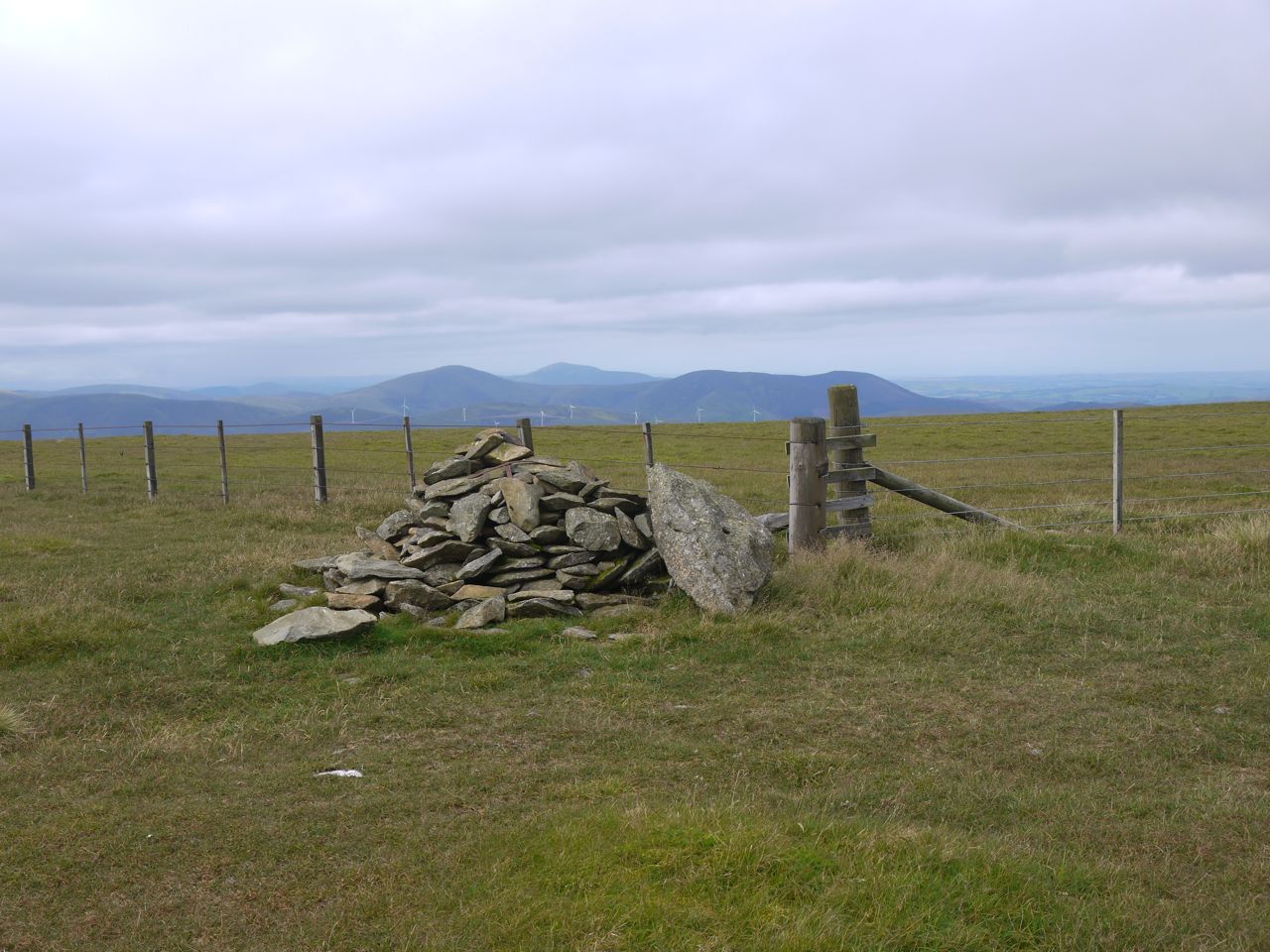
There is large cairn on Wood Brae, which is not marked on the OS map. Unfortunately I mistook this for the cairn below the summit of Nickies Knowe and thought we were well ahead of schedule. I can’t say exactly where the cairn was but I suspect it was at about 560m. Once we crested the next wee rise it was obvious this wasn’t Nickies Knowe since the hill was there in the distance. The actual marked cairn is a much less impressive affair.
The walk up Nickies Knowe was a succession of false summits; our mettle was tested but we plodded on with our heads held high.As we gained height though, the ground grew firmer and the grass shorter. Once on Nickies Knowe we could see the undulating way ahead to Talla East Side and Lochcraig Head. The OS has a rather strange section marked as “Pile of Stones” where there are two cairns amidst a sprinkling of stones. I’m unsure whether the carpet of stones are the pile, or one of the cairns.
Pile of Stones on Lochcraig Head
By the time we were approaching the summit of Lochcraig Head, the early sunshine had given way to strong winds and dark clouds, so Loch Skeen looked quite dull. Our route then followed the wall across the boggy col of Talla Nick, but a bit of stone hopping had us across with dry feet. Once out of the col we had a relatively easy stroll along the plateau to Molls Cleuch Dod for lunch.
Loch Skeen under stormy skies
With hindsight, Conor suggested that we might perhaps have got off the summit, and out of the wind, for lunch. Youngsters!
From Molls Cleuch Dod my plan was to head down to the Gameshope Burn. If we could cross, we would take in the Fruid Donalds: Garelet Dod and Erie Hill. If we couldn’t cross, the plan was to head along the Gameshope Burn back to Talla Linnfoots.
Molls Cleuch Dod
We headed west down the grassy slopes of Molls Cleuch Dod and rejoined the fence at about 640m. Luckily the burn was low enough to allow us to cross. The best way over was to cross Donalds Cleuch Burn and then Gameshope Burn, Conor and I choosing different crossings. The footbridges across the upper reaches of Gameshope Burn are long since gone.
Gameshope Burn
From the burn crossing my plan was to head along the fence to a sheepfold and then directly across the slopes of Garelet Dod to its summit. The ground around here was quite hard going with deep tussock grass and I thought I spotted a track further up the hill so headed for it. As it turns out it was probably made by a quad bike in a single pass and was not much of a track to follow. Despite being a gentle gradient I found this section quite tiring and had to have a bit of a breather at the sheep fold.
Having experienced the grass I decided not to climb across the slopes of Garelet Dod, but instead to head more directly up to the shorter grass and firmer ground further up the hill.
Gameshope Loch
Garelet Dod is flat topped without any definite summit marker but does offer good views, including Fruid Reservoir and Gameshope Loch, bringing to five the large bodies of water seen on the walk. I’ve read that Gameshope Loch is the highest loch in southern Scotland.
Looking north to Erie Hill
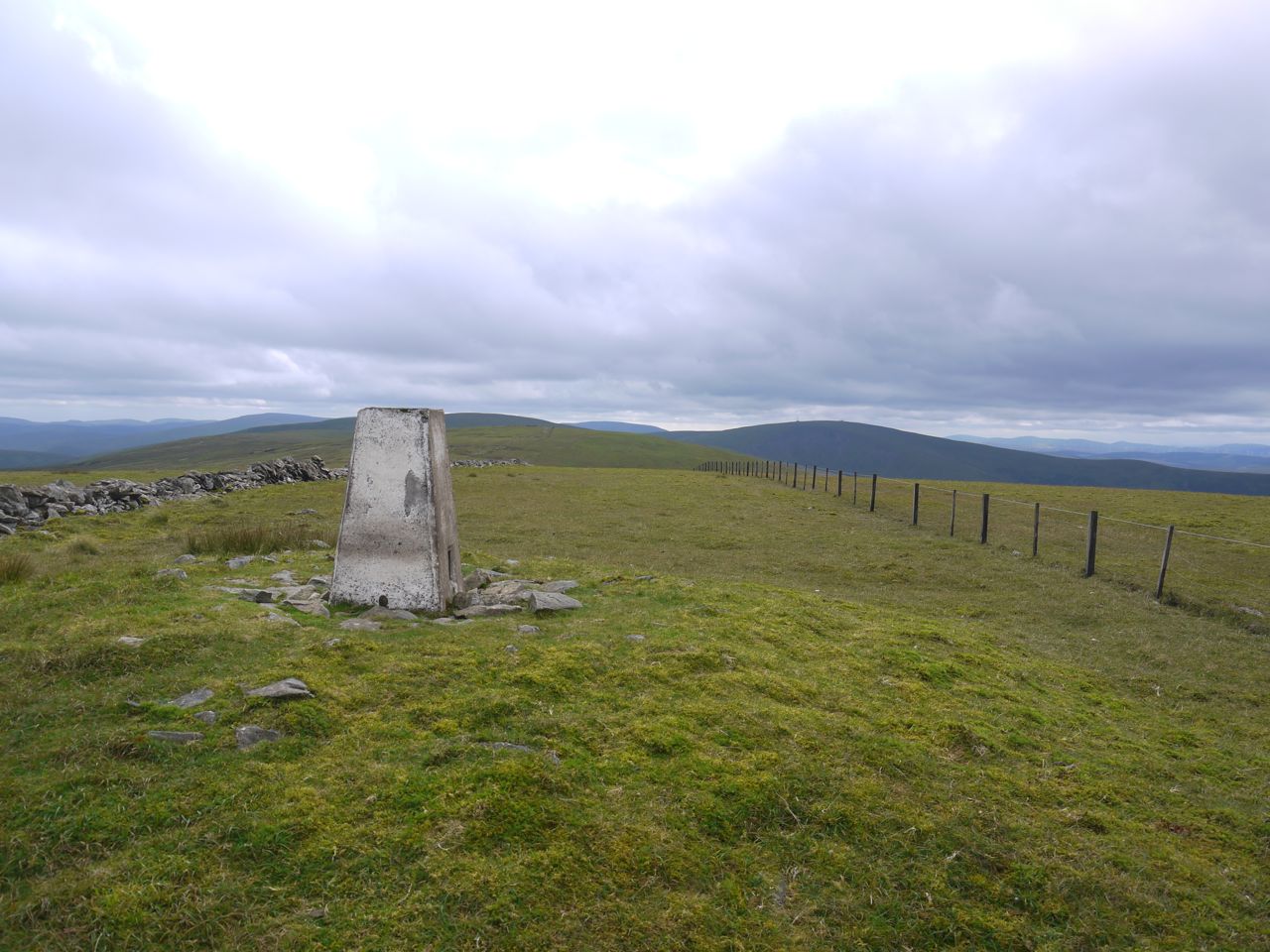
From Garelet Dod we followed the ridge north taking in Erie Hill, Lairds Cleuch Rig and Garelet Hill, the wind blowing in our faces all the way, and our water bottles almost empty. From Garelet Hill, with its eroding trig pillar we headed directly down to the one remaining bridge over Gameshope Burn. This required a compass bearing from the summit since the slopes are concave and the descent route can’t be seen until from the top.
Garelet Hill's eroded trig pillar
The descent was hard on the thigh muscles, and some zig-zagging was needed in the steeper sections but the ground was firm.
Rowan in Witch Linn
Four Donalds. The ascents and descents take a bit of effort and Gameshope Burn might be a problem to cross following rain but the walk is relatively easy once up on the ridges.
Most of the hill names around here have an English ring to them, and though their origins are often Norse, their meanings are obvious; for example Hart Fell, Saddle Yoke or Broad Law. Carrifran Gans is less obvious, and I have read various suggestions but the one which rings true to me is Caer-y-Fran, cymric for Fort of the Ravens, or with a bit of poetic license Place of the Ravens. Caer Gigfran actually translates from modern Welsh as Fort Raven (Google translate). The cliffs at the head of Carrifran Burn are now called Raven Craig and perhaps they too were once called Carrifran? The burn is Carrifran, as is a local farm. Since “gang” is Scots for go, this large hill is the one passed on the way to the Raven Craig.
There isn’t a great deal of parking space near Carrifran so I stopped in a lay-by just before the bridge over Carrifran Burn, about 150m from the entrance to Carrifran Wildwood. There is a car-park at the wildwood site but the gate was closed. It wasn’t locked and I wasn’t sure if parking was allowed but a car was parked in there.
Carrifran Wildwood
The Carrifran Wildwood project aims to restore the area’s original flora (and therefore fauna), by planting trees appropriate to the area. You can have a look at their website. This is clearly a long term project and the earliest plantings are only about ten years old. There is some way to go before this has reverted to a natural wilderness but you can get a flavour of it walking through the young trees.
I headed along a path through the wildwood which is signposted to the “viewpoint”. This is an old sheep sheiling sitting atop a small knoll in the valley. There is an excellent view up the U-shaped glacial valley to the cliffs of Raven Craig.
Carrifran Glen
My plan had been to head up from here to the fence climbing over Dun Knowe to Carrifran Gans, but the land was pretty wild looking so I headed down a faint track through chest high ferns which led me to the path leading up the valley. Unfortunately this began to descend, which was not my wish, so just after passing a small stream I turned NE and made a beeline for the trees visible on the ridge. The stream was just to my right throughout this section, audible but invisible beneath very deep grass. Every now and then I would come across sections of flattened grass about a metre across, somewhat akin to small crop circles which I presume were caused by an animal.
Between the sheepfold and the hill
My route was barred by a steep sided knoll about where the T of Keld Pot is on the OS map. I tried to skirt the southern flank of this but had eventually to climb its steep sides. I suspect it would be better to just go straight over it. I reached the trees and fence at about 280m having worked up quite a sweat. I could see my next target, a plantation of trees further up the steep ridge of Carrifran Gans; and steep it was, the next kilometre would be a 380m climb. There is a brief flattened section at Dun Knowe where the fence takes a small bend and a fallen wall offered a comfortable seat. Fifteen minutes rest and a slug of water had me recharged for the final climb to the summit. What appears from the road to be a path up this ridge is in fact a collapsed dyke. In some of the steeper sections this offered the best footholds but beware, the stones aren’t stable.
Sat on Carrifran Gans
After all this hard work, I found myself on the featureless plateau of Carrifran Gans. This hill, with its cliff-steep sides always looks impressive from adjacent hills, but the excitement is all in the climb and not in the summit features. The summit cairn is a dinky wee thing but the only seat for miles. There is a faint track heading just south of east from the cairn, which I presume is a route down the eastern ridge either finding a way to Polmoodyburn Bridge or more likely joining the forest tracks to Polmoody, a much longer but less steep route. It is worth wandering over to have a look across to to Raven Craig, Saddle Yoke, Rottten Bottom and Hart Fell. As I walked the fence to my right suddenly rang out, and I looked up to see a pair of deer running away. I presume one must have twanged the top wire of the fence as it jumped.
The next hill on the route, White Coomb, with its cliffs, the coomb, in summer grey rather than winter white, sat just a gentle stroll across slightly sodden grass. The weather had held out so far but I could now see the rain approaching from the south and feel the breeze picking up. Visibility remained good though and from the summit I could easily make out the Eildon hills.
White Coomb summit
White Coomb’s summit cairn stands a little way from the fence and has its own moat. The last time I was here it was an empty ditch but today was filled with water. I sat on the cairn to have my lunch and had to be careful to keep my feet out of the water. Usually on these hills I don’t meet other walkers but White Coomb must be a real pull because I met three pairs of walkers up there (four poled, two sans poles).
From the Coomb I headed over to Firthhope Rig with some wee birds (wheatears) flitting ahead of me on the fence. Firthhope Rig is another non-descript plateau. While descending I spotted a small mound in the distance which I thought was a cairn but it obviously wasn’t the highest point. Then it moved.
Badger on Firthhope Rig
I haven’t seen a badger on the hills before. It watched me much I would watch someone I had seen standing in my garden.
From here I descended to the aptly named Rotten Bottom. This is an area of peat bog which “drains” into Gameshope burn. It sits above Raven Craig and is where a 6,000 year bow was found about 20 years ago. That’s why I’m pretending to be an archer in picture at the start of this post with the rock formation of Games Castle in the background.
Rotten Bottom
I had intended having a go at climbing Games Castle but I was 45 minutes behind schedule with 6 miles still to go so I pressed on. Rotten Bottom proved challenging. Just after the archer photo the rain arrived, light at first but enough to have me stow my camera. While stowing, the rain grew heavier, so I thought I would swap water-resistant for waterproof outers. Then the heavens opened with a mixture of very heavy rain and hail. I hate putting on waterproof trousers when standing in a bog and my trousers were virtually soaked by the time I had the over-trousers on.
In the planning stages I had wondered about skirting the edge of Rotten Bottom, along the top of Raven Craig to avoid the bog, but had decided to head for Games Castle so I could climb it. I don’t know if that would be better but following the fence led to impassable bog. The fence does cross these sections but isn’t robust enough to allow its use as a bridge. I managed by island hopping between peat hags to get across but took a rather indirect route. It was quite a relief to get out of Rotten Bottom and onto the firmer ground of the hill.
I had wondered about taking a more direct route to Cape Law, climbing it north of Stirk Craig but the ground looked pretty boggy all across the valley. My advice for crossing Rotten Bottom would be to head down to Games Castle then pass south of it and stay close to the edge of Raven Craig (providing visibility is good enough to see the edge).
The fence climbing west out of Rotten Bottom reaches the top of an un-named knoll with a spot height at 687m where it meets two other fences. From here I took a 3km detour to Cape Law for nothing more than hill-bagging. I had missed it out, due to a short-cut, on my Blackhope Round walk earlier in the year and its omission had continued to prey on my mind. The walking unfortunately was now a trudge in heavy rain, in full waterproofs with rumbles of thunder in the distance. I planned heading down Whirly Gill if the thunder came closer; it would be a longer walk out but would have me off the exposed hill-tops.
Firthhope burn (audible from here) beyond Raven Craig
By the time I was back the the un-named hill, spot height 687m, the rain was easing considerably and it looked as though the sky might clear. I had reached the end of my map’s visibility, so took it from its waterproof case, refolded it to show the way ahead, replaced and re-sealed it. I would walk to the stream at Priest Gill and decide whether to head over Saddle Yoke or down Whirly Gill. I had also seen a path heading along the eastern face of Saddle Yoke but it looked to exceed my “have I got the bottle for that” score many times over. I wondered if it was just a geological feature but there is a stile over the fence at Priest Gill so perhaps people do go that way. It clearly wasn’t for me.
I looked at the map several times as I walked along but when I got to Priest Gill I looked down at my map and it was gone. It had been hung round my neck but was no longer there. I took off my rucksack to see if it was tangled up with it, but no joy. Looking back I could see no sign of it. I can only presume that it had been blown off during one of the bursts of rain and wind.
This left me in a bit of a quandary. I could see where Whirly Gill probably was but couldn’t remember if there were any important things to avoid. On the other hand my planned route over Saddle Yoke and Peat Hill followed the fence, and at Peat Hill took the left hand fence, which would keep me away from rock outcroppings and just leave me with about 100m of steep descent at the end. Since I had no map I would have to follow the fence. I was surprised how much the loss of the map upset me.
The one saving grace was that the rain stopped and the sun came out again.
Saddle Yokes summits
There is a faint track beside the fence heading up to Under Saddle Yoke suggesting that others had come the same way. When I had come off Saddle Yoke previously I had stuck to the ridge line and the ground had been deep tussocks, this was much easier going. Not far below the summit there are a couple of peat hags blocking the way and here the track ends briefly. Presumably walkers take different routes around these.
I had forgotten that Under Saddle Yoke and its companion are conical so it was a pleasant surprise to find that the top I could see was not a false summit. From here I was able to look over to Carrifran Gans and see how steep my approach had been. While climbing Saddle Yoke, in the narrow col, my phone rang, so I edged to a safer section, and dug it out of my rucksack. It was Mrs D’n’S checking that I was OK, since there had been very heavy thunderstorms at home. This call alerted me that my brain’s conversation centre had been shut down so I had a wee break at the top and rebooted my brain (had my last banana.)
There are two ridges leading south off Saddle Yoke, separated by Spoon Burn. I had previously climbed the western ridge but was now going to follow the eastern ridge, Peat Hill. The fence takes quite a dip down the steep upper section of Saddle Yoke and my legs didn’t enjoy the descent. My heart was lifted, however, by the sight of quad bike tracks along the fence on the flatter section below me. I had worried that the final section might be too steep for me but where quad bikes can go, so can I.
At the flatter section, beginning above Rispie Lairs, the quad tracks led both SE and NW suggesting that there might have been a way down into Carrifran Glen, which would have been ideal for me. But without my map I didn’t want to stray from my planned route. So I followed the fence, and the quad tracks, though these were very faint close up and often seemed to disappear and reappear. Eventually I reached the bend in the fence that I remembered but there was only one fence leading from it. Was this the one I was to follow or not? The quad tracks led on, so I followed them and came to a gate near the Spoon Burn.
Below the gate were newly planted deciduous trees amidst deep grass, presumably part of the Carrifran Wildwood project. This was the steep section I had worried about. Luckily for me the quad tracks zig-zagged down through the plantation and led me past a sheep fold to the A708.
It was then just half a mile back to the car.
Carrifran Gans at the end of the day
This was quite a strenuous walk initially, the ascent of Carrifran Gans sapped my energy, but beyond that the going was very easy except for Rotten Bottom. But I suppose the name should be a clue. I usually clip my waterproof map case onto my rucksack but had disconnected it to put the case away when the weather was good. Well there’s a lesson there.
Bail Hill (Arch)-Green Hill-Mullwhanny-Colt Hill (Arch)-Benbrack (Arch)-Conrick (Arch)
My challenge was to walk through each of the four Sandstone arches at Cairnhead, north of Moniaive on the same day. The Striding Arches were designed by Andy Goldsworthy in 2002. Each arch of hand-dressed red sandstone is four metres high, with a span of seven metres. Three arches are on the summits of Benbrack, Bail Hill and Colt Hill and there is also an arch at Conrick.
I parked close to a stand of trees at an old quarry opposite Glenjaan Linn. There is a sign to some nearby picnic tables. The OS map shows a path heading directly up a forest break to Bail Hill, but a brief glance up the forest break didn’t show any signs of a path and the way up looked quite steep. I am always wary of forest breaks and decided it might be easier to head up the unforested Dalwhat Hill instead.
Start of the walk
This was an unpleasant climb. The day was humid. The lower slopes were covered in chest-high fern interspersed with gorse bushes. The ground beneath this flora was strewn with large rocks, steep and uneven. And the flies, oh my, they were out in droves and supported by midges. Whenever I paused for a breather the flies seemed to increase their numbers and move in for the kill.
Just above 300m there is a drystone dyke separating the fern-covered lower rocky section from the boggy and cragged upper slopes. A faint track headed off SE and I followed it while it climbed, then left it to zig-zag up the hill between the rocky outcrops picking my way through waterlogged sphagnum moss and areas of standing water. I was heading for the upper tree line but there were numerous false hopes where I thought I was there only to find there were in fact more trees.
Eventually I reached the corner of the trees at the top of Dalwhat Hill. Having reached this point I expected to be able to look up to the Arch on Bail Hill, but though the hill was there a quarter of a mile away, I saw no sign of the Striding Arch. The views to the east did open out however and I could see Lowther with its radar station, Queensberry and the Solway Firth.
My next choice was which side of the fence to walk. I chose the forest side which looked greener, and it rewarded me with more practice picking my way around boggy areas. It also seemed to be magnetic. Why else would there be so much rusting fencing material there? The Bail Hill arch only came into sight when I was within a few metres of it. Naismith would have had me at the first arch in 55 minutes, but I walked through it after an hour and 25 minutes. My energy stores had been deeply tapped but I was relieved to be on the hill tops.
Striding Arch, Bail Hill
From the summit of Bail Hill, the Arches on Benbrack and Colt Hill could be seen clearly and gave me some idea of the walk to come. I had intended to pause at Bail Hill for a snack but as soon as I stopped moving the flies attacked forcing me to grab my bag and eat as I walked. The day’s weather changed here to light drizzle, heavy enough that the camera had to be stowed, sometimes heavy enough for a jacket, sometimes not. Unfortunately there was to be much donning and doffing of the jacket as I tried to get the right balance between dampness from the rain or from perspiration.
The walk from the Bail Hill arch to that on Colt Hill follows a fence so navigation wasn’t a problem. The terrain was wet, with waterlogged sphagnum moss deep enough to swallow boots, black peat bogs and small lochans. There were some faint quad bike tracks but these tended to be much more waterlogged than the surrounding ground and were best avoided.
Between Transparra and Mullwhanny there is a dip through a wide forest break. This was even boggier than the hill tops and the way was further barred by two water filled ditches that were too wide to jump. I managed to use the fence to edge across these. By the top of Mulwhanny I was running on empty and the flies had been drizzled away. I sat down on a fallen section of wall, and as I ate my lunch I felt my energy return.
I certainly needed that energy because between Mullwhanny and Blackcraig Hill there is a steepish 100m descent and re-ascent. This would once have been in a narrow forest break but the eastern section has been felled recently. Unfortunately several trees now lay across the easier, albeit boggy, ground forcing me to make my way across the felled forest terrain for a while.
Striding Arch, Colt Hill
I walked through the Colt Hill arch 3 hours and ten minutes after starting, half an hour behind schedule. I had been considering calling it a day and heading back down the forestry track, but the Benbrack Arch, less than two miles away as the crow flies, was too tempting.
I tramped my way down Colt Hill and up onto Black Hill to join the Southern Upland Way at a sign “Benbrack Arch 2”. I secretly hoped it was in km though I knew in my heart it was miles. This section of the SUW was boggy, which wasn’t surprising. I’ve walked this section in time of drought and it was boggy then. This section has good views of the Carsphairn Hills and the Rhinns of Kells.
I walked through the Benbrack arch at 4 hours 15 minutes.
Striding Arch, Benbrack
As I walked up Benbrack I mused as to the best way off. The most certain was to retrace my steps back to the forestry track in the col between Colt Hill and Black Hill and follow that back to the car (over five miles and some re-ascent). My original plan was to walk down to Little Dibbin Hill and follow the forest break down to a path next to Dibbin Lane (on the OS map). There are however several forestry roads not marked on the OS and as I walked across the opposite side of the valley I was looking for a route down to one of those. There did look to be a forest break at the top of Back Burn and that seemed to join the forestry track.
Criffel beyond Wether Hill, from Benbrack
So I headed off Benbrack along the fence heading SE and when it joined another fence at 530m I turned left and headed into a forest break. This was steep, slippery and petered out after about 50m. I then had a choice of continuing on through the dense forest in the hope of finding a break in the trees or climbing back out and going back to my original plan.
Forests worry me. Navigation is very difficult. The denser sections can be impassable. But perhaps more worrying, since I was solo, the chances of being found, if injured, when not on a track are slim. So I turned about and climbed back out of the trees. I subsequently looked on Google Earth and with hindsight I should have carried on. Perhaps more importantly I should have marked the forest breaks and new paths on my map rather than just remembering them.
So I headed down to Little Dibbin Hill, which is really several small wet hummocks amidst very wet boggy grassland, with a tiny lochan. I entered the forest at a break in the easternmost corner.
This proved to be well lit and easy to follow. There were some fallen trees to get round but the main problem was the combination of steepness and slippery soft surface. I stopped at one point to check my direction with a compass and found I was still sliding downhill. I looked for human footprints but saw only the deep prints of deer. Whenever the gradient eased the ground became very muddy indeed and it was difficult to stay upright.
At 425m the forest break branches. The left fork heads slightly uphill so I ignored it. I should have taken it since it would have led me to the Back Burn and the forestry track. As it was I continued on down and soon after hearing the waters of Dibbin Lane I came out of the forest into waterlogged grassland with waist high grass. As I waded through this jungle I noticed a flat section above me immediately next to the forest and climbed back up to it. This was indeed the track marked on the OS map, but I doubt it has seen human traffic for a long time. Being on a track gave me a false sense of security and my left leg’s plunge into a grass-covered knee deep puddle came as quite a shock.
The track passes briefly into the forest during which time it is firm and well defined. Perhaps it is maintained by forest magic and deteriorates when it leaves the cover of the trees. The track ends at Dalwhat Water.
I had hoped that there would be some way to get across in a degree of dryness, but there had been recent heavy rainfall, so I was disappointed. I was growing tired and couldn’t face tramping through the deep grass and bog of the banks to look for a better crossing and one leg was very wet already. The river looks as though it might be easy enough to cross in drier conditions just not this day. I found a section which had a shallow section in the middle, which I’ll bet is usually a small island, jumped to it then waded the rest of the way, climbing from the water wet from the knees down.
Byre Arch
My newly wet feet made the remaining quarter of a mile across the water meadow less of a challenge since I had already kissed dryness goodbye. I eventually emerged onto the road near the sign for Byre Arch and trudged up to the final arch walking through it 5 hours and 20 minutes after leaving the car. I drank the last of my water and was rejoined by the flies.
There was then a further 1.7 miles along the road to get back to the car. I felt too tired to change into dry socks but made good time with a sub 15 minute mile, presumably driven by the elation of a challenge completed and the joy of a firm dry surface to walk on.
My advice: Choose a dry week. It is probably a good idea to climb the steep forest break to Bail Hill which is about a quarter of a mile past the stand of trees with the quarry, (half a mile beyond the cattle grid). I can’t say what the Bail Hill forest break is like, but it can’t be as bad as the way I went. When coming off Benbrack try to get to the forestry road which crosses Back Burn at 340m. This will allow you to cross the stream by bridge. The forest break I took was easy to follow, but be sure to take the left fork at 425m.